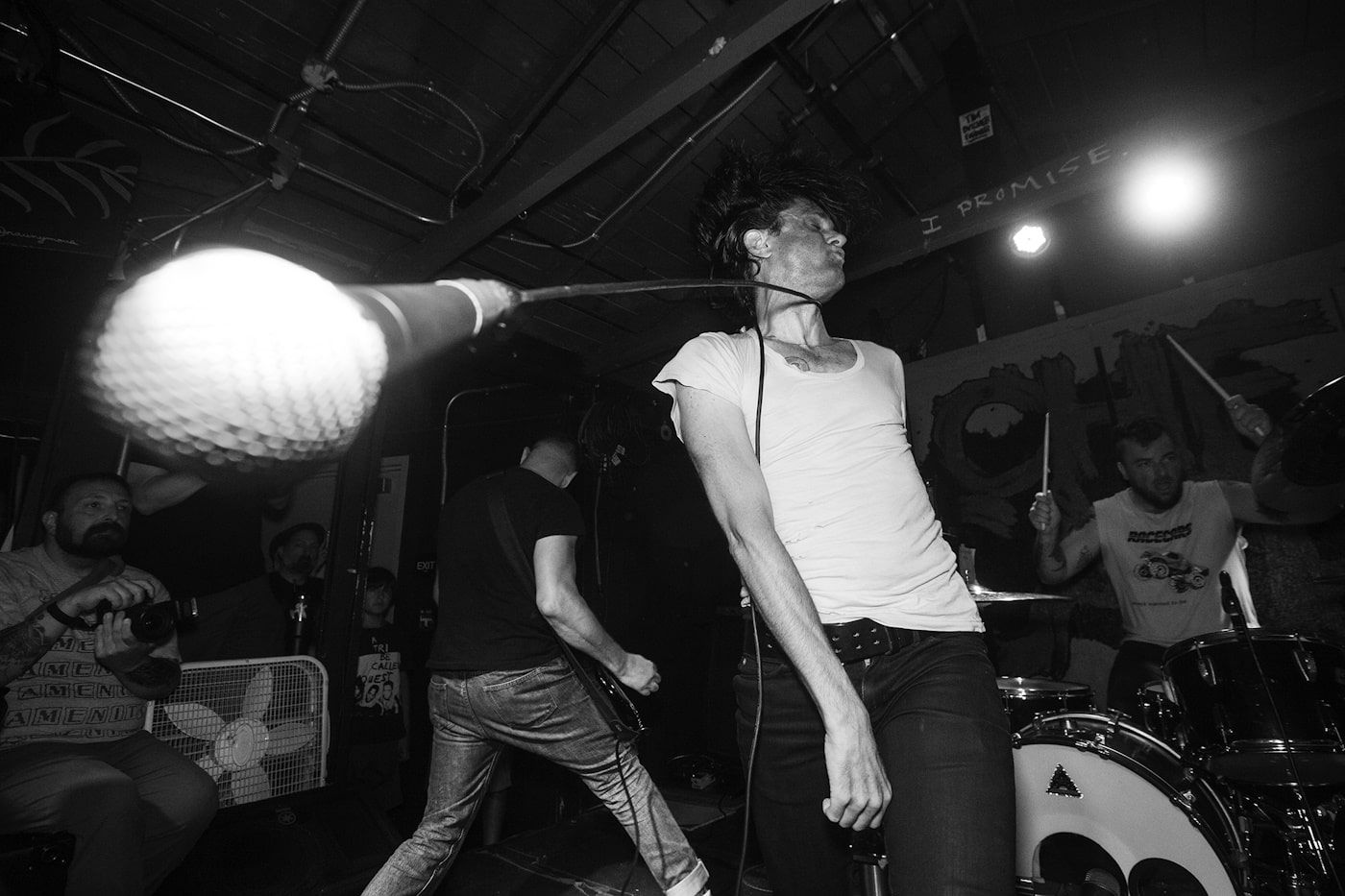



With the release of Krater, Charlie Werber (LOVELY LITTLE GIRLS, THE FLYING LUTTENBACHERS) steps fully into the light as a solo artist—though not without disintegrating the concept of “self” altogether in the process.
Built around circular polymeters and metaphysical ideas of motion and stillness, Krater is a hypnotic durational experiment, split between an isolated drum performance and a collaborative excursion with Daniel O’Sullivan. It’s a record that rewards deep listening—and that probably shouldn’t be interrupted mid-spin.
In the weeks surrounding Krater’s release (June 21st), a conversation between Charlie and a fellow Chicago-based percussion shapeshifter was arranged. His chatting partner was Thymme Jones of CHEER-ACCIDENT, just featured on IDIOTEQ at this location.
If that name rings familiar, it’s because we recently covered CHEER-ACCIDENT’s new LP Admission—their 26th full-length album, and a record that once again flips the script, this time leaning into elliptical pop structures while still embracing the sonic ambiguity and playful defiance the band is known for.
What followed in their conversation wasn’t a standard gear talk or retrospective. Instead, Charlie and Thymme met in the liminal space between movement and meaning.
They discussed their shifting relationships with practice, the power dynamics of solo performance versus ensemble improvisation, and how different “Peters” (Murphy, Gabriel, Hammill) rank in terms of raw intensity. There’s talk of Pro Tools, birthday serenades in the dark, and one unfortunate incident involving a poisonous mushroom.
Thymme Jones is the founding force behind CHEER-ACCIDENT, one of Chicago’s most consistently unpredictable and enduring experimental rock outfits. A multi-instrumentalist, composer, and producer, Jones has spent decades blurring the lines between pop, prog, noise, and the absurd—often within the same song.
His work with CHEER-ACCIDENT stretches back to the ‘80s, but his long-standing collaboration with SKiN GRAFT RECORDS began in the mid-90s, intersecting with projects like BRISE-GLACE (with Jim O’Rourke and members of DAZZLING KILLMEN), YONA-KIT, and YOU FANTASTIC!. Since their official SKiN GRAFT debut with Salad Days in 2000, Jones and CHEER-ACCIDENT have delivered an increasingly unclassifiable body of work, including the sprawling Introducing Lemon, the remastered reissue of Trading Balloons, and more recent efforts like Fades, Fringements I & II, and 2025’s Admission—a pop-forward yet ambiguous release that continues to resist final definition.
Thymme’s approach to drumming—simultaneously economical and expansive—mirrors his broader artistic outlook: intuitive, layered, and often playful in its confrontation of expectation. Whether collaborating on soundtrack projects (Gumballhead the Cat) or contributing to Chicago’s fertile avant-rock ecosystem, Jones has remained a central figure in pushing the possibilities of rock music outward.
Scroll down to read their full conversation between Charlie and Thymme —sprawling, strange, and exactly what happens when you put two minds that don’t believe in linear time in the same room.
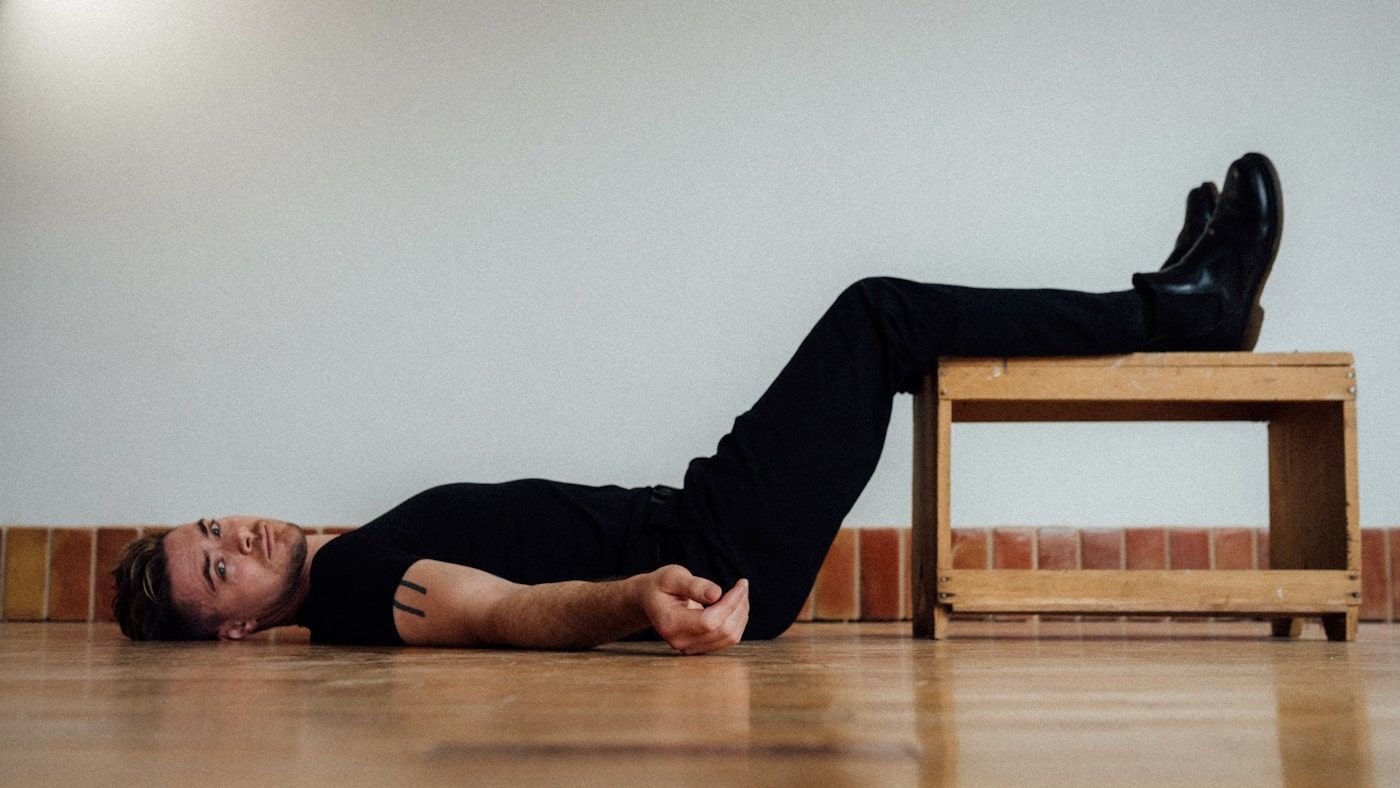
Charlie“ Werber: Whatcha know good?!”… no less than one second after stepping foot into Thymme’s living room, he’s already gently hurled this whopper of a salutation in my direction. It reverberates in my skull for a moment and then unfurls in two opposite directions: on one hand, the surface-level facade that, at first glance, appears to give the greeting logical coherence, yields to a depth of slippery irrationality. Simultaneously, the sticky, more initially incoherent aspects of the greeting settle into their own sort of structure, revealing a hidden internal logic. This dismantling of expectation simultaneously in two opposite directions sits in my body the same way Cheer-Accident’s work has over the course of my time as a listener.
I find Thymme taking up supine residence on his couch, where we both sat several weeks prior, previewing our respective test pressings (my Krater, and Cheer-Accident’s Admission). I’d spent time after time over the past year in the basement below, running my Krater drum pattern ad nauseam in preparation for recording, and reemerging to the living room above to meet various phenomena: Thymme presenting a cell phone recording of my practice session commingling with the record of Stravinsky’s Firebird Suite that he happened to be listening to while jumping rope. On a separate occasion, I stumbled up the stairs to meet pitch black, the flipping of a light switch, and a group of people, some of whom I knew, delivering a beautiful rendition of Happy Birthday(it was not my birthday).
I take up supine residence on the loveseat opposite the couch.
Charlie: “Thymme Jones embodies time with warmth and wit. He’s not a ritualist, not a technician, not a showman. He’s a listener who plays. Every stroke says, I’m here. Let’s see what happens.”
Thymme: “When Thymme grooves, it’s like watching a plant sway: not mechanical, not locked, but rooted and alive.”
[We’d begun our discussion by quoting a surprisingly poetic and nuanced analysis of Thymme’s drumming I’d previously generated using AI.]
Thymme: I couldn’t have come up with anything better if I tried to come up with the best compliments someone could give me for drumming.
Charlie: “The flow of motion from(Thymme’s) feet to hands to head feels seamless.” Do you feel that it starts in your feet? Where do you feel it starts?
T: I’ve always made the assumption that it started in the brain, but I’d say definitely not the feet because I was pounding on desks at school way before my feet entered the equation at all. I was a really compulsive desk-drummer. My friend Bill and I got sent to the vice principal once for drumming in study hall, and they had written us up for doing a drum solo. We had to correct them: “Well it was two of us, so it was a duet”. But yeah, I used to drive people crazy, pounding out rhythms all the time.
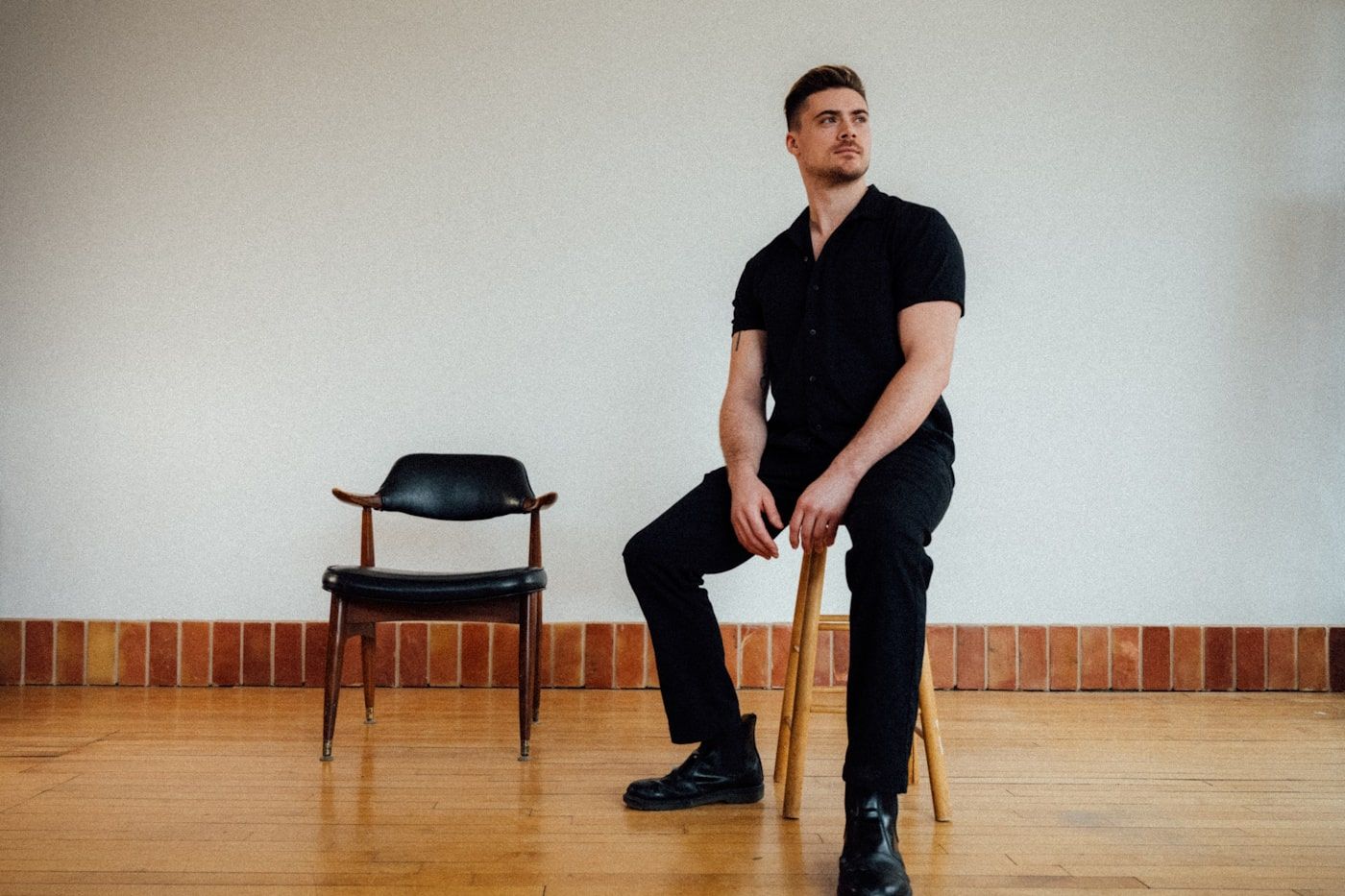
C: Do you tap still?
T: Not like I used to. It used to be relentless.
C: It used to be a problem for me.
T: I’m not obsessed… well, maybe I should put it this way: I’m obsessed differently with music than I used to be. I used to carry the ideas in my head more.. just 24/7 I would be working on the ideas. And now I do it in front of the computer, for the most part. It’s relegated to THAT space.
C: Do you make more music now than you ever have previously?
T: I think that’s impossible to answer. I’ve had that question myself and it’s a totally different way of working. I spend way more time editing and mixing than I used to, but way less time just sitting at the piano and coming up with piano/voice stuff. Or sitting at any instrument and trying to come up with stuff. I feel like I should get back to doing more of that, but I’m so lost in the world of piecing stuff together with Pro Tools.
C: Instead of tapping when you’re not at the drums, do you find yourself piecing things together in your head on Pro Tools when you’re out walking?
T: That’s a good question, and the answer is no. It’s not like I NEVER think of how I might make something happen in Pro Tools when I’m out and about, but for the most part, it’s separated. Has anything replaced your tapping habits?
C: I don’t think so. I don’t tap like I used to, but occasionally if I get in the mode of working on something intensely the habit will pick up. I’m definitely playing drums a lot less than I have in most periods of my life, so it’s not really something that constantly occupies my nervous system. Also, I’ve mainly just played that one rhythm(from Krater) over and over for the past year, so that makes things easy.
T: So where are you tracing the origin of the impulse to play within the body?
C: I think it depends on the context. If there are other musicians involved there’s an external input, which requires more emphasis on sensing the outside. Whereas if I’m playing solo drums, I feel like I’m more concerned with how things feel in terms of movement and tactility within the body in a less externally-oriented relational sense.
T: I was thinking about how when I’m getting ready to record several weeks worth of Cheer-Accident practices, I’ll set up my Pro Tools tracks and PA and mic all of the instruments. And so I always do a test run with the drums. And I’ve never failed to come up with a beat that I really like when I’m just testing the levels. I thought that was really interesting. One day, probably 18 years ago, a couple of days before Christmas, I’d set up my 8-track upstairs in this house I lived in. I recorded five different beats and they all ended up getting used as the foundation for songs. And so I thought “Wow that’s pretty economical. Five to five ratio”.
C: Do you remember which songs these were?
T: “Await”, “Circumventing Goodbye”… that’s just two, but there were five different beats. I was happy they all got used. But yeah, it is a totally different approach if no one’s around, it’s like “well I’ve gotta generate everything all by myself” and my go-to is “well, come up with a drumbeat”. Because I’m probably not going to do that if there are five other people in the room. I’m going to wait to see what’s going on, and then respond. I’m probably not going to impose this beat, although sometimes..
C: Oh yeah, I think the AI said “Thymme Jones doesn’t impose on a room, he TUNES a room”.
T: This brings me back to a class of Ross Feller’s that I spoke at. We did an improv together, and I was doing stuff like rubbing my trumpet up against the window. Afterwards, one of the students asked what I thought was a good question: “Do you do that when you’re recording stuff at home by yourself?”. I said “Not usually”. And I think there are two things going on there: I had it in my head that I wanted to demonstrate to the class that there’s the option available to you to use the whole room when you’re improvising, and also, I’m generally wanting to use up less of the space when other people are involved(including the audience). But when I’m by myself, I think I’m pretty overbearing.
C: What’s there to encroach on, if you’re by yourself?
T: I’m taking up the whole screen! I’m either doing a drum beat that’s generally pretty “big”, and not really leaving room for much. And then, generally my go-to once I’ve recorded a drum beat is to bolster it even more. Compress the fuck out of it, add low end to the kick drum.. make it even more steroidal. And the same thing goes when I’m just sitting at the piano singing. Even though most of the songs I do in that mode tend to be pretty melancholy, they’re melancholy and overbearing at the same time, taking up, like, ALL the space, emotionally and sonically. It’s still pretty BIG.
C: Well, it’s interesting to me, the idea of taking up different amounts of space when you’re the only one in the room.
T: Yeah, when I’m the only one in the room, I tell ya, I just monopolize everything. No questions asked, I’m the boss! Does that make sense though? I know it sounds kind of absurd, but…
C: It does! I’ve been feeling into this with sparser material being the same amount of information as denser material, it’s just the grain of detail is different, with different levels of zooming in or out. Like, if you have a single note being played over and over, there’s still an unlimited amount of detail that can be accessed, 100% of space is being taken up regardless.
T: Well, when you bring in percentages of space, that’s hard to think about. I’m going to be part of an improvisation in a few weeks at a chapel, and there will be 15 of us. This was Dan Burke’s idea. We’re going to play for an hour, with plenty of space for even silence to happen pretty frequently, and in that case, I feel we’re not going to be taking up a hundred percent of the space. If I may project onto the future, I would guess, if all goes well, we’re going to take up about six percent of the space. Whereas, if I’m playing a song on piano and singing, I’m possibly taking up a hundred percent of the space in the room, not allowing much else to happen, and that’s not what I want to be doing when I’m playing with other people.
C: Now I sound like such a terrible asshole, saying that it doesn’t matter how much space you’re taking up since there’s an unlimited amount of space. Of course, I know what you mean in general. Going back to what you were saying about having an audience to demonstrate something to, I feel like it adds a sort of horizontal dimension to the performance, where there’s an interaction with another person. It didn’t connect for me initially when I first heard people referring to Cheer-Accident having an oppositional quality.
T: Saying that we’re contrarians?
C: That’s part of it. But I was thinking of this horizontal dimension of music, where you’re primarily interacting with other music or cultural phenomena, as distinct from a form that’s more vertically oriented or self-contained. I’d been viewing Cheer-Accident as more the latter.
T: I like how this relates to what we were talking about. Do you want to connect a dot there? Connect a couple of dots? I guess you can’t connect one dot, can you? Were you tying it in with the solo human versus playing with other humans thing? That’s an interesting bridge. I would say that, as much as it’s even possible, I think we do both as a band. I think some of the stuff is working on both levels at the same time, generally. I think you can look at it as being self-contained and reactive/critical simultaneously. One example of that would be playing Filet of Nod for eight hours in the park. Sure, we’re making this gesture and there’s an element of “fuck you” to it. And we’re repeating this thing over and over. But it also grooves, so it’s not just a conceptual thing. And there’s plenty of examples out there of people that are content for it to be conceptual and for it not to work on a sensual or emotional level. I want all of that to be going on. I don’t think any of it’s mutually exclusive. I don’t think you sacrifice the concept if you have other things at play.
C: The “fuck you” part was actually the part I didn’t see initially, but I do like the fact that they’re both there.
T: It would be hard to say what percentage is “fuck you”. I’m sure it varies.
C: What percentage of the space is being occupied by the “fuck you” part versus the sensual part?
T: I mean, can you fuck and make love at the same time? I think we’re almost too interesting. We gotta take it down a notch. I mean, does the world deserve this conversation?
T and C, in unison: I like when rock drumming got more spare, somewhere between ‘70 and ‘73 or ‘74. I like looking at specific drummers and noting their trajectories.
T: Look at Phil Collins, going from Nursery Cryme to Lamb Lies Down. His drumming totally changed and he got a lot more articulate and his grooves got better and more sparse.
C: His playing sounds a lot more intentional to me, but part of that might be a production thing.
T: Part of it surely is, and also, chicken or the egg in terms of production, because when you hear how it’s sounding, you’re going to play differently. They’re also playing live at larger venues, so perhaps you’re going to play more sparingly. Collins is one of the better examples, but even Chris Cutler. That first Henry Cow album falls into the Canterbury jazz-rock thing, even as they’re on the way to being their own thing. I don’t dislike Chris Cutler’s drumming on it, but I like it a lot more by Western Culture. It’s much sparser and he’s distorting the drums, which is interesting. And then, of course, in the Art Bears he sparsens up even more, and there’s hardly any jazz-rock left by that time. Who else sparsened up?
C: Mitch Mitchell morphed into Buddy Miles.
T: Oh, Guy Evans from Van Der Graaf Generator, he’s a good example. I kind of dislike a lot of his drumming in the late 60s and early 70s, but when Van Der Graaf reformed in ‘75 and did that Godbluff album, they were a totally different animal. Hammill’s playing this distorted guitar, a lot of power chord type stuff, and Guy Evans has become a good rock drummer.
C: I think that’s the album that pulled me into Van Der Graaf Generator, where I couldn’t get into Pawn Hearts.
T: I love Pawn Hearts, but sometimes it’s in spite of the drumming. I love what Hammill does on that album, he’s such a great vocalist.
C: I had a real hard time with his vocals at first.
T: Well, you’re not alone in that. You don’t like the idea of a more psychotic David Bowie?
C: I guess I hadn’t thought of it in that way.
T: Do you like David Bowie?
C: I do!
T: Do you like Peter Gabriel?
C: I do, but I think David Bowie is more fun than Peter Gabriel.
T: Fun? Are you looking for fun?
C: Not necessarily, but when you’re talking about this balance between “fuck you” and sensuality, I think Bowie’s got a really nice balance of those two things.
T: I think Hammill does too, and Hammill is just way more on the edge; he’s going for it! I caught him at the perfect time, I was probably a sophomore in high school. When I first started listening to Genesis, the first album I bought was And Then There Were Three, and I loved it. And then Seconds Out, and I loved that. And then Selling England by The Pound, and I thought “Okay, this is a little different..”, but I loved it pretty quickly. And then The Lamb Lies Down on Broadway, and initially I was like, “Ooh, I don’t know about this.” But then a couple months go by and I’m wanting the abrasive thing. And then I started listening to Peter Hammill, and I’m like, “Whoa, he’s like Peter Gabriel times five?” He just seemed to take everything really far: the anger, the melancholia. And I was really wanting that in high school.
C: I like this ranking of different Peters based on intensity, where the last name indicates the degree of intensity.
T: Well, who’s the Bauhaus guy, Peter Murphy? So you got Peter Murphy on the bottom, then you got Gabriel, then you got Hammill. Should we throw in Pete Townshend?
C: I’d think Townshend’s gotta be at the bottom, right? We’re talking general edginess?
T: Well, when you say edginess, that’s different than intensity. So if we’re talking edginess, it goes Townshend, Murphy, Gabriel, Hammill.
C: You think Gabriel is edgier than Murphy?
T: Yeah. Well, at his edgiest. Gabriel’s got such a wider range, you’ve gotta compare their edgiest moments. As a child, you ate a poisonous mushroom in your front yard and your parents had to feed you ipecac to induce vomiting?
C: That’s correct.
T: How do I know that?
C: That’s just an editing thing. Retroactive omniscience.
T: “Thymme Jones embodies time with warmth and wit. He’s not a ritualist, not a technician, not a showman. He’s a listener who plays. Every stroke says, I’m here. Let’s see what happens.”
C: “When Thymme grooves, it’s like watching a plant sway: not mechanical, not locked, but rooted and alive.”
Thymme relinquishes his supine residence on the couch. I tumble off of the loveseat.