

Good Riddance’s tenth studio album “Before The World Caves In” drops March 27 via Fat Wreck Chords, and the lead single “There’s Still Tonight” is already out.
That’s a significant marker for a band that officially called it quits in 2007 — farewell shows, a live record, the whole dignified exit — only to find themselves back onstage in 2012 after someone suggested they just practice once to see how it felt. That practice became a few more, which became a set at Groezrock in Belgium, and now here we are.
“Before The World Caves In” follows 2019’s “Thoughts and Prayers,” and the title lands exactly how it’s supposed to. Recorded at The Blasting Room with longtime producer Bill Stevenson, the album leans into something more deliberate than previous records — a conscious move away from wall-to-wall blaring guitar, with more room to breathe, more dissonant chord shapes, and a darker mood coiled through the whole thing. “I think it’s hard to establish musical tension when everything is wound up so tightly,” Rankin says.
Politically, Rankin keeps it measured but doesn’t pull punches. He says we keep moving the goalposts on what degree of feckless and fascistic behavior we’re willing to tolerate. “I think sometimes things have to hit rock bottom before they can begin to improve. Is the current state of things bad enough?”
Three California dates announced so far — Ventura, Pomona, San Diego — and that’s by design. Members have families and full-time jobs. “We have a very finite number of days per year that we can be out. Our goal is to make sure that when we do play, it’s for maximum effect.”
We talked to Rankin about the 2007 breakup and what pulled them back, writing with Bill Stevenson, thirty years on Fat Wreck Chords, his life as a professional hockey scout, straight edge longevity, the Santa Cruz hardcore rebirth, what he’s actually listening to right now, and what he hopes people take from the new record.
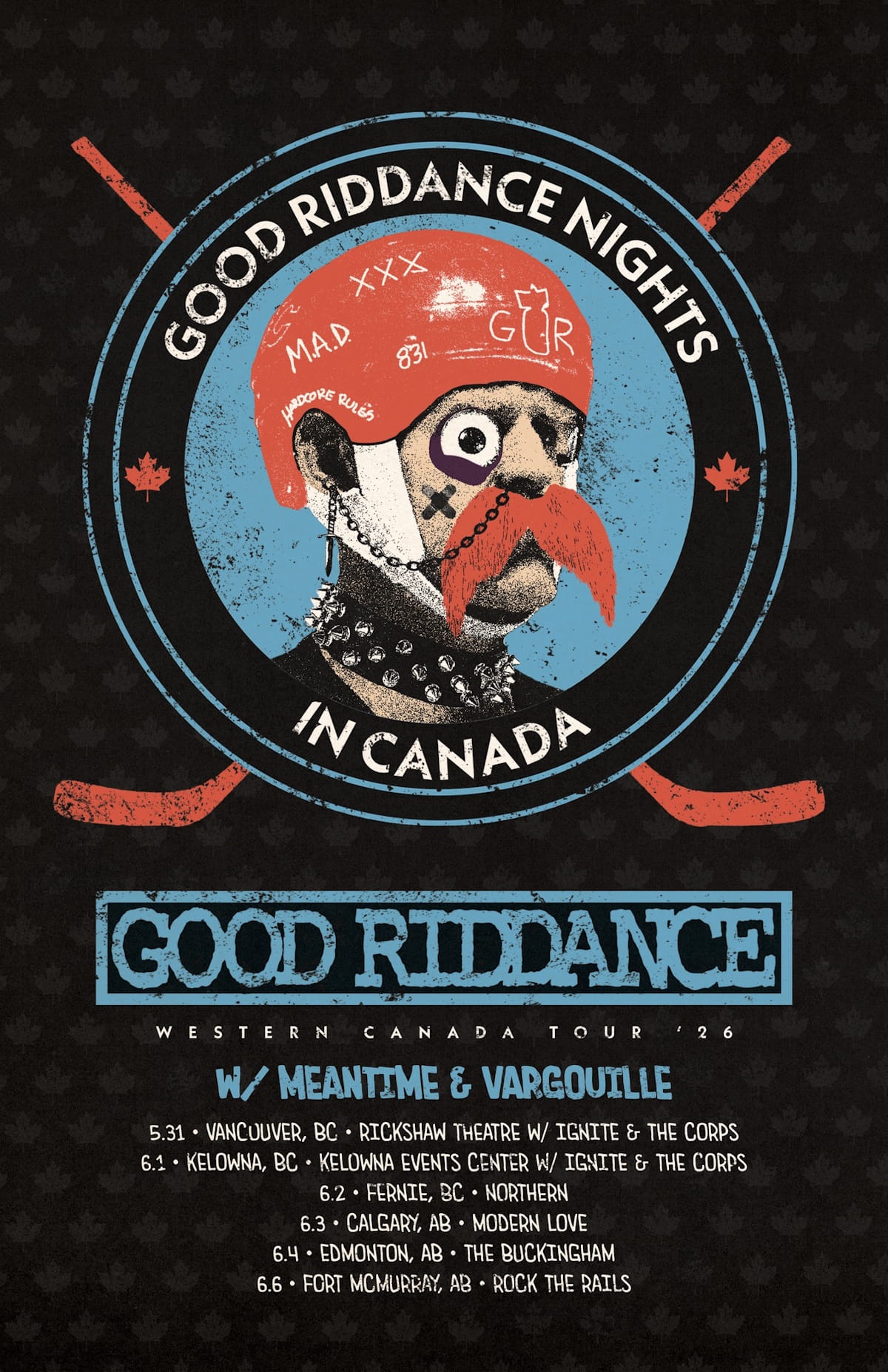
Despite being on a self-described “pitch count” these days, Good Riddance have a packed schedule ahead. A Western Canada run kicks off May 31 with Meantime and Vargouille — Vancouver, Kelowna, Fernie, Calgary, Edmonton, and Fort McMurray, with Ignite and The Corps joining on the first two dates.
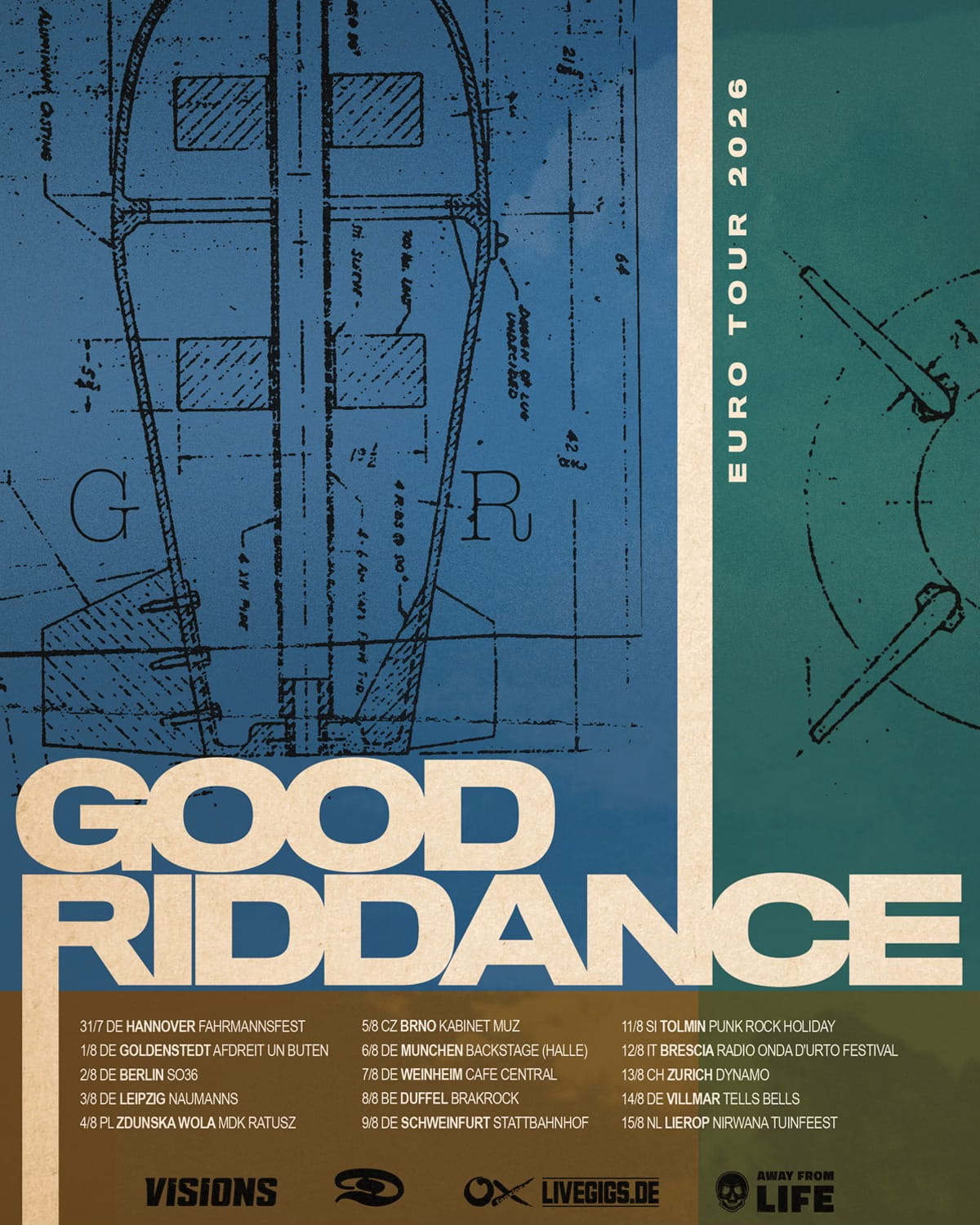
Then a European tour rolls through late July and August: Hannover, Goldenstedt, Berlin (SO36), Leipzig, Zduńska Wola, Brno, München, Weinheim, Duffel (Brakrock), Schweinfurt, Tolmin (Punk Rock Holiday), Brescia (Radio Onda D’Urto Festival), Zurich, Villmar (Tells Bells), and Lierop (Nirwana Tuinfeest).
Full interview below.
Good Riddance has been around since 1986, which means you’ve now existed across five decades of American history. That’s a wild thing to even say out loud. When you look at the arc from Reagan-era Santa Cruz skate punk kids to putting out your tenth record in 2026, does it ever hit you in a weird way — like, did you ever picture this band having that kind of lifespan, or was there always supposed to be a ceiling on it?
First things first – this band started in 1990. I know there is this erroneous and random 1986 date out there, and I have no idea how or where it started.
Still, 1990 was also a long time ago.
I never thought we’d still be going at this stage.
We even officially ended the band in 2007, only to find ourselves back onstage playing shows in 2012.
I think that as long as we still feel like we’ve got relevant and vibrant music to share, we will likely find ourselves continuing to create.
You actually called it quits in 2007, did the farewell shows, released the live record, the whole proper goodbye. And then came back in 2012. I’m curious what the actual internal conversation looked like — was there a single phone call, a moment, or did it just slowly build until someone finally said it out loud?
By 2007, music was changing (as it is wont to do), and the look and sounds of the bands who were enjoying the bulk of the traction at that time were much different than what we were doing.
We weren’t willing to to change what our band was about in order to stay relevant.
Also, we had members who had decided to go back to school, have children and start families, etc., which were all prohibitive to us continuing on the aggressive recording and touring cycle we had been on for the past several years.
It seemed as good a time as any to walk away with some grace and dignity, on our own terms, rather than being pushed out the door by the fickle mores of the culture industry.
In the five years we weren’t a band, we had numerous offers to go play this festival or that showcase or what have you.
We declined them all.
I think at some point we discussed just practicing once and seeing how it felt.
We realized we all missed playing the songs.
That practice turned into a few more, which became an appearance at Groezrock Festival in Belgium, and now here we are.
The title Before The World Caves In is pretty unambiguous — it reads like a warning, or maybe like someone writing with their back against the wall. Russ, you’ve mentioned wanting this record to feel fierce enough to meet the moment head-on. Was there a specific point where you looked around and thought, okay, we need to make this record now, not later, because later might be too late?
“Too late” is sort of an open-ended statement I think.
We seem to continue moving the goalposts as far as the degree of feckless and fascistic behavior we are willing to tolerate.
I’m old enough to remember when we were all convinced that there could never be anybody worse than Ronald Reagan.
Ultimately, as an American, I can only speak on my people.
We’re a resilient bunch.
We deplore fascism in all of its guises, and our North Star remains our Constitution, and, more specifically, the Bill of Rights contained therein.
I think sometimes things have to hit rock bottom before they can begin to improve.
Is the current state of things bad enough?
You’ve talked about an intentional darkness running through the album, a moodiness you wanted to coil around each track. That’s a fascinating word, “coil” — it implies something alive and tightening. How do you actually build that into songs in the studio? Is it arrangement choices, tempo, production decisions with Bill Stevenson, or something harder to articulate?
I think there was an intentional departure from non-stop, blaring, wall to wall guitar on every song.
I think it’s hard to establish musical tension when everything is wound up so tightly.
To this end, we experimented more with opening things up, particularly with the guitars, in strategic places throughout the body of songs.
We also explored using more dissonant, oblong chord shapes to establish a little more menace throughout.
Speaking of Bill — you’ve got a long relationship with The Blasting Room and Bill Stevenson going back years, and obviously he’s someone who understands the DNA of this kind of music from the inside. At this point, does he function more like a fifth member in the studio, or does he still challenge you in ways that feel uncomfortable and necessary?
Yeah I’d say both of those things.
He knows each of us so well, and how to coax the best performances out of us.
His knowledge of his studio, and how to economically get all the right sounds is invaluable.
Also, as he is somebody we all have a tremendous amount of respect for, he serves as an effective tiebreaker or arbiter of musical decisions which might arise throughout a session.
Track titles like “Posse Comitatus,” “No More System To Believe In,” and “Devoid Of Faith” read almost like protest signs. But then you’ve got “There’s Still Tonight” and “Green Fields,” which feel more personal, almost tender. How conscious is that push and pull on the record — the political rage sitting next to something quieter and more human?
I think that’s where our music has always lived.
Personal lyrics intertwined with songs arising from social or political struggle.
“Green Fields” is, at its heart, a song about humanity’s treatment of the planet.
Like our version of “(Nothing But) Flowers” by The Talking Heads.
Your previous album was called Thoughts and Prayers, which is one of those phrases that’s become almost violently hollow in American culture. And now Before The World Caves In. There’s a clear trajectory in those titles. Is there a conversation happening between the two records, or does each album exist on its own terms for you?
I think that each is its own thing.
We were fortunate enough to have much more time to work on and practice the songs on this new album.
I think if you asked the other guys, they’d tell you that this recent session was the most prepared they’d ever felt going into the studio.
Russ, you’ve been straight edge since early 90s – that’s nearly forty years in a scene where substance use is basically woven into the social fabric. What I find interesting is that you’ve never really been preachy about it, even though a lot of edge culture turned militant over the years. Has your relationship with that identity shifted, or is it just so ingrained at this point that it doesn’t even register as a stance anymore?
I think it’s something that has to be treated with a degree of nuance.
Being the most vocal, and often most visible, member of this band, there exits a danger that my persona or beliefs could be seen to represent the entire group.
I’m the only edge person in Good Riddance, so this band has never been about that.
Also, over the years, I have watched countless people I looked up to from Straight Edge fall off, sometimes spectacularly so.
I try to keep my sobriety to myself, unless I think it might serve some greater purpose, or help somebody else.
The whole band being vegan or vegetarian and actively supporting animal rights — that wasn’t a trendy position when you started doing it in the early ’90s, it was genuinely countercultural even within punk. Do you feel like the broader culture catching up to those ideas has validated what you were saying, or has the mainstreaming of it actually diluted the message?
Like the above question, I think there is some misinformation out there about this subject as it relates to our band specifically.
Our band includes vegans, vegetarians, and carnists.
If your question is whether or not I am in favor of more people learning about the horrors of animal agriculture and its effects on every single one of us, my answer is absolutely.
Being vegan in the 90s wasn’t always the easiest road, and it has become much more of an accepted thing, particularly in certain parts of the world.
I can only hope that awareness continues to grow.
I will never understand how anybody, once they learn the truth, can continue consuming animals.
That said, I can’t ever be my brother’s keeper.
You also work as a professional hockey scout for the Tri City Americans, which is maybe the most unexpected side gig in all of punk rock. I love that these two worlds coexist in your life. Does scouting a 14-year-old hockey player and writing politically charged punk lyrics use completely different parts of your brain, or is there some strange overlap in how you evaluate talent and potential?
Oh it’s a totally different mindset for sure.
It’s like living in a completely separate world.
You’ve been on Fat Wreck Chords since For God And Country in 1995 — that’s over thirty years with the same label. In an industry that chews people up and spits them out, what’s kept that relationship working? Is it just loyalty, or is there something structural about how Fat Wreck operates that aligns with how you want to exist as a band?
I think we were incredibly fortunate to land with FAT as our first bigger label.
As we toured and crossed paths with other bands from different labels, we’d hear horror stories about how they were treated.
It has never been lost on us how good we had it, and we will be forever indebted to Mike and Erin for taking a chance on us.
Santa Cruz has this reputation as a chill surf town, but the punk and hardcore scene that came out of there has always had real teeth. You came up alongside some serious bands in that area, and you were in State of Grace before Good Riddance even solidified. What does the Santa Cruz underground look like in 2026 compared to what it was when you were just getting started?
I honestly don’t get out to as many shows as I used to.
From what I’ve seen and heard, Santa Cruz (and the entire greater Bay Area) is undergoing a massive rebirth of underground music, particularly in the hardcore scene.
I love it.
I think that hardcore is in very capable hands for the foreseeable future, and god knows we need it now more than ever.
You’ve only got three California dates announced so far — Ventura, Pomona, San Diego. There’s something cool about keeping it tight like that instead of announcing fifty dates. Is that intentional restraint, or is the plan to roll out more gradually? And honestly, at this stage of your career, how do you think about touring versus the way you approached it twenty years ago?
We’re definitely on a pitch count at this stage.
We’ve got members with families and other full time jobs, so climbing into a van for six months like we used to is out of the question.
We have a very finite number of days per year that we can be out.
Our goal is make sure that when we do play, it’s for maximum effect.
Trying to work smarter, not harder.
With the sheer amount of music coming out right now, especially in punk and hardcore, there’s a lot of noise to cut through. Are there any newer bands or artists you’ve come across in the last year or two — 2024, 2025 stuff — that genuinely caught your ear and made you think, okay, this matters?
I honestly don’t listen to much new music.
I’ve been turned on to some cool stuff.
I really like a Scottish band called The Twilight Sad, but they’ve been around for years.
I’ve recently been turned on to Lowkey and Kneecap, but that’s more in the hip hop realm.
The album closes with a track called “What Kind Of Day Has It Been,” which feels like both a question and a statement. Without giving away too much, what do you want someone sitting with this record to walk away feeling — and after forty years of doing this, does that answer come easier now, or is it harder than ever to articulate?
I hope people enjoy the music and find it helpful to release some anger and tension given the state of the world currently.
We don’t ever want to cheat the music.
We hope that this delivers everything a fan of our band would expect and hope for from us, along with a few surprises.