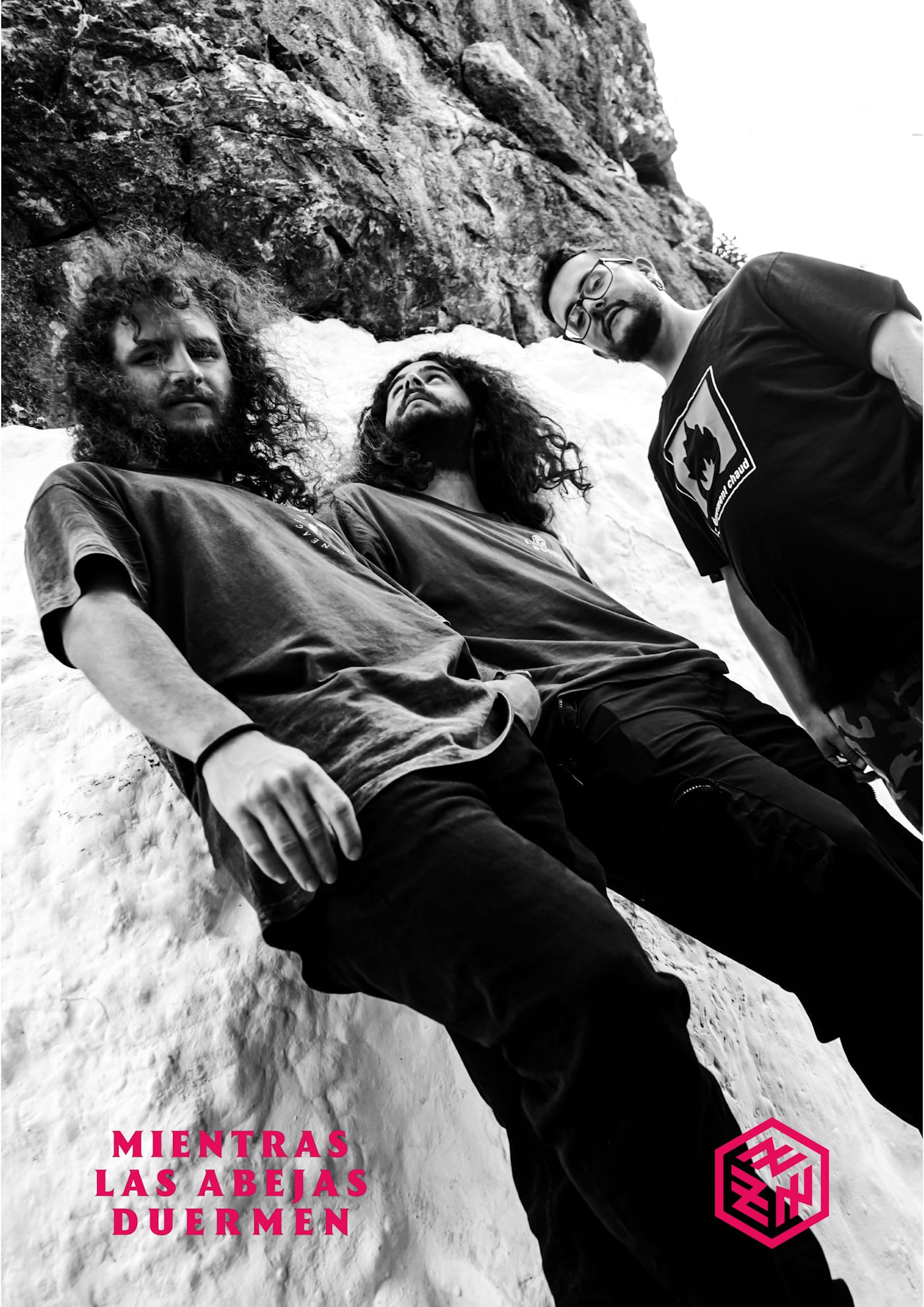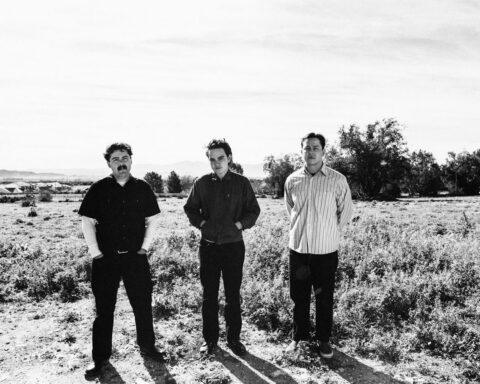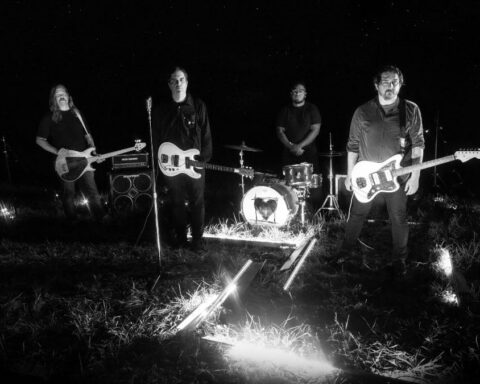



A guy gets stung by a bee outside the rehearsal space and says “we’re going to have to rehearse while the bees are asleep.” That’s the whole origin of the name. Mientras Las Abejas Duermen — “While The Bees Sleep” — don’t read too much into it, or do, whatever you want. The band themselves say words and ideas belong to no one.
What matters more is what happened inside that room. Three friends from a small mountain town in the Sierra de Cádiz, southern Spain, who’d spent years playing as hired hands across other people’s projects — pop, rock, punk, whatever came up — but never anything that was actually theirs. One day they set up a makeshift recording studio in their rehearsal space, hit record, and just jammed. No agenda, no genre target, no fixed goal. Just noise and time and freedom. And from those sprawling, unfiltered sessions, a band took shape.
Their debut full-length, “Mlad,” came out February 26 through Kozmik Artifactz on vinyl, with the digital edition handled by Estudio Mazmorra. It was recorded and mixed by Rafa Camisón at El Bisonte Estudio, mastered by Mario G. Alberni at Kadifornia Mastering. Six proper tracks plus three shorter instrumental passages called “Cruz de Benalfil,” “Cruz del Tajo,” and “Cruz de la Viñuela” that function as waypoints between the longer pieces.
And those longer pieces are genuinely long — “Huellas Y Rumores” opens at nearly nine minutes, “Los Hijos Perdidos de Umrica” runs close to eight, “El Camino Silencioso” just past eight, and “La Ley del Cuarto ¿Quién Es el 67?” stretches past eleven and a half minutes. This is not a record for the impatient. But if you’re willing to sit with it, the payoff is real.
The sound lands somewhere in the wide-open territory between heavy psych, stoner rock, desert rock, and doom — with smooth, clear vocals sung entirely in Spanish that sit on top of everything like heat haze over asphalt. There’s a meditative patience to how these songs unfold, layers building and dissolving without rushing toward any obvious destination.
The band describes their approach as capturing “the way we see things in the small villages of the southern Spanish mountains” — a self-portrait of the sensations, good and bad, of living isolated in the hills. Dark, mysterious, inward-looking, but not suffocating. More like a long drive through landscape that keeps shifting when you’re not watching.

The creative process mirrors the music’s temperament. After those initial jam sessions were recorded, the band went back and listened for the passages that hit hardest — sometimes things that didn’t impress them while playing but landed differently on playback, and vice versa.
There was a lot of raw material, and not all of it made the cut. What survived got shaped carefully but lightly, with arrangements and overdubs added subtly so the original roughness wouldn’t get buried.

“We didn’t want to lose the rawness of the original ideas,” they explain, “and also so that they would be as faithful as possible when playing them live, something important for a trio, since when you overload the songs, then, when it comes to performing them, it becomes basically impossible for just three people.” That restraint shows. Nothing on “Mlad” sounds overproduced or overthought. It breathes like a live room, even when the layers get dense.
The album artwork was done by graphic designer Alberto Oliva. The band gave him no direction — just the name and the full album to listen to. He built the visual identity entirely from what he heard. “The truth is, we’re more than happy with the result. Thanks to our close relationship, he was able to perfectly capture what we wanted for the songs, even without any guidance: the feeling of traveling inward, where everything is sometimes dark and mysterious.”
There’s an eclectic confidence to these tracks that rewards patience. “Huellas Y Rumores” opens the record with a slow burn that earns every one of its eight and a half minutes. “El Camino Silencioso” — “The Silent Road” — does exactly what the name suggests, pulling you along a path that reveals itself gradually. And “La Ley del Cuarto ¿Quién Es el 67?” is the kind of nearly-twelve-minute piece that drifts through several moods and textures without ever feeling like it’s padding for length. The three “Cruz” interludes give the album a sense of geography, like trail markers on a mountain hike, breaking up the longer explorations with quieter, more contemplative passages.

This kind of heavy psych and desert rock doesn’t show up on these pages as often as the hardcore and post-hardcore stuff that usually fills the queue, but that’s exactly why it’s worth highlighting when something this genuine surfaces. Mientras Las Abejas Duermen aren’t chasing a trend or trying to sound like anyone specific. They’re three guys from a mountain town who plugged in, hit record, and followed whatever came out until it became something worth sharing.
The fact that it emerged completely unplanned — no concept, no ambition beyond the room itself — is exactly what gives “Mlad” its weight. It sounds like it was made by people who had nothing to prove and nowhere to be, and that kind of freedom is hard to fake.
If you’ve got a long drive ahead of you this summer, preferably through dry, open landscape with the windows down, this is the one.