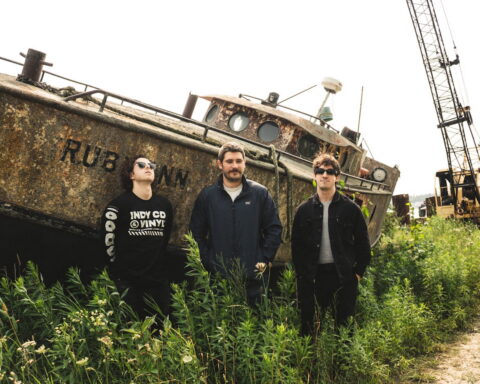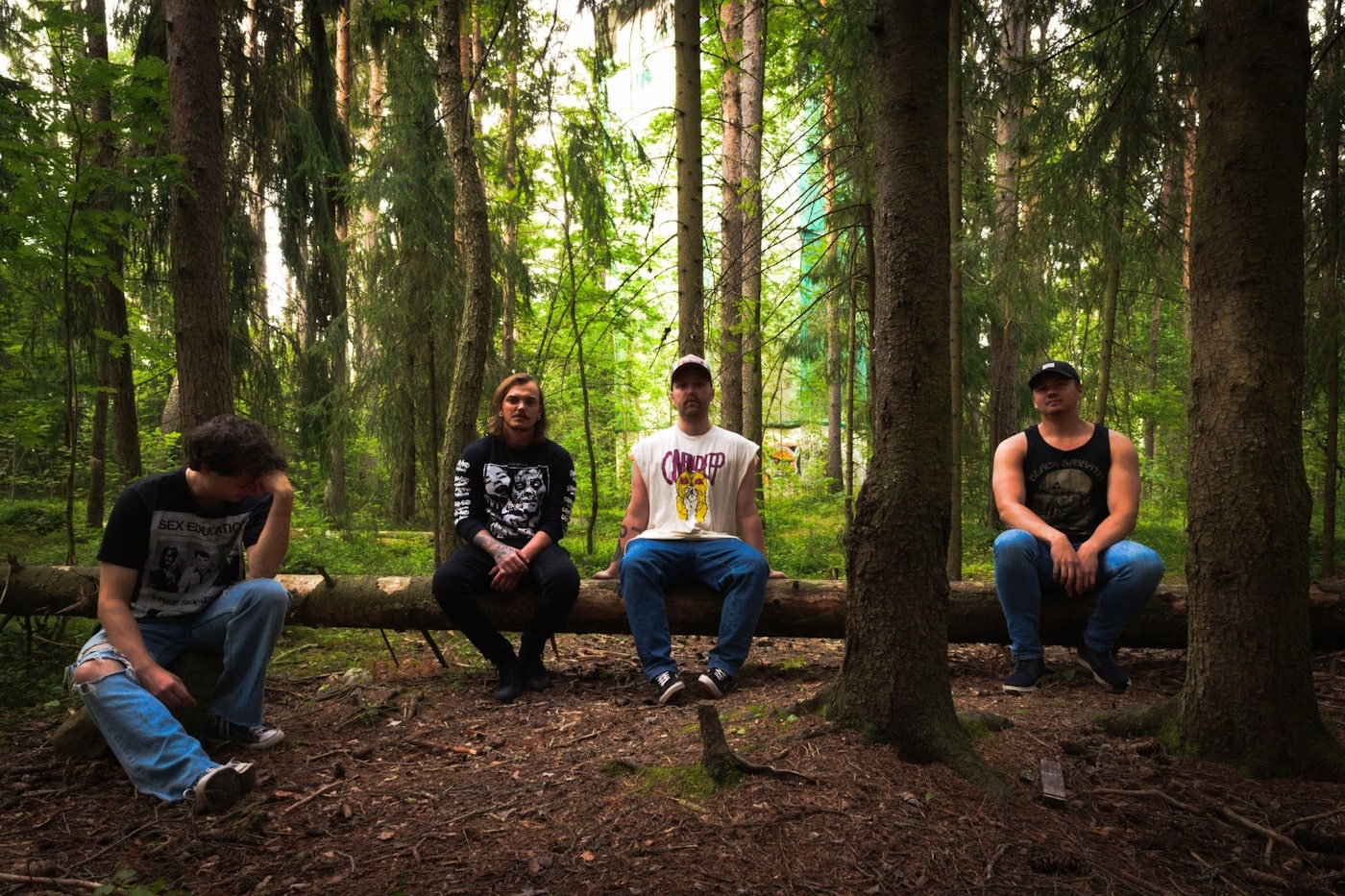


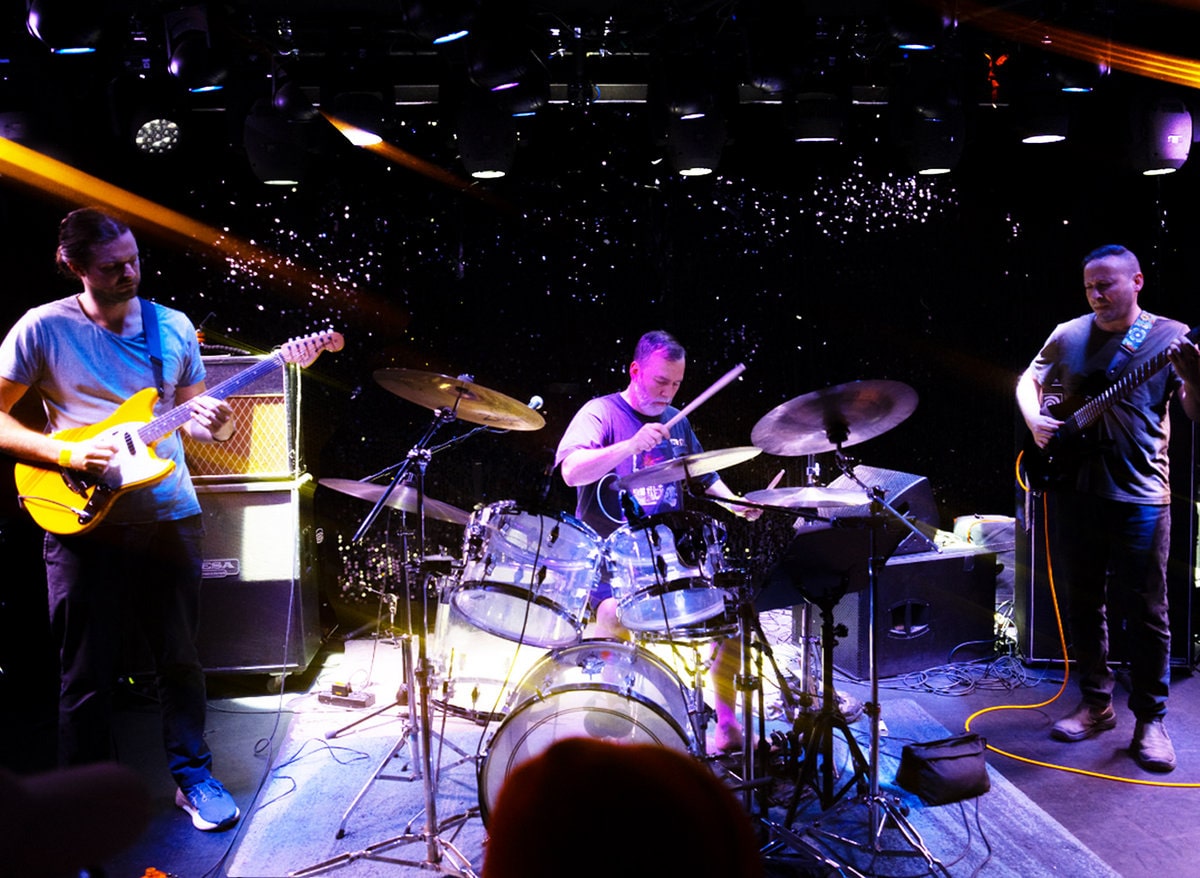
Yowie have spent a quarter of a century bending avant-progressive rock into their own angular vocabulary, and their fourth album “Taking Umbrage” — out October 3 via Skin Graft Records — is the result of eight years of slow, painstaking assembly. It’s also the first time the band re-formed with guitarist Jack Tickner from Wollongong and bassist Daniel Kennedy from Philadelphia, joining Saint Louis drummer Defenestrator. The lineup only played together as a full unit hours before recording, a decision that shaped the entire process.
The band describe their sound as “hyper-composed” yet still swinging in its own crooked way. Kennedy puts it bluntly: “The little parts make the big picture. The big picture emerges from the little parts.” For Defenestrator, the method is about tension: “This band tortures rhythms until they reveal their most angular anti-groovy essence, and then we throw a grooved version of it down into the pit to antagonize the angular part.”
The Yowie test for material is ruthless. Kennedy says it means: “No major, no minor, no 1-4-5, no four times of anything, no solos, no bullshit.” Defenestrator admits to keeping “up to 11% bullshit,” but adds that ideas rarely die outright — they get benched until their “Yowieish essence” emerges. The group’s notation reflects their independence, each member developing a private language to map structures that only they can fully decode.
With distance dividing them, much of “Taking Umbrage” came together online. “Even though it’s not an ideal format, everyone cared enough about the music to make it happen across three distinct time zones,” says Tickner. The resulting songs wrestle with density, tempo, and arrangement until they finally lock in. “Grimgribber,” for example, was described as “particularly obstinate” by Defenestrator during the writing and mixing phase.
The sound of the record is as much about restraint as excess. Tickner highlights a brief pause in “Grimgribber” where the band deliberately leaves space: “Just a breath to put some emphasis on the next section.” Kennedy points to “Skrimshander” where “Martyr= 1:14, Villain= my 4-note bass at 2:05. The knife twists at 2:18.”
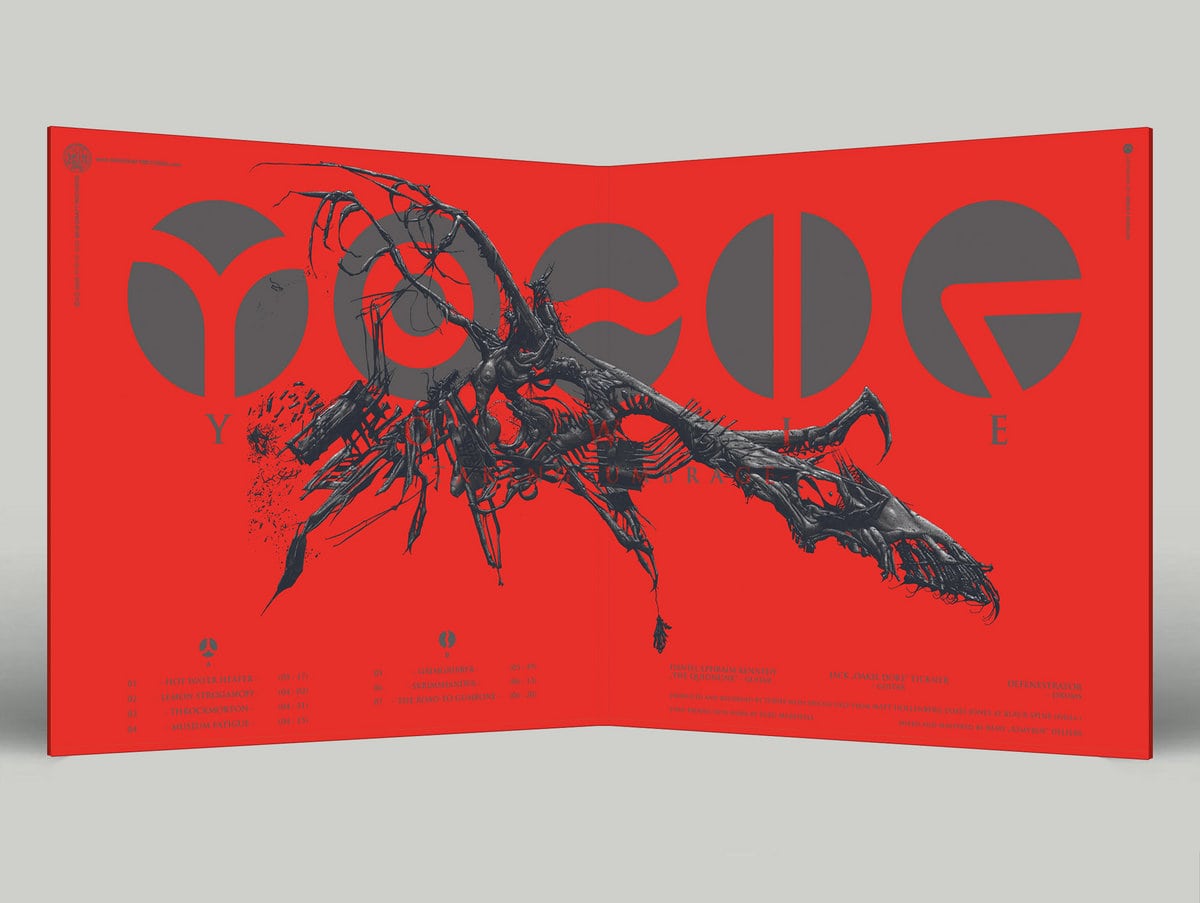
Working with longtime label Skin Graft allowed Yowie complete freedom. “Skin Graft has never talked us out of anything,” says Defenestrator, aside from insisting they give their first album titles and artwork. The visual side of “Taking Umbrage” comes from Arnulf Roedler, whose line-heavy artwork, Defenestrator says, mirrors Yowie’s layered sound: “When Yowie is at our best, we strive for some aural version of that experience.”
The band’s live shows lean into the physical and the chaotic. Tickner recalls a Paris audience moving in sync to impossible rhythms: “I absolutely love when people are interested enough to learn all the rhythms and dance perfectly to every beat. Makes me feel like I’m back in Paris 100 years ago watching Rite of Spring for the first time.” Defenestrator remembers the danger too: “During ‘Mysterium Tremendum,’ a very nice young lady came flying out of the crowd and took out my hi-hat stand with her head. That is the sort of thing we do not want to stage manage. We live for it.”
“Throckmorton,” the song premiered here, is one of the clearest entry points into “Taking Umbrage.” Tickner calls it “the first track I’d offer to any new listener,” while Kennedy and Defenestrator debate whether “Hot Water Heater,” “Lemon Stroganoff,” or “The Road to Gumbone” mark the deepest cuts of the record.
Below you’ll find our full interview with Yowie, covering how they push rhythm until it fights itself, the private rules of what makes an idea “Yowie or not,” how psychology slips into composition, their stubborn relationship with technology, and why micro-decisions like a single suspended chord or a mix tweak matter as much as the big picture.
So I just finished that Rick Beato’s chat with Les from PRIMUS about how nothing beats a crooked groove and a weirdly personal sense of style they own and your record felt like the natural sequel to that convo; wanna riff on where that instinct to make the “wrong” thing danceable actually lives for you?
Jack: I have always deeply respected guitarists who can make their instruments ‘talk’. Not in a Stevie Ray Vaughn kind of way but in a more primal animalistic sense. I remember listening to Damning with Faint Praise with the Basil’s Kite guys and all of us being certain that there were bird sounds overdubbed.
Daniel: In Primus it’s the “wrong” notes but the “right” rhythm whereas we try to use “wrong” pitch and “wrong” rhythms too. Groovability, like beauty, truly is in the eye/ear of the beholder
Defenestrator: In the west we are generally taught that danceable means “round” numbers. That means to make something that compels audience members to move with a pointy rhythm is an extra challenge; and I am here for it, especially if the dancing is not at all traditional. Eastern Europeans know what I am talking about; shout out to Bulgarian wedding music.
When you talk about “hyper-composed” but it still somehow swings, what’s the practical trick there — are you baking in pockets for muscle memory, or is the groove an emergent property you only hear after the thousandth rewrite?
Jack: There is a nucleus of an idea and then there are 3 people standing over it poking and prodding it into a specific shape. For many bands I think this process can kill records, as ideas get overcooked, but for Yowie this process is a crucial ingredient.
Daniel: The “groove” (or lack thereof) was suggested immediately in the very first seedlings for a song. The little parts make the big picture. The big picture emerges from the little parts. There isn’t much repetition, we just keep going (if you see what I mean) & imo this gives the sensation of a consistent “groove,” when really there may be more changes there than one would notice on the first few listens.
Defenestrator: Much of the time, this band tortures rhythms until they reveal their most angular anti-groovy essence, and then we throw a grooved version of it down into the pit to antagonize the angular part. When they fight it out, there can only be one winner (which of course is you, the listening public).
Zooming in on the earliest seed for “Taking Umbrage,” what was the very first motif or constraint you threw on the table that made everyone else go, “okay, that’s the map”?
Jack: I wasn’t there for the earliest seeds but there are most definitely agreed upon rules for the specific way you must fertilize this garden.
Daniel: I don’t remember motifs or constraints, just writing a whole lotta riffs with Shawn over the internet at first, years before we found Jack when our third voice was still a very big question mark. Some even from past un-used Yowie were on the table, and we still intend to use things in our catalogs for future recordings. However “Hot Water Heater” was the first song we started together as well as the first completed (as far as writing the basic structure).
Defenestrator: Yep Hot Water Heater was a series of interrogations and transpositions of multiples of 5 on top of one another. For some reason it was all very fivey or tenny or fiteeny or thirty-y. There was a notion of stitching them together with this major sense of continuity but the individual riffs just had too much character; they couldn’t be the ground while something else was the figure.
You’ve said you’ll interrogate whether an idea is “YOWIE or not” — what’s the private checklist for that, and can you remember a beautiful idea you killed because it failed the YOWIE test?
Jack: It’s a closely guarded secret. Or maybe one of the other guys will say.
Daniel: No major, no minor, no 1-4-5, no four times of anything, no solos, no bullshit.
Defenestrator: I will allow up to 11% bullshit, but that’s a matter of taste, really. But can I remember an idea that was strangled in the crib? Oh man, far too many to count. I probably have well over 100 hours of these recorded. I hold out hope that many of them will be rehabilitated one day. These ideas don’t really get rejected; they get benched until they reveal their Yowieish essence. And I am a patient man (he says, grinning maniacally, while hundreds of tiny screams emanate from an old hard drive in the basement).
Walk me through your notation vs. ear split: are these pieces living as dense scores, code-like spreadsheets, or weird little mnemonics only the three of you understand?
Jack: Shawn, Daniel and myself all have 3 very distinctively different ways of understanding and notating this music. Shawns is definitely the most unique but maybe the most easily understandable to a lay person. Daniels is the most comprehensive and mine is the most approximated. I’ll say a great deal for me it is hugely intuitive, only if none of us make a mistake ever. In that case it becomes like a stack of jenga blocks except no one is shouting ‘jenga’ we’re all just deeply disappointed.
Daniel: We all are responsible for our own parts by whatever means necessary. For me, that means a chart with “slash” rhythmic notation and an ever-evolving tab score, written in pencil. The chart definitely came about after all the music was pretty fully written.
Defenestrator: I have created my own version of music notation, which really only works for drums. This is not for any reason other than I never really took music lessons and I am astoundingly stubborn. It is just my own personal set of numbers and symbols that I understand.
On the time grid: are you chasing countable meters, or do you prefer stitching together feel-blocks that refuse to sit inside integers — basically, are you mathematicians who love drums, or drummers who tolerate math?
Jack: Depends who’s asking. I love to nerd out about numbers but for most the general public that’s like putting a huge sign on your head that says “I am a complete loser”. Ditto for microtonal music, as soon as you roam into the realm of numbers and math processes for art the average person gets put off more and more. The assumption being that the more math oriented the music is the less human it becomes. So I’m going to pretend I never have had to count in my life.
Daniel: The answer is “both” to both your questions.
Defenestrator: I feel like I am neither, really. I hear rhythmic ideas in my head or stumble upon them at times, and the drums just ended up being the way I can communicate those.
Since the guitars talk like two stubborn dialects, how do you prevent “clever chaos” from becoming just… chaos — do you impose roles (narrator vs. saboteur) per section, or is it pure counterpoint knife-fighting?
Jack: This is the first band I’ve joined where I was encouraged to play more abstractly and obnoxiously. It feels like the whole time we are being antagonists to each other to some degree. I enjoy this feeling, I think a lot of this type of music is plagued by everyone doing the same thing all together all of the time.
Daniel: It’s as simple as having the right dancing partner. There isn’t much back-and-forth planning between us, usually on a given part one person will write theirs first, the other writes theirs to go with it
Defenestrator: Historically, there have absolutely been roles assigned. For instance, I recall insisting on “Ineffable Dolphin Communion” that a guitar part be written that is mocking and antagonizing the previous part, and then that mocked part had to get angry and stick up for itself.
Eight years is a long tunnel — where did the draft folder betray you most: tempo, harmony palette, or arranging density?
Jack: We only had one beef about harmony on the record which is pretty great all things considered. The tricky part was just communicating extremely minor changes or suggestions to music via email. I think we got pretty good at it.
Daniel: Maybe some of the tempos on our demos were a little brutal.
Defenestrator: I would say arranging density. There were a couple on here that just would not cooperate with us, their masters. Grimgribber was particularly obstinate.
Bringing in DANIEL KENNEDY from PHILADELPHIA and JACK TICKNER from WOLLONGONG sounds heroic and a little masochistic — what did distance force you to unlearn about how YOWIE writes?
Jack: I have zero complaints, working with these guys via email was fine. Even though it’s not an ideal format, everyone cared enough about the music to make it happen across 3 distinct timezones.
Daniel: Using internet instead of in-person, an emerging trend!
Defenestrator: Previous versions of this band had a truly absurd amount of tweaking in the room, recording it, listening, judging it, finding something that wasn’t right, then changing that and repeating the process. Much of that became a wrestling match, you vs the riff, as opposed to a barroom brawl.
You reportedly played together as a full unit only hours before recording — what broke first in the room: a part, a wrist, or an assumption?
Jack: Post flight from Australia I hadnt slept for 48 hours, I landed in Philly at 7pm and hopped in Daniels car, he was blasting some of the most beautiful intense tech metal/math music I’d ever heard in my life. He took me to his house and put a guitar in my hand and suddenly I was playing these Yowie songs with the actual people in the band in real time while also being barely conscious. I was in a transcendent state but I think I broke first from fatigue.
Daniel: Our assumption that tracking the songs together would be easiest was challenged by us not having the time-in as a group, which will definitely be different for our next (unwritten) album…
Defenestrator: 100% the assumption that we could practice a few days and iron out any kinks. The red light was on like immediately so, DO IT RIGHT, NOW.
Give me one moment each of you quietly saved the record — a micro decision that a casual listener will never notice but you’d fight to keep in any alternate universe mix.
Jack: I snuck a suspended minor chord in a song for all of 5 seconds. I won’t say where.
Daniel: I championed the song “Lemon Stroganoff”
Defenestrator: I erased Jack’s minor chord when no one was looking. Also, in Grimgribber, as we were mixing (long distance with Remy in France), everyone was saying “yeah that sounds pretty good,” and I kept saying “No, you can’t hear the interaction between these notes” and I asked Remy to tweak Daniel’s notes I think like 7x before people said, “OHHHHHH now I hear it.” Many of these songs sort of exist in this platonic world of forms in my head and I will not shut up until the material world steps up its game.
You’ve got post-production fingerprints from Tazu Marshall and a mix/master from RÉMY DELIERS — what did they hear that you were too close to hear, and what did you refuse to let them “fix”?
Jack: This wasn’t really a thing to be fixed but I found that over time I kept asking for less and less distortion until I had an entirely clean guitar sound. The impulse for a lot of this music is to make a very chunky guitar sound but I think the cleaner you go the more perverted it sounds.
Daniel: There was a longer post-production phase just due to the limited abilities of my home studio, imo. Mixing with a guy in France (Viva!) had its difficulty bc of the distance but we were used to that anyways.
Defenestrator: Tazu was able to hear an incredible level of detail with some of the janky little details that only materialize when you are in an artificial recording environment. Good ear on that man. Remy was able to get the guitars just like these boys like em, and that tone thing is pearls before swine for me.
“Skrimshander” was pitched as an excursion that collapses and fights back — be specific: which motif is the martyr, which is the villain, and where exactly does the knife twist?
Jack: I hadn’t thought of it this way but I’ll say the moments where we are in sync I added every available note on the fretboard to try and tap into some Messiaen kind of biblically sublime feeling. I have different thoughts on Yowie harmony where I think note choice is extremely important and spent a laughably long time picking out the perfect harmony for each song. I have every song tabbed out exactly note for note.
Daniel: Martyr= 1:14 Villain= my 4-note bass at 2:05 The knife twists at 2:18.
Odd-meter pits are a thing at your shows — how do you stage-manage that risk/reward so the room doesn’t just trip over itself?
Jack: There is a bell curve of danceable music where when you are slightly mathy/proggy the dance-ability diminishes but when you take it further and further people start to dance again. At shows there tends to be a lineup of interested musicians up the front and then a pit behind them. I absolutely LOVE when people are interested enough to learn all the rhythms and dance perfectly to every beat. Makes me feel like I’m back in Paris 100 years ago watching Rite of Spring for the first time.
Daniel: Our fans aren’t clumsy enough to trip over themselves, but sometimes they might drool over themselves.
Defenestrator: There have been incidents. One time at Foam in Saint Louis (R.I.P., pour one out), during “Mysterium Tremendum,” a very nice young lady came flying out of the crowd and took out my hi-hat stand with her head. That is the sort of thing we do not want to stage manage. We live for it.
View this post on Instagram
Your drummer’s a clinical psychologist who’s never owned a cell phone — how does that frame rehearsal culture, attention spans, and your tolerance for the dopamine economy?
Jack: I am 100 percent an ipad kid. Left alone in the mean streets of Wollongong I was raised by Sonic the Hedgehog, he is an extremely close friend of mine. Shawn makes it work without a phone, I think the internet does all the things the phone needs to do. I’m a self confessed dopamine addict, always chasing that dragon, my life is like the film Trainspotting but it’s Final Fantasy 10 on my phone instead of drugs.
Daniel: Shawn has taught me that cell phones are over-rated. I also love final fantasy games but 10 was a huge letdown
Defenestrator: I, being me, have taught myself that social media coming through cell phones will be the thing that finally takes down this species. The war is lost.
I am looking at mountains in Utah that might allow me to carve some hieroglyphics that will last a few million years, to be interpretable by future spiders. The hieroglyphics will roughly be translated as:
“Heed This Warning: If one of you invents spider internet, crush that spider immediately. Stick with spider newspapers, spider record stores, and spider porn mags. Signed, the monkey creatures who used to run this joint (yes, the one that left all those water bottles around).”
If psychology is a tool in the kit, what’s one cognitive bias you deliberately exploit in your structures — primacy, expectation violation, change blindness?
Jack: So I am a Registered Music Therapist here in Australia. I have a few clients I work with who love Yowie and I love to play dissonant music with them. There is a certain ‘C major fascism’ stereotype to Music Therapy and it is my absolute pleasure to destroy it.
Daniel: We are subject to all cognitive fallacies and so it is just a matter of trying to be ahead of your listener’s cognitive fallacies.
Defenestrator: We often do a lot with pareidolia, whether we mean to or not. Our first record was reviewed by a paper in Pennsylvania. Their main gripe was that the vocals were too abrasive. It took us a while to realize that they thought the guitars were vocals. And I think Jack mentioned recently that he and others listened to “Damning With Faint Praise to find the overdubbed animal sounds that they were sure were on there.
You’ve been called an “acquired taste,” which is usually a lazy dodge — what’s the practical on-ramp you’d give a new listener so they find body before brain?
Jack: I think Yowie is outsider music first and foremost before being cerebral. I saw a guy at our NYC show dancing to us in a sort of furry outfit and I thought this is exactly the type of person I want to feel comfortable at a Yowie show. I think seeing it live is a better on ramp than anything else, something about the physicality and the danger of it. Particularly festivals, in that space people let their guard down and aren’t concerned with ‘Am I the type of person to enjoy this?’.
Daniel: Come to a show You’ll like it
Defenestrator: If I were trying to lull someone into a false sense of security I would start them with “The Fourth Wall Will Not Protect You.” If that is too much, then just turn around and go the other way. And to be honest, if you aren’t the sort of person who might be interested in acquiring a new taste, you maybe have come to the wrong place. Carry on. Nothing for you to hear here.
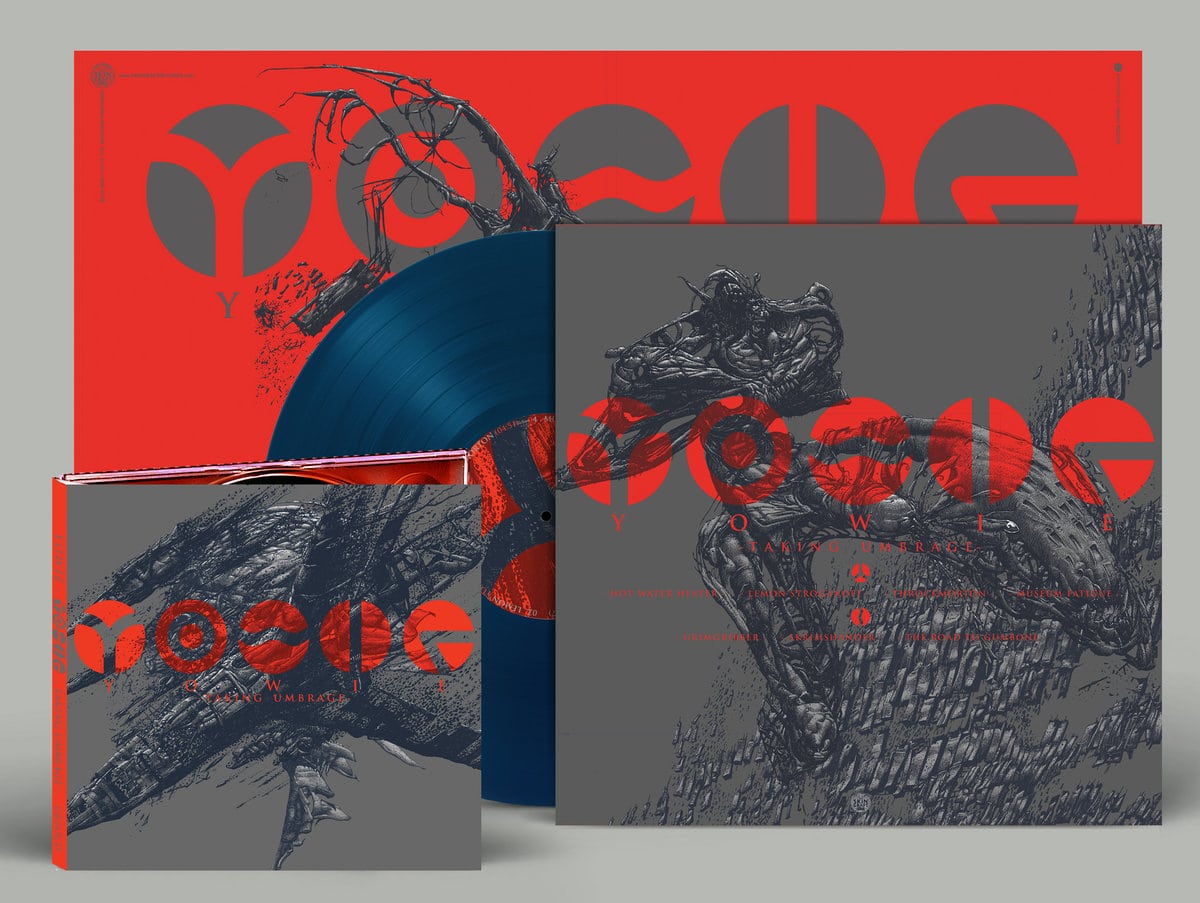
Live vs. record: the LP and digital sequences differ — how do you design narrative per medium, and what does vinyl demand that streaming can’t handle?
Jack: We wanted the listening experience to be more balanced on each side for our record. It was a long conversation but I think what we landed on was great.
Daniel: Yup, basically just a different track order to accommodate the format yet still make sense as a sequence.
Twenty-five years with SKIN GRAFT is a marriage by underground standards — what has that long trust enabled you to attempt that a newer label would have talked you out of?
Defenestrator: Skin Graft has never talked us out of anything, except for releasing our first album with no title, artwork, or song names (because Skin Graft is just so darned conventional and oppressive). We have had total artistic freedom, and I really couldn’t imagine it any other way. Perhaps I am spoiled, and/or incredibly lucky, but I nearly certain that if a label tried to roll up and tell me my bidness I would be out. See the aforementioned stubbornness.
You did a split with PILI COÏT and previously tangled with DAVID YOW lore by way of THE JESUS LIZARD family tree — what did those collaborations recalibrate about your own boundaries?
Defenestrator: The one with David Yow was unique because it is our only recording that has a human voice. It in some ways was not unlike our AC/DC “Dunderdruck” adventure, in that we were not creating everything ex nihilo, but were interacting with something outside the band. With Dunderdruck, we were interacting with a song in conceptual form, and with David Yow, we were interacting with this very specific recording of his voice. It was a fun experiment, and you will hear a lot more of it when the David Yowie album comes out in 2039. Pre-orders are up now.
Art direction matters for music this architectural — what did ARNULF ROEDLER’s visuals lock in about the record’s geometry that the mixes alone couldn’t carry?
Defenestrator: It’s funny- as the person least concerned with album art (at first) for this band- like literally, “We don’t need that,” Arnulf’s art really changed my mind. His art is captivating, and has an obscene number of lines/strokes that allow you to essentially appreciate it at different distances/depths of magnification. I would say when Yowie is at our best, we strive for some aural version of that experience.
There’s microtonal DNA in JACK’s background with BASIL’S KITE — where does that slip into “Taking Umbrage” in a way a non-theory listener would still feel?
Jack: Prior to me joining, Yowie was already a microtonal outfit just in a completely different way to the way I use microtones. I played around with the idea of doing this record on a 17 tone guitar but inevitably decided to stick to 12, as the music demanded a certain athleticism that just wasn’t possible on my janky hand fretted guitars. There was a moment where I put on a just intonation b7 #11 chord but it didn’t make the final cut.
Daniel: My “blue notes” are often accidentally microtonal, largely we are 440 12-tone based and *sometimes* even a tonal center- but that’s where the “normality” ends.
I’m curious about restraint: tell me about the simplest, most air-filled 10 seconds on the album and why you refused to decorate it.
Jack: 3:12-3:20 on Grimgribber, just a breath to put some emphasis on the next section. Really nice when playing live as well to be able to pull out my favourite Yowie rock n roll stage move I call ‘gently swaying side to side’.
Daniel: Going back to skrimshander- 0:55-1:04 you ALMOST make it to 10 seconds of introducing the theme before we only ever screw around with it from then on.
Europe run incoming — beyond the logistics nightmare, what’s the one ritual you’ve built to keep a touring day from flattening your brain before showtime?
Jack: I forget to eat on tour and end up losing extreme amounts of weight. I lost 5kg (11lbs) in America. This tour, I’m hoping to keep myself stuffed with waffles and bread and cheeses to keep my nervous system in check.
Daniel: Practice is the secret to playing music good as well as quelling anxiety.
Defenestrator: I noticed Jack was losing weight while recording, so I had to gain a bunch during that process so that the band didn’t drop a weight class. There were a lot of Belgian beers involved, but it was worth the sacrifice. You’re welcome, guys.
Let’s talk cities: what does a great YOWIE venue look like from the stage — ceiling height, PA voicing, crowd proximity, any “odd-time-friendly” acoustic quirks?
Jack: At all times we need perfect dry unaffected sound, we are forced to be extremely anal about sound otherwise it all falls apart.
I love a math rock crowd in all its strangeness, some moshing, some still, someone with their arms crossed looking pissed, a tall man with a beard having the best time of his life. For me there is always a feeling of being amongst friends.
It’s important to me to be warm in the room where I’m playing. It was so cold in North America in winter I couldn’t feel my fingers, my country gets hot but not very cold. Maybe a private room where I could have a nice bath would be good, or even better a sauna. I’ve heard Europe is extremely courteous for artists. Maybe I’ll add a sauna to the rider.
Daniel: I love a good medium-sized venue with lots of stickers on the walls in the bathroom, a talented sound-person at the helm, a few seats for folks who need them (otherwise standing room only)
Defenestrator: To be honest I prefer a room with no stage, with the amps set up behind me, and guitarists to my left and right, so you can draw a straight line between us. Bonus points if the crowd can encircle the band (aka be “behind” the band). Fuck a fourth wall. And the 1st-3rd too.
St. Louis roots first — who’s quietly pushing your hometown forward right now, venues or artists, that deserve more oxygen?
Defenestrator: Man, I would say The Conformists have consistently gotten 1/87th of the credit they deserve for a few decades now. There are some great bands here now; Van Buren, Zantigo, Subtropolis, Fister, and Furnace Floor all leap to mind.
While we’re mapping scenes, give us a quick field report: one PHILADELPHIA act and one WOLLONGONG (or broader AUS) act you discovered in 2024–2025 that wrecked you, and why.
Jack: It’s gotta be Milton Man Gogh from Brisbane/Melbourne. Truly one of Australia’s best bands right now, if you get the chance to watch them live don’t miss out.
Daniel: In 2024 I played a show on bass with my college pal who makes very strange music that I got more familiar with for the occasion; it definitely “wrecked” me and it’ll “wreck” you too- George Korein and the Spleen. (You’ve heard of “outsider” music- this guy makes Daniel Johnston seem like Whitney Freakin’ Houston)
More 2024–2025 recommendations for heads who live on the edges: a couple of US names, a couple of EU names — the stuff you put on in the van and then everyone stops talking.
Jack: Daniel showed me so much great music but out of all of it I deeply resonated with Behold the Arctopus. Something I tell myself when all of the news of the world gets too grim and unbearable is that I am lucky enough to be living at the same time as Behold the Arctopus is making music.
I also adore Balinese Gamelan music, I’ve listened to Cudamani Gamelan ensemble more times than I can count. I love that just across the ocean from me is this extremely old, extremely unique musical tradition. For anyone reading, if you like Yowie stop what you are doing and look up ‘Kebyar Perak sikedek’ on youtube.
Indonesian gamelan tends to be really slow, purposeful and royal sounding. Balinese Gamelan is an entirely different beast, extremely loud, quick dynamic shifts, dense polyrhythms, huge sudden tempo shifts. I hope I can get over there and watch some someday, or maybe even take the band and make a tour of it.
Daniel: Of course there will be a certain percentage of Longmont Potion Castle listened to on this tour.
For fans of Yowie, I definitely recommend the full discography of the band Idiot Flesh. Most people are not familiar and it’s tough to find, but worth it.
Defenestrator: For the van I will likely want a great deal of Tom Ze, Clipping, Goat (the japanese band), The God Awful Truth, Imelda Marcos, Ni, and Rong.
If you had to teach “How To Hear YOWIE” as a 30-minute workshop before the show, what are the three exercises you’d make the audience do?
Jack:
Step 1 – I demand everyone give me their phones, I put them all in a large sack and slam it against the wall.
Step 2 – I put on the film Rem Lezar.
There is no step 3.
Daniel: 1- please eat a good meal one-two hours before listening 2- this is only for those who love music- as opposed to hair, fingernails, lyrics, sleight-of-hand, tapdancing etc etc- so maybe come into it with some background appreciation for music as an “art” form 3- explaining it won’t make you like it any better or worse. You don’t have to figure it out. Just listen & enjoy
Defenestrator: Do not analyze the music. Do not think about the music. Turn off that part of your brain entirely. We are doing all the cognitive processing for you; that’s what you paid us the big bucks for. Let your analytical mind clock out and have a break for like 45 minutes.
Final selfish ask: if “Grimgribber” is the door, which track is the attic and which is the basement — and where should a curious listener go snooping first if they want to get lost on purpose?
Jack: Lemon Stroganoff is both the attic and basement at the same time. Throckmorton is the first track I’d offer to any new listener.
Daniel: I’ll go Attic= Throckmorton … Basement= Road to Gumbone … lost destination= Museum Fatigue … Outhouse= Creating Rem Lezar
Defenestrator: “Hot Water Heater” is the door, but “The Road to Gumbone” is a hidden room in the basement that your older cousin is super pissed you found because it has a lot of black light posters and roach clips in it, but he wants to make sure you don’t snitch, so he lets you hang out there, and you develop a big crush on one of his friends who, yes, is a lot older than you, but you are smitten anyway, so when the bong is passed to you, you try to act like it’s something you do all the time but you overcommit and end up in a really bad coughing fit and reach a sort of trance state listening to everyone’s laughs become distorted and start to turn into colors and then you wonder how laughs can become colors. And “Museum Fatigue” is the breakfast nook.