

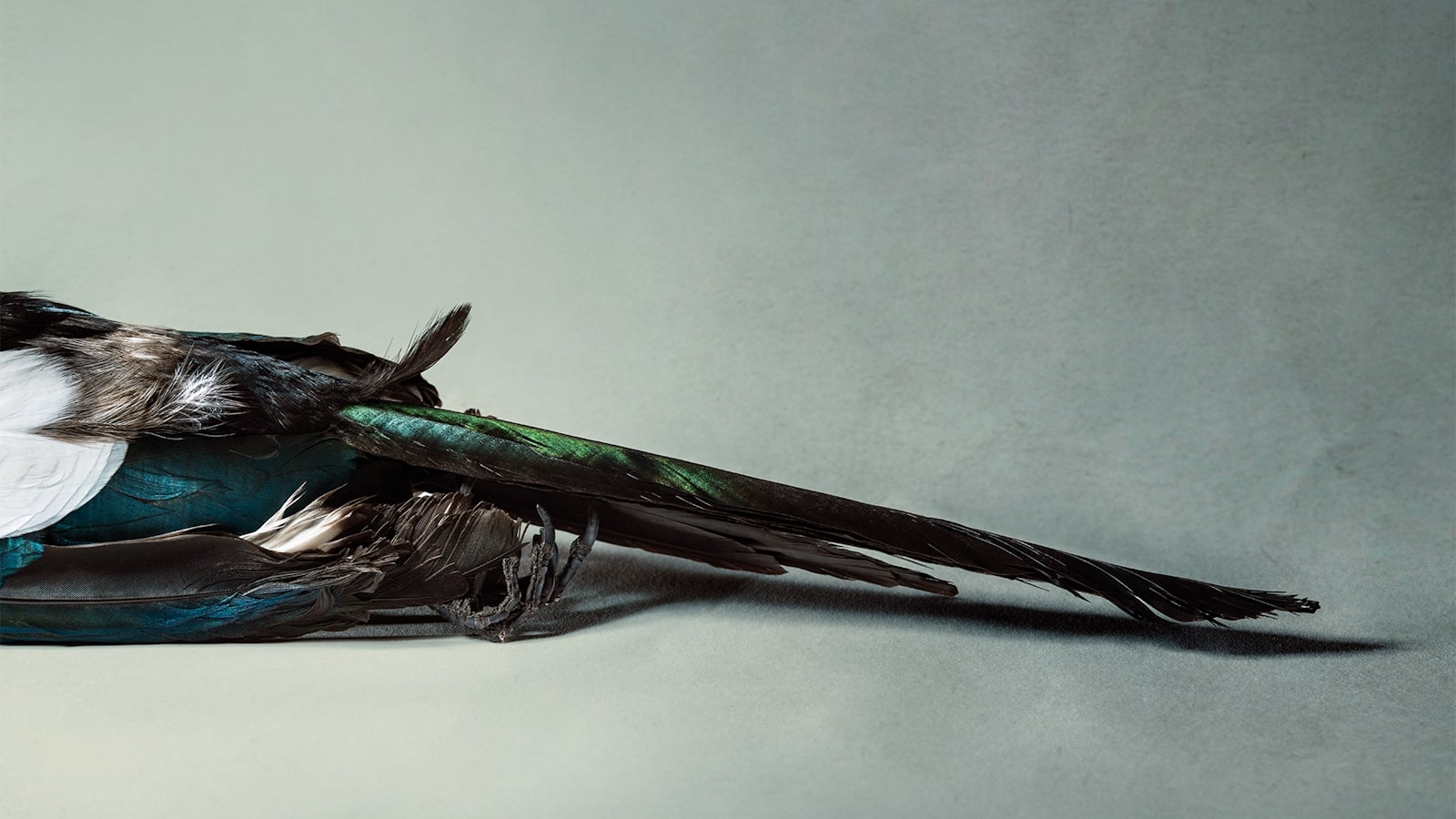
Most things like this don’t start in a studio. They start on a quiet street, early enough that nobody’s watching, with a bird lying perfectly still on the pavement. Lucynine saw the magpie, newly dead, preserved like someone had pressed pause.
He took it home, lit it with softboxes and colored gels, and built a whole photographic limbo around it. That bird ended up staring out from the six-panel digipak of “Melena,” released October 3rd through Talheim Records.
The record leans into post-black metal’s sharpness, but it doesn’t stay rigid.
There’s crust stomp in the joints, synthwave orbiting the edges, and those Italian vocals tucked deep in the mix, like someone yelling from the next room.
The negativity is blunt and unadorned, and nothing here tries to soften the blow.
View this post on Instagram
The single “Oltre la soglia” follows a man who’s burned through every sentimental tether he ever had. When nothing holds you, you don’t drift — you harden.
He redirects frustration into violent anger and a warped brand of self-love, warning others to fear the product they helped shape. The track’s ending folds into a slow, heavy breakdown, not triumphant, just exhausted.
The visuals didn’t arrive by accident. “To make a living, I work as a photographer,” Lucynine says, adding he puts music on the same creative level, even if the camera pays more bills. “Every time I compose (or listen to) music, an image always forms in my head. In fact, sometimes my music actually starts from an image. An image that becomes sound.” There’s no clean separation — one leaks into the other.
Before the magpie, there was a pigeon, run over outside his home, half-decomposed and smeared into texture against asphalt. That became the cover of the single “Narciso non muore.” It reads like a pattern in the chaos: roadkill, but with detail if you bother to look.
The magpie carries more weight. Strict monogamy linking quietly to depression. Messenger of the gods in Norse mythology. A sign of mourning across the British Isles. Witchcraft in Scandinavia. Put together, they shape something that feels patient and inevitable. “I couldn’t have asked for better,” he says.
There’s a strange calm to the way it’s shot. “A formal elegance — subtly echoing the gentle sound of the name Melena — stands in stark contrast with its real meaning,” he explains. And when you look at it, you understand. It’s not bathed in clichés. No black-painted skulls. No gothic font to tell you how to feel. “Sometimes it’s not necessary (or can even be counterproductive) to resort to the usual black, dark, gloomy stereotypes to express something negative. I like the meaning not to hit immediately, but to emerge after a moment of thought.”