
The new album “Two Stories of Resemblance” by Mademoiselle Plume Rouge lands on Bandcamp via Signora Ward Records with a clear structural intention: a diptych split into two narrative arcs, each grounded in a different philosophical and aesthetic source.
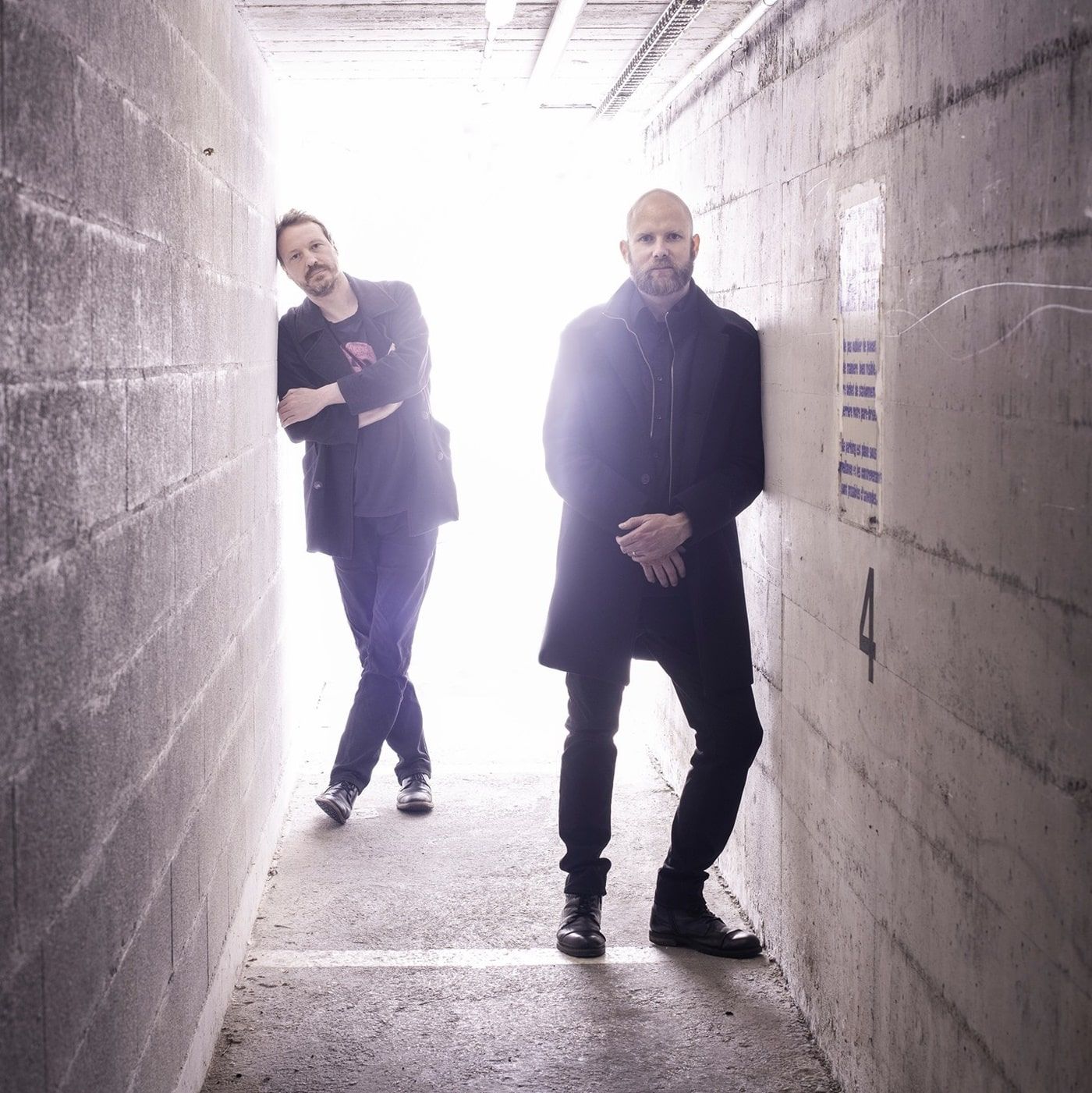
The duo — created in 2018 by Stéphane “Povitch” Augsburger (electric guitar, sampled voices) and Frédéric Minner (electric bass, soprano saxophone) — approaches this record as a focused extension of the work they have explored since “Junkie Movie Music” and “Horror Politics.”
Recorded, mixed and mastered by Davide Cristiani at Bombanella at Groundfloor Studio in Modena, and co-produced by the band and Cristiani, the album pulls together doom metal tension, contemporary composition, dark jazz, free jazz, fragments of noise, psychedelic drift, and Japanese traditional motifs.
The first part of the diptych sets the tone through the tracks “Dead” and “Undead,” both woven from a Zen story told by Taïsen Deshimaru in “L’Esprit du Ch’an.” It’s the story of Master Dogo and his disciple Zangen attending a funeral ceremony; at the coffin, the disciple strikes it and asks, “This, is it dead or alive?” Dogo answers, “Alive or dead, I cannot say.”
The exchange continues on their walk home, with the master repeating, “Alive or dead, I cannot say,” as Zangen increasingly demands clarity. After Zangen finally hits him, Dogo excommunicates him according to temple rules, and the disciple reaches enlightenment shortly after.
The duo interprets the narrative as a demonstration of the limits of language in Zen: the idea that conceptual explanation breaks down when dealing with subtle states of consciousness. Their own framing of it is straightforward: communication between master and disciple must occur “from mind to mind directly,” without conceptual scaffolding. With what they call a “playful state of mind,” they twist the parable into a ghost story about death and reanimation.
View this post on Instagram
The opening of “Dead” lays out this shift clearly. A solitary, disassembled saxophone theme signals a funeral procession, followed by Gertrude Stein reading fragments of “If I Had Told Him a Completed Portrait of Picasso,” repeating variations of “If I told him would he like it.” The piece builds through an obstinate doom-metal guitar and parallel saxophone lines, while mourners’ voices rise above the pulse. It ends with Stein’s voice speaking of “exact resemblance,” which the duo notes ties both to the Zen narrative’s cyclical nature and to their own compositional choices: repetition, dissociation, and patterns that echo but don’t fully resolve. “Dead” functions as a sound-driven reflection on the story’s metaphysical tension rather than an illustration of it.
“Undead” continues the arc with hypnotic bass motives at both low and high frequencies, punctuated by percussive hits from tom floor and tingsha — Tibetan cymbals that push the mood toward ritual. They describe the first half as “a procession of degenerated monks… carrying a corpse to reinstill life in them.” The midpoint becomes a darker ritual space, and the ending locks into a repeating melody on guitar and bass that frames the moment of reanimation as both “joyful but frightening.”
The album’s second story — “Crystals in Color” and “From the Realm of the Crystals” — shifts from metaphysics to natural processes, refracted through eco-anxiety and archival science. Both tracks were written as soundtracks for Jan Cornelis Mol’s 1927 silent films on the crystallization of substances like boric acid, uranium nitrate, and caffeine. Mol’s films show chemical processes that the human eye can’t register unaided; the duo points out that the accelerated imagery makes the crystals appear like “strange plants, a groping, organic life form.” The visual effect becomes a pivot for their writing: the music aims to treat these films not as scientific documents but as abstract, aesthetic movement — nature performing its geometry like an accidental painter.
“Crystals in Color,” the colored version of Mol’s footage, opens with an atonal bass improvisation surrounded by unintelligible voice fragments and processed ambient sounds, including water recorded with an ambient microphone and pushed through effect pedals — an approach they credit to Cristiani. A lone saxophone introduces a more concrete theme later, with percussive gestures inspired by Japanese traditional music that nod back to the first half of the album. The final section cycles the atonal bass back in, with a second saxophone entering in canon. The track’s shape mirrors the films’ branching crystallizations: expanding, hesitating, collapsing, restarting.
“From the Realm of the Crystals” takes the abstraction further. Each section corresponds to a substance shown in Mol’s film, with shifts marked by spoken words from poet Irina Hrinoschi, who names each material. The track uses repetitions, micro-variations, ruptures, and density changes that recall Ligeti, Berio, and Cerha, while also bringing in long-vibrato saxophone lines tied to Japanese musical aesthetics. It’s the piece on the album where the contemporary composition influence stands most clearly on its own.
The title “Two Stories of Resemblance” pulls from Stein’s “If I Had Told Him a Completed Portrait of Picasso.” Her poem, dedicated to Picasso, attempts through language what Cubism does visually: breaking, repeating, shifting perspective through formal means.
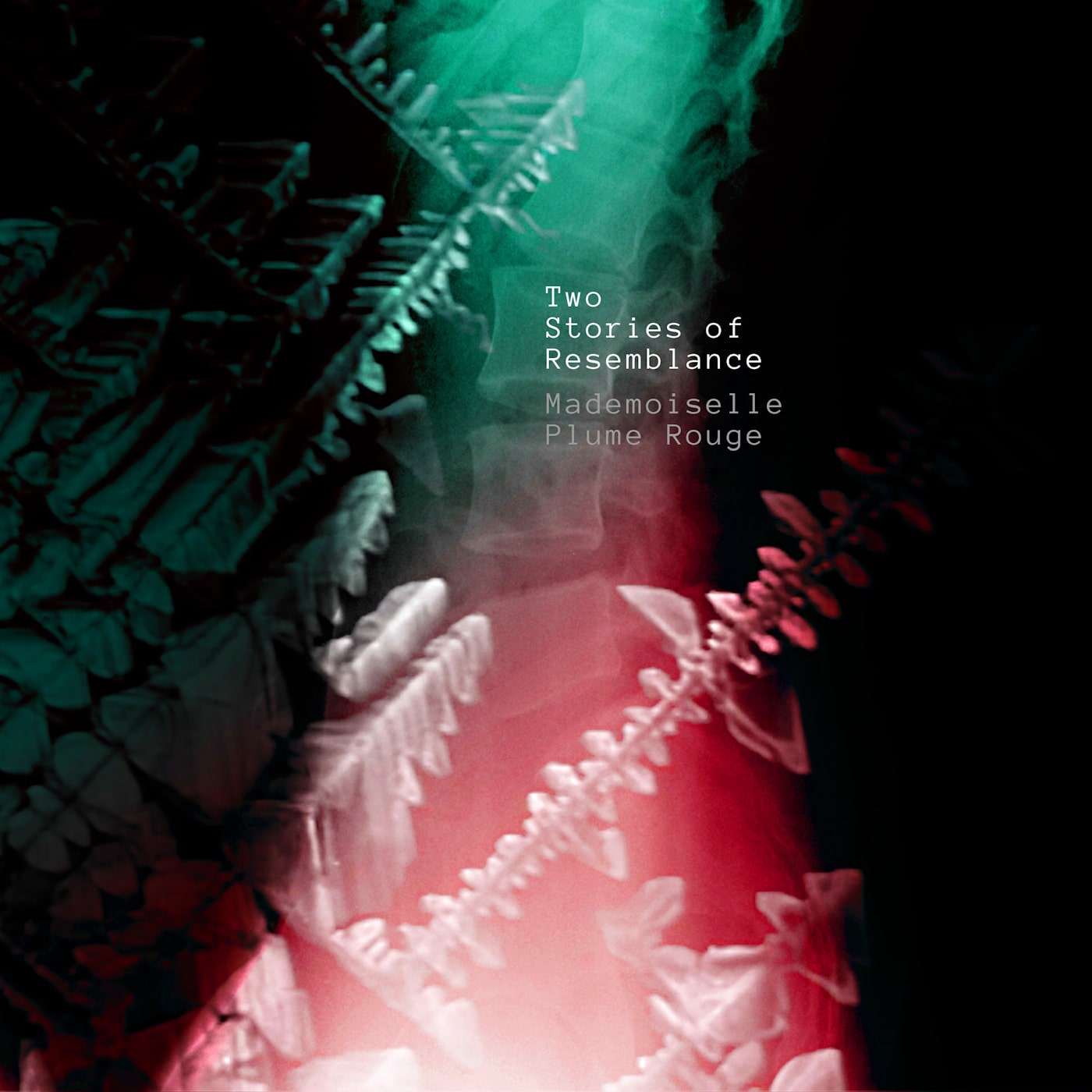
Excerpts appear in “Dead,” strengthening the connection. The duo notes that the four tracks apply Stein’s principles — repetition, micro-variation, rupture, dissociation — not to text but to sound. The cover reinforces that link by juxtaposing a human spine with images of crystals that resemble bones, tying death and natural formation together without collapsing them into a single meaning.
Across the record, Mademoiselle Plume Rouge work less like a band in a traditional songwriting cycle and more like a duo shaping a conceptual structure with sound. They link Zen metaphysics, Stein’s Cubist approach to perception, and Mol’s crystallization films without smoothing the differences between them. The album stays cinematic, abstract, and grounded in specific references that shape the music directly rather than metaphorically. It’s an unusually clear articulation of how philosophy, literature, and early scientific cinema can align inside experimental music without turning the concept into the main event.