


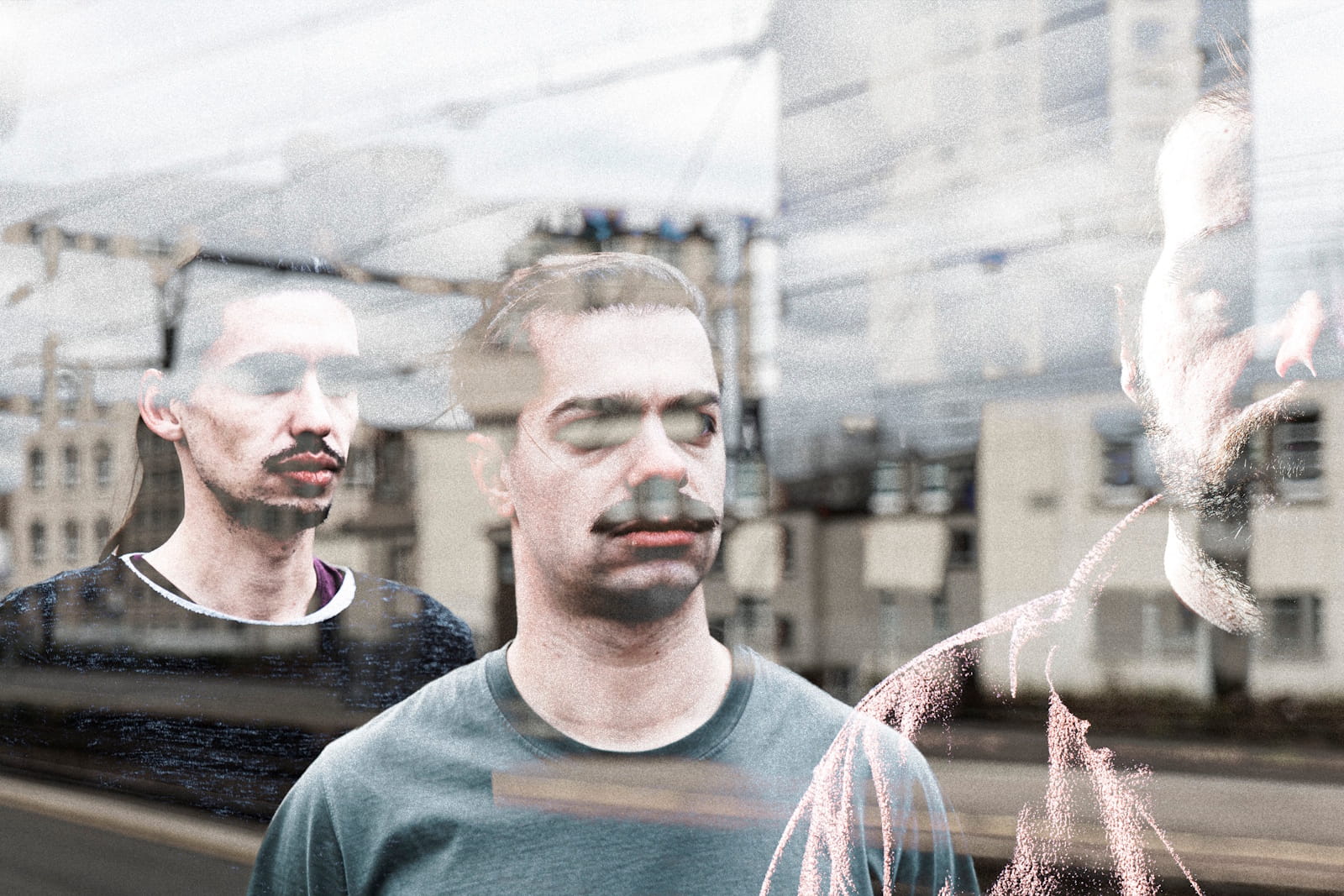
Eleven tracks, eleven angles on the same collapsing city. Ko-ma’s debut album “Anthropolis“ — out now via Kinsfolk, Ma Saret, Tout Doux, No Need Name, and Coeur sur toi — is a double LP built around a single connected narrative.
Each song follows a different character inside a fictional urban sprawl where greed, fear, and small compromises stack up until everything buckles. The Tours-based post-hardcore trio (Eliot Remblier, Léonard Szakow, Pierre-Louis Geslin) spent months carving this thing into shape, and the result plays less like a record and more like a political thriller set to noise rock.
We premiered the first single “N.Fit” back in November. That track introduced the album’s register — a selfish politician hiding private rot behind a polished mask, his cruelty driven not by ideology but by “fear from someone else, love and admiration for this same person.” Now, with the full record in hand, it’s clear “N.Fit” was only one tile in a much larger mosaic.
The band has it: “The album is a story displayed throughout eleven tracks, a series of various and antinomic characters. Still, something binds them together: their city, a network of which they’re both victims and instigators. An entity both cold and warm, far and close, concrete and intangible; a machine fated to collapse.”
The name itself is a compound joke with serious legs. “It’s a pun between Anthropology (the scientific study of humanity) and Polis (which means ‘city’ in Ancient Greek).” What unfolds is something the band previously described as “a dystopian and enigmatic essay on the human condition in contemporary Western cities” — mafia networks, police investigations, ecological and health scandals all tangled into a single storyline.
“I.Light,” the opener, drops the listener straight into chaos. “We wanted the listener to arrive in the city right in the action — like they’ve lived there for years before the music even starts,” the band says. The narrators here aren’t revolutionaries. They don’t carry ideology or solutions. “They only have fatigue, envy, grief, and the feeling that history cheated them. They inherited promises that never materialized — better lives, dignity through work, stability — and they’re watching those promises decay in real time.”
The repetition in the lyrics — “Take / Blame / Yell / Bet” — is deliberate. Mechanical, almost ritualistic. “Violence begins as language, then gestures, then collective chaos. The riot isn’t political as much as emotional — people trying to feel alive or visible.” And the contradictions are baked in from the start: wanting solidarity while resenting each other, hating the powerful while wanting to be them. The city appears immediately as a system that traps everyone into roles they only half-understand.
By “R.Pressure,” the fourth track, the album shifts from collective rage into individual narrative. Kate, the song’s narrator, is pragmatic. Almost clinical. She sees the system’s rules and decides to play them better than everyone else. “While writing this, we were thinking about how exploitation can feel empowering before it destroys you,” the band explains. “She doesn’t initially see herself as a victim — she feels powerful, useful, necessary. Money becomes proof of existence.”
The turning point isn’t crime — she’s already crossed moral lines long before. It’s attachment. Evan, her best friend, is the only thing still connecting her to humanity, and saving him forces her to confront the part of herself she buried to survive. Her arrest, paradoxically, reads as liberation. “Prison removes her from danger and from the system she tried to master. It’s the first moment where consequence becomes unavoidable — fate entering the story not as punishment, but as emotional awakening.” The band notes that this track deepens into the more narrative aspect of the album: “The heart of the story begins here, previous tracks serving mainly as context.”
“A.Genic,” track nine, introduces Tony — the album’s main antagonist. But Ko-ma didn’t want theatrics. “The scary idea behind this track was: what if the villain is simply the most rational person in the system?” He doesn’t poison the city out of hatred. He does it because maintaining the illusion is easier than admitting failure, because he’s desperate and can’t see another way.
His transformation isn’t sudden. “It’s administrative. Paperwork, classifications, small compromises. Violence appears almost accidentally, as if humanity just slips away when efficiency becomes the only value left.” This is where, as the band puts it, the album’s central truth surfaces: “The city isn’t collapsing because of one villain, but because every character, at some point, chooses self-preservation over responsibility.”
“S.Down,” the closer, runs over eleven minutes and has no clear narrator. “The voice could be the city, fate, collective guilt, or simply the echo left after everything breaks.” After all the individual stories, the track zooms out. The realization is uncomfortable: nobody was purely controlled by the system — they also sustained it. “The toxic relationship described in the lyrics works both romantically and socially. Everyone expected meaning, justice, or love in return for devotion, but the city was never capable of loving them back.”
But Ko-ma are careful to note this isn’t nihilism. “Collapse is also release. Once the structures built on greed and fear fall apart, something else might emerge. The younger generation represents that possibility: people who inherit ruins instead of promises, and therefore might finally build something different.” The album ends not with answers, but with space — “the silence after impact, where renewal becomes imaginable.”
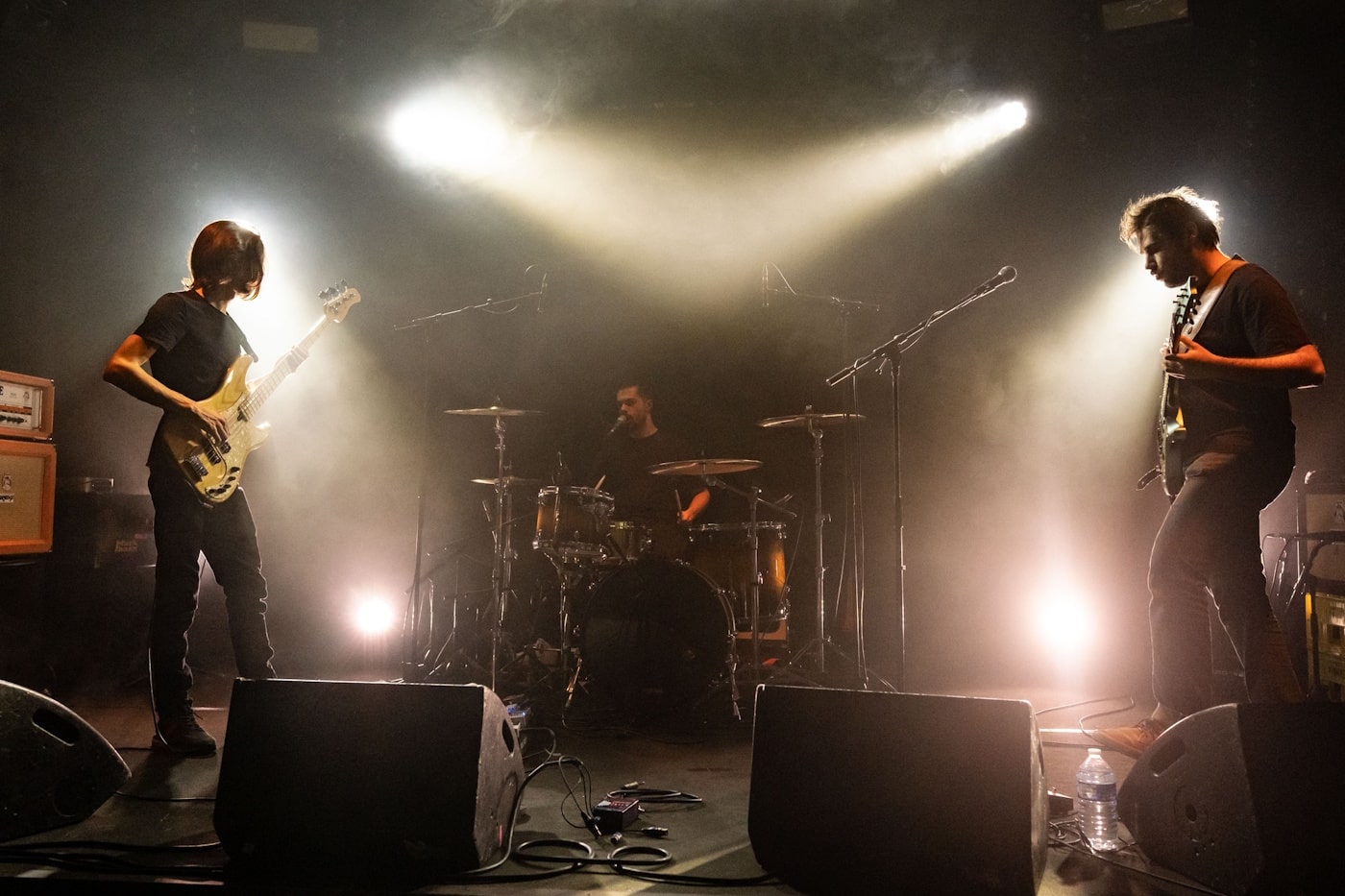
The five-label co-release is unusual but practical. “This record is a double LP which needs quite a lot of money to produce vinyls,” the band explains. “The pressing is twice as expensive as a regular LP and we only work with small labels that don’t have a lot of money to operate. It was a necessity for us to gather several labels to press this record on vinyls, but we’re also glad to work with all this network of individuals, true DIY records that carry the same spirit as ours.”
It’s also how things tend to work in their corner of the French scene. “There are lot of micro labels in France, often carried by a single person, and they usually know each other quite well, making a lot of partnership in order to press the records they want to support.”
Ko-ma love their city, but “Anthropolis” wasn’t drawn from it directly. “It (luckily) did not really inspired us for the album. What inspired us is large occidental cities in general, especially industrial ones. Tours is a bit too small and not really much industrial.” Still, social and political echoes are unavoidable — “in Tours and everywhere in Europe, America and beyond.”
Musically, Tours punches above its weight. “Though quite small — the city is 140,000 people — it’s very rich and flourishing. Lots of bands and genres are represented, in rock, punk and hardcore but also in jazz, electro, rap and pop.” For their specific scene, though, the context is national: “There’s only a few post-hardcore and noise rock bands in each cities, we need to tour in order to play shows regularly.”
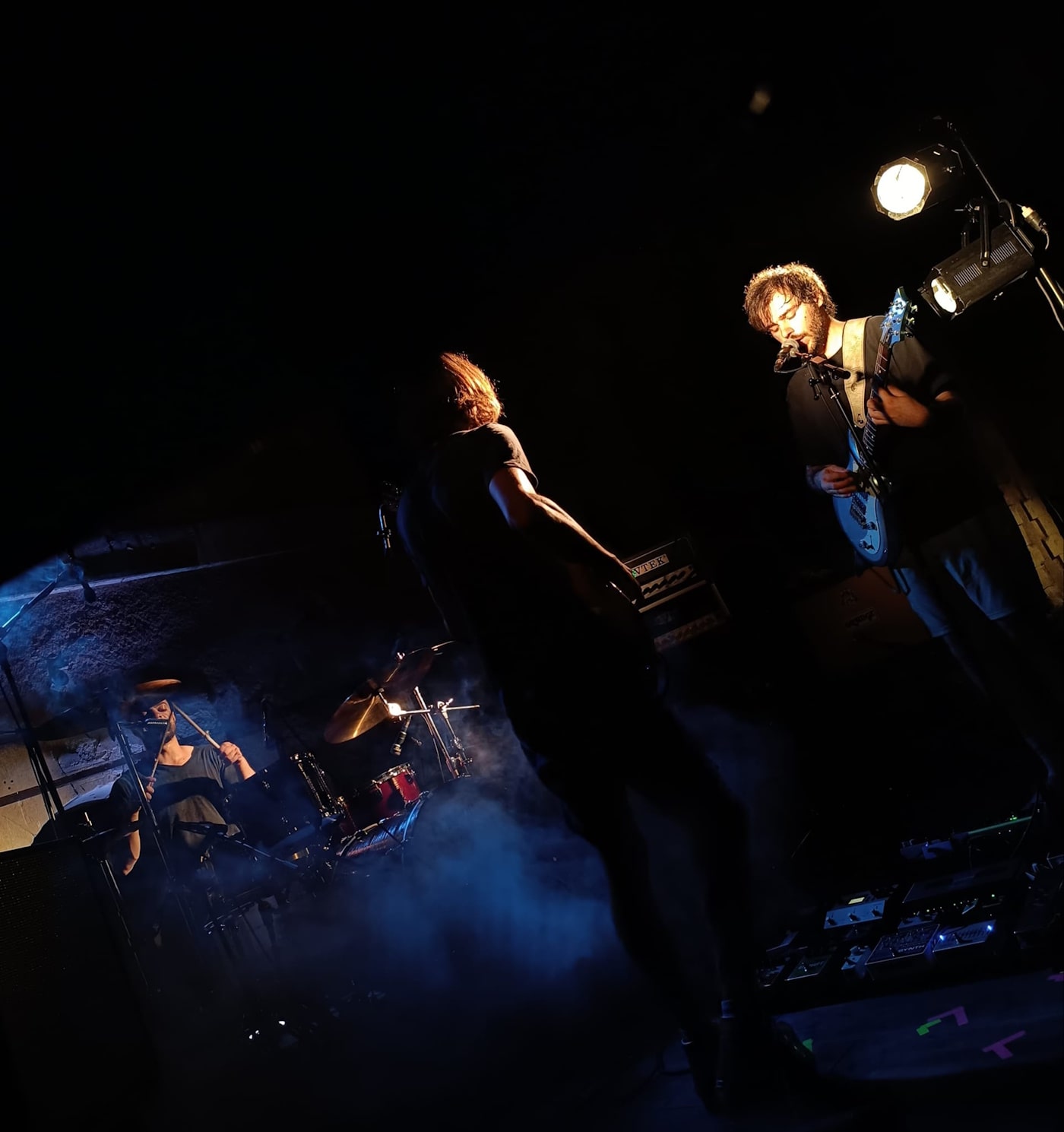
The album’s artwork, created with graphic designer Adeline Dadon, reinforces the concept — a human face assembled from urban elements, mostly black and white, accented by colors “referring to natural elements, such as fire, water, earth — something primal and wild amongst the very urban and industrial elements.” The band encourages looking closely: “There’s a lot of details to find.”
“Anthropolis” was written, composed, and played by Eliot Remblier, Léonard Szakow, and Pierre-Louis Geslin. Recorded and mixed by Remblier at EMHR Studio, mastered by Thibault Chaumont at Deviant Lab. Available now on CD and digital via Bandcamp.