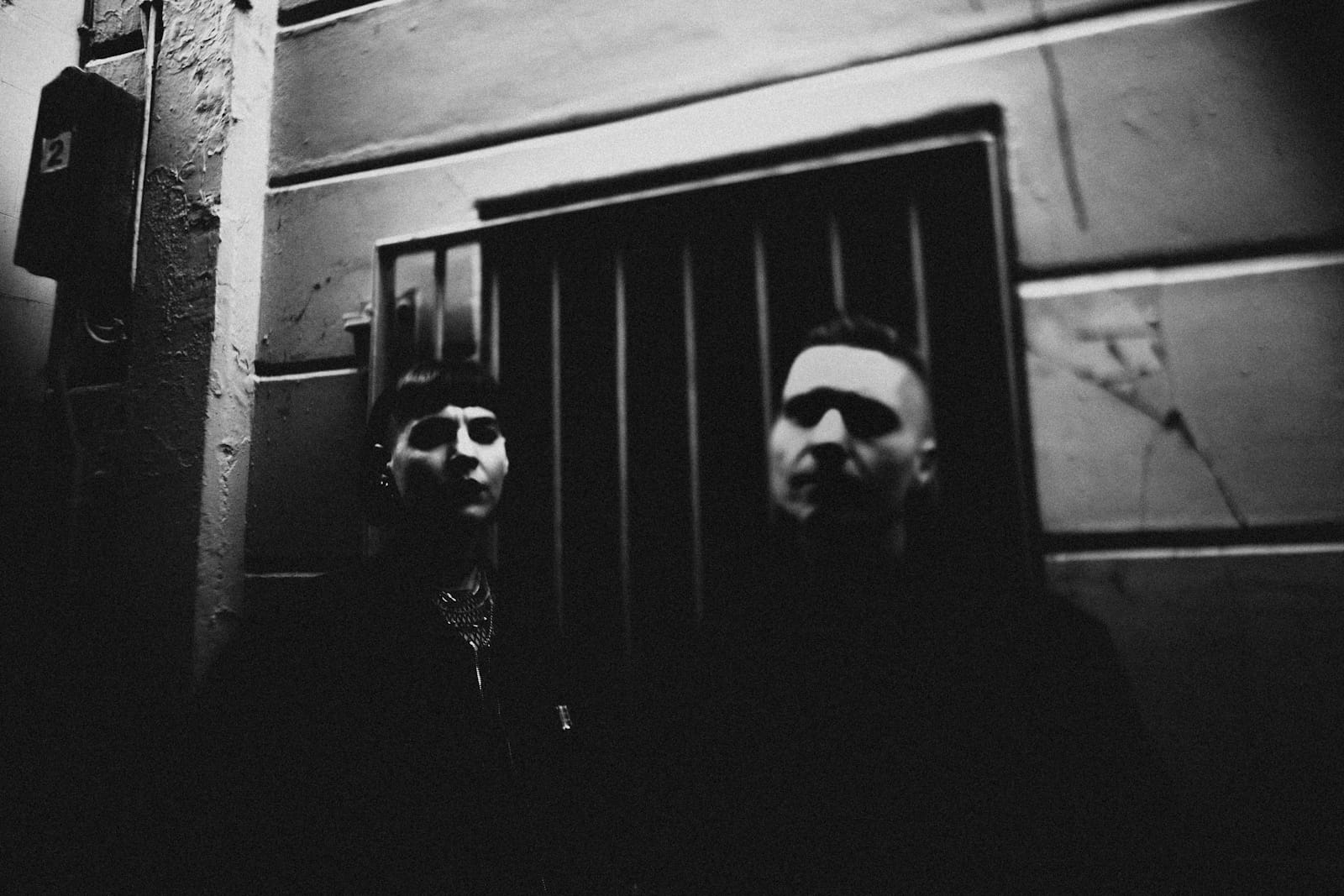

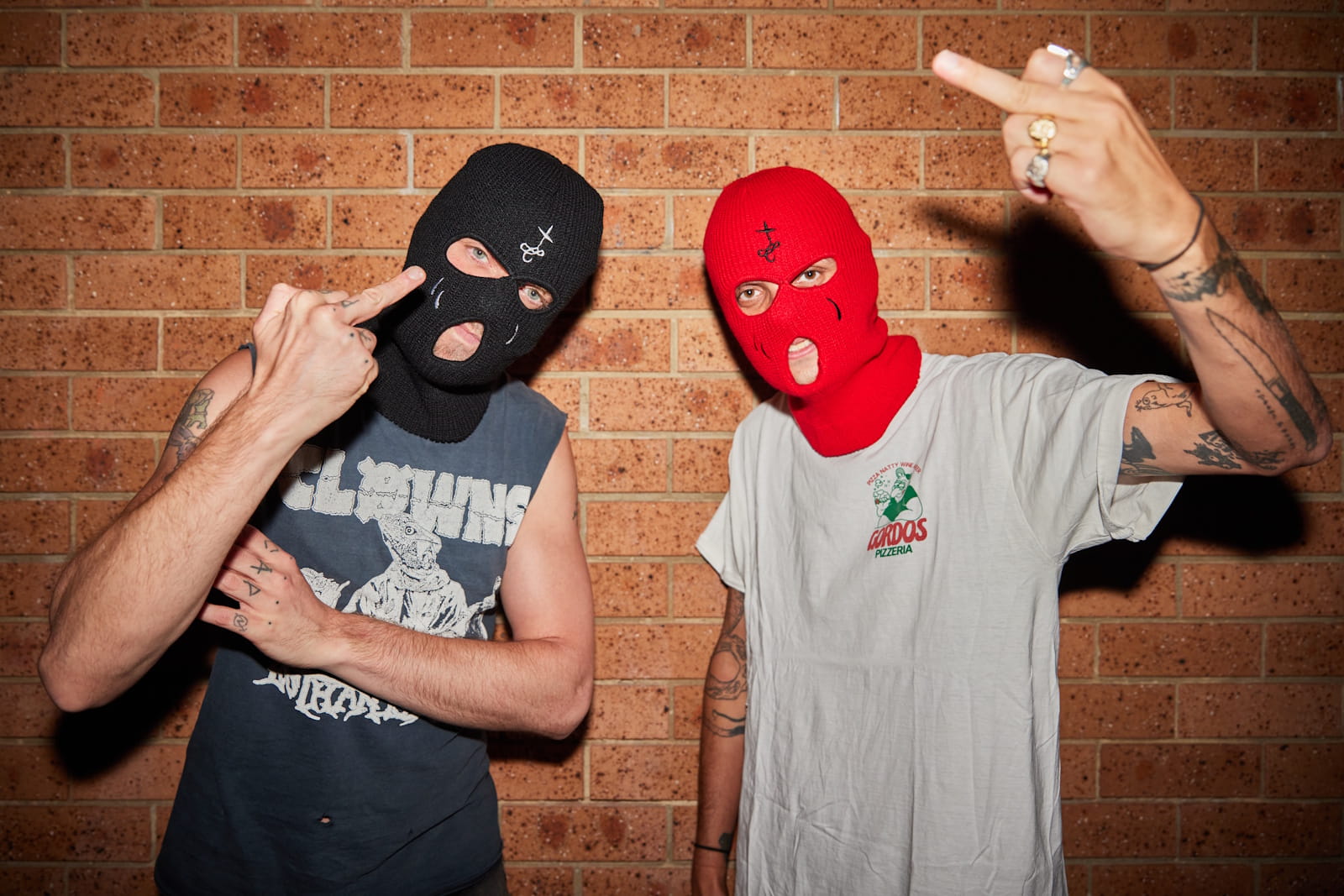
Sydney two-piece Marrickvillainz didn’t set out to start a band. They barely set out to make a record. What they ended up with is “It’s A Band, Not A Bánh Mì” — eight tracks of sludgy, grungy punk recorded over three chaotic days in Brisbane, finished over six months of getting drunk in a bedroom in Sydney, and held together by a two-decade friendship, a bunch of mates who happened to be around, and a flat ‘no’ to do things properly.
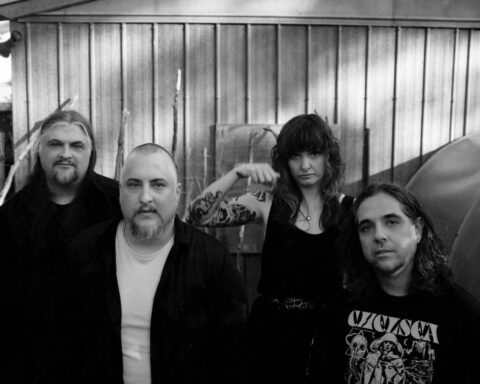
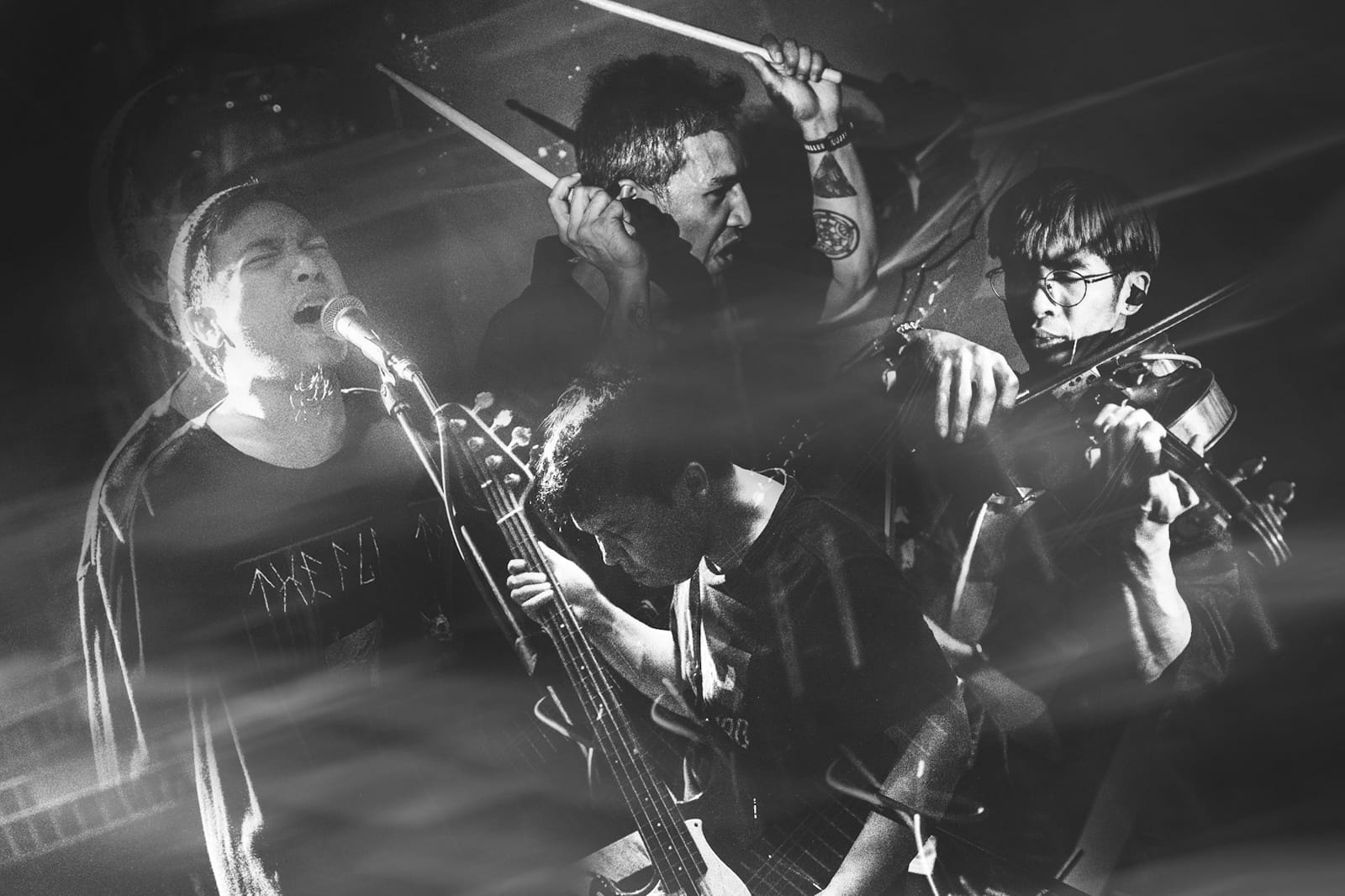
The band is Wome on vocals and drums, Smorg on vocals and guitars, and eventually Nathan on bass — though Nathan didn’t join until after the record was basically done. There’s no bass on the album at all. What sounds like low end is actually Smorg’s guitar run through a split signal and an Electro-Harmonix POG octave pedal, pitch-shifted down. The whole thing was tracked at a studio in Brisbane run by Seany D from Thy Art Is Murder and an engineer called Dan — “Daniel the Manual,” as the band calls him, “because he’s an absolute weapon of an engineer. But like all those weapon engineers, he’s a bit of a grump.”
The backstory is better than most band origin myths because nobody wanted it to happen.
Smorg had stopped playing in bands entirely. His previous project had imploded, Covid happened, and he’d spent the downtime practicing guitar on his own terms — chord progressions, harmony, composition — with zero intention of doing anything public with it. “I told him I wasn’t really interested in doing anything tbh,” he says about Wome’s initial pitch to keep making music after a loose jam at a house party where both of them were, in his words, “super fucked up.” Wome backed off, but the space he gave ended up being the thing that brought Smorg back in. They jammed as a two-piece for about six months, working through songs Smorg had been stockpiling without any real plan.
Seany D, who used to crash at Smorg’s place between Thy Art tours, heard what they were doing and offered his new Brisbane studio. So Smorg and Wome drove north over New Year’s to record. The trouble started before they even left Sydney.
Wome went up early, staying with their mate Cam in Brisbane. A drunken argument got him kicked out of Cam’s house on Christmas. “He was hysterical and all over the place, saying he was gonna fuck off back to Sydney and that he hated Cam and the whole thing was fucked,” Smorg recalls. “I remember just being super stoned at my ex-girlfriend Katie’s house thinking this was a stupid way to start the recording process.” Katie and an old friend of Smorg and Seany’s, Mislav, drove up with Smorg as morale support. They regrouped in Bangalow, stayed at a house where one of the residents sold mushrooms, ate a bunch of them on New Year’s Eve, and eventually made it to Brisbane having already been partying for days.
At the studio, things got worse before they got better. Dan and Seany D wanted to track everything to a click. Smorg agreed. Wome, it turned out, does not play to a click. “Tome isn’t a metal drummer — those guys do things by the book with super precision — Tome is a punk to the core,” Smorg says. The first session was spent trying to get “Brizvegas” down to a metronome with Wome hungover and everyone’s mood sinking. The studio crew started saying they wouldn’t have time for a full album — maybe one or two songs.
Smorg walked out with Mislav to a gaming bar called Netherworld, got a burger and a cocktail, and sat there playing The Simpsons arcade game feeling like he’d ruined everything. “I remember sitting there with Mislav while we were playing The Simpsons game, just being like, ‘I’ve fucked this up.'”
A few cocktails later, something shifted. He called Wome: they were scrapping the click track, he’d bought a case of beer, and they were doing it their way. Wome was reluctant — they’d already burned hours on the failed session. Smorg told him to trust him. “This whole record is supposed to be about having fun and hanging out with our mates, and it’s turning into a fucking joke and a nightmare. Fuck all this shit.” He handed Wome a beer and told him to take some drugs. “Tome was like, ‘Shit… Maybe I’ll take some drugs!’ I was like, ‘Definitely take some drugs, dude. That’s a really good idea.'”
They took speed, got in the room, told Dan and Seany they were starting over. Dan’s response: “If it sucks, you can’t blame us.” From there, Wome locked in — what Smorg calls “the Tome-zone” — and crushed every take in one or two passes. They finished tracking all the drums in a few hours, having already lost most of a day to the click track disaster. By the end they were so wrecked that Smorg was on the couch yelling at everyone that they were the best band in the world while the rest of the room told him to at least listen to his takes back before making any decisions.
The final day was guitars. Smorg tracked everything, Mislav came in to lay down solos, and Wome — who’d gone out partying the night before and come back hammered — spent the session screaming in Mislav’s face about his “bullshit metal solos” on the bridge of “The Forest Remembers…” while everyone else had been working sober for ten hours. “It was pretty funny, but it was also really annoying,” Smorg says. Mislav’s unofficial role was “Executive Producer” — a joke title earned by sitting on the couch eating food, cracking jokes, and keeping morale up when Smorg was spiraling. “He saved me when I was bumming out. So Tome abusing him was like a balance or something. The raging Yang to Mislav’s sober Yin.”
After Brisbane, Smorg recorded all vocals, strings, horns, and percussion in his bedroom over six months. The process was simple: people came over, they got drunk or high, and whoever was there ended up on the record. “There wasn’t any formal decision-making,” he says. Sierra, a violinist Smorg plays soccer with — “she was always wearing cool Metallica and Run The Jewels shirts” — turned out to be a full symphonic lead violinist. Louis improvised saxophone. Mislav’s little brother Gogs sang lead on “Powerpuff Girls” because he’s a massive fan of the show and happened to be in the next room. Smorg’s housemate Terrah and her friends did call-and-response parts. Soma, a hip-hop and R&B artist and old friend of Smorg’s, jumped on “Style > Substance” because she was hanging out and asked to hear what he was working on. Nathan guested on “Locust Of Control,” heard the rest of the record, and offered to play bass. That’s how the band became a three-piece.
Wyświetl ten post na Instagramie
The artwork came from Smorg’s mate Aki — “I wanted an OG Marrickville cunt to do the artwork” — and Seany D mixed and mastered the whole thing.
The name Marrickvillainz isn’t random. Marrickville is the honorary centre of Sydney’s Inner West, where Smorg and Wome grew up. Smorg describes it as one of the last parts of the city with actual life in it — “lots of Vietnamese and Greek immigrants so it has lots of really good food, a lot of bars and pubs that play music, and an actual emphasis on community in the arts and culture.” He’s blunt about the rest of Sydney: “The majority of the city is a fucking shithole where you can’t really go out and find anything interesting other than $15 schooners and overpriced undervalued schnittys, especially in the CBD.”
The only interesting nightlife left, in his view, is concentrated in Newtown, Enmore, and the Marrickville area, plus the warehouse scene in adjacent Sydenham — industrial spaces converted into rave spots. “Sydney isn’t really a nighttime city anymore. It’s much more of a wake up early, douche your arsehole with wheatgrass and get breakfast type city, which is fine if that’s the kind of person that you are, but we’re not that.”
Their response has been what it’s always been: do it yourself. Smorg has been throwing house parties with bands since he was eighteen. The local precedent runs deep — he traces it back to a thing called Punx Picnic that used to happen in St Peters park, which he compares to Kyuss’ legendary generator shows in the desert. “I remember the first one I went to, I would’ve been like 13 maybe 14, and they were just so sick.” Twenty years later, the same mentality drives the band: DIY shows in back alleys, generators at Sydenham Skate Park, electricity stolen from whatever power point is available. “It’s about community and people and doing things whether or not you’re being told that you can’t — you just fucking do it because you want to.”
He doesn’t hold back on why heavy music struggles in Australia. The target is Richard Kingsmill, the long-time head of Triple J, Australia’s national youth broadcaster. “Our youth radio station was run by a geriatric old fart for about 500 years, he was like Noah, gatekeeping the arc, and he was obsessed with the most boring safe weak bullshit music. Richard Kingsmill can suck a dick bro. The cunt has basically tailored the soundscape of the entire country to his very particular, very boring, very middle-of-the-road taste.”
Meanwhile, he says, “Australia has a lot of really good heavy music in both punk and metal and electronic and hip-hop scenes. There’s plenty of good, interesting, diverse music that’s out and it just never gets heard.”
Among the Sydney bands Smorg rates, the standout is Canine: “They are just so insanely talented. Every single member of the band is fucking incredible and they just have such an intense presence on stage.” He also shouts out Op Ibis, Cream Soda, Robber, and Darkhorse.
But the collaborations on “It’s A Band, Not A Bánh Mì” aren’t scene-specific. Soma makes hip-hop and R&B. Mislav plays in a psychedelic garage prog band called Forest Hall. The broader circle includes friends in Thy Art Is Murder and Sticky Fingers. “Our musician friends in Sydney are pretty diverse in terms of all the sounds.”
The three members of Marrickvillainz have been tangled up in each other’s musical lives for close to two decades, through a chain of connections that nobody planned.
Wome was the subject of a song by a local punk band called Doing It For The Money. The track, “Tome’s Band,” became a running joke across Sydney — “the chorus goes, ‘I wish I was in Tome’s band,’ and it’s just super catchy.” It spread from school to house parties to kids from private schools up and down the coast, all before most of these people had actually met Wome. He hated it. “I remember I used to grab him when they’d be playing the song and be like, ‘Hey man, you’re THE Tome, this one’s about you,’ and he’d be like ‘Ahhhhhhhh!’ and go rage somewhere.”
Wome eventually started his own band, Cap A Capo — the name a shorthand for “kill a capitalist.” They were Inner West punk royalty for years, put out a full record, did it all themselves. When their bass player Luke left (he’s now in Operation Ibis), Wome asked Smorg to join. They’d already been playing shows together — Smorg’s band The Colt 44s used to play with Cap A Capo in squats on Parramatta Road when both bands were sixteen or seventeen.
The reason Wome even knew about The Colt 44s was Nathan. Smorg met Nathan at university doing sound engineering, then bumped into him again at a bus stop after dropping out. Nathan needed to record someone for his final project, and that’s how The Colt 44s’ EP got made — by chance. Wome heard that record and asked Smorg to come play. Then, separately, the Colt 44s’ bass player’s little brother Lach was looking for a singer for his band Hypergiant. Nathan saw the ad in the paper and joined. “All of these things are kind of just almost serendipitous,” Smorg says. “They’re not really anything that had been planned out where it was like this contrived kind of ‘we’re gonna be a huge band.'”
What none of them wanted was the machinery that comes with being in a band. Smorg is direct about it: “When you’re trying to do things in a band, it becomes less about the music and more about fulfilling all these different duties and obligations, whether it’s merch or marketing or media or whatever the fuck. All that shit that has nothing to do with music starts becoming all-encompassing.” He says they’ll always play regardless. “I’m a musician. I’ll always be a musician. Whether or not we’re making money or whether or not anyone gives a shit, we’re still gonna do it.” Playing shows again has already brought the stress back. “There’s a lot of minutia that becomes part of the machine that is being in a band. There’s a lot of pressure and a lot of stress and a lot of extra shit that nobody really hears about and nobody is really interested in. But if you’re gonna pursue something that’s not paying you and not really providing you a future, then you better fucking love it.”
On Wome specifically: “There’s a joke in the secret track — it’s the only line that Mislav wanted changed when he was recording vocals for it — where it’s almost comical how punk rock Tome is. He’s the most punk rock dude you’re ever gonna fucking meet, to the point where it gets pretty tiresome to be honest, but it’s authentic and it’s legit and that’s just him. You can’t fault him for being himself, and even if himself can be a bit of a cunt, at least he’s real.”
Track by track, the record covers a lot of ground for a two-piece.
“Brizvegas” started with a riff Smorg wrote in Brunswick Heads, near Byron Bay, while visiting his godfather in the Northern Rivers and listening to a lot of Johnny Cash. The lyrics are about how chaotic and fun Brisbane is. The choruses, worked out with Wome, are a roll call of mates — DJ Diabetes, Toby from the Black Market, and Bobby T, who has since passed away. “This song is basically a shout-out to Brizzy because I fucking love it. It’s a great city, very authentically Australian, and because of the heat, also slightly insane.”
“Style > Substance” was built around four notes Smorg hit by accident. The lyrics were sparked by watching Zane Lowe interview Josh Homme from Queens Of The Stone Age — “the most insipid, servile, contrived interview I’d ever seen. Zane’s just an insufferable cunt, always trying to inject himself into the orbit of whoever he interviews.” Soma sings the pre-choruses and choruses; Mislav takes the second verse.
“Powerpuff Girls” is their most popular song and goes off every time they play it live. Wome was against covering it — “much like he was against calling the band Marrickvillainz, and much like he’s against everything ever put forward because he’s a negative creep.” Lead vocals came from Gogs, Mislav’s little brother and Smorg’s housemate, who was in the next room during tracking. The bridge solo is from Smorg’s cousin Dan in Spain — “whenever I visit family in Spain, they ask what I’m making and I’ll send him a track; he absolutely shreds every time.” Louis’ saxophone at the end was improvised over a clean guitar part, completely unplanned. Christie, a “little street urchin dude” they met partying in Brisbane’s West End after wrapping the studio sessions, gets a shout-out in the lyrics.
“Three Are One” is the only track not recorded in Brisbane — Smorg did it alone in his room during Covid. Lyrically, “it’s about fucking.” Musically, he wanted to push past riffs and work on harmony and composition, citing the Beatles and the Kinks. He played tambourine, bass, and egg shakers himself. Sierra’s violin came after Smorg discovered the soccer mate in cool Metallica shirts was actually a trained symphonic violinist. “I went to her graduation at the Con later; she’s just an amazing musician.”
“Punching Hillbillies Gives Me That Hoedown Syndrome” opens with a voice note from Smorg’s Spanish cousin Jorge, pulled from a family WhatsApp group chat. “I’m in a group chat with my Spanish family and I have no idea what anyone is saying half the time.” The track was written in Brunswick Heads, and lyrically it’s about getting wrecked. Mislav solos in the bridge, Louis blasts saxophone in the chorus. Louis was in a high school funk band with Mislav and Seany D.
“Violent Taro” is the first song Smorg and Wome wrote together. The story behind it: their mate Cam inherited an apartment in Brisbane where the drummer from Violent Soho was living. The guy stopped answering calls, stopped paying rent, and went completely silent. “The whole song is based on that.” Mislav solos on this one too.
“Locust Of Control” is the only song not in C — Smorg thinks it’s in D. He was deliberately trying to move away from riffs and write more interesting chord progressions. The pre-chorus vocals are Nathan’s: “I wanted some hectic, massive metal vocals, so I messaged Nathan and he knocked it out of the park.” That performance is what got Nathan into the band — he asked to hear the rest of the record and offered to play bass.
“The Forest Remembers…” is the longest and most ambitious track on the record at nearly fifteen minutes. It deals with heavy family stuff lyrically. Musically, it moves through time signature changes, shifting parts, and multiple directions. Sierra played strings, Mislav soloed (while Wome screamed in his face about it), and Louis went off in the bridge. The final build layers about twenty instruments. Smorg directed the professional musicians — Sierra and Louis — by getting drunk at the desk and telling them to “go fucking nuts, just lose it.” His assessment: “It sounded sick in my opinion — very Frank Zappa.”
“It’s A Band, Not A Bánh Mì” is out now via Bandcamp. Marrickvillainz launched the record with a free show in Sydney on March 14th.
Wyświetl ten post na Instagramie