


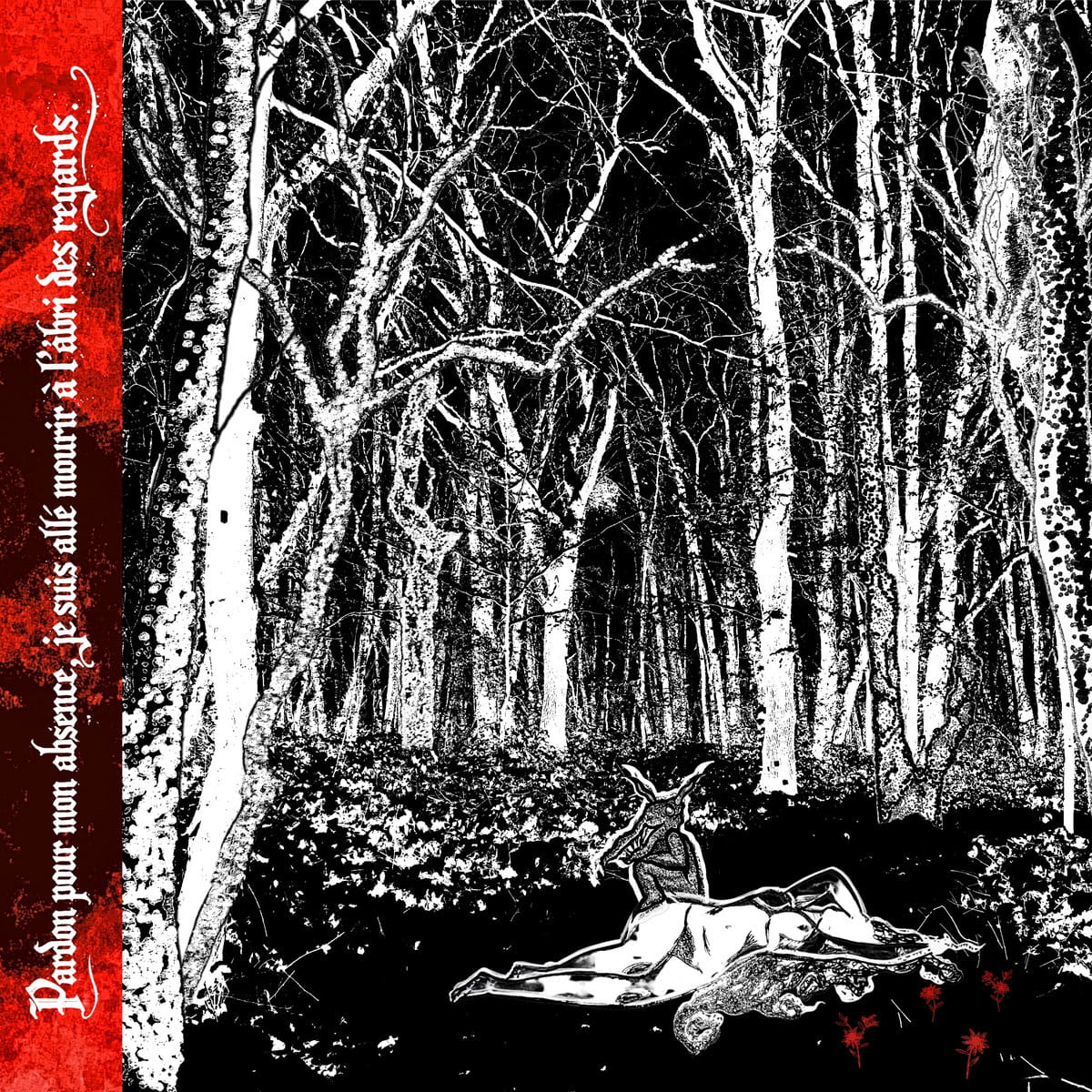
The cover catches you before anything else — a naked figure on the ground in a snowy forest, edelweiss at her feet, a small daemon perched on her chest, trees fading into the dark behind her. It’s the kind of image you sit with for a minute before pressing play. What plays underneath does more damage.
L’Idylle, the four-piece from Rouen, designed the cover themselves over several weeks.
The idea came on a bus to Dublin. They wanted to come back to the forest, partly as a callback to their previous EP, partly because the urban environment around them is, as they put it, “an concrete smothering urban jungle, towers of steel that compress our bodies, oppress our minds, always watching, always above us.”
Wyświetl ten post na Instagramie
A forest looked like the opposite of all of that. They took photographs on a snowy day near home. Hand-drew the trees, the daemon, the flowers.
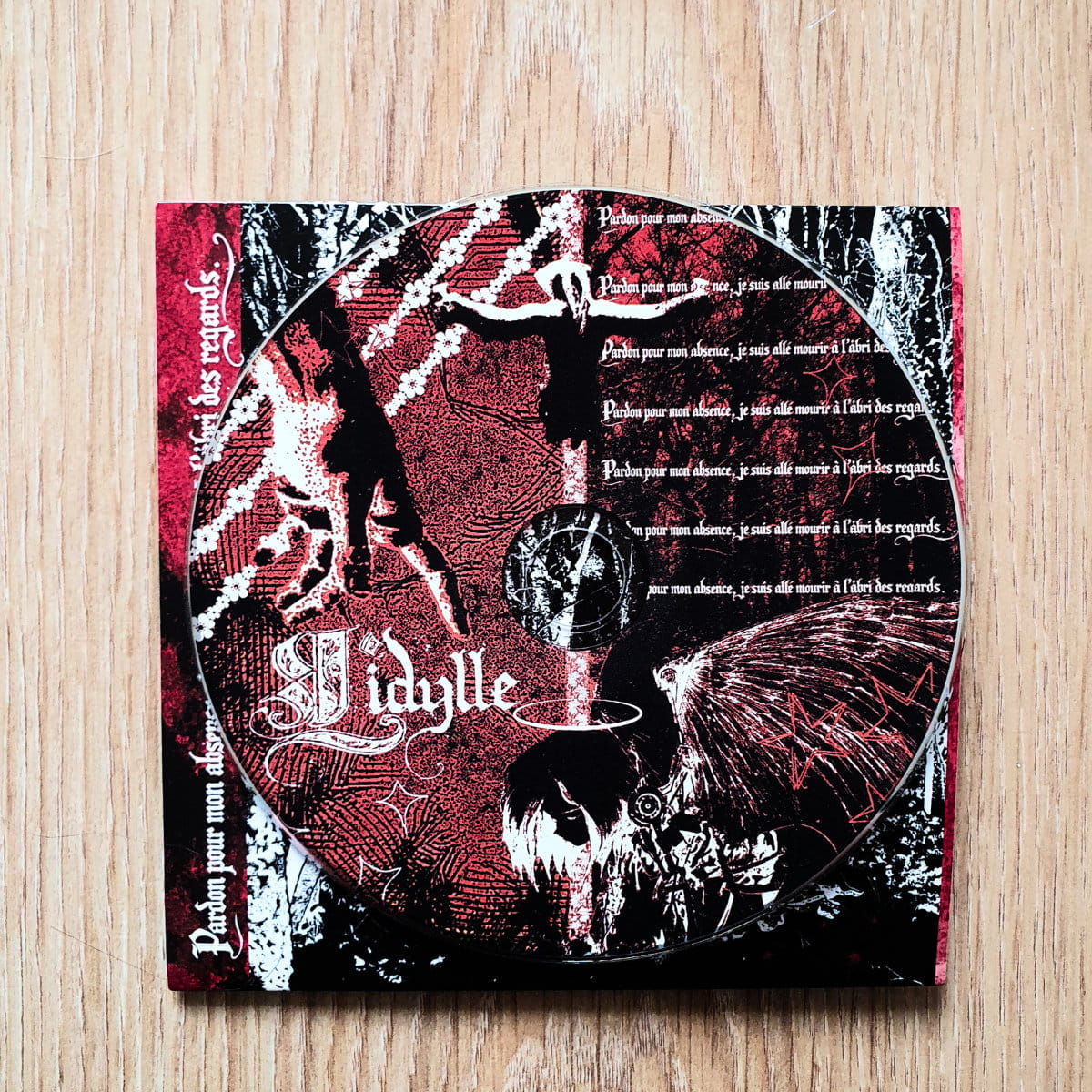
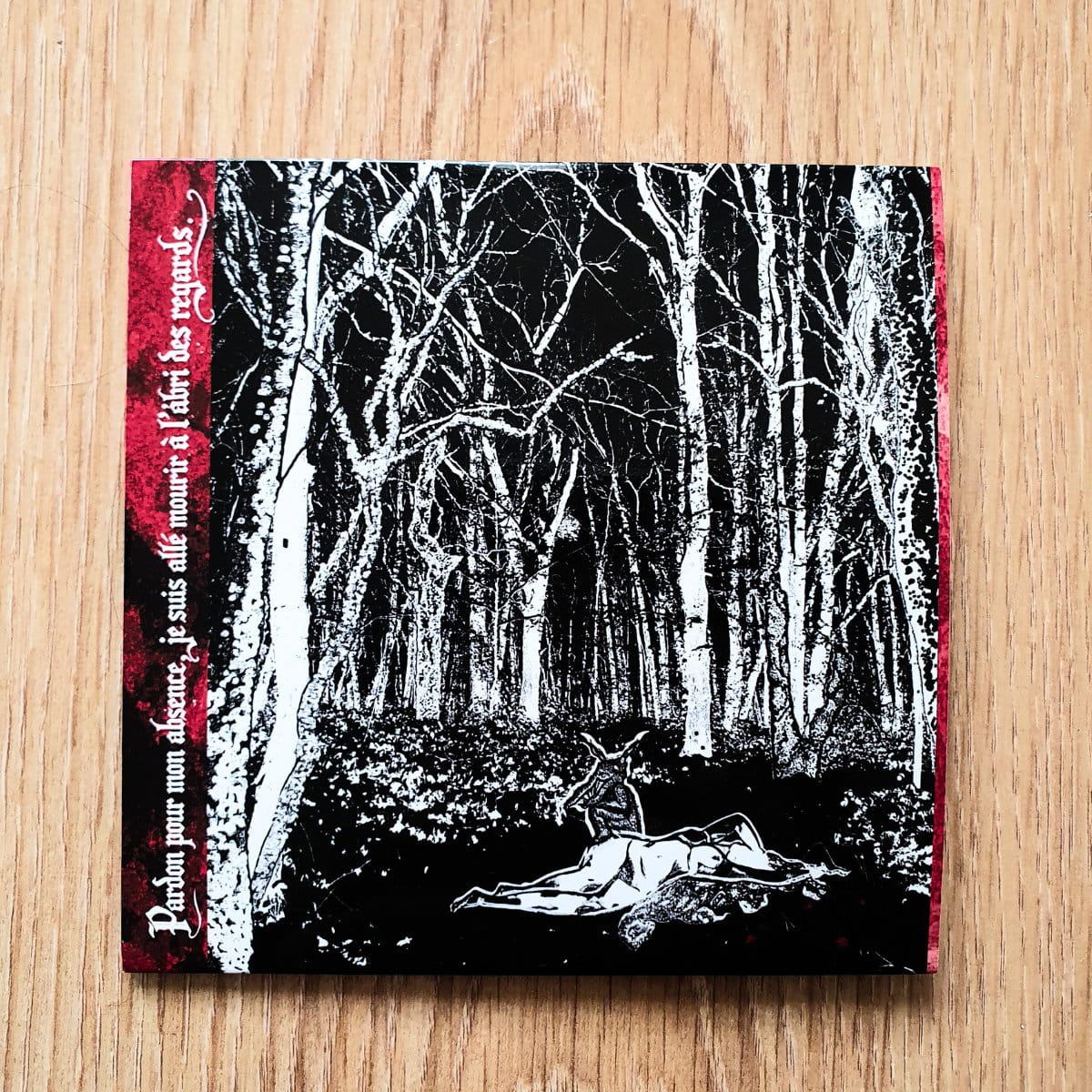
Layered everything in collage and photo edits. No graphic designer in the band. The red banner across the bottom of the image is also a manipulated photo. Red, black, white — the antifascist palette, and the colors they’ve used since the start.
The body itself is a reference to Alexandre Cabanel’s “Birth of Venus.” Naked. Vulnerable to men’s gaze. This time protected by a dense, dark forest, far from anyone’s sight. Sleep, possibly dream. The daemon on her chest is the guilt of disconnection, the cost of stopping answering anyone. The trees fading behind her are mental prison, the cage we trap ourselves in. Edelweiss at her feet — fragile flowers that grow in eternal snows, in places nearly untouched by human hands. “Protect the place,” the band write. “We hope.”
The title arrived later, all at once.
“The title came to us like that, a flash. Without a thought. Like a confession you can’t hold it in any longer. It was a survival act to say something, to yell something about what’s happening around us. Everything goes beyond words, beyond music. We disappeared. We went away. Because we couldn’t hold it in anymore.”
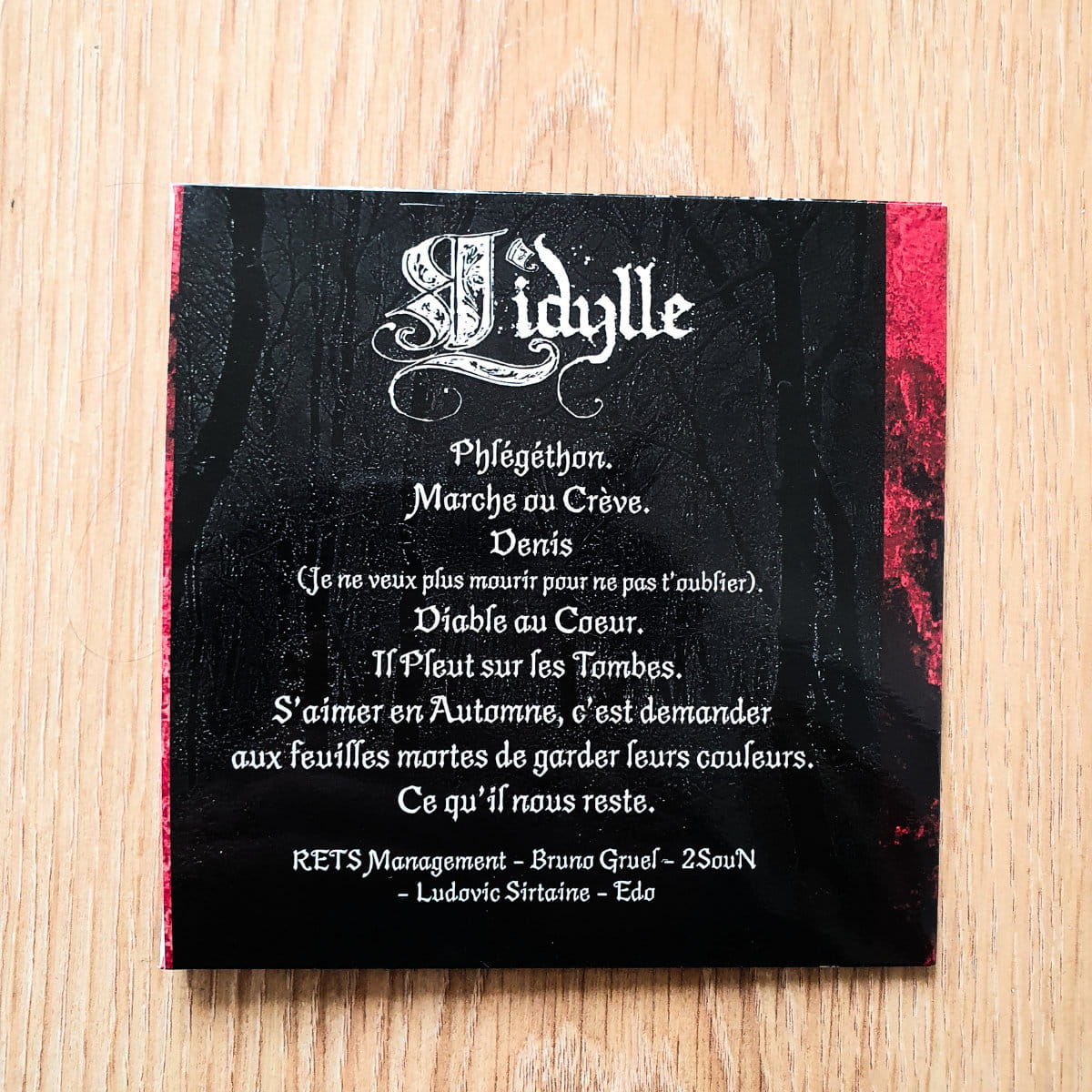
“Pardon pour mon absence, je suis allé mourir à l’abri des regards” — sorry for my absence, I went to die away from sight — arrives April 10th on No Funeral Records. Seven tracks. A follow-up to a release that already had a forest at its heart.
Wyświetl ten post na Instagramie
Most listeners outside France won’t understand the lyrics word for word. That’s not really how this band work on you. Screamo built on post-hardcore organic heart, emoviolence at the edges — even before translation, the shape of what L’Idylle are doing carries enough to land the meaning.
The disappearance the title refers to wasn’t metaphorical at first. It started with the loss of a loved one — what the band describe as “not an abstract death, a death produced by our surroundings. A direct consequence of violent work conditions, the aftermath of a system.” After that, they say, the veil came off:
“The wars. The bombings. The policy of destruction carried under the false pretense of security, liberty. The colonial logics, imperialism system, the capitalist society. Everything is plain clear. Everything is before our eyes. Accessible. Everything is permanent, and everything is already over at the same time. But still, we have to keep on. They ask you to keep on.”
Carry your life as if everything was normal. Do your groceries. Go to work. Consume. Obey. Grab a drink with your friends. Don’t make any waves. The pressure of pretending — and of refusing to pretend — is one of the EP’s organizing tensions, and the band put it plainly. Every action carries a sense of responsibility. A sense of guilt. What you eat has consequences. Living has consequences. Every position taken is political, and always was. You enroll in the small pools of freedom, comradeship, solidarity you can find. You refuse. You disobey. You feel agency for a moment. Then you remember you have no real power, and that’s the most depressing part.
L’Idylle’s reading of 2026 through that lens is direct:
“Fascist discourse is becoming listenable. The unacceptable is becoming acceptable. Genocides is just an opinion now. The unacceptable is slowly becoming debatable and then acceptable. They used to say ‘nevermore’. But shouting ‘nevermore’ asks of you to refuse, to disobey. To refuse, to disobey in this time we live in, put you aside of everyone else.”
So everything piles up. Images, violence, corpses, lies, deaths. Contradictory feelings — sure one day, doubting your own anger the next. Wondering if you’re the one who’s the problem. Feeling unadapted to a world too violent to absorb. Over-stimulation, they call it. Not hatred, exactly. Saturation. Until you wish for the noise to stop, for everything to disappear. So they did.
“We went agonizingly far from the sights of everyone. It’s an image. It means we collapsed on ourselves. We closed. We retreated ourselves from the world. We burned the bridges. But we cut ourselves from our own emotions by doing so. We stopped saying we weren’t okay anymore. Because it’s vain to say it.”
The shame of the retreat sits underneath a lot of the EP. Shame at not doing more. Hiding the sadness, the cracks, the loss, the disillusion, the grief, the end of innocence. Hiding to digest. Hiding to learn. Hiding to realise, eventually, that there is no fate, no fatality.
The turn in all of this is that the retreat had a purpose. Not as healing. As a way of catalysing the rage outward instead of inward.
“We had to succeed in taking something away from all this. A strength. Anger. To catalyse this over boiling rage that destroys us. But not against ourselves. Against The Hand that dictates our lives. Not the Hand of Fatality. The Hand of Numbers, an Invisible Hand. Because to exist, is to revolt. Life is a revolutionary act in a world submerged by death.”
L’Idylle complicate this with one more layer — that being out of the system doesn’t actually take you out of it. The daemon on the cover is partly that. We are part of the machine, exploited and exploiting at the same time, sometimes just to feed ourselves. Crumbling. Retiring. Taking shelter. But also accepting, observing, trying to take something away from it.
The closer, “Ce qu’il nous reste” — “what’s left to us” — is where the EP lands. The band’s own words on it:
“When everything crumble and collapse, when you have nothing in your hands anymore. What’s left? People are what’s left. The relationships. Fragments of love are what’s left. Despite everything it’s still you, it’s still your choice to love and to live. Not as a naïve project, but as something vital. Because they certainly will take everything from us. Our rights, our house, our community, our bodies. But that is something they will never really destroy. Our capacity to love.”
L’Idylle’s own summary: a fall, a retreat, a vanishing, a homecoming. Not healed. Not fixed. But alive, ready to keep on — to love, to fight, to scream. Even if no one listens. Because that’s everything that’s left for us to do.
“Pardon pour mon absence, je suis allé mourir à l’abri des regards” is out April 10th on No Funeral Records.
🔔 IDIOTEQ is ad-free, independent, and runs on one person’s time. If you want it to stay that way: DONATE via PayPal 𝗈𝗋 SUPPORT via Patreon.
Stay connected via Newsletter · Instagram · Facebook · X (Twitter) · Threads · Bluesky · Messenger · WhatsApp.