


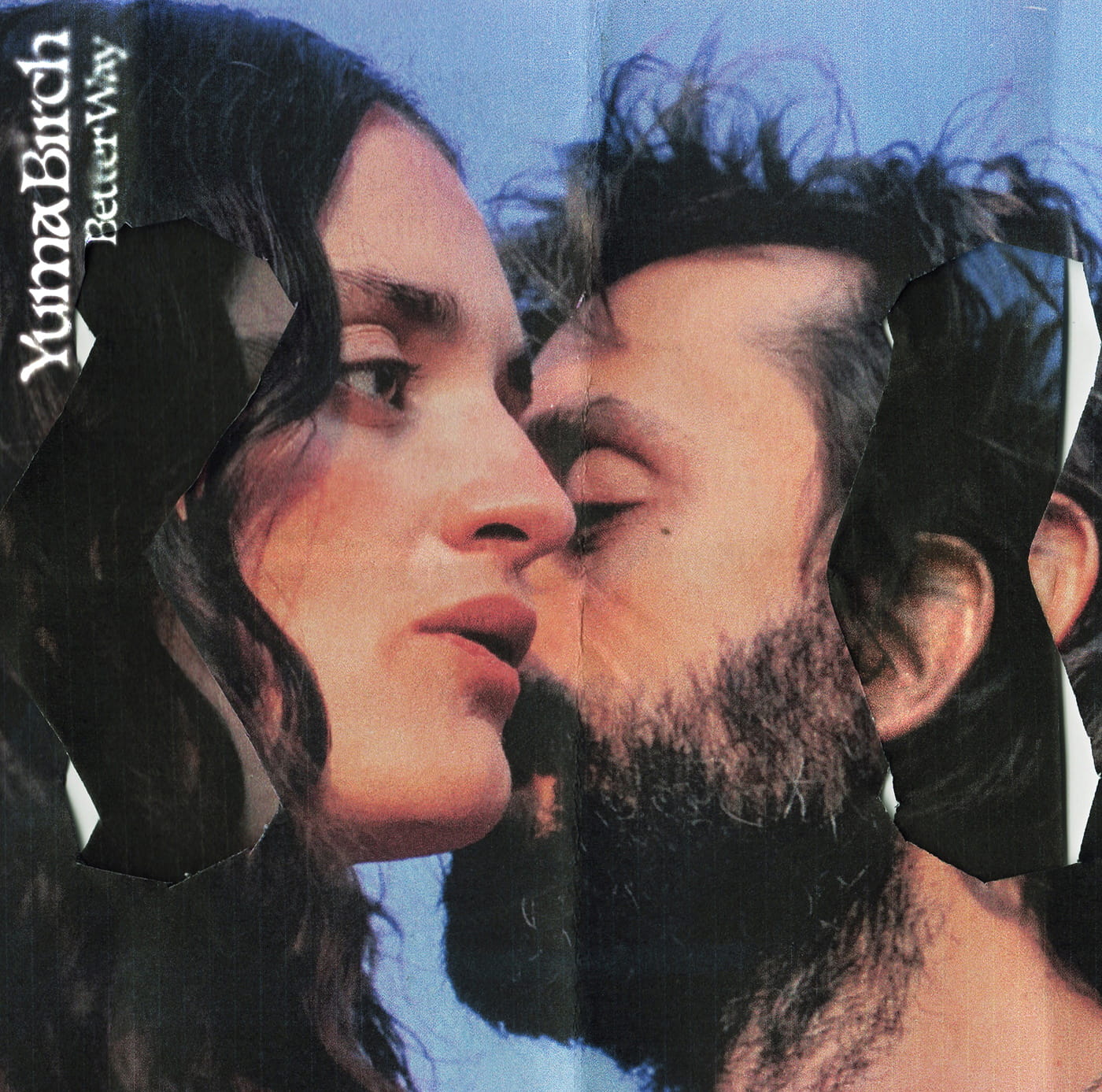
There’s a lovely intimacy to the way Costanza Delle Rose and Edoardo Elia sing together on “Better Way”, the debut album from Italian duo Yuma Birch. Their music has the gentleness of indie folk, the blurred guitar textures of shoegaze and a fondness for little irregularities that make these songs difficult to pin down. On “Seven Souvenirs“, even the identity of the person telling the story is open to interpretation.
The two voices meet over a repeating pair of chords, an isolated guitar riff, bass, drums, viola and street noise. Costanza and Edoardo imagine the encounter taking place inside a dream, where two people recognise each other so completely that their individual thoughts become difficult to separate.
“It’s fascinating for us to switch roles, especially when it comes to the distinction between masculine and feminine perspectives. Some songs were written by Costanza, others by Edoardo, and we enjoy stepping into each other’s shoes, trying to interpret the other’s thoughts and feelings through our own sensitivity,” the duo tell IDIOTEQ.
One of the lines in “Seven Souvenirs” is wonderfully awkward: “You’re my perfect match, you’re made of what I hate”. It’s about the kind of love that develops once the initial infatuation has worn off and you begin to recognise the whole person in front of you. At the end of the song, the music seems to move backwards, gradually erasing the images that came before.
“In a way, one could listen to the song endlessly, changing perspective with every line and imagining a story that takes on different shades and meanings each time.”
Costanza’s previous work with Be Forest and her solo project Koko Moon, along with Edoardo’s time in PUÀ, gave them quite different starting points. Working together has allowed them to approach their own words with a little less certainty about what those words actually mean.
“There have also been occasions when we created lyrics entirely from scratch and only later sat down together to understand what it was we were actually talking about. It’s an exciting process because it allows us to explore different points of view and give voice to something that, perhaps, neither of us would have expressed in quite the same way alone.”
Writing lyrics specifically for each other is something they’d like to try in the future.
One evening in Bologna, the pair found themselves surrounded by couples in a bar on Valentine’s night. Two young people were on what appeared to be their first date. After a moment of silence, the woman asked, “Have you ever been in love?”
Costanza and Edoardo returned to the studio with that question in mind, wondering how many different kinds of love a person can experience and whether knowing somebody’s romantic past tells you much about their present feelings.
On “Valentine’s”, Costanza’s brighter singing and Edoardo’s darker, more fragile delivery sit over deep bass, guitars with softened attacks and a brisk drumbeat. The arrangement grows distorted and agitated in the middle before returning to the chorus.
“In Valentine’s, the shift in perspective happens for another reason: the question we direct outward, as we so often do, would perhaps reveal far more answers if it were turned inward instead.”
There’s considerably less emotional composure in “No Other One”. The duo approach physical intimacy through instinct, with the tension of tightened strings and a prominent bass line giving way to an irregular melody. An invitation to sing together competes with the urgency of touch and the possessiveness of somebody caught up in their own desire. They wanted the language to be exaggerated and adolescent, drawing on the almost absurd intensity that romantic feelings can sometimes reach.
Love on “Better Way” can also involve a great deal of time spent alone. In “Sailor”, one person stays behind, living through days that seem to repeat themselves, while somebody they love is constantly travelling. Even the prospect of a reunion comes with the uncertainty of whether their feelings will still be reciprocated.
“Sailor and No Other One, on the other hand, are far more physical songs. They are tied to the body, to absence, deprivation, and desire that erupts like a magical act, allowing us to merge with the person we love.”
During the eighteen months they spent working on the album, Costanza was living in London and Edoardo divided his time between Rome and Bologna. Getting together to work on songs involved a fair amount of travelling. A session in Sasso Marconi proved especially useful in helping them understand the kind of music they could make together, with the main recording sessions taking place in Pesaro and at Bottega Studio in Colle Ameno, Sasso Marconi.
“The great joy of working side by side came from the fact that each person’s strengths helped complete the other’s songs. Because of that, there was never any sense of forcing things or asking the other to change. Each of us was free to work with the material in our own way.”
Repetition is a big part of how Yuma Birch write about time and the things we struggle to express. The opening track, “Emotional Devotional”, is built around the tonic and the fifth. Its narrator seeks shelter in prayer at a moment of emotional weakness, repeating the same words in the hope of receiving some kind of sign.
“Sometimes, the repetition of just two chords, as in Emotional Devotional, allows the simple and recurring lyrics to gain even greater strength, creating a sort of circular redundancy that feels almost impossible to escape, as though musically recreating the sensation of being trapped inside a thought.”

The intensity of the performance changes as the prayer continues. The narrator experiences what seems to be a moment of revelation, only to find themselves back where they started. The duo relate the song to the wheel of karma and suggest that it could work just as well at the end of the record. Its final crescendo leaves the narrator’s plea unanswered.
On “Mother’s Son”, the same concern with time takes on a familial and spiritual dimension. The mother is both an actual parent and a collective figure connecting the individual to something older. The father represents a more fragile masculine presence, overwhelmed by the world and at risk of becoming isolated from the people around him.
Looking at time horizontally, as the duo imagine it, everything appears chaotic. A vertical perspective allows somebody to locate themselves within a much longer succession of lives, deaths and births. There’s another possibility in the chorus, where life is compared to a dancefloor and the past and future briefly disappear into the present.
It’s easy to appreciate that thought in the context of a record with such a strong melodic pull. Yuma Birch can get quite philosophical about the passing of time, yet something as ordinary as dancing with other people can provide a moment of relief from all that thinking.
“I Wanna Tell You” deals with a quieter kind of solitude. There are things we would love to communicate to another person but can barely articulate to ourselves. In the duo’s account of the song, those feelings tend to become clearer in the middle of the night.
“So they remain inside, emerging especially in the silence of the night, when we are alone with ourselves. It is in those moments that we can stop controlling them, let them flow, and allow ourselves to feel them. The song becomes an invitation to connect with those most authentic and vulnerable parts of us that daylight often hides.”
One of the most unusual recordings on the album came out of just such a night. “Some Other Place” has no regular beat or metre, and the voice is almost unrecognisable.
“Edoardo wrote it one night in a studio in Rome, improvising on a Casio keyboard. The lyrics emerged naturally, and the recording was captured directly on a phone before being included in the album exactly as it was. In this case, there was no predetermined structure; the moment itself, with all its spontaneity, shaped the song’s final form.”
The lyrics concern memories that come back to us in fragments. A moment of love can remain extraordinarily vivid even when we’ve forgotten much of the world around it. The image they use here is a white butterfly, remembered in such close detail that its wings almost become the entire scene.
Putting an untouched phone recording alongside carefully arranged songs is part of the freedom Costanza and Edoardo have given themselves in Yuma Birch. They approach each composition on its own terms, resisting the temptation to tidy up every irregularity or develop an idea simply because a conventional arrangement would demand it.
“We rarely begin with a fixed rule. Instead, we try to find the form that belongs to each song. Sometimes that need is clear from the start; at other times, it only emerges during the creative process.”
It’s tempting to hear “Better Way” as a concept album, given how often these nine songs return to the suspension of time. The connections came as a surprise to the people who wrote them.
“Time is certainly a central theme of the record. During the creation of both the album and the individual songs, we never sat down and decided on a specific structure or concept to follow. Each song was born with its own soul and identity, telling stories of experiences, desires, and fears that we carry with us every day in our lives.”
“Only after finishing the album did we realise that all the songs were actually connected by an invisible thread, without needing to be confined to a specific place or moment in time. It was something we discovered retrospectively, simply by allowing each track to move naturally in its own direction.”
Wyświetl ten post na Instagramie
For the closing composition, “Dòbhran”, the duo drew on their interest in esotericism and the relationship between the natural world and ancient spiritual traditions. The title is the Scottish Gaelic word for otter, and the piece consists of three connected songs representing immersion, change and a return to the light.
“The otter, which gives the piece its title, is a kind of inner animal that journeys through the depths, confronts the loss of its points of reference, and slowly rediscovers its shape. It serves as a metaphor for our relationship with the past and everything we carry within us. The goal is not to escape who we once were, but to embrace and integrate it so that we may become something new.”
Wyświetl ten post na Instagramie
In their imagined journey, the otter loses its bearings underwater before gradually encountering signs of light again. Costanza and Edoardo connect its eventual return to the surface with a recognition of the person we have become.
“When the otter finally reaches the surface and lifts its eyes to the sky, it sees the stars. For us, this image represents a moment of recognition. It is not about returning to who we once were, but about learning how to inhabit the person we have become.”
“Better Way” was released on 30 October 2026 through Dischi Sotterranei. Listen to the full album here or check the vinyl edition through the label.
🔔 IDIOTEQ is ad-free, independent, and runs on one person’s time. If you want it to stay that way: DONATE via PayPal or SUPPORT via Patreon.
NEW: IDIOTEQ Explore 🗺️ Browse 15+ years of our archive by city, country, and style. Find artists on the world map or trace related sounds through the styles map.
Stay connected via Newsletter · Instagram · Facebook · X (Twitter) · Threads · Bluesky · Messenger · WhatsApp.