

Since I Love Your Lifestyle dropped “Summerland” back in 2024, nothing in the emo-adjacent world has grabbed us with quite the same force — that record basically lived in our ears for weeks straight. But San Sebastián quartet Comic Sans might be about to change that. Today, March 13th, they release their third album “Todas las cosas que nos salió mal” (All the Things That Went Wrong) via Barcelona’s BCore, with support from Stiff Slack in Japan, Through Love Records in Germany, Saltamarges in Girona, and Discos 17 Dolores in Valencia.
It arrives after “Éramos felices y no lo sabíamos” (We Were Happy and We Didn’t Know It) and the EP “Ojalá fuera mi cumpleaños” (I Wish It Were My Birthday), and it lands like a band that finally knows exactly who it is.
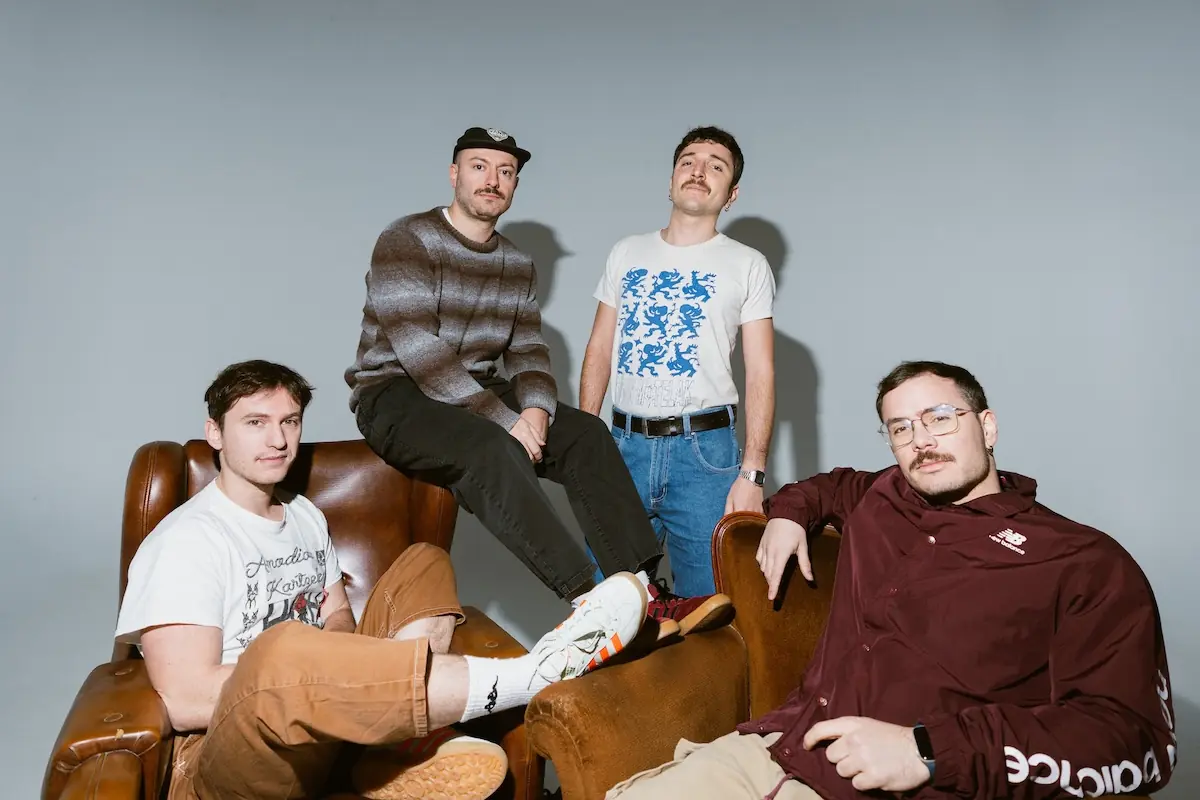
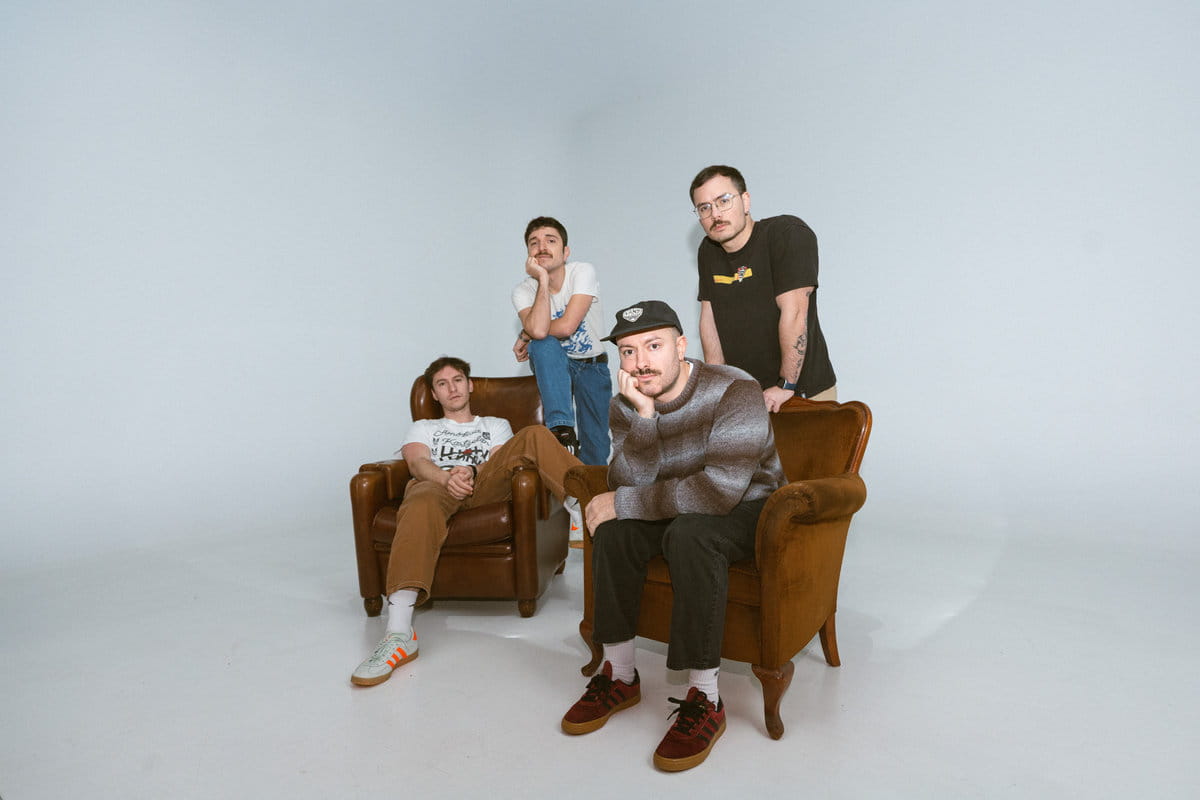
The current lineup — Manza on vocals and guitar, Ander on guitar, Diego on bass, Mickele on drums — is the product of years of rotation. The project started in 2019 when Manza and two friends, Mundu and Koldo, began playing emo songs together. Jontxu joined, and they recorded “Jon Lee” in 2020. Then jobs and life got in the way, as they tend to. Koldo left, Endika came in. Mundu and Jontxu left, Ander and Mickele replaced them. Two years ago Endika had to step away and Diego filled the gap. “Now we are planning to keep it this way… ideally forever,” Ander says, laughing.
The band name, for the record, has no grand origin story. During early rehearsals, Manza was working as a waiter and had to pick a font for the bar menu. He saw “Comic Sans” on the list and thought it was perfect. Everyone agreed. That was it.
Half the lyrics were still up in the air when they hit the studio
The record was made at Ultramarinos studio in Sant Feliu, a coastal town on the Catalan coast — which, by all accounts, kept things from spiraling. “Since we all live in different cities, we don’t really get much time to rehearse together,” Ander explains. “When we hit the studio, about half the lyrics and vocal melodies were still up in the air. It was pretty challenging to get everything done on time and still hit the quality we were aiming for, but being by the beach really helped keep the stress levels down, and we managed to figure it all out together.”
Ander is from Iruña, Mickele from Valencia, and the band is based in Donostia (Basque Country). That geographic spread could easily be a problem, but Ander frames it differently. “Maybe the thing that went right is that we managed to finish the album,” he says. “Jokes aside, I think the best thing that happened during the making of it is that it allowed us to realize that we do connect really well as musicians when it comes to songwriting. Like we understand each other and don’t have trouble communicating how we want something to sound like, or how to lyrically express some idea. Even though we didn’t have a lot of rehearsal time together, every time we made it to the rehearsal room everything went smoothly and we had a lot of fun.”
Heartbreak, unemployment, and the stuff that happens on tour
The lead single “Cosas que salen mal” (Things That Go Wrong) opens the album’s emotional territory directly — a long-term relationship ending, the stubborn loop of not being able to stop thinking about someone. Over a midwest emo gallop built on drum rolls, sudden stops, and bursts of speed, the track moves from “I think it’s about time I forgot about you” to its closing admission: “I think I’ve finally managed to forget about you.” The guitars are polished and loaded with riffs, drawing openly from The Promise Ring, Get Up Kids, and Blink-182, plus the broader pool of 90s emo that runs through the band’s bloodstream.
But the album as a whole isn’t just breakup songs. “Our lyrics are about our realities,” Ander says. “Most of them about heartbreaks or relationships in general, but we also talk about precariousness in both our professional and ‘musical’ lives. In our songs we talk about friendship, unemployment, and the things that happen to us or come to our minds while on tour.”
Asked to describe their music in one word, the answer is immediate: “Fun.”
Moving away from the conventions they grew up on
“Todas las cosas que nos salió mal” marks a conscious push from the band to sound more like themselves and less like their reference points. Without abandoning midwest emo’s core parameters, they’ve aimed for deeper lyrics while staying honest and direct, and a more personal approach to structures, effects, and melodies. “For this album we wanted to push our sound somewhere new without losing who we are, focusing on more polished lyrics, more distortion, and songs that are just really fun to play,” Ander says. “It’s not a super tight concept album, but I guess the common thread is a bit of maturity — or the loss of innocence — after two albums, an EP, and dozens of gigs.”
The influences are still legible and they look beautiful — American Football, Cap’n Jazz, Mineral, At the Drive-In, Karate, Fugazi, Marietta, Algernon Cadwallader — alongside Spanish-language touchstones like Berri Txarrak, Dut, Nueva Vulcano, Cala Vento, and friends Nogato. But the direction is toward something less inherited and more their own.
On the question of lineup changes and what they actually do to a band’s sound, Ander is frank: “I think the shift is immediate, yes. Everyone has their own capacities, influences and likes, and also their own way to communicate with the rest and to work as a team. I’d say that in our case it is really easy to tell the differences, from the rehearsal dynamics to the final song’s sound and structure. I think that our last album is noticeably different — and hope that a bit better — from our previous works.”
Spanish emo is scattered, connected, and very much alive
Spain’s emo scene is small, dispersed across the country, and tightly knit precisely because of that. Ander rattles off the map: Nogato in Madrid, Garbí, Bernal, and Laid in Valencia, Boys Kissing Boys in Barcelona, Mentah in Galicia, Mirlo in Elche, Shonen Bat in Málaga. “We are not a lot of people and we are all dispersed around the country, but it makes it possible for us to know and befriend each other and to meet whenever there is a concert — we don’t miss a single one.”
The connections stretch well beyond the Iberian Peninsula. The closest international link runs to Italy — bands like Ojne, Put Purana, and Stegosauro, plus the people organizing DIY shows and festivals, stay in close contact with the Spanish scene. Comic Sans played a screamo festival in Milano called Can I Scream, and Italian bands have come to Barcelona for Emostiu fest. Stegosauro, in particular, gets a specific shout-out: “In 2023 these Italian guys released one of the most brilliant math rock/emo albums of the last decade,” Ander says. When asked what record made him think “damn, I wish we wrote that,” that was the one.
Austria fits into the network too — DIY labels and booking people from Head in Clouds and Strayrecords organized gigs for Comic Sans in Graz and Vienna. “Viktor, the guy from Strayrecords — on whose sofa we slept — is also in a band called Knifelong and they’ve been playing in Spain recently.” In France, connections run through Toulouse (Seitanshellbikepunks) and Brittany (Papiernoirs, L’ouille Pleour), though the band hasn’t played there yet.
Latin America is another active thread. Comic Sans have played with Argentine band Fin del Mundo, who’ve visited Spain multiple times and even recorded a song with Valencia’s Bernal. “We are also in talks with bands and collectives from Chile, Perú and Argentina,” Ander says. “Here we love the music they are doing and I think that they do also enjoy a lot of what we are into. Latin American DIY scenes are amazing.” A festival in Denmark is also on the horizon for May.
Records that got under their skin recently
Outside the Spanish orbit, Ander has been deep into screamo and adjacent stuff from the US — February, Melancholy Club, For Respect’s first EP, Ogbert the Nerd’s last album. From Latin America: Corriendo, Mil Ataris Por Segundo, and the wonderfully titled Recuerdo Acariciar Sin Miedo las Alas de un Ave Herida. “Maybe these bands didn’t have a direct influence in the way we wrote our songs because they’re mostly screamo bands,” he admits.
Closer to home, it’s the Valencian punk and post-punk wave that has his attention right now — Fantastic Explosion, Sonido Ordeno, Finale, Taqbir. “Spain is kind of a melting pot of scenes, from the most mainstream indie to some of the boldest, most innovative punk, spread all over the country,” he says. “These days there are dozens of collectives and bands in different regions that almost specialize in very specific sounds and aesthetics, while still being closely interconnected with scenes in other parts of the peninsula.”
Wyświetl ten post na Instagramie
DIY in the age of the anxious popularity contest
The band’s perspective on the tension between DIY ethics and the realities of streaming and social media is worth hearing in full. They release through BCore and have label partners spanning four countries, but their definition of emo is partly political — rooted in DIY, care, and humility.
“All the streaming services and social media stuff have transformed music into a kind of anxious popularity contest,” Ander says, “with bands using their time to create ‘content’ in order to reach as many people as possible, which, for some people, could be seen as the only way to get gigs or to be listened to far away from home. It seems to me that we are forgetting that things were working without all these tools and media overdose only 20 years ago.”
He doesn’t deny the practical benefits, though. “At least when it comes to communication and logistics, belonging to DIY scenes has never been as easy as now. You can organize a whole tour just by writing to people on any social network, checking out who they follow or they are followed by, looking for collectives, venues, bands, houses to sleep… and keeping everything DIY.”
The tension, in his view, isn’t going away: “I think it’s a really interesting and intricate subject — the relationship between being in DIY/underground scenes and still being doomed to deal with social media and streaming platforms, with their hierarchical and anxious ways and the material effects they have on us both as musicians and political subjects.”
Wyświetl ten post na Instagramie
Spanish is their first language. Manza doesn’t know a word of English.
On the question of singing in Spanish rather than English, the logic is simple. “Spanish is our first language and it’s a lot easier for us to open up about how we feel in Spanish,” Ander says. “Also, Manza doesn’t know a single word in English.” Fair enough. Plus Spanish fits this niche so well!
Geography seeps into their songs in less obvious ways, too. “I guess the biggest influence Spanish geography has had in our music is having close friends in different cities, who we mostly only get to see when we play shows there. For example, Madrid comes up a few times in our songs, even though it’s not really a city we connect with, but some of our dearest friends live there.”
Outside of music, the members keep themselves afloat with day jobs they’re not exactly passionate about. “Mainly we pursue to keep ourselves alive through jobs that we don’t like,” Ander says. Beyond that: cinema and video games, long arguments about science fiction films.
Wyświetl ten post na Instagramie
Japan looms on the horizon via their Stiff Slack partnership. They haven’t been yet, but they know what they love from there — Toe, Tricot, By the End of Summer, The Cabs, Envy, Advantage Lucy, Number Girl. Pressed for a favorite, Ander picks Toe. On their image of the country: “Beauty and balance are central to Japanese culture and we find that fascinating. One of my favorite movies is The Taste of Tea.”
And the definition of emo? Ander starts with the joke — “‘Real Emo’ only consists of the DC Emotional Hardcore scene and the late 90s Screamo scene…” — before getting to what it actually means to them. “For us, emo is made up of two parts: a musical one and a political one, which is just as important. We don’t believe there can be emo without DIY, or without a way of organizing and relating to each other that’s based on care, affection and humility.” Then the kicker: “And of course, after the shows and the parties, we should all end up screaming along to the cheesiest 2000s song at the top of our lungs.”
“Todas las cosas que nos salió mal” is out now on BCore, Stiff Slack, Through Love Records, Saltamarges, and Discos 17 Dolores.