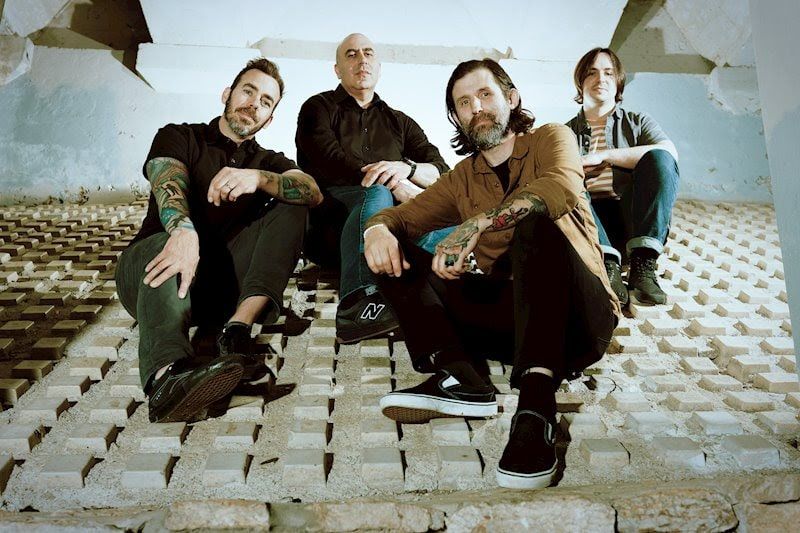

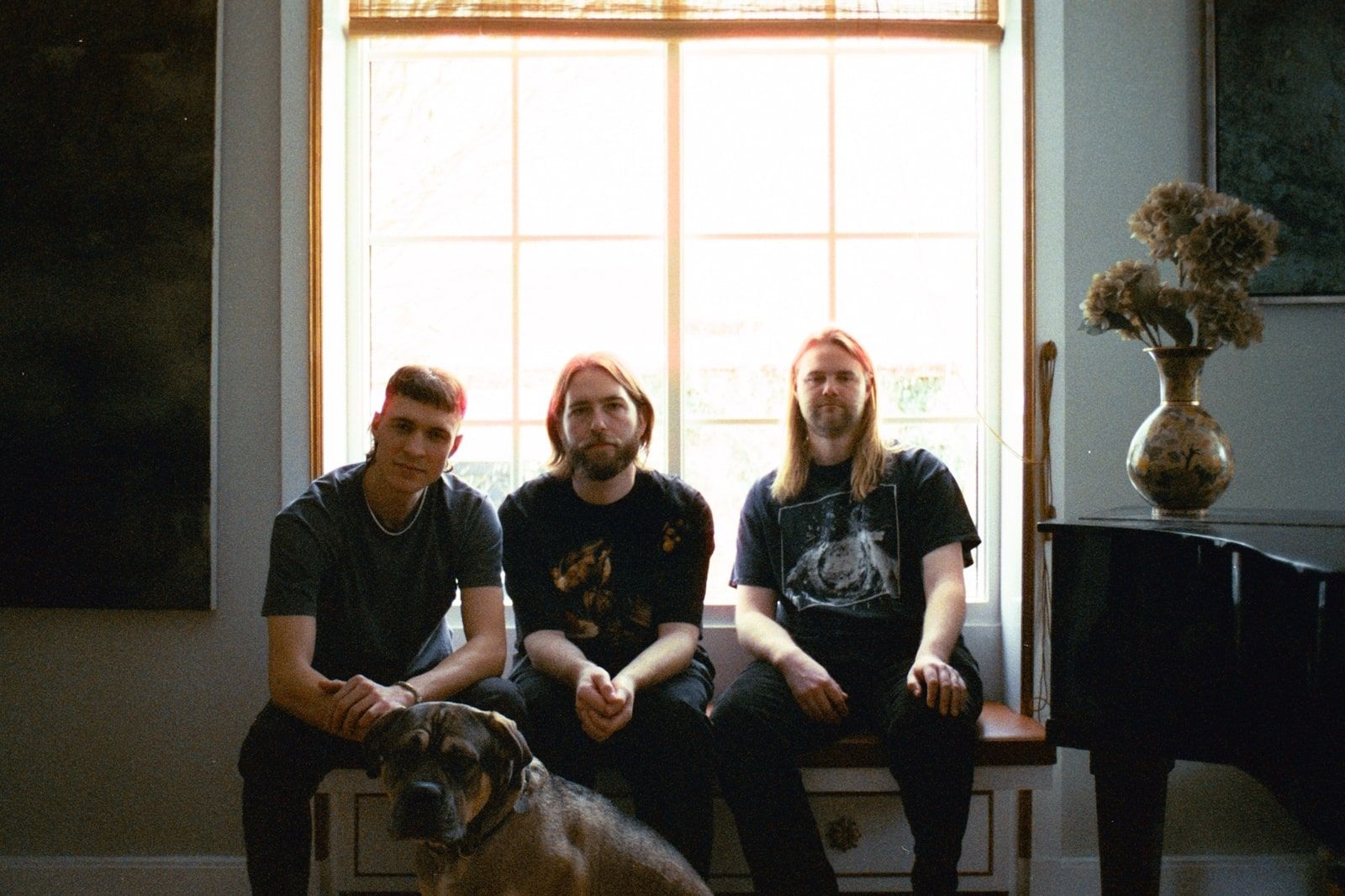
Poptones’ second album “Pure”, out September 26th via Happy Metal Records, trades restraint for range. The Copenhagen trio—Mads Bertelsen, Simon Hiemstra, and Anders Poulsen—sound less like they’re chasing a sound and more like they’re chasing instinct. Recorded in fragments across Denmark, India, and Italy, the 12-track album moves from brooding trance to full-blown chaos, blending solo sketches, improvisational games, and dense layering of non-traditional instruments. The result sits somewhere between avant-rock, indie, and post hardcore, but isn’t loyal to any of them.
The shift is noticeable from the first single, “Skin of Sea”, which began during an improvised session in a house where Danish Prime Minister Jens Otto Krag once died. The band describes its creation as “intuitive,” completed in a few hours—unusual for a group that usually edits heavily. It also marked their first foray into vibraphone and saxophone, opening up what they call “a grander sound.” Saxophonist Oscar Alstrup, who first joined for that track, now appears throughout the record and plays live with the band.
Elsewhere, “Say Something Now” emerged from an improvised session using UNO cards to direct the band’s next musical steps—part experiment, part inside joke, all captured with seriousness. “Mirror World” leans metal, featuring Copenhagen hardcore vocalist Victor Kaas of Eyes and LLNN. And “17 Hours”, adapted from the memoirs of Bertelsen’s late grandfather, adds a quietly personal layer to the record’s dense structure. The lyrics, taken directly from the original Danish text, root the song in family memory and legacy, while tracks like “Thin Air” echo the emotional terrain of a solo journey through Nepal.
Improvisation, though, isn’t chaos for Poptones. It’s craft—shaped by a long friendship and years spent at the Rhythmic Music Conservatory, where their process was encouraged, but also challenged. As the band puts it, “We’re more a product of the school’s theory than users of it.”
“Pure” still carries traces of the trio’s early writing days on Denmark’s rural west coast, but it’s less about nostalgia and more about movement. Across the album’s runtime, Poptones pull in vibraphone, lap steel, screamed vocals, and extended instrumental swells, testing how far their shared language can stretch. The result is both volatile and reflective—unconcerned with genre, faithful to process, and committed to staying honest with each other.
In our interview below, the band breaks down their creative methods, talks about writing from grief and intuition, reflects on the role of abstraction, and revisits the attic that started it all.
“Skin of Sea” feels like a storm rolling in quietly. What was it like chasing a song that fast, that intuitively—especially compared to your usual pace?
It was wonderful! We used to go a lot back and forth between sections while writing, but in this case we just followed the pace of our intuition. Pretty fast, we had the feeling that the foundation of the song was done.
Since then, we have added a lot of stuff like the slide guitar, saxophones, vibraphones and so on. But we didn’t wanna add something that changed our initial idea too much. Somehow, it was a continuing chase of catching and strengthening the intuitive idea as much as possible.
It resulted in a song that moves naturally, and we absolutely love it. Both the song and the process with it.
You’ve said this track was your first deep dive into new instruments. Did that moment with the vibraphone and sax feel like an irreversible shift?
Our first album “Between Darkness & Daylight” is very processed, lo-fi and noisy, so we wanted to try something else this time. We actually went into the studio with the idea of making the whole album into a hi-fi version of our sound in the rehearsal space, with not too many add-ons in the post-studio process. But somehow we still left a lot of space in the compositions to add extra instruments afterwards. The outro in Skin Of Sea might be the clearest example of that.
The idea with the vibraphone actually came in the studio, but we didn’t have a vibraphone there. We decided to “just try it out” on all the tracks, and immediately when Anders started playing it, we actually felt that irreversible shift, and wanted to add it as much as possible. It’s just a really beautiful instrument that gives some depth and calmness to our sound.
For the saxophone inclusion, we just met up with Oscar, who Simon has already been playing with in other contexts, and started recording some improvised parts in the Skin Of Sea Outro. It all suddenly became clear haha. We needed the saxophone on as much as possible!!
When you go back and hear that outro on “Skin of Sea,” do you still hear the initial spark—or something entirely different now?
We’ve heard it a thousand times, and we definitely still feel it. Every time we get blown away by how beautifully Oscar is phrasing on the saxophone. It feels like a part of the song that has always been there, but it was the last layer we added. We are grateful that they want to be part of the album.
You guys used a broken phone camera, slowed to 20%, to shoot the video. Was that a limitation-turned-tool moment, or was the blur always the point?
Simon: Actually we just needed to figure out a low-budget solution that still offered something to the experience. Simon’s phone camera is filming in the way that you see in the video, so it’s not a filter or anything. Just slowed down and added an extra layer with different colors. It’s very annoying for most filming or picture purposes haha, but as soon as we figured out that it could actually work this way, it became our go-to video recorder, which you will also see in our other music videos. That broken phone camera kinda made the visual (or at least video) vibe of the whole album.
The video is actually recorded on one of the spinning-bike screens in a fitness gym. It’s supposed to show a forest route of Slovenia or something, I don’t remember. But it worked!
At first it was just a fun experiment, but the blur has since become an emotional tool to play along with the mood of the song. We love how it offers an almost hypnotizing experience that allows you to disappear into the music. That is how we experience it at least.
“Say Something Now” came out of an UNO-card improvisation game. Can you walk me through that session—what the room felt like, what made you trust the process?
Simon: We went into that summerhouse with the purpose of writing new songs, based on various methods for collective improvisation.
We had prepared different methods like; Play along to another track from the speakers – continue after the song stops, different click tempos in each of our ears, a specific choice of genre improvisation, short parts of playing improvised unison riffs and so on.
The UNO-method actually kinda happened in the summerhouse. We had brought a game to play UNO with and just realized how it could actually be used as an improvisation tool, because of its simplicity in characteristics.
So we were used to play with improvisation games and have in general, huge trust in each other as very long-term musical partners. In that way, the room always feels safe enough to do something weird, unnatural or whatever. We are aware of where the weird experiments can take us and how they can shape our creativity in new directions, which we love to work work with.
But we are also just having fun while playing together, and because there was something within the UNO method that felt kinda silly, we were also laughing a bit through it – while taking it very seriously at the same time. We also had the idea of guessing what cards the others had after the session, just to both stay aware of others’ playing styles and just for the fun of guessing and seeing who was right or wrong.
Improvisation feels like a backbone for this album. At what point in the process does instinct end and structure begin?
Either there’s a slight idea or no idea beforehand. Often when we write together we just start playing. Reacting to each other’s emotions and ways of playing in the specific moment. We have done this so many times and we know each other so well that we instantly tune in on each other. We try to record this process and once we are playing something we like, we use that as the foundation and work from there in order to write the song. From that moment it’s all about structure and making a song out of it. Sometimes it comes very naturally and other times we have to write the parts 10 times before it’s done.
You’ve written some songs that started as solo sketches, others as group chaos. How do you know when something’s strong enough to bring into the shared space?
Mads: I don’t think we consider anything as not good enough to share. Sharing music with each other has become a safe space, which is very important for us. If it wasn’t, the music wouldn’t appear so fluently. We are very close friends and we know the inputs from the others will make the initial idea even better.
I’m wondering—does being lifelong friends give you a creative shortcut, or does it force you to be more honest and brutal with each other?
Simon: Well, for us it’s not an “either or” in this situation. We do somehow have a collective creative shortcut, since we are very aware of what each of us likes, and how we can reach that. We are of course a bit brutal in being critical towards each other, but in our case, I think it’s mostly just about being honest about what you feel and not necessarily trying to mask it in a way that will perhaps just lead to confusion. We are friends and will always stay friends, however “brutal” (honest) we might talk to each other haha.
You’ve lived, studied, and toured together since forever. What’s one silent rule in the band dynamic that no one says out loud but everyone feels?
Mads always gets the nice bed for some reason haha
Your time at the Rhythmic Music Conservatory—how much of “Pure” comes from the theory, and how much comes from rejecting it?
Simon and Mads: This particular school is actually unlike any others. The school encourages you to experiment and to follow your ideas, with a focus on the different parts of understanding yourself as a musician. The focus lies on stuff like investigating your own methods for songwriting and what context you find your own musical expression within. The board wants you to create something unik which is both inspiring and terrifying because it can quickly become a pressure, and you get very critical of yourself. When is something good enough, special enough? That’s maybe the hardest part of the process when studying at RMC.
At the same time, it’s very open to different musical expressions, which forces you to make opinions and be reflective about music you wouldn’t usually listen to.
I don’t feel like we directly use the theory of the school. We have been inspired by our time there, which most directly can be seen in our use of the improvisational games, inclusion of more avant-garde elements and stuff like that. I don’t think we would have dived into that kind of creation process without RMC. In some ways, we are more of a product of the school’s theory than users of it.
When you’re playing something like “Hypnagogic State” or “O of Life,” are you trying to reach a trance, or just hold the tension between chaos and stillness?
In Hypnagogic State and especially the outro afterwards (Eyes Closed), we’re definitely attempting to reach some sort of trance. A feeling that seems forever. We usually want to move on to the next part pretty quickly and it has been difficult for us to stay in the same part for longer times. We are huge fans of bands like Swans, who are masters of holding on to the same parts for extremely long times and we’ve tried searching more for the feeling Swans gives us, by prolonging parts more on Pure. We have allowed ourselves to get lost in the trance sometimes without getting out. It has been pretty rewarding, we think. O Of Life is for us a tribute to hardcore and the chaos that lives inside us. But if the listener gets feeling of a trance listening to the song, we are absolutely delighted!
Some tracks, like “17 Hours,” are so personal they feel like letters. What was it like translating your grandfather’s memories into something performable?
Mads: It was a beautiful process. I know he would have loved it no matter what because that was his nature. Such a loving and caring man, whom I miss so greatly. Putting music to his memories has been an honor, and because of the personal connection to the song, it might be the song I love the most.
Was writing in Nepal and reading Poul-Erik’s journals more about family legacy—or were you chasing some kind of emotional geography?
Mads: The surroundings you place yourself into forms your creativity. That’s for sure. So a big part of the process was also to explore how my writing would transform. But it was also a way to step in my family’s footprints, and imaging how they felt and what they saw back then. I’m very happy about the text I wrote on the journey throughout Asia. I’ve never been so personal in my wiring before, and of course it gives you a whole new perspective to see how people live in these areas and how brutal and beautiful nature can be.
“Mirror World” feels like a mental spiral set to dissonant hardcore. What was it like collaborating with Victor Kaas on something so jagged?
We were already friends with Victor and has been working together with him in other projects. We are really huge fans of especially Eyes and we know that people in the Copenhagen hardcore scene are experimenting a lot with features and collabs. We wanted to try that as well and just asked Victor if he wanted to scream a bit on Mirror World, which he was immediately up for. Then we wrote him some lyrics, a melody sketch and he recorded it himself, nailing it completely the first time we heard it. Huge shout out to Victor for being a part of this btw!
How do you find balance in your songs between vulnerability and abstraction—how personal is too personal when writing as a trio?
Mads: I absolutely love how you can write a deeply personal text and then cover it in abstractions. You really have to look for the meaning. Or sometimes it makes way for the text to mean something else. Something the listener might relate to. When writing as a trio, I feel like I have to adjust the tone of the language to the temper of the song. But for me that’s just a dogma in a sense.
Your early material had more brooding minimalism. “Pure” feels more raw, even volatile. What cracked open in you between those two records?
Simon: I think it’s mostly about the new directions each of us has taken with music writing. Working with more genres and including them in our collective sound. That process has opened of for new values in our music by working with space and other instruments.
At the same time, I feel like most songs on Pure had an initially stronger direction and idea than on Between Darkness & Daylight.
Do you ever feel like you’re chasing the feeling you had back in that attic on the west coast of Denmark, or have you let that version of yourselves go?
Simon: I don’t think we’re necessarily chasing that feeling anymore. We had some wonderful times back then, but we were also a very different band with two more members who have since moved on. And we were also very different people with different practicalities in each of our lives than now. Back then, we could meet every day and play together, which we did. Getting older gives you more responsibilities and there are just some things that you can never get back to.
It’s a bit like chasing the feeling of being young and more vulnerable and available for new musical experiences. I feel like we, back then, were more focused on what other people would like. How can we become big and play big concerts. Now we are way more aimed towards making something that challenges us as songwriters and maybe tries to challenge to way that rock music can sound like.
You’ve each explored solo paths in recent years. What did you learn from being apart that fed into the writing of “Pure”?
Simon: The insights we have gotten from working with other people, collectively and as solo artists, and with other genres, have really given us some insights into working with new elements in our music. I, Simon, have been working with both improvisation, metal and experimental ambient guitar music the last years. Playing with stones and needles on the guitar, which can be heard on Mirror World and Thin Air, and also moved on to the 7-string guitar (metal guitar, fuck yeah) which opened up for some heavier riffs and bigger chords in Pure.
In total, working with other genres, opens up for the understanding of the different characteristics and forces within the genres. We have been bringing some of those into our collective expression, which has pushed us into new territories.
How do you know when a Poptones song is finished? Or do you just learn to let go at some point?
We can really work on the same song forever. The dubbing process can continue until there are no more instruments in the world. We are very aware of that, and tried to work against it this time, by having a focus on keeping a lot of the feeling from the studio recording in the final result. At the same time, we have been pretty busy finishing up the record and were pretty fast to say “There it was” and just move on to the next track. I think these kind of deadlines really works well for us. Otherwise, we get too focused on the details that no one else will ever notice.
What Danish artists—underground, leftfield, or just emerging—should we be paying attention to in 2024 and 2025?
Simon: I, Simon, am writing this, so I think it’s okay to say that you should keep an eye out for the next Blood Child release.
Mads is playing the bass in the band, and his two brothers are also a part of it. The music is experimental, orchestral, sometimes rock and sometimes not. For what I’ve heard, it sounds very promising.
Besides that, we have some fucking cool artists like Taxidermy, Soap Horse, Alba Akvama, and Heathe.
And finally—what would you say to the 17-year-old versions of yourselves sitting in that attic, just messing with chords and not knowing where it’d go?
Just have fun and make the music you want to make. Don’t worry too much. Always buy instruments used, it’s much cheaper and as good haha.