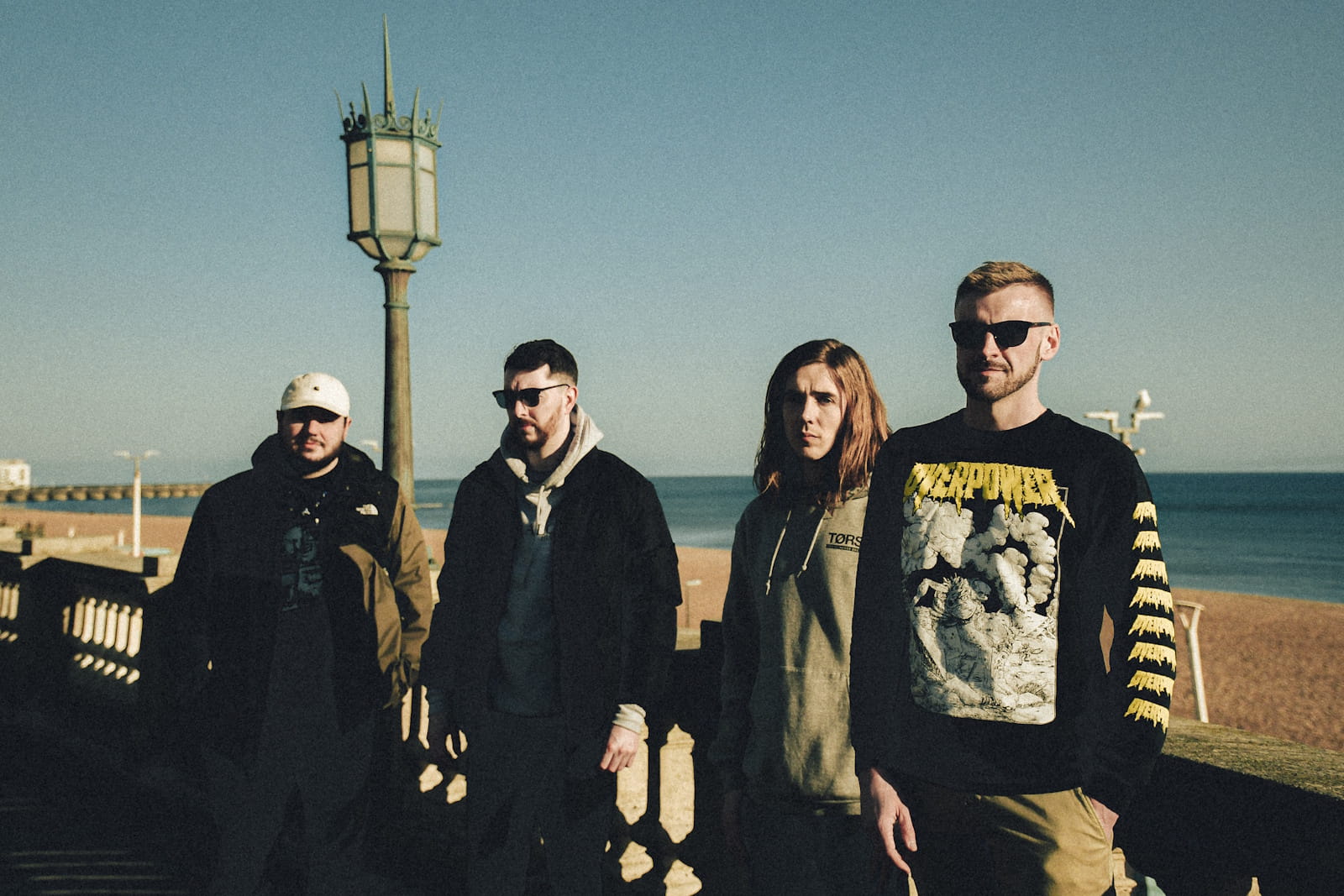

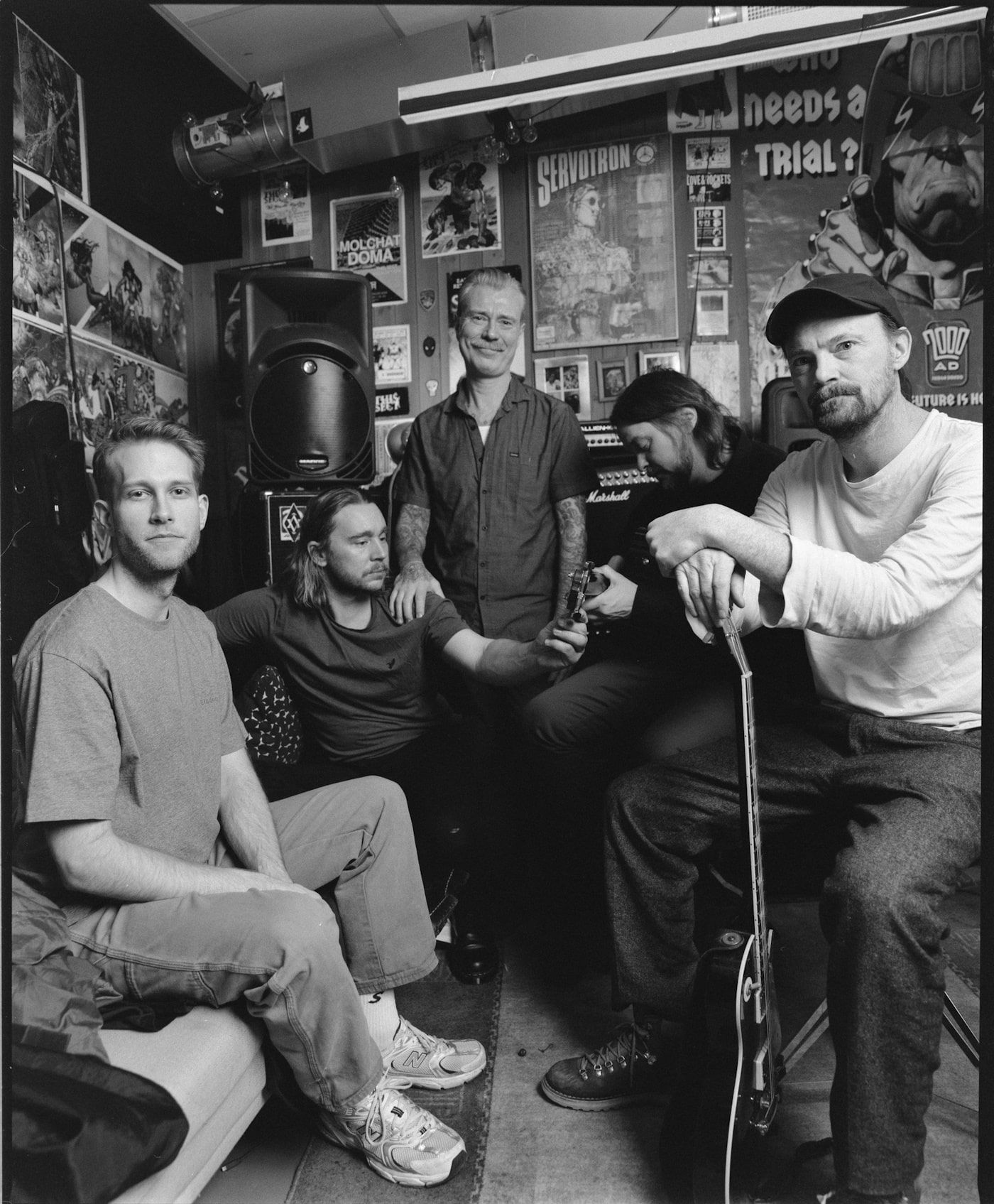
Oslo’s Damokles have been frequent visitors to these pages, and with good reason – few bands pull off the trick of sounding simultaneously dystopian and deeply melodic, the kind of stuff that burrows in and stays. Their third record “A Trophy Collection,” out today via Sect Appeal Records, is a concept album that follows a fictional serial killer from adolescence to the courtroom. It’s not told in order, and that’s the point.
The album’s thirteen tracks scramble the timeline deliberately. Lyricist and artist Gøran Karlsvik: “We let how the songs sounded together dictate the order, rather than try to deliver a chronological story. I wanted a mixed up narrative anyway, peeping into various stages in his ‘career’, all the way from plotting his first hit as a teen, onto gradually becoming a seasoned killer, floating through his demeanours with self-confidence and an almost chameleon-esque charm.”
The bookends tell you everything. Opener “An Open Letter” drops us into the courtroom, the killer confronted by victims’ families, rationalizing, showing zero remorse — all of it filtered through a lens of twisted artistry. Closer “Post-Mortem Lament” follows him into an afterlife heavy on Greek mythology, drifting along the river Styx with his victims at his side, content he’ll never be alone. The band name itself is a nod to that world — the Sword of Damocles, kept in its original Greek spelling, the ancient parable about constant threat looming over those in power.
Between those two poles: the hunt, the ritual, the self-mythology. “Red Tag” is the killer culling his city, turning skeletal remains into “connect-the-dots pieces of freeform art.” “Angel in a Dumpster” carries this eerie tenderness — the killer as caretaker, promising he’d never leave his victims discarded. “Waterworks” is pure stalking, clinical and patient, down to memorized jogging routes and Reebok shoes on tarmac.
“The Quiet Game” is maybe the bleakest of the lot: “You prepare to sleep, I pretend to live.” “Grief Eater” invokes Abaddon, king of an army of locusts, the biblical angel of the abyss. “Dirt Forge” and “Orphanmaker” work the space between obsession and violence, while “My Freudian Slit” — title and all — is the killer as sculptor, carving, watching, becoming.
So why spend an entire album inside a serial killer’s head? Karlsvik has the background for it. He’s an author and journalist who has covered real crime scenes, and wrote an award-winning book on the history of capital punishment in Norway, “Grim Justis – Svartebok om Dødstraff i Norge.” “I wanted to step out of my ‘comfort zone’, or maybe the correct term would be ‘discomfort’, as I’ve usually used my creative writing as a vessel to purge my own demons,” he says. “I wanted a slight break from that catharsis and focus on telling a story, and not my own. To explore different avenues of humanity than my own psyche.”
His research appetite goes back decades — Ed Gein, Jeffrey Dahmer, John Wayne Gacy, Albert Fish, Ted Bundy. He cites the 1986 TV series “The Deliberate Stranger” as his first exposure to the genre, and says he’s read “American Psycho” roughly ten times. Two books were especially useful: “A-Z of Serial Killers” and “Answer Me! The First Three” by Jim Goad. The character he built borrows the vulnerability and loneliness of Gein, Dahmer, and Fish, then morphs into the savagery of Gacy and Bundy.
View this post on Instagram
But the record isn’t interested in glorification. Karlsvik’s take is more diagnostic: “The over-arching plot in this concept album is that a monster can be created, through a perfect storm of Nature vs. Nurture. Somewhere along the line, during formative years, there’ll be tell-tale signs of antisocial behaviour, and it’s up to us as a society to detect this. Just look at Dahmer; the clues were there, yet no-one cared to investigate further. Every killer was once a neglected child, built to feel some semblance of love and kinship. No man is born evil.”
He pushes it further: “The concept of ‘evil’ is just a biblical moral construct, built to front mythological fear, life is more complex than that. There are no boogeymen, besides those we create ourselves as a broken collective. We have a tendency to dehumanize our villains. That to me feels like the same sort of trap that these offenders went into in the first place; the first stop in their procedure would be to dehumanize their victims.” He pauses on that point — wars, genocides, the same mechanism recurring through history. “I tried to look behind the façade. Even the scariest motherfuckers out there were once kids. Empathy for the devil!”
Sonically, “A Trophy Collection” is a deliberate step away from the noisier post-hardcore Damokles have leaned into before.
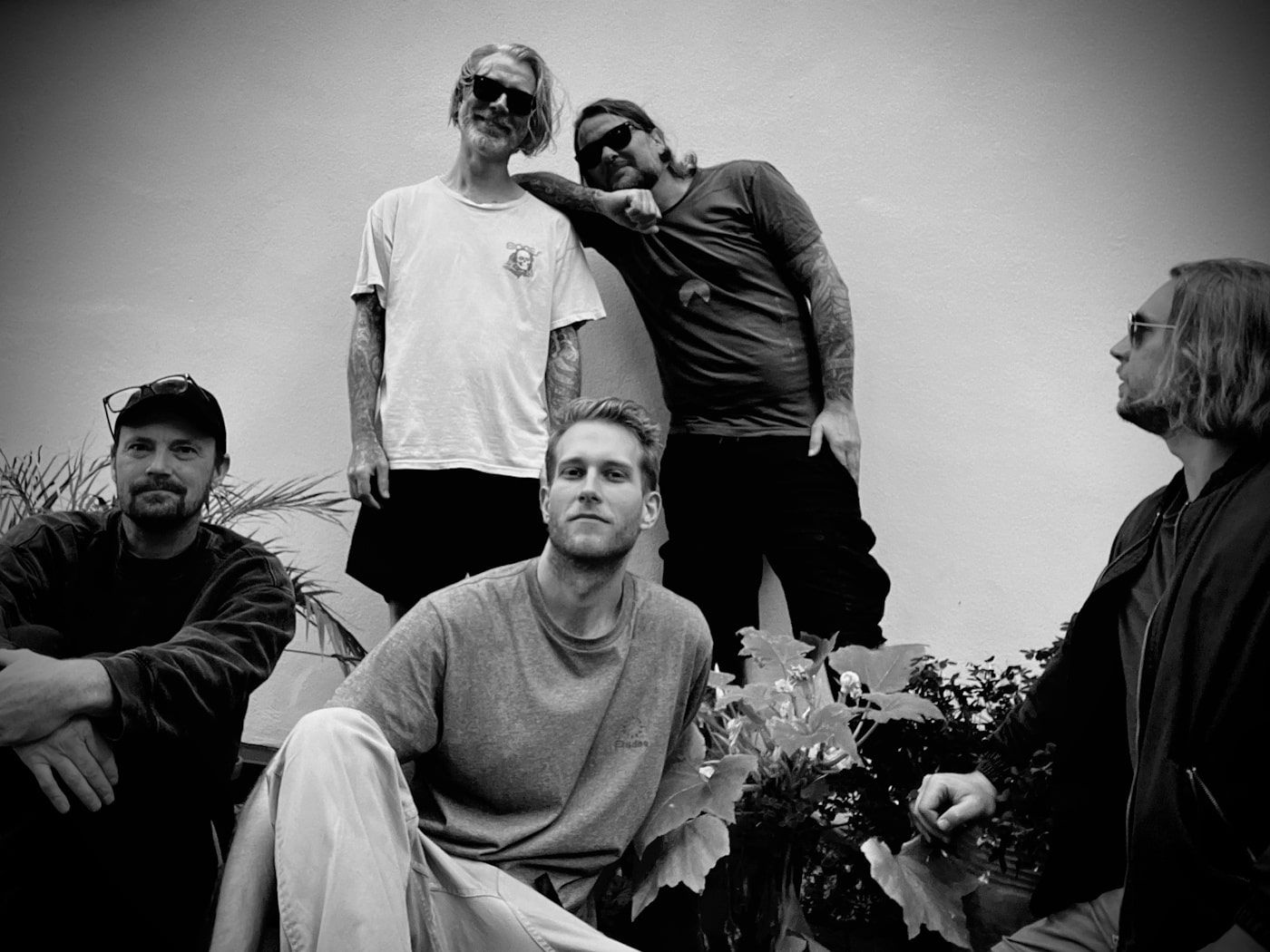
The band — Jonatan Eikum, Ronny Flissundet, Gøran Karlsvik, Kristian Liljan, and Fredrik Ryberg — still keep Fugazi-esque post-hardcore running at the base level of their atmopsheric alt indie rock, but the surface here draws more from Nick Cave (the Birthday Party era and those first nine Bad Seeds albums, specifically “Deep in the Woods”), Bowie’s Berlin-era experimentalism, Afghan Whigs’ sensual and unsettling swagger, and The Cure’s epic melancholia. There’s even some Beach Boys in the vocal harmonies.
View this post on Instagram
“We wanted this album to be a thing of gruesome beauty, and focused on the pop element of it, rather than to be in our noisy post-hardcore comfort zone,” Karlsvik explains. “We’ll get right back to that modus on album four anyway…” He also notes the deliberate elegance in the songwriting: “I wanted an elegance and grace in the songs, seeing how bleak the subject matter is. To cushion the blow with noise certainly wouldn’t work, both aesthetically and contentwise.” The band jokingly call some of these “power ballads,” and there’s truth in the joke.
Mixed and mastered at Crystal Island Studio. Artwork and lyrics by Karlsvik. Released through Sect Appeal Records with booking handled by Relentless Booking.
The Oslo context matters here. Damokles have operated out of a shared studio space at Mir — a venue and artist community — since 2003. Karlsvik describes the local scene as having shed its old divisions: “Back in the day the local scenes in Oslo were very divided, folks kept to themselves in their own micro cosmoses. Now, thanks in many parts to some really good alternative venues, like Vaterland, Goldie, Revolver, Mir, Brewgata, Blitz, Hærverk and Blå, plus related mini festivals, I really feel that it’s all one big happy family now. No sharp elbows, metalheads and electronica nerds all come together for shows.”
All five members are active across other projects – Contrarian, Rule of Two, Inhumanoids, Endtimers, Dunderbeist, ZAP, Kite, Astrosaur, and This Sect — connecting them to wildly different corners of the Norwegian underground. Karlsvik himself is equally invested in electronic music through Contrarian and Inhumanoids these days. The crossover is real: Damokles draw audiences from indie rock circles and hardcore punk alike. “The main point being that we all like to keep busy,” he says. “Punk rock lifers forever, eternally sixteen years old on a mental scale.”
“A Trophy Collection” is out now.