
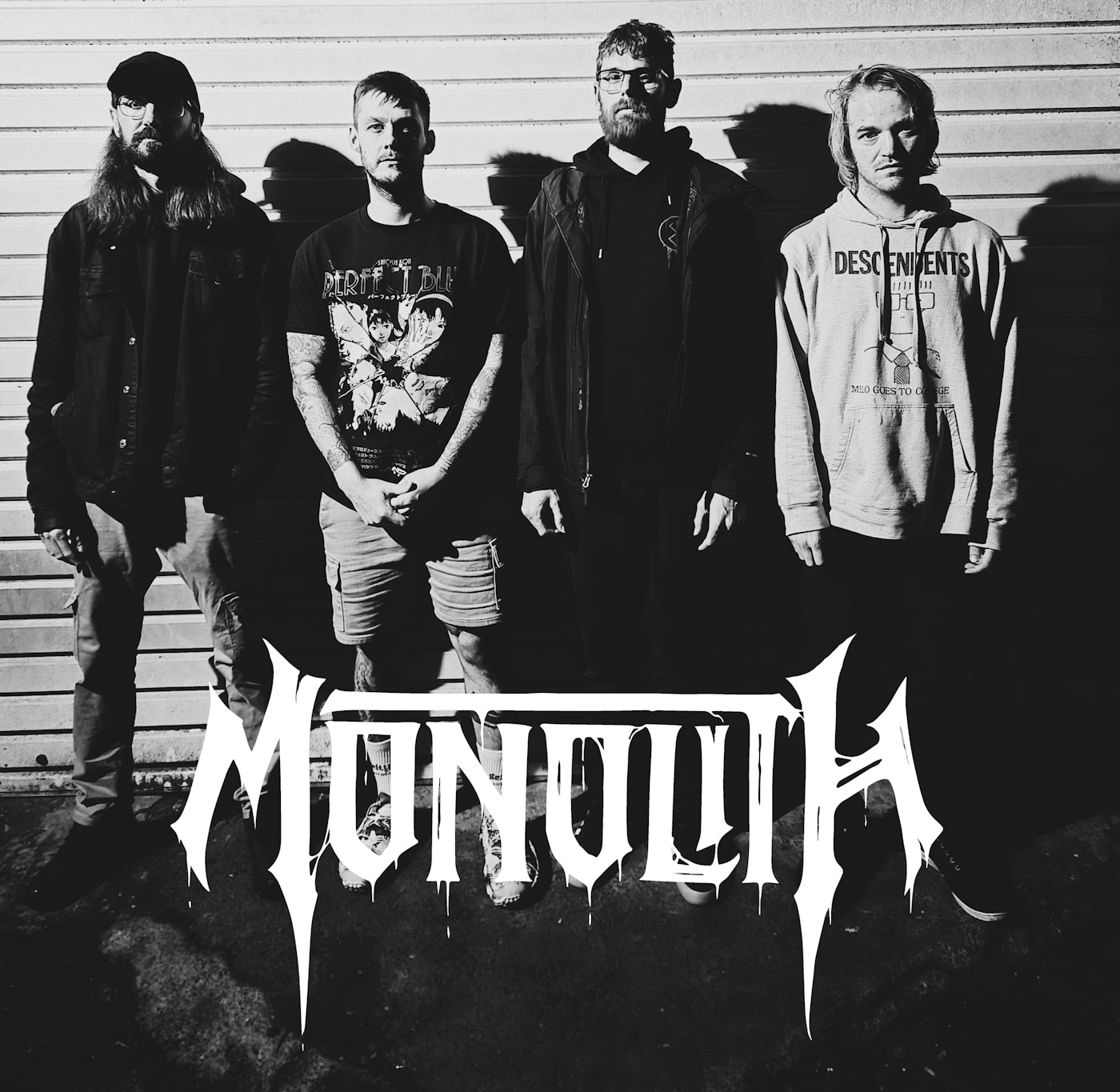
On 5 December 2025, MONOLITH release their sixth studio album “The Price of Their Heaven”, a self-recorded, self-released ode to melodic hardcore and hardcore punk that rewinds their sprawling sci-fi universe to the point just before judgement falls. The Devon and Cornwall band pitch the record as “a scathing indictment of society told from the viewpoint of a downtrodden man with a thirst for revolution”, tracked live with improvised vocal delivery, no overdubs and performances captured in single takes.
Recorded, mixed and mastered once again by guitarist Rob Gibbons and issued through Nightmarcher Records, it’s framed as MONOLITH at their most bare and exposed rather than as a studio puzzle.
Like everything in the MONOLITH catalogue, “The Price of Their Heaven” is just one piece of a much bigger narrative puzzle.
All their records form a single looping story built on ontological and temporal paradoxes, where each chapter causes the events before and after it. “Sancta Trinitas” introduces the galactic super-entity known as The Monolith God, watching a self-destructing Earth from the Great Attractor and answering with a neutron star and impending starquake. “No Saints No Solace” follows a man who believes himself to be the devil and is condemned to eternal torment. “Hornets Nest”, “Lord of the Insect Order” and “The Black Cradle” stack up murder, alien caterpillars and deep-sea escape attempts against that same looming extinction event.
View this post on Instagram
“The Price of Their Heaven” sits before all of that.
The lyric sheet makes it clear that these songs “take place prior to the awakening of The Monolith God, outlining the world we find ourselves in today and its downfall that ultimately leads to the judgement and the creation of the starquake.”
The story is told through “the thoughts and eventually the actions of a man disillusioned by the state of the modern world”, a working-class figure from a town “forgotten by its former industry”, where people “live to work in order to survive and are chastised for wanting more, whether it be resources to thrive or to have meaning in the things they do.”
That set-up bleeds directly into opener “What”. The narrator dreams of another reality: “I dream of staring up and all is serene, there’s still questionless death but we get to live in between.” Instead he wakes in “the familiar tale, the same place a few degrees from nowhere”, a landscape where “there used to be people here, we used to hear their songs / Now there’s nothing, now there’s no one.”
The core phrase of the album lands early and repeats like a warning siren: “This is the price of their heaven, they stole it all and we just let them.” The voice isn’t heroic; it’s resigned, stuck asking “where did it all go so wrong” while watching “the docks, now orange and jagged” collapse into the sea.
Across “What”, MONOLITH keep circling that uneasy complicity. The narrator admits, “We close our eyes and wish we never have to speak out / We lament on if onlys and crawl back into our shells,” even as he spells out how thoroughly people have been strip-mined: “We fed it our limbs and dreams, they mean nothing if we don’t succeed.” The “it” is never named, but between industry, state and capital, you don’t really need a label.
“Choice” drags the lens to war zones and the military economy. The main character shows up as “a forgotten man in a forsaken land, just taking the only option I had”, standing under bombardment while “the dust bombards my eyes” and “the blasts assault my ears, I’ve no idea what they’re saying.” The word “Invader” drops like a stamp from somewhere above his head, not something he’s chosen. He knows exactly who benefits: “The boys down at Lockheed are smiling, they say business has never been so good / But we don’t share the same spoils do we, I’m not allowed to breathe the same air.” The judgement about who is “savage” cuts both ways: “He told me they were savages there but the reflection is quite damning.” The track reads like someone realising in real time that their role in the script is disposable.
On “Do”, the target shifts back to work and the myth of meritocracy. The narrator describes being drilled “to the bone” with the promise that “we’ll discover what makes us whole”, calling it “a strange fetish they’ve got us craving.” Any sense of autonomy is treated as theatre: “There’s no time to question it at all, to change the words atop the gates, was the choice ever not an illusion?” The supposed exit ramps are bleak: “A few more years, you’ll be set free / Life committed, you’ll be set free.” When he wonders, “Can my actions at least be used for good,” the answer from the world around him is to brand him “ungrateful, utopian, not living in reality.”
“Do” is where the record’s political teeth really show. The narrator asks, “When did it become radical to strive for something more than survival for all beings,” then follows the money: “Do you ever wonder why they monopolised violence / Nothing is gained through negotiation; how it’s always been.” He knows how these thoughts get framed: “These ideas are very dangerous things / Their way of life is not to serve us.” There’s a hint of possibility—“We can defy, in great numbers our rise couldn’t be hampered”—but it’s immediately undercut by regret over “seasons wasted, paralysed by hope alone, naively expectant of change.”
“The” takes on climate breakdown and growth-at-all-costs politics in blunt language. “The impact is there and they ignore it / They just fund the spread of another opinion / The machine must keep whirring, the uncontrollable growth system.” The hook isn’t subtle: “Only when it’s too late will they sell you the solution.” One line sums up the modern policy argument in a single question: “Which charts do you side with, the climate or the economy?” Later, the narrator sketches the psychology that keeps people in line: “Apathy is borne from its design, we cover our eyes from the ruins / Look to only preserve yourself, sleep away all the unease / Learn to adore the seclusion, embrace the will of the tides.” That last twist—“At least I get to see out another day but is that all I’ve got to live for? / It will until it won’t: we will until we won’t”—spells out how temporary that safety really is.
View this post on Instagram
“People” pushes hardest into explicit, present-tense politics. The opening mantra, “Appease appease, the game we seem to play,” sets up a situation where “history is bound to repeat but the beast has changed.” Leaders “say nothing and continue to ignore our pleas”, while “people [are] stripped of their humanity.” The line “One day they will be free, from the river to the sea” connects the song to a specific liberation slogan, and MONOLITH don’t soften the language around it. The narrator insists “you can’t change what we have seen, you can’t bury us all under the rubble” and asks, “We’re the people full of hatred while you obliterate anyone who stands against you?” The chorus of voices promises that “their names will ring out and echo in your ears for eternity” and calls “an entire nation… the price of your heaven.” Accountability is non-negotiable: “You will bear the brunt of the shame / You will atone for the crimes we all have witnessed / They will call us every name and try every way to silence / We will call it for what it is.”
If “People” is the mass front of the record, “Have” zeros in on home soil, watching a country drift towards reaction. “There’s always talk of values, but the message has been diluted along the way / Once stoic in adversity, tolerant and diverse at its core / Now we’re acting like our special friends and it’s fear and hate thy neighbour.” Politics is reduced to a game where “it’s all winners, losers and spite, step on anyone to get to the top.” The narrator refuses to sign up: “I serve no man, no flag, no fucking god.” The description of “bootlicking brown shirts” and “well funded odious pigs all at the trough / With just their own concerns at heart” lands like a barstool rant aimed at pundits and politicians trading on “take back our country” rhetoric without any real sense of what that would mean.
By the time “Left” and “Except” roll around, the character is frayed from overload. “The cycle is always the same, too much happening to even concentrate / I’m struggling to keep the faith,” he admits, watching “so much rage with no outlet, no one feels represented.” Whoever “they” are in this context, “they want us to turn to hatred / But they need us and we don’t need them at all,” a line that tries to flip the power dynamic even as he acknowledges being “forced to kneel before them and call it peace.” The answer he offers is to “return our sights to the orchestrators… the oppressors,” treating them as “just flesh after all,” not untouchable figures.
“Except” sums up the cost of that same progress-talk from the ground level. “It feels so damn wretched, the defenceless get sacrificed / We’re dying in the name of progress, but where are we really heading?” The golden age everyone was promised is already gone: “The golden age, ripped away, bled dry no need for better days / They stood on a platform of ‘we could all see ourselves bloom’ / But now things don’t grow on trees, yet we can see the roots part the ground beneath us.” The blood metaphor becomes literal: “If there was a way they could leverage our blood they would / Isn’t that what they are doing anyway? / Just in a more insidious way that comes across in our best interests.” The image of “wells” built in hope of rain, only for those in power to “gorge on the pain of those who were chosen for the greater good,” underlines how far the record is from simple protest sloganeering.
View this post on Instagram
“Apathy” sits on the lyric sheet as a title with no printed text, which feels deliberate given how central the word is to the album’s framing question. Rather than spelling everything out, MONOLITH leave a gap where resignation should be, a silent counterweight to what comes next.
On “Or”, that gap closes. The track opens: “The stage has been set, their power so vast / The liberty is a luxury, a mere slack on the chain,” with basic empathy treated as contraband: “Pushed and corralled, outlaw basic empathy.” The sense that the system can be reformed is gone: “It could never be relinquished without decimation / The incentive is to extract, hoard and consume / We foster a world that breeds its own tyrants.” Even successful revolt looks compromised: “All it would [take] to dethrone one and another takes its place / All the while the suffering permeates.” The narrator knows the warnings “long ago uttered” and still recognises that “it’s too late to halt.” Yet there’s a refusal to treat life as something handed down from above: “Our existence is not a concession or a debate / An unobtrusive life is not one you can constrain and dictate.” The song ends with a blunt instruction: “Learn where you must stand and hold the hilt with both hands / Never bow to their demands, take them with you if given the chance / Arm yourself, show them the price of their heaven.”
Closer “Violence” is exactly what the title suggests: the character finally acting on the question that’s been forming across the record—“What meaningful choice do the people have left except apathy or violence?”—and choosing the latter in an attempt to “spark a revolution” that ultimately fails.
The song opens with the unsettling admission that “the taste confounds the appetite / A cynical conclusion to epochs of struggle,” but there’s no pretense of moral high ground. “We always return to our unrefined ways / I suppose we were really savages all this time / But God, isn’t this so damn satisfying?” The track leans into rejecting imposed order—“Never destined to be servile, living outside their projections / Embrace the violent rejection of order”—and imagines an aftermath where “the age of silence dies tonight, it’s ours to reclaim, we could fail but the people will remember our names.” The fantasy of “moss covering the shrines, their estates rewilding” is checked by the recognition that “they have poisoned the land and what grows bears their mark.”
The last line folds the whole thing back into its opening image: “One last time I stare up, as my ears ring, all is serene, death awaits but I got to live in between.” It’s not redemption; it’s a small, stubborn claim to having existed inside the damage before the universe moves on and The Monolith God finally wakes.