

Eddie Ando spent years wanting to put the noise of a rock band together with the freedom he remembered from clubs. With Echo Servants, a new independent band from Nagoya, Japan, he is finally getting somewhere with that idea.
Their debut single, “Snow & Honey”, brings noisy 12-string guitar and Cha’s vocals into a recording with trap-style hi-hats, sub-bass and synthesizers. It is rooted in shoegaze, noise-pop and post-punk, though Eddie’s idea of what those sounds can do has changed considerably since he first started looking for bandmates.
One of the more revealing things about the band is that the first version of “Snow & Honey” had none of those electronic parts. Eddie recorded it with an unplugged Rickenbacker 360/12 and a rough guide vocal. He was still imagining Echo Servants as a fairly large rock band, potentially with a DJ alongside the usual instruments. Cha’s arrival, some unsuccessful attempts at putting a lineup together and a second song called “Anything” gradually changed his approach.
“Until then, I’d been thinking, ‘Who else do we need to complete this band?’
“But I started asking a different question: “‘What does this song actually need?’”
Long before Echo Servants existed, Eddie was playing Sex Pistols covers with Aaron, an exchange student from New Zealand whom he met in high school. They had similar tastes and started a band together, eventually becoming known around their local area. Eddie enjoyed the attention up to a point. Being recognised as “the guy from the band” wherever he went started getting on his nerves.
The two were also going to clubs before they were legally old enough to get in. They lied about their ages, discovered techno and reggae, and found themselves spending time around music that worked very differently from the punk they played.
“What I particularly loved was the anonymity of the dance floor. In a dark club, it didn’t really matter who was in which band or who was watching you. You could simply disappear into the music. I felt incredibly comfortable with that.”
The Stone Roses were already showing him how dance rhythms could work with rock music. Primal Scream’s “Screamadelica” was another big record for him, and My Bloody Valentine’s “Soon” offered an especially convincing example of heavy guitar noise working alongside dance music. He loved the idea that a rock band could be part of club culture.
Those interests survived several changes of musical direction and became central when Eddie started recruiting musicians for Echo Servants. His post on OURSOUNDS, a Japanese website for finding bandmates, used the phrase 踊れるノイズ, or “danceable noise”.
He had previously run into differences with people who wanted to play more conventional rock music. This time he wanted prospective members to understand where he was coming from before they responded.
“So the phrase ‘danceable noise’ was both a musical idea and, in a way, a filter.
“I wanted the power and noise of rock, but I also wanted the groove, freedom and anonymity I’d experienced in clubs.
“I think it was my way of saying, ‘Echo Servants isn’t going to be just a conventional rock band.’”
Cha answered the OURSOUNDS advert. She already knew Eddie’s earlier solo project, m.a.d. sonics, and liked what he had been making, so the two had some common ground before they started working together.
At that point Eddie was writing mostly on his own. With no settled band around him, he had been spending a lot of time experimenting with guitar chords and different voicings, trying to work out which combinations he actually liked. Amusingly, after all that experimentation, “Snow & Honey” ended up using a very simple chord progression.
The guitar itself had taken some finding.
Eddie had spent a long time searching for a Rickenbacker 330/12 or 360/12, partly because of Andy Bell from Ride. He particularly liked Bell’s black 330/12, and Johnny Marr’s use of a black Rickenbacker was another reason he wanted one in that colour. Eddie eventually found a black 360/12, his little tribute to both guitarists.
The instrument can sound remarkably different depending on how much distortion he uses. With a little gain, he gets the chiming quality associated with older 12-string recordings, including The Beatles. Heavy distortion brings out the interaction between the octave strings and harmonics, creating a much rougher, wider guitar sound.
“I don’t want to use a 12-string guitar simply to recreate the sounds of the past.
“I have enormous respect for Andy Bell and Johnny Marr. But I don’t want to copy their sounds or their image. I want to take the things that have influenced me and turn them into my own musical language in the present.”
The first Echo Servants song to use that guitar was actually “Anything”, which the band are planning to release next. It also gave Eddie his first opportunity to experiment with trap-influenced hi-hats.
He had started listening to trap through Lil Peep, later finding Travis Scott and becoming particularly interested in the hi-hat programming of xaviersobased. When Echo Servants still could not find a drummer, Eddie asked Aaron, now living in New Zealand, to record drums for “Anything”.
The song carried a strong influence from The Jesus and Mary Chain, with Eddie paying particular attention to William Reid’s guitar distortion. Putting detailed programmed hi-hats over Aaron’s live drums proved trickier than he expected. They spent time working out how the different rhythms could coexist.
Around the same period, a drummer and bassist briefly joined Echo Servants. Eddie’s growing interest in trap rhythms and electronics did not really suit their musical approach, and they eventually left.
The experience loosened up Eddie’s thinking about the whole band. Cha was happy to use backing tracks where necessary and suggested that they could start playing gigs without waiting indefinitely for the perfect lineup.
“I think that was when Echo Servants began to evolve into something where the band itself could change shape according to the needs of each song, rather than forcing every song into a fixed band format.”
By the time they returned properly to “Snow & Honey“, Eddie had already experimented with live drums, programmed rhythms and the Rickenbacker on “Anything”. He could now build the new recording around what he wanted to hear.
The acoustic sound of his unplugged 360/12 had given him the first version of the song. From there he added electric guitars, programmed drums, trap hi-hats, sub-bass and synths, followed by additional piano and synthesizer layers. The guitars remained the main instrumental part, with the synths used mostly for texture.
Cha took care of the vocals and brought an arrangement idea that Eddie had never considered.
The song originally had a quiet, almost whispered passage leading back into a fairly standard return of the chorus. Cha suggested bringing in a sudden burst of fuzz guitar instead. The vocals following that section also changed, with several lines overlapping in a way Eddie compares to a round or canon.
“That made the song much more dramatic.
“I don’t think I would have come up with that section on my own.
“As we continued working on it, ‘Snow & Honey’ gradually stopped feeling like ‘a demo I’d written’ and started feeling like ‘an Echo Servants song.’
“I think the arrangement toward the end really symbolizes that transformation.”
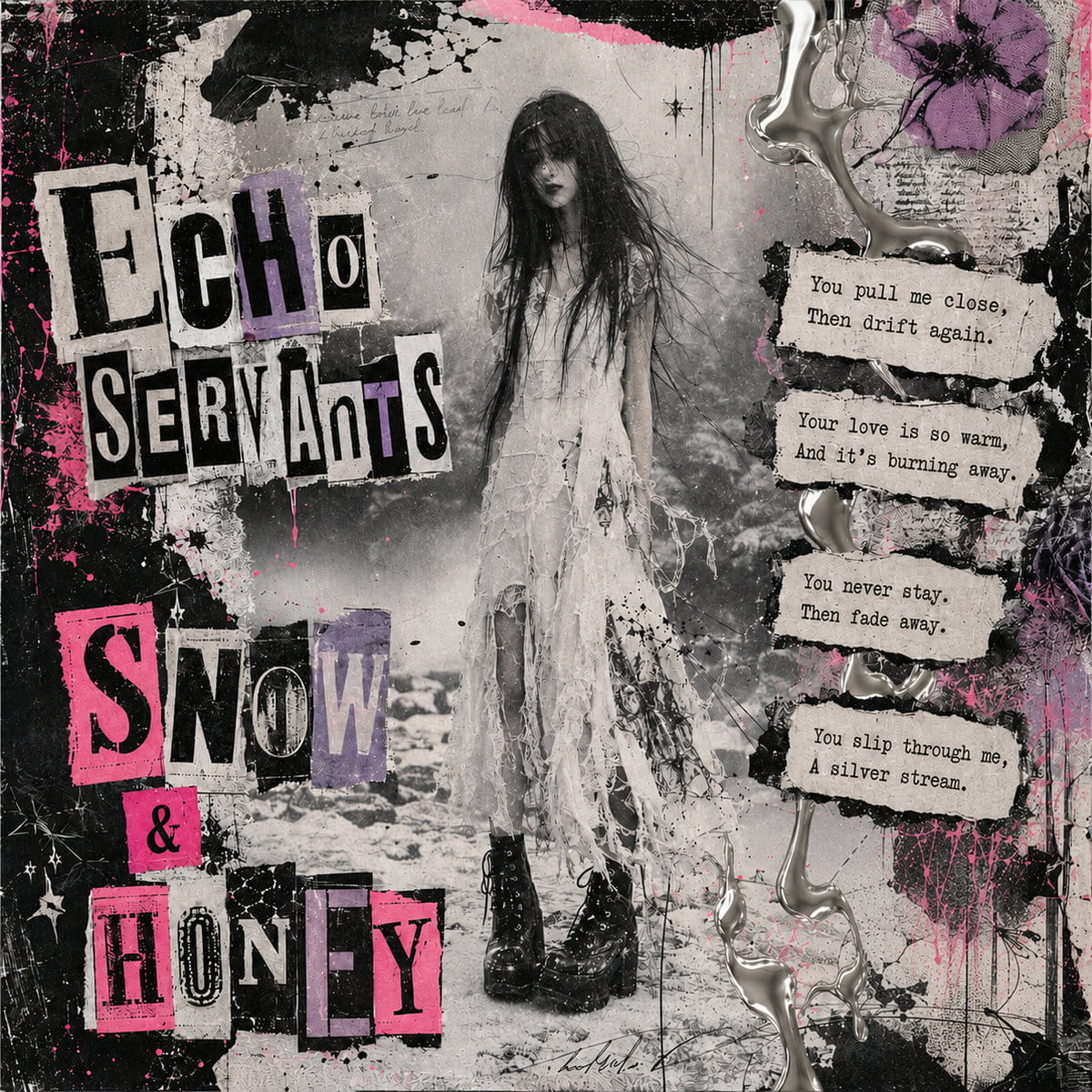
There is another interesting connection to Eddie’s teenage years in the finished recording. For the heavily distorted chorus guitar, he was thinking about Steve Jones of the Sex Pistols, particularly the direct, physical character of his playing. He also sees something slightly reminiscent of the Pistols in the single’s artwork.
He only noticed those connections afterwards. There was no original plan to make a song about his younger days, although some of the music he grew up with had found its way back into what he was doing.
“Snow & Honey” also contains a much more personal part of Eddie’s history.
The title arrived almost at the same time as the lyrics, appearing naturally as the opening phrase of the chorus. As Eddie developed the song, he began thinking about someone who could be warm and affectionate yet remain out of reach. The words deal with attraction, closeness, distance and the difficult business of letting strong feelings go.
He points to one particular lyric:
“your love is so warm / and it’s burning away”
For Eddie, the phrase “burning away” carries a sense of allowing an emotion to run its course, eventually accepting that it cannot remain what it once was. The song draws on different memories, feelings and imagined situations, and he does not consider it a literal account of one relationship.
Some of those feelings go back to his parents.
They divorced when Eddie was seven. Ten years later, around the time he was playing Sex Pistols covers with Aaron, he wanted to reconnect with his father. He eventually found him living in Tokyo and began seeing him again.
Eddie sometimes ended up carrying messages between his parents. His father told him that he still loved his mother deeply and felt lonely. His mother understood why Eddie wanted to see his father, but she had no wish to see him herself. She spoke about her loneliness too.
“I sometimes felt that part of my mother’s loneliness came from the sudden absence of a love that had once been very intense. My father had loved her deeply, and after the divorce that presence was simply gone. I also felt that, after him, there was never really anyone who loved her in quite the same way.
“So I was hearing two very different sides of the same broken relationship. There was still love, but also distance, anger and loneliness. I think that contradiction stayed somewhere inside me.
“Those experiences probably shaped the emotional vocabulary I later used in ‘Snow & Honey,’ even though the song itself is not a literal retelling of them.”
Eddie thinks growing up around those experiences may also have made him sensitive to other people’s loneliness. He connects that with his attraction to songs where warmth and sadness exist together, and with the importance he places on kindness.
His relationship with Tokyo is bound up in the same memories. His father’s office was in Shibuya, and the area still makes Eddie a little sad when he thinks about it. He used footage of Shibuya Crossing in the video for “Snow & Honey” partly for that reason. Among all the people, lights and movement, he sees a place connected to his father and that period of his life.
Those teenage trips to Tokyo also gave Eddie a wider musical outlook than his hometown alone could have offered. Later he studied in Vancouver and travelled to Seattle many times.
Nagoya remains important to him, especially its live music venues.
Electric Lady Land in Osu was somewhere he went regularly from junior high school onwards, and he would love to play there with Echo Servants. He also mentions Daytrip in Tsurumai and the larger Bottom Line. With an earlier band, he played at HUCK FINN roughly once a month for a period, and remembers a particularly varied mix of acts there.
Pop-oriented groups were using programmed tracks, and digital hardcore bands also played the venue. Eddie had seen plenty of examples of musicians combining live instruments and electronics locally, even before he started Echo Servants.
He does not identify the new band with one specific Nagoya shoegaze or post-punk scene. Their music draws on several areas, and he is comfortable with Echo Servants finding their own place in the city.
“Nagoya is home, but my perspective was never entirely local.”
He has also wondered about the effect of growing up in Aichi, an area strongly associated with manufacturing. Cars are the obvious industry, though machinery, ceramics and aerospace are also part of the region’s working life.
Eddie is cautious about drawing a connection between that environment and his music. Still, he wonders whether living somewhere that people and machines coexist so naturally has contributed to his comfort with putting electronic rhythms alongside electric guitars.
The band are now working towards bringing those ideas onto a stage, although Echo Servants have yet to play their first gig.
The current planned four-piece setup has Cha on vocals, Eddie on guitar, Teramoto on drums and Tsuyopon Miyake on percussion. Cha may also play fuzz-heavy bass on certain songs. Depending on the arrangement, sub-bass, synths and programmed hi-hats can come from backing tracks.
For “Snow & Honey”, Eddie thinks the combination of a live drummer and percussionist could make the trap hi-hats unnecessary altogether.
“I don’t want the live version to feel like four people trying to imitate a finished recording. I’d rather let the song change when real players are in the room.”
Wyświetl ten post na Instagramie
The band are also planning to record another, more dance-oriented version of “Snow & Honey” with the current four-member lineup. Eddie sees the possibility of having different arrangements for the same song as something worth pursuing, and the live setup is still open to changes.
“The recording can be one version of the song, and the live performance can become another.”
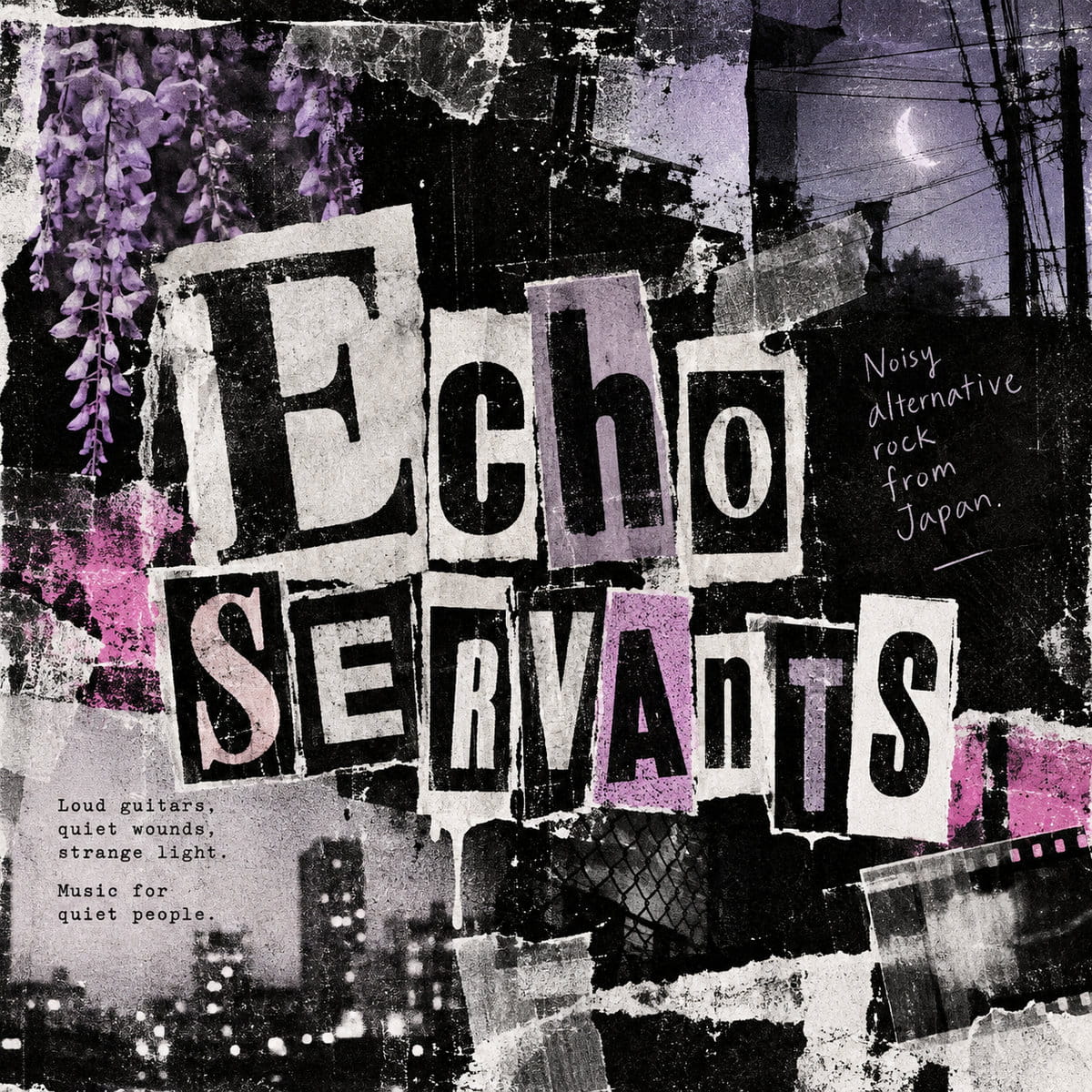
For all the attention given to loud guitars and rhythms, Echo Servants have a surprisingly quiet little phrase attached to their name: “Music for quiet people.”
Eddie says he probably came up with it himself, although he is open about having used ChatGPT to help refine some of the band’s language.
His idea of quiet people has little to do with musical volume. He is thinking of people who spend a lot of time in their own heads, following their interests in music, film, art, fashion or underground culture, often by themselves. Someone listening through headphones on a train or walking alone through a city might be just as absorbed in loud music as somebody standing at the front of a gig.
That takes us back to the teenage Eddie disappearing into a club full of strangers, enjoying the chance to listen and move without anybody caring what band he was in.
“Echo Servants can be very loud, but I don’t think loud music belongs only to loud personalities. Someone can be quiet on the outside and still have a very loud inner world.
“That’s really what ‘Music for quiet people’ means to me.
“The noise can exist on the inside.”
“Snow & Honey” was released independently on 2 October 2026 as Echo Servants’ debut single. Eddie wrote and composed the song, played the guitars, handled programming, and mixed and mastered it. He and Cha produced it together. The band also reported early radio support from DKFM and Red Devil Radio before the release.
You can find Echo Servants at echoservants.com and Instagram, and listen to “Snow & Honey” through their SoundCloud link.