


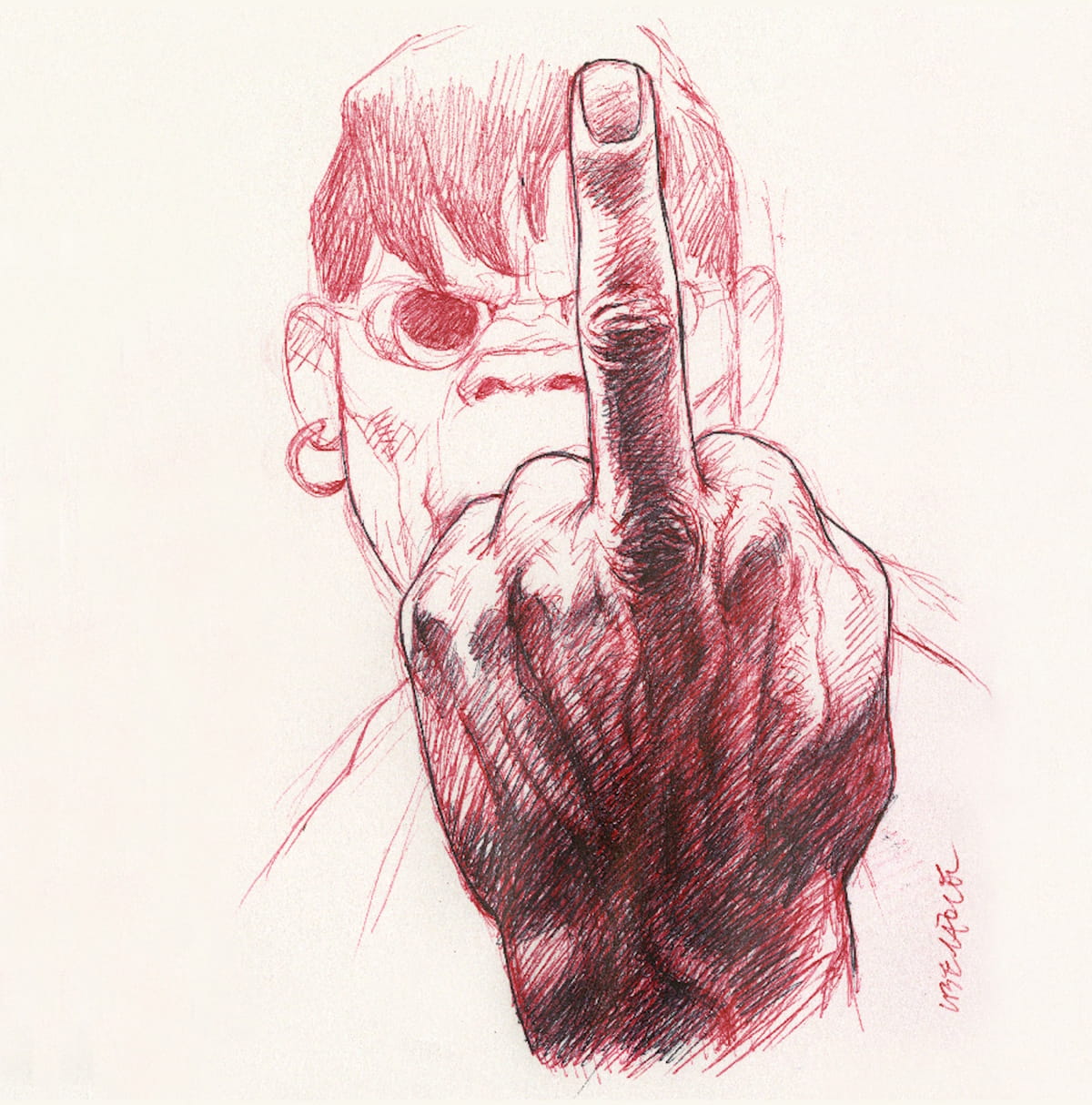
Tanino Liberatore drew Ranxerox flipping the bird for the cover. Paolo Palmacci specifically asked him to. Ranxerox is the android Liberatore assembled from photocopier parts in the pages of Cannibale and Frigidaire in the early 1980s, which means he is also, in Palmacci’s reading, a relative of the fanzine itself, the medium the photocopier made possible.
The cover image of “No Capitulation” performs its own argument. An android built from the same machine that built a subculture, telling everyone looking at it where to go.
“No Capitulation” is the vinyl compilation Palmacci first mentioned in our recent feature on his Fanzinet project, the systematic mapping of 1980s Italian punk fanzines hosted on the Capit Mundi? blog. It came out on 15 May. It is the next step in what Palmacci has called his “open-heart cultural operation”, his attempt to put the critical tools of punk subculture back to work at a moment when, as he puts it, “DIY is increasingly being replaced by AI and critical thinking is ever more rapidly heading toward extinction”. He calls the music inside “musica indispettente”, a play on “musica indipendente” (independent music) that swaps in the Italian verb “indispettire”, to spite or irritate. Spiteful music, shipped with the slogan “listen today and start understanding, in convenient instalments, by the end of 2028”.
The compilation is built around seven imaginary bands.
The bands do not exist. The people performing as them do. Palmacci impersonates one. Six other contributors take the rest. The connection back to Fanzinet is not accidental: four of those six appeared on cassette compilations curated in 1985 and 1986 by the Latina fanzine “Plastica“, on which Palmacci also appeared. He tracked them down during the archival work for Fanzinet, asked them about their old contributions, then asked if they wanted to inhabit one of the fictional bands he had built. They said yes.
The band names are themselves a small treatise on wordplay. Miss Antropussy folds “misanthrope” into something a little ruder. Punkiderma stitches punk to pachyderm. Tom Binou comes from “tombino”, an Italian manhole cover, which is why his band is called Tom Binou and the Ratlickers and the song is “Rock Around the Cloaca“. M’incul Pop rewires MINCULPOP, the Fascist Ministry of Popular Culture (Italy’s organ of state censorship and propaganda), into something that translates as the pop that screws you over. Sonic Barabba, Jim Secjelagotch, and TCYTUAH round out the lineup, each rigged with their own internal joke.
Some, Palmacci notes, were satirical pokes at bands still operating in the province of Latina, where he came up. Others were built to make the listener stop on the name and think.
Jim Secjelagotch’s “Had to Cach the Latex” puts the Doors, Pink Floyd, and Elon Musk in a blender: “Is this the end beautiful friend? / Open AI and let the music die / Careful with that Mask, Elon / Take your filthy hands off the stars / and leave me alone.”
The title routes a Neapolitan turn of phrase about good mozzarella (“the milk has to come out”) through the acidity of psychedelic music. Sonic Barabba’s “Christ in Plastic” runs a two-thousand-year line from Barabbas to the kidnapping and murder of Aldo Moro, where the imagery slides between papal scandal and Italian state terror: “Marcinkus / Archangel Gabriel is much more son of a bitch than Henry Kissinger / Wrapped in Orange Vinyl / so wash your hands / Ponzio Pilato / crucified for Penthouse”. Tom Binou and the Ratlickers’ “Rock Around the Cloaca” calls out the Italian massacre map by name (Piazza Fontana, Piazza della Loggia, San Benedetto Val di Sambro, Via Fani, Bologna Station, Capaci, Via D’Amelio), then closes on a line attributed to Goethe and rerouted into the gutter: “if you really just can’t, at least get the fuck out of the way”.
Miss Antropussy’s “Agent Orange Returns” is the most direct piece on Trump and what Palmacci calls “new american imperialism”, ending on a chant of “with friends like this / we don’t need enemies / ever again”.
Punkiderma’s “Peso Ergo Sum” (Italian for “I weigh, therefore I am”) plays Descartes against Kundera, with the title resting on the Italian double meaning of “pesante/pensante” (heavy/thinking): “every lightness is unbearable to me / because it’s only the symptom / of your pettiness”.
M’incul Pop’s “…” builds double-meaning innuendo out of the censorship apparatus that once silenced dissent and now sells back consumerist pop. TCYTUAH’s “There Are Wars” is the bluntest text on the record, freely adapted from an article by the Turkish journalist Ece Temelkuran on radical evil, the neoliberal machine, and the daily livestream of genocide.
Between the tracks sit the “réclame”, retro Italian-style fake adverts for fictional Capit Mundi? products. “Holygram Restyler” promises happier daily log-ins for those who pay the weekly subscription to feel creative (“artificialized or your money back”).

“Capit News (in Filthy-Vision)” is a satellite news service broadcast at 3:15 in the morning, branded as the shadow opposite of the Istituto Luce, the Fascist regime’s propaganda film agency.
“The Proto-Collapses of the Elders of the Hpyrloo Nursing Home” is a role-playing game with the Protocols of Zion buried inside its title. “Psycho-Prompt” is a virtual hardware store.

“Mule Thinker” is a thougt emulator for those worried they cannot install the system’s latest update: “the voices that guide you while you shop or when you’re at the ballot box don’t come from outside, they’re inside you”. “Fabulous Future for Dummies” rewrites history for the functionally illiterate, who dream of digital totalitarianism while awaiting the coming of the Great Chip.

Hpyrloo, the imaginary city these adverts keep advertising, is the conceptual centre of the record. The name, pronounced in Italian, sounds like “accapirlo”: “if only one could grasp it”.

Palmacci builds it as a Hakim Bey-style Temporary Autonomous Zone, set against what he describes as the technocratic utopia of the PayPal Mafia.
He calls his approach “homeo-utopia”: curing utopias with utopias. Buy the vinyl and you get an instant residency application form inside. The sublingual three-inch purple vinyl also has an NFC tag tucked in, which redeems the digital version on Bandcamp when held against a phone. The ad copy for the format mocks itself: “you’ve got a DeLorean with a souped-up exhaust faster than the one in the movie, an atomic precision slingshot in your pocket, and a geisha android for a wife that you designed in 3D with the dedicated app, but if you still feel something’s missing, then you need our ‘Sublingual 3-inch Pocket Purple Vinyls’ for faster assimilation”.

The vinyl was pressed for a reason. Palmacci wanted the project to have a physical reality that connects back to the concreteness everyone who contributed comes from. The sleeve that holds the disc is a single large folded sheet, “Capitzine?”, which is, in form and content, a fanzine. Liberatore handled the front. Three other collages inside are by Angela Valcavi, Giacomo Spazio, and Fabrizio Basso. The largest of them was assembled by Palmacci himself.
He locates the whole apparatus in a tradition of situationist détournement, dosed with surrealism and dadaism, and points out that the project is built across media in a specific order. The Capit Mundi? website comes first, presenting the imaginary bands and their releases. Images and videos follow. Then the bands take shape. Then the record is pressed.
The story is not over.
Palmacci is planning a happening-event at which one or two of the bands will perform live. The current hypothesis is the Cicerones and the Tokkamose. At that event the unsold copies of the vinyl will, in his words, be “immolated to the Great Nothing”, a closing act of non-surrender. He cites Caesar’s line on the suicide of Cato the Younger, who killed himself rather than submit: “I envy you your death, Cato, since you envied me the glory of saving you”.
What Fanzinet and “No Capitulation” share is the same claim: that the analog network Palmacci has been reconstructing, one fanzine at a time, still contains usable equipment, the critical reflexes and production habits and ways of relating that survive being slowed down.
The aim, he says, is modest. “To generate some small new state of agitation.” He signs off the way he closes most of his messages. “I’m still trying to understand many aspects myself. Little by little we’ll get there.”
🔔 IDIOTEQ is ad-free, independent, and runs on one person’s time. If you want it to stay that way: DONATE via PayPal 𝗈𝗋 SUPPORT via Patreon.
Stay connected via Newsletter · Instagram · Facebook · X (Twitter) · Threads · Bluesky · Messenger · WhatsApp.