
A drum mistake sits at the center of Gnaw’s first EP. A clipped MIDI bar, one beat missing, the rhythm stumbling in a way that shouldn’t quite work. Instead of fixing it, they leaned in. That small rupture became a kind of internal logic—something unstable but repeatable, like a thought you can’t shake.
“Gash” opens from there, already mid-question. Tara exlains: “‘Gash’ is an urgent questioning to, ‘Should I still go for it?’ Grappling with the tension of desire against the weight of aging and doubts. You might have poured yourself into the ride once but find yourself asking if it’s worth going again.”
The song doesn’t resolve that tension so much as circle it, driven by drums that were originally just a solo experiment in Logic. Dan recalls building everything around that initial take: “At some point I thought, okay, this drum part might actually work as a song, and that idea ended up driving the whole track.”
The instability wasn’t planned. “I accidentally cut off a beat in each bar while editing the MIDI drums,” he says. “But that subtle mistake made the rhythm feel really erratic, and that sense of instability ended up becoming something that felt really foundational to Gnaw’s sound.” Even the guitars follow that logic—less about weight, more about unease. He chased a synth-like glide using only guitar, EQ, and stock distortion, trying to mimic portamento without smoothing it out too much. “I wanted to recreate that and make it sound a little uncanny on first listen.”
Zakhran locked his parts in almost immediately. “We did a few more for safety but he really got it down in the first take,” Dan notes. For Zakhran, it felt familiar terrain—odd time signatures, shifting ground. “I’m addicted to math / odd time signatures,” he says. The reference point he reached for was The Armed’s “AN ITERATION,” not for imitation but for its density and forward motion.
If “Gash” starts from fracture, the newest single and the EP’s second track “Star” stretches that outward.
The image was simple at first—a descending meteorite—but it didn’t stay abstract for long. “The idea of ‘stars’ expanded in my mind from something cosmic and celestial to something closer to everyday reality,” Tara says. “I was imagining what someone might feel like in the pursuit of ‘stardom’ – to a point of madness. A kind of mental, burning ritual. Stars shine brightly, but they’re also distant. They might eventually burn out.”
Dan approached it with restraint. “I wanted to write something heavy, but not too overtly heavy.” The main riff falls down the low E string, split between two impulses: one rooted in the weight and texture of Hole and The Smashing Pumpkins, the other unexpectedly lifted from Girls’ Generation’s “Into the New World.” “That melody is so simple but incredibly effective,” he says. “I rearranged the notes from it in a way that contrasts with the heavier half of the riff, but not in a way that feels too jarring.”
Time signatures slide in and out—3/4, 4/4, 7/4—partly a nod to Rush, partly just instinct. “I’ve always loved how they use unusual time signatures—sometimes subtly—but in a way that really defines the song.” There’s also something else threading through it: the way Crying rework prog ideas into something playful without losing intention. That approach feeds directly into how “Star” moves, especially once the chorus shifts key through a pivot modulation, borrowing from The Beatles’ “Lucy in the Sky with Diamonds” and Weezer’s “Falling for You.”
Wyświetl ten post na Instagramie
Zakhran treats the drums as something more elastic than a fixed backbone. “I wanted to play around with the feel of the beat by changing where the snare lands,” he says. At the time, he was deep into DnB and breakcore—Russell Holzman’s playing, Cycle-One’s “Cast Away,” Bring Me The Horizon’s “puss-e.” Those ideas bleed into the intro and the last chorus, just slowed down enough to sit inside the song without breaking it.
“Treats” shifts the weight again, this time onto bass. Tara frames it from the inside: “It explores an unstable internal world and existentialism; the riffs push forward but something simmers underneath. There’s an awareness that you can’t face yourself. And with that comes disbelief: how could someone still love you in spite of everything?” The arrangement leaves space for that tension. Dan deliberately stepped away from guitar-first writing. “The bassline came from my attempt to recreate a kind of pop sentimentality, but with the bass guitar acting as the primary driving force.”
Guitars still cut through, but differently—harmonized lines instead of block chords, drawing from The Strokes’ “Under Cover of Darkness.” “Since the bass was carrying so much of the rhythm, it didn’t feel appropriate for the 2nd guitar to be playing chords. We wanted to let the bass breathe and shine as much as possible,” he says, before adding, “I feel like we should bring harmonizing guitar back and I will probably die on that hill.” The solo leans heavier, pulling from Deafheaven, Chat Pile, and Zolof the Rock & Roll Destroyer, more about pressure than precision.
Zakhran treats it as a reset. “As someone that has been playing mostly prog and math rock, this song was a refreshing challenge for me.” He pulls from indie rock and pop—Arctic Monkeys, The Strokes, Phoenix—tracking the accents of the vocals and guitars, then breaking loose in the bridge when given the space.
Wyświetl ten post na Instagramie
“This Is My Life Now” drags itself forward at a different pace. Tara describes it as “a trudging confrontation with a mechanical, colourless life,” where everything feels locked into repetition, broken only by “rare flickers of light.” The song took time to land. Dan shelved it for months. “Everything just sounded really bad and I’ve learnt that not all chord progression or riff works with this beat.” When he came back, it was through repetition—looping the rhythm until something clicked.
The shape comes from restraint. Influences like Big Thief’s live version of “Dragon New Warm Mountain I Believe in You” and Red House Painters’ “Between Days” pushed him toward space—pauses that let each chord sit longer than expected. “It’s groovy, it’s simple, it’s compelling,” he says. “It brings so much focus to each chord, each note, the vocal melody that floats right above and through.” The aim was to push melancholy through something heavier, letting it sink rather than drift.
Then the ending breaks that pattern. The same chord progression accelerates into something closer to eurodance, pulling from Blümchen and Jane Remover’s “Frailty.” “It became really apparent that there is some level of catharsis here,” Dan says. Zakhran takes that shift and pushes it further, even as the rest of the track resists release. Recording it meant stripping things back. “The drums had to be much simpler which forces each hit to be more intentional,” he says, referencing Mew’s Silas and the way minimal playing can sit against more complex structures. For the second chorus, he flips the feel into half-time, “to hopefully pull them into a ‘dreamier’ feeling.”
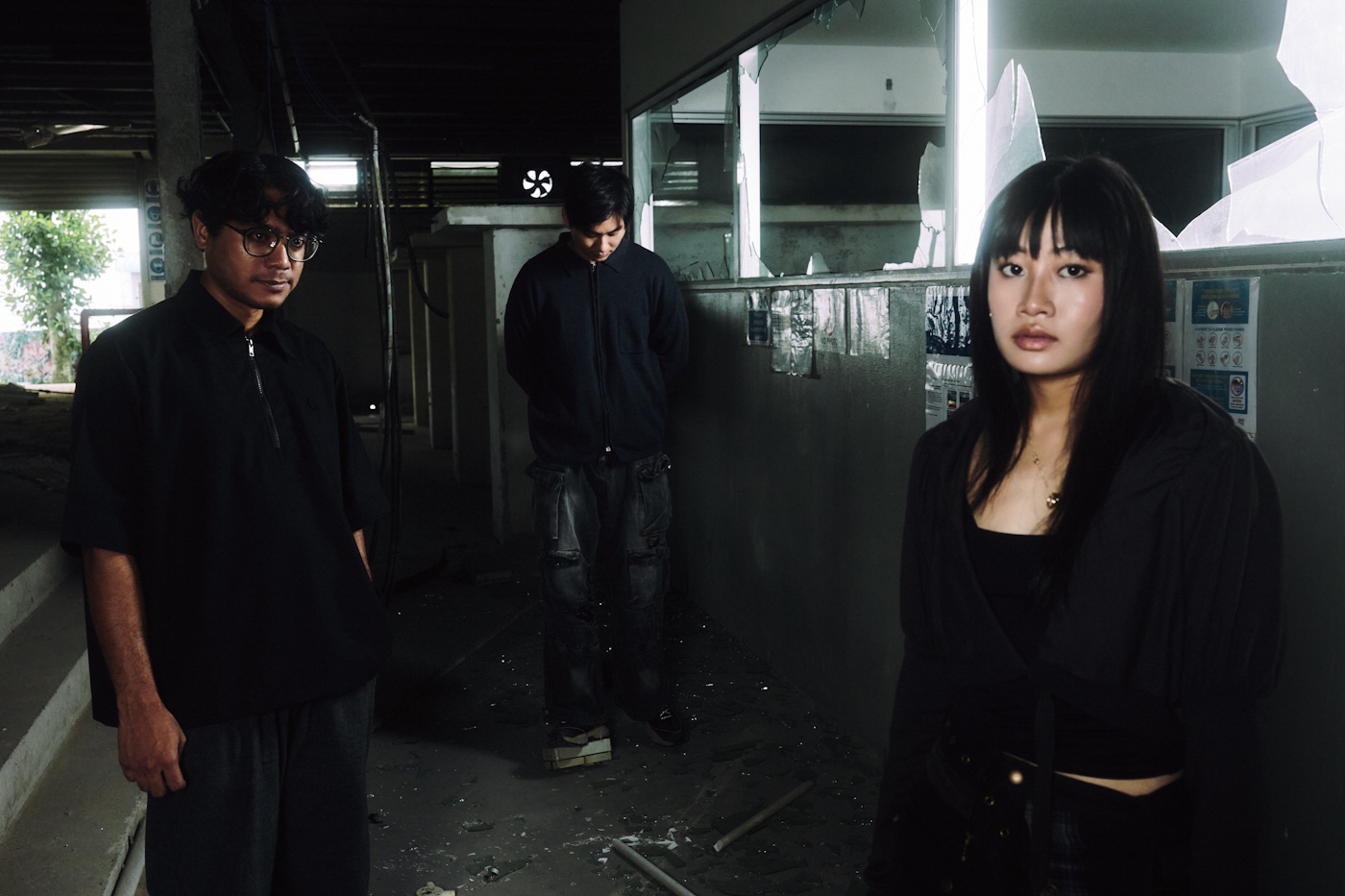
All of this sits inside a broader context that doesn’t get spelled out directly in the songs but leaks into them anyway. Singapore’s scene, as they describe it, is wide open—multiple pockets, different sounds, people showing up for each other without much friction. That openness makes it easier to borrow, to collide ideas that wouldn’t normally share space.
At the same time, there’s pressure running underneath daily life. “It can get dreary living in a country with a strong pressure to conform to a certain pace of life, expectations, and particular definition of success,” they say. That tension feeds directly into the two poles of Gnaw’s sound: chaos and catharsis. “It is not a commentary on the state of things, nor are we challenging the state of things. We just want to create a worldview through Gnaw to remind people that even if you feel like a cog in a machine, you still matter.”
Their reference points reflect that push and pull. There’s no fixed lineage, just a loose filter: songs that “boggles our mind, makes us feel things, and something that becomes a chaotic earworm.” Gnaw ends up as a collection of those instincts rather than a single direction.
Wyświetl ten post na Instagramie
Even the production follows this strategy. No amps, no amp sims. Guitars and bass go straight into an interface preamp, then get shaped with distortion, compression, EQ. “We basically apply digital distortion to everything,” they say, but carefully enough that it doesn’t flatten the original idea. The aim isn’t polish. It’s to “capture the energy and chaos of a live band through a digital medium” without sanding down the edges that made it worth recording in the first place.
“Inside a Machine That’s Glistening” is out April 10, with “Star” leading and a video for “Gash” arriving alongside the release.
🔔 IDIOTEQ is ad-free, independent, and runs on one person’s time. If you want it to stay that way: DONATE via PayPal 𝗈𝗋 SUPPORT via Patreon.
Stay connected via Newsletter · Instagram · Facebook · X (Twitter) · Threads · Bluesky · Messenger · WhatsApp.