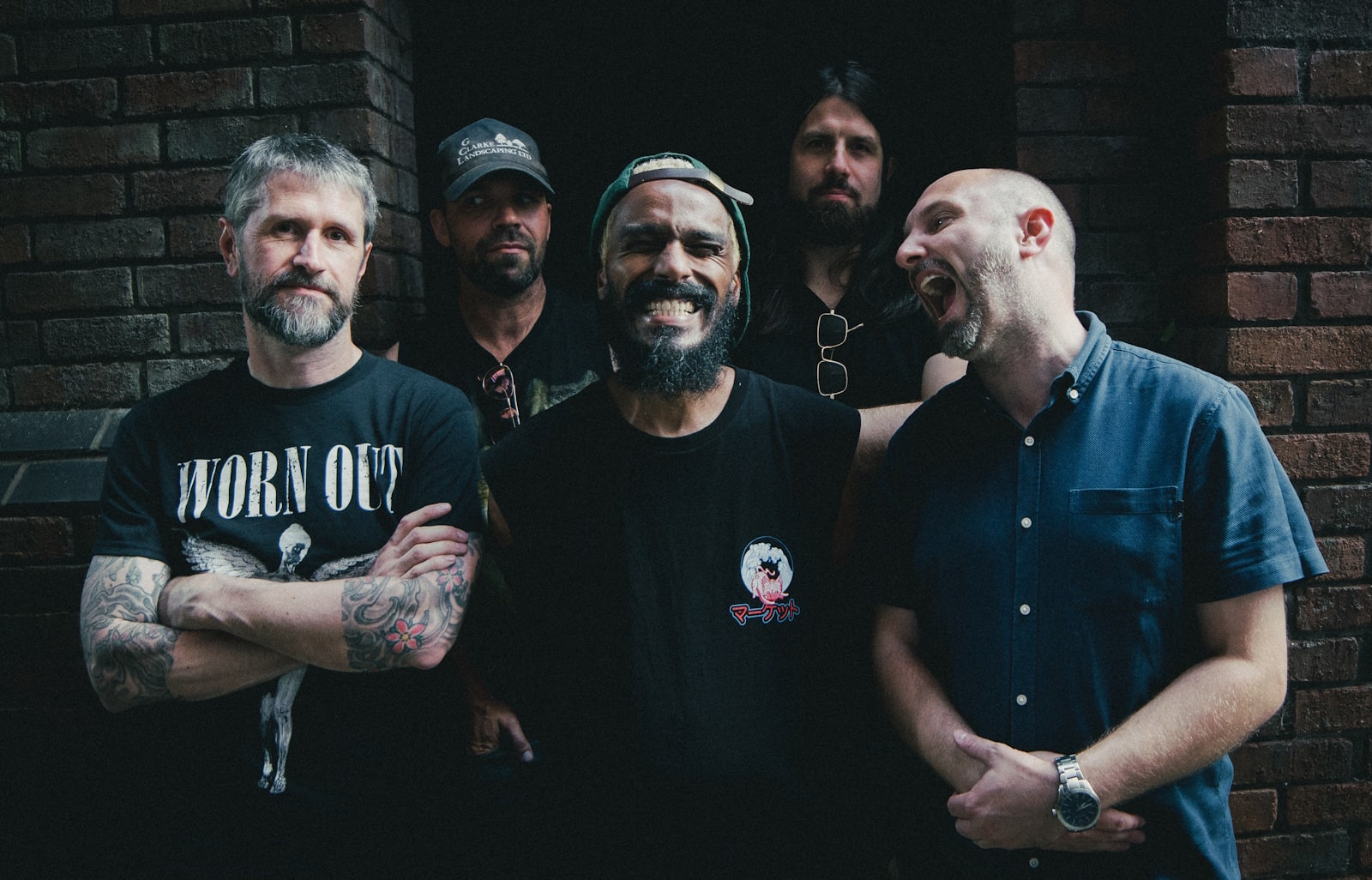



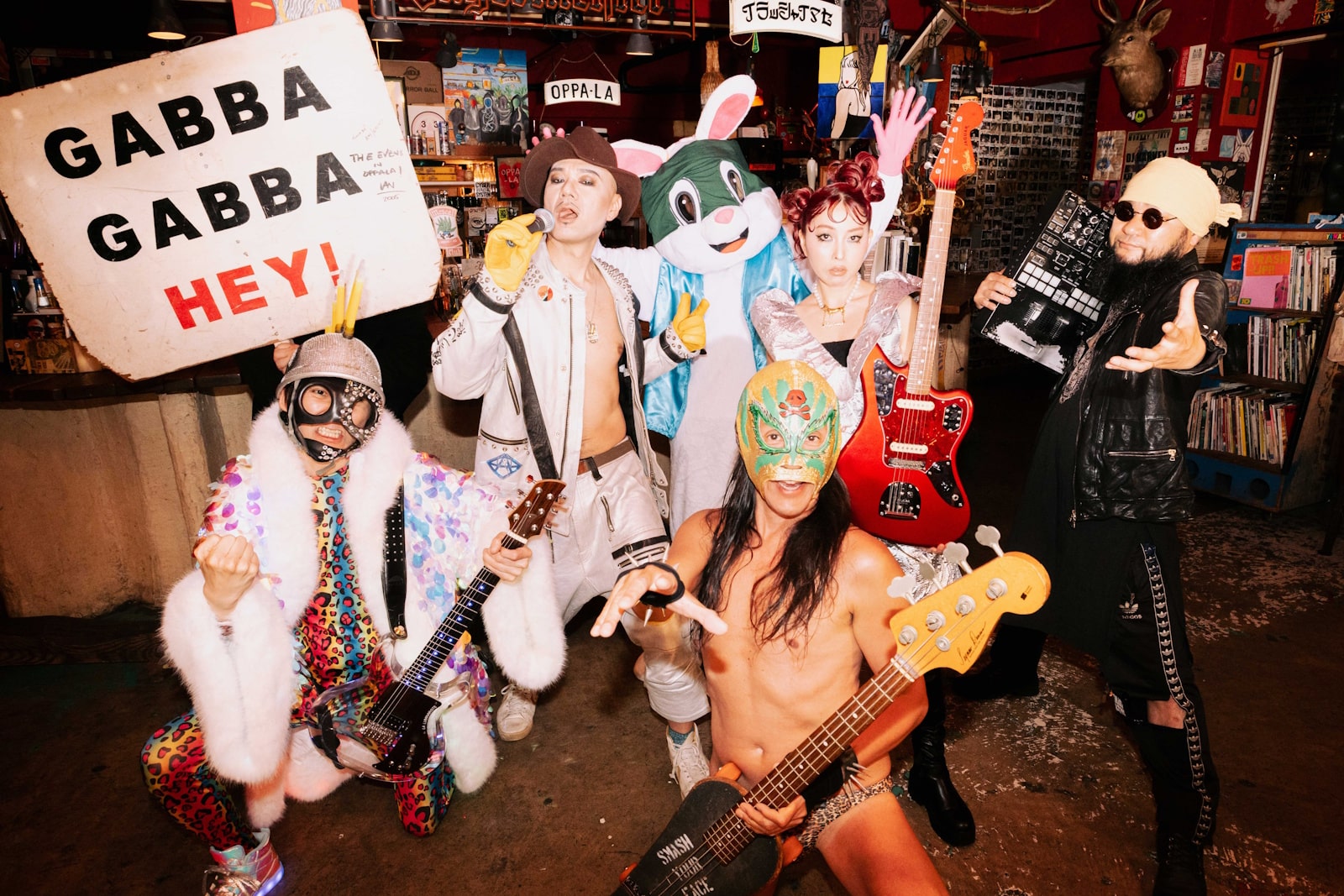
SMASH YOUR FACE have been kicking around since the late ’80s, first as a bunch of childhood friends hammering out hardcore in Tokyo basements.
Back then it was all rehearsal-room vibe, no internet, no smartphones, just zines, local gossip, and the few overseas records they could scrape money together to buy and swap.
“I think having less information allowed us to create more original music,” they say, and you can hear that stubborn originality in how the band kept twisting their sound—adding crossover thrash muscle, then turntables that became more than a gimmick, part of the actual backbone.
The new record, “Sayonara Smash Your Face,” is produced by Atsuo from Boris and carries a cover illustration from actor-artist Tadanobu Asano, a longtime friend who also plays in his own band. For SMASH YOUR FACE, saying goodbye is less about endings and more about ripping away old skin. “I chose this title because I felt that in order to move forward, I needed to break away from the past and Smash Your Face.”
Guests on the album—Cypress Ueno, Roberto Yoshino, Kaori Masukodera, and Tsuyoshi from Fuck On The Beach—aren’t random cameos but part of the same extended crew. “The artists who participated in this album are people who take part in our events,” they explain, treating the record like a stitched-together map of their own corner of the underground.
The spirit, though, still feels like it did when they started: no guarantees, no roadmap, just the urge to try things. “I never thought, ‘This will work.’ But he has a hardcore spirit, so I was sure it would be fun if he joined the band.” That kind of logic explains how scratches live alongside blast beats without ever sounding forced.
View this post on Instagram
In the full interview below, the band dig into their early days in Tokyo’s hardcore scene, how the underground has shifted, working with Atsuo, the strange energy of Japanese live shows, and what “sayonara” really means for them now.
You’ve been doing this since the late ‘80s – what’s the first image or memory that comes to mind when you think about those early days of SMASH YOUR FACE, before it even felt like a “real” band?
When we started SMASH YOUR FACE, we were just childhood friends who got together to form a band, so we all just had fun rehearsing, and I think that’s very important for a band.
Back then, Japan’s hardcore scene was already carving out its own identity apart from the US and Europe. How much of that early local energy shaped you, and how much came from chasing records and sounds from outside?
At the time, there was no internet or smartphones, so our sources of information were local information in Tokyo, magazines, and fanzines. We were still in our teens, so we didn’t have much money to spend, so we bought overseas records and shared them with other band members to
get information. However, I think having less information allowed us to create more original music.
There’s always talk about how Japan’s hardcore in the late ‘80s and ‘90s had a different kind of urgency – tighter, faster, but also more open to weird experimentation. Did you feel that freedom back then, or did it only come later when you’d already proved yourselves?
I feel like the underground music scene at the time was an environment where people could create more freely than they can now. There was no social media, and people didn’t have to worry about making money.
Going from raw hardcore to bringing in crossover thrash and eventually turntables and scratches – that’s not a small leap. Was there a moment where you thought “this is going to work,” or was it more like slowly adding pieces until it clicked?
I never thought, “This will work.” (laughs) But he has a hardcore spirit, so I was sure it would be fun if he joined the band.
View this post on Instagram
Turntables in a hardcore band can feel like a gimmick in the wrong hands, but here it feels like part of the muscle. How do you approach keeping it organic, so it’s not just “hardcore with a DJ” but something that lives in the riffs and rhythm?
Yes. He’s a part of the sound, the core of it. We only have experience in hardcore bands, so we create the band sound first, and then the DJ joins in. After that, we adjust the band sound again. I think this is an original production method that other bands don’t have.
Your new album was produced by Atsuo from Boris – that’s already a statement in itself. What kind of atmosphere did he bring to the sessions that maybe pushed you somewhere unexpected?
His presence was essential for this album. We needed a more holistic approach. We intuitively felt we needed to break away from our previous sound.
View this post on Instagram
The cover art is by Tadanobu Asano, which is wild because his acting career has such a global footprint. How did that collaboration happen, and what did you want the artwork to say before anyone even hears a note?
I’ve been friends with him since we were young, and we perform at events together with his band, “SODA!”. In addition to being an actor, he’s also an artist who draws illustrations. I’m a fan of his
illustrations, so I’m very happy that he drew an original illustration for me.
You’ve got guest spots from Cypress Ueno, Roberto Yoshino, Kaori Masukodera, and Tsuyoshi from Fuck On The Beach. That’s a pretty wide net. Were you intentionally building an album that’s like a meeting point of different corners of Japanese underground, or did it happen more by instinct?
The artists who participated in this album are people who take part in our events. I had wanted them to participate when I was making the album, so I was happy that it was possible.
View this post on Instagram
When you think about “Sayonara Smash Your Face” as a title – it’s loaded. Is it a farewell to something specific, or more of a tongue-in-cheek nod to the fact that bands like yours have to constantly reinvent to stay alive?
I’m glad you understand. SAYONARA means farewell. I chose this title because I felt that in order to move forward, I needed to break away from the past and SMASH YOUR FACE.
The Japanese hardcore and crossover scene in 2024 and 2025 – what’s the real pulse right now? Is it younger bands pushing things forward, older bands refining their sound, or some messy mix of both?
Young bands are emerging and veteran bands are continuing to perform, but it seems like there isn’t much interaction between bands. This is partly because each band is active in their own scene, but we would like to continue to work together across generations and genres.
The Japanese hardcore and crossover scene in 2024 and 2025 – what’s the real pulse right now? Is it younger bands pushing things forward, older bands refining their sound, or some messy mix of both?
Recently, I thought SkipLife from the Czech Republic and So Close from Italy, who both appeared at the same event, were great bands.
Who are some Japanese artists you’ve discovered or reconnected with in the last year or two that you think people outside the country should be paying more attention to?
You know a lot! I was at the same event as Otoboke Bieber a while ago and it was so exciting. They quickly became a popular band.
Looking back, do you feel like you’ve carried the same core spirit since the beginning, or has the band’s personality shifted into something totally different from those first rehearsals?
We’ve been together for many years, and our spirit of challenge remains the same. However, I think our sound has changed. It’s become more technical in some areas, more aggressive in others. I feel like we’ve grown.
If you had to write a letter to the version of SMASH YOUR FACE that was just starting out in the late ‘80s, what would you tell them about the road ahead?
I hope you will cherish the time you spend with the friends you will meet. I believe that these experiences cannot be exchanged for success or money.
And on the flip side – if that younger version of the band could hear “Sayonara Smash Your Face” today, what do you think they’d say?
I can’t imagine it. Lol. If you listen to it, I’d love to know what you think. I think punk is music for young people. I’d be very happy if they could accept it.
Thank you so much for your time. Feel free to share your final words and take care!
Thank you very much for taking the time to come. I hope everyone will have a great time. I hope you all will come and see our show. I hope you are all well.