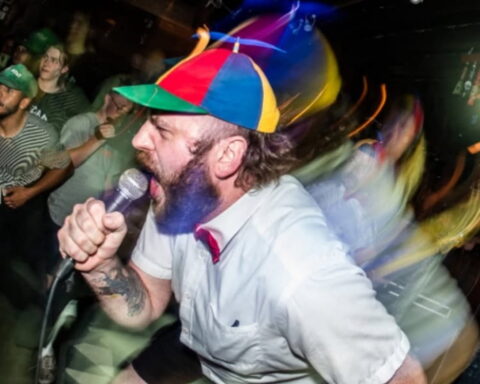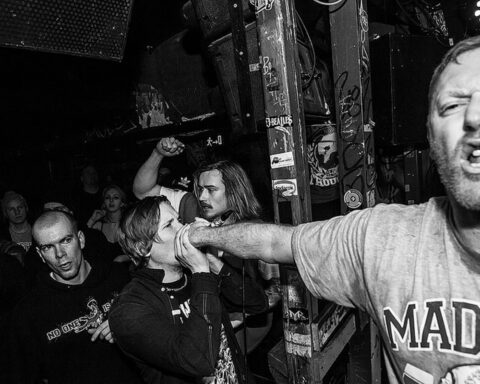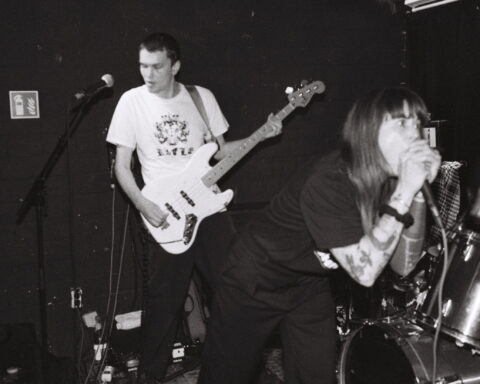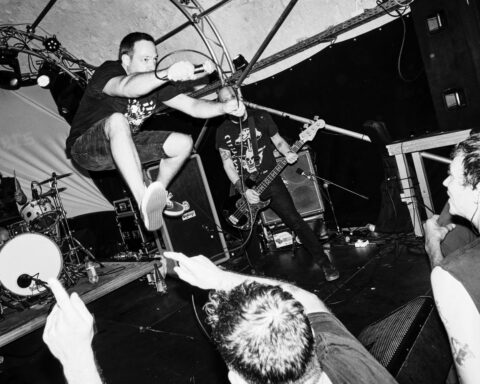


Hardcore is the broad name for the fastest and heaviest music to come out of punk, and for the scene built around it: short songs, high tempo, shouted vocals, lyrics delivered as statements. Its signature move is the breakdown: the guitars drop into thick palm-muted chug, a double-kick pedal clicks underneath, the drummer rides quarter-notes on the crash, and the whole thing works as an instruction to open the pit. Records are built to end quickly. Berlin's La Haine fit five tracks and eighteen minutes onto "Spilling Raw", tom-heavy and screamed, with softer passages that last seconds before the pace snaps back. Denver's Tunnel Jumper get through eleven tracks in twenty-six minutes, one of them seventy-five seconds long and carrying a single line, "Look what man has built."
What counts as hardcore has widened with every decade since hardcore punk named the first of it in the late 1970s. A band starting now can reach back to 1970s street punk, 1980s metallic crossover and 1990s youth crew inside one record, and plenty do. Concrete Youth spent years in metallic hardcore, youth crew, crossover and beatdown before binning their most technical ideas and keeping the parts you could hum, and the South Jakarta band came out the other side playing melodic hardcore. Dimming, spread across Queens, Brooklyn and the Bronx, pull New York hardcore towards death metal and doom.
The metal end arrived later and stayed inside hardcore. Punk got heavier and metal got faster through the mid-1980s until the two began to assimilate, and by the 1990s formalised styles were splintering off in numbers. Integrity are usually credited as the first band called metalcore, and Vision of Disorder drew the blueprint the style still works from, with more technical riffs and more brutal songs while still playing like a hardcore band. Racetraitor have carried the political and metallic end of that through three decades in Chicago: a mid-1990s start, a split in 1999, a return in 2016 against the presidential campaign of that year.
Youth crew came together in New York and left a vocabulary the music still uses: gang vocals, a galloping pace, lyrics short enough to shout back, and straight edge bound into all of it. Ray Cappo and Jordan Cooper had started Revelation Records in New Haven meaning to press one record, Warzone's "Lower East Side Crew", and their 1988 compilation "New York City Hardcore: The Way It Is" made it the scene's central label. Trashxstrike wanted one song that treats the straight edge decision as something you keep as an adult, written without lecturing anyone, and Adam Lentz, forty-five and almost twenty-five years into working at Revelation, has started a label of his own with five hundred opaque-red copies of a French punk record.
The rooms and the records are the other half. CBGB ran a weekly all-ages matinee on the Bowery through the mid-1980s, its crowd mostly teenagers. The same work still goes on by hand: Trashxstrike found a plant by typing "record pressing Philadelphia" into Google and pressed two hundred copies for a little over $2,000, and La Haine tracked guitars at home, self-released two hundred records and sent the profit from the release show to the Berlin community space next door to their practice room. Venues are the fragile part: Calgary was down to a single all-ages venue for heavy music by 2010, lost it in 2013 and went without until after the pandemic.
Pukarana have been going in Durán, Ecuador since 2003, with Elizabeth and Catalina Coronel the two who never left, and their early shows ran through auto repair shops, community halls, backyards and warehouses, usually until the police turned up. CNHC Fest grew from a backstage conversation in Wuhan in April 2012 into a fourteen-edition festival drawing bands from Tianjin, Beijing, Guangzhou, Hong Kong, Macau and Harbin. Splin work out of Bielsko-Biała, where the room Przestrzeń Wolności hands to local crews has no stage and nothing between band and floor. Inkwell's entire run fit between spring 1995 and spring 1996, inside an Atlanta house-show network busy enough for something to happen almost every night.