

Oceano’s “Mass Produced” was the exact moment Nic Heidt checked out. Not from metal itself — from the sound of it. “That was the impetus for me to do this whole thing,” he says. The tones had calcified. The drums hit the same. Everything was optimized to the point of suffocation. So he built Grave Generator: a metal project run entirely on synthesizers, programmed drums, and a stubbornness about doing things the wrong way.
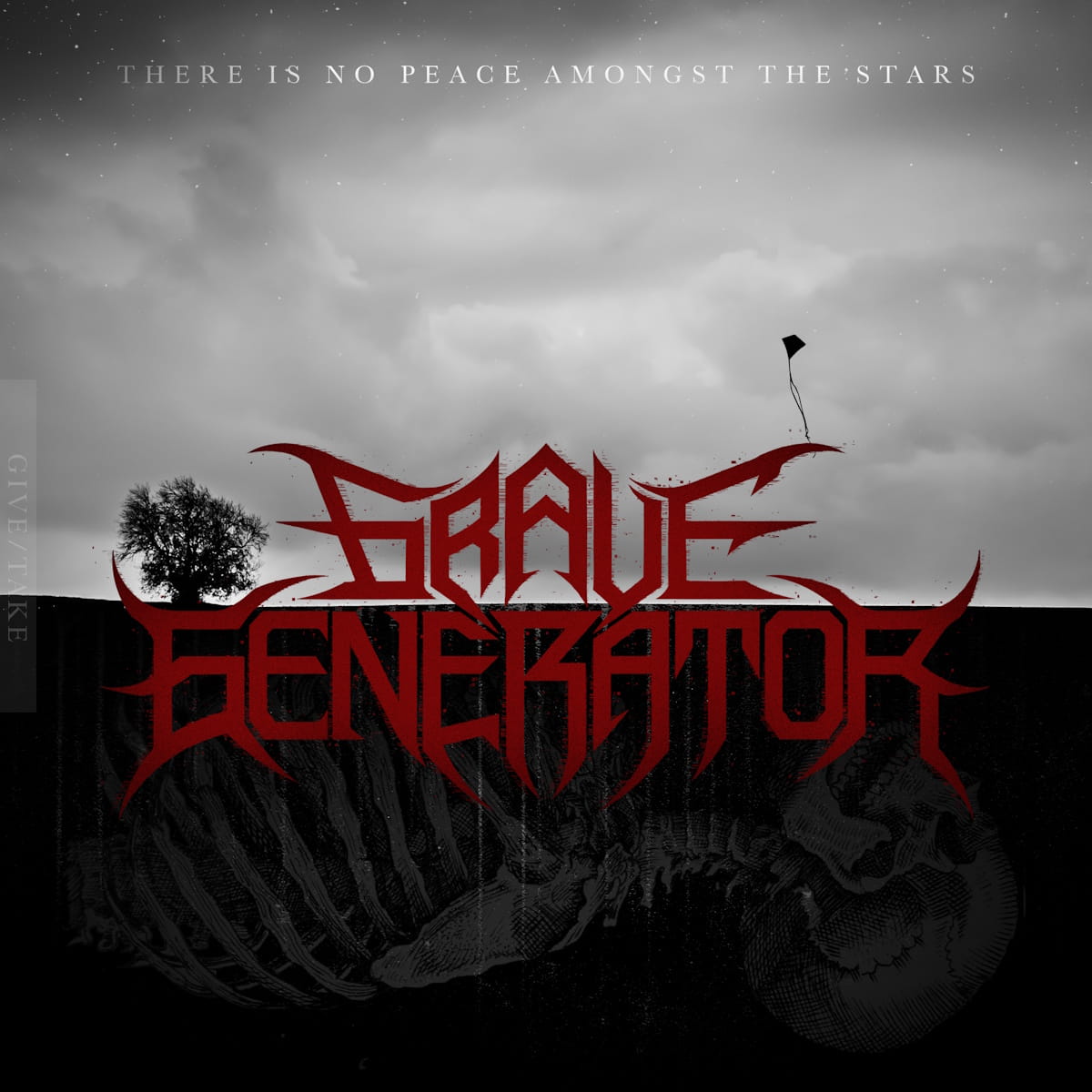
Based in South Korea and releasing his debut EP “There Is No Peace Amongst The Stars” on March 20 via Give/Take, Heidt isn’t making industrial music dressed in metal clothes. This is double-kick-laden, mosh-pit-ready aggression — just with no guitars and no bass guitar in sight. “Can you even create metal without guitars and bass?” was the foundational question. “Not industrial, with its driving four on the floor beats and club-ready arrangements, but screeching, double-kick-laden metal suited to mosh pits?” After finding a collaborator willing to hack through that problem in Jonathan Ford of Dissociate, who handles atmospherics and incidental sounds, the answer turned out to be a pretty emphatic yes.
Heidt’s frustration isn’t abstract. He can point to exactly where things went stale. “Take the 90 bajillion bands in the last 2 years that are trying to sound like Lorna Shore,” he says. “The biggest problem is that it’s just so easy to do now. It’s really easy to sound perfect. Get one good bit, chop it, clean it, ctrl+C, ctrl+V. Auto align it, auto pitch it, auto quantize it, auto EQ it, auto compress it, auto master it. Everything is so optimized. Where’s the fun in that? Where’s the happy accidents? Where’s the life?”
Then there’s the lockstep djent kick — guitar, bass, and kick drum all hitting the exact same accents for every riff. He loves it in doses but calls it “boring for everything all of the time. No one comes up with cool grooves independent of other elements anymore. Rhythmic elements in metal are often a single monolithic thing now.”
And the density problem. He points to Orbit Culture’s “Death Above Life” as an example — a record he says he loves — but one where “every single little bit of space in the frequency spectrum is just being taken up 100% of the time by something. I feel like it’s actually fatiguing to listen to.”
His own approach inverts most of that. Heidt cites an interview with producer Michael Beinhorn: “He talked about how he would rather have one interesting sound than layers of boring stuff.” So Grave Generator doesn’t pile on. Few sound sources, each one given room to breathe, the ear pointed toward one big, nasty thing rather than inundated with layers for the sake of layers.
Freed from the conventions of standard metal instrumentation, the project explores tuning, timing, and tonal shifts that wouldn’t be possible with guitars. Heidt’s influences sprawl across Nile, Testament, Prodigy, and Stabbing Westward — and the music absorbs all of it without sounding like a genre exercise.
The records that rewired his thinking tell you a lot about where Grave Generator comes from. Black Pegasus floored him with “this sudden, and very emotional, blues style solo in the middle of a death metal epic. It really hit home how heavy beautiful emotions can be as opposed to always being pissed off.” City Morgue’s debut was “so ‘un’ everything — unrefined, unapologetic, unproduced, unplanned,” a reminder of how little he cared about production beyond a basic threshold. And Impure Wilhelmina caught him off guard via the algorithm: “crazy, almost black metal tonality, but with rock drums… and then they started singing instead of the expected screaming.” He bought their newest album on Bandcamp immediately.
His setup is straightforward by design. “I don’t feel like you need a bunch of crazy stuff to make music,” he says. “Like a rock band has guitar, bass, drums, vocals… and done. Too much other stuff just becomes a distraction.” He’s been a Sonar/Cakewalk user for 20 years. “Plus, it’s free, so you can’t really go wrong there. I don’t understand all the hoopla about specific DAWs.” The bass on the EP was done with a Microkorg, primary synths with an IK Uno Synth Pro, and leads in software using IK’s Syntronik 2 with an Oxygen Pro Mini controller. Ford’s side of things runs through a Health Club, MPC Keys 37, and MPC Live, all processed through a Sherman Filterbank 2. Vocals were tracked with a Neumann TLM 102 straight into a Tascam 2×2 interface. “I love the TLM 102/103 mics. They sound great on anything. Just big and open.”
Drum programming is where Heidt gets demanding. He uses IK’s Modo Drum — “ridiculously sensitive, you can change every little thing about it” — but insists you have to treat the software like actual drums. “You’ve really got to dirty them up.” He plays patterns in manually rather than copy-pasting, lightly quantizes but never hard-quantizes, edits velocities by hand because his controller’s sensitivity isn’t great, and air-drums “like a dork” to figure out fills. There are no impossible beats. He used to play drums for fun and understands the mechanics of a real kit, so everything stays physically plausible.
One critical rule: he refuses to automate synth parameters. “I play in the MIDI, and then record each track live to audio, working the parameters manually in real time. I practice and do several takes to get it right.” The logic is the same as a live band committing to a take — no temptation to fix it in the mix, no getting lost in minutia. “The sound that feels right on the day during the take is the sound I try to use so that what I’m feeling is put out there.”
Wyświetl ten post na Instagramie
His writing process has a mantra: write fast, record slow, mix fast, master slow. “Write fast to get the emotions right, record slow to get the parts right, mix fast so it feels like it should, master slow to get the little stuff right.” Songs start with a riff on guitar or synth, get arranged by feel as quickly as possible, and he’s actively pushing himself to build full arrangements from memory before committing anything to a DAW — chasing a more open, organic feel rather than what he calls the “curated song structure” you hear a lot of now.
Lyrics come before vocal melodies, always. “I feel like I get more interesting vocal patterns and more meaningful lyrics that way since I have to figure out how the completed lyrics can fit into the song rather than what words can fit into a pre-determined idea.” He admits he’s only a mediocre vocalist and practices heavily before recording. “Even though it’s all synths and programming, I practice, play, and record it all like a live band as much as possible.”
The discovery process threw up some surprises. Working through a series of covers as proof-of-concept before writing originals, Heidt found that “having a really nice, deep bass really makes things feel heavy. And that’s something a lot of modern metal lacks.” He points to Author and Punisher’s “Nocturnal Birding” as a reference point: “The really prominent bass just makes you want to listen louder and feels ridiculously glacial in its heaviness.”
Not everything worked. A ping snare fell flat. The thunk-style snare big in metal production right now — “the one that sounds like someone smacking a large, dead fish on a door” — didn’t fit either. He started with heavy vocal distortion that sounded great in isolation but ate the mix alive, so he blended clean and distorted takes roughly 50/50. “Too much distortion on anything just drains away the character that creates the emotion rather than making it harsher.” He also tried Neurosis-style mid-era soundscaping — specifically influenced by “Enemy of the Sun” and “Through Silver in Blood” — with Ford contributing atmospheric tracks. Layered in full, they made the songs more cerebral but less aggressive. He ended up using pieces of Ford’s work sparingly, for effect only at certain points.
Wyświetl ten post na Instagramie
The economics of metal factor into his thinking too. “Every few days there’s an article about how, unless you are in the top echelon of music, touring is just plain unsustainable. Visa problems, gas prices, venue cuts — everyone is hurting now.” He sees it firsthand in South Korea: Cryptopsy played recently and tickets were $120. “I completely understand why it was that much — just one stop with full expenses, getting into the country. But that’s crazy for a single metal band.” The downstream effect on creativity is clear to him. “If you are a subsistence-level band and release an album that isn’t full of exactly what your fans consider absolute fire, one where you try to take some chances and explore, you risk losing basically an entire album cycle if it doesn’t hit.” With album cycles stretching from one or two years to four, five, or more, the pressure to play it safe compounds.
As for the local scene in South Korea, Heidt doesn’t have much to report. It’s primarily in Seoul and he’s too far out to get in the loop. “I know it’s there, but I can’t get out to shows like I wish I could.”
He’s careful to note that none of this is about trashing anyone. “I love all of the bands I’ve mentioned here. There is absolutely no hate when I’m naming names — I’m just identifying what I like and don’t like artistically and trying to find new avenues.” He’s also aware Grave Generator hasn’t dodged every pitfall he’s identified. “It’s an ongoing process of discovery and tinkering. I’d rather try as I go and release new music than sit and overanalyze it and never put anything out.”
“There Is No Peace Amongst The Stars” is out March 20 on CD and digital via Give/Take.