



In 1968, the opening shot of Rogerio Sganzerla’s O Bandido Da Luz Vermelha put one sentence on screen while a voice-over whispered the protagonist’s confession: “What am I? The only thing I know for sure is that I failed.”
The sentence reads GUERRA TOTAL NA BOCA DO LIXO. Total war in the garbage mouth. The phrase stuck in Caveiras‘ heads. It became the title of their new LP, out February 13, 2026 on Florence-based label UR Suoni.
Sganzerla’s film, a Cinema Marginal classic loosely based on the life of São Paulo criminal João Acácio Pereira da Costa, is a touchstone for the Italian trio, who go by the alter-egos Zé Caveira (vocals, sampler, live FX, percussions, flute), Diabo Branco (bass, vocals, percussions, clarinet), and Bicho (drums, percussions, vocals).
Boca Do Lixo, literally “garbage mouth”, is the run-down São Paulo district of Santa Ifigênia, given the name in the ’40s when it became known for organized crime, prostitution, and drug dealing. By the ’90s, the crack epidemic in the area was so widespread that Brazilians started calling it Cracolândia. On the record, the place is something else.
“Little by little, we started creating our own personal mythology around these inputs,” the band explain. “So our Boca Do Lixo became something different. It became a symbol, a community of losers, the gathering of the oppressed and the dispossessed. It’s the field where a never-ending war is fought each and every day: the total war opposing the few who own everything to the many who own nothing. That’s the idea behind the title.”

The music shares the title’s restlessness. Caveiras call what they do baile punk, twisting the name of Brazil’s biggest electronic genre, baile funk, into something with a European punk spine.
Born in Rio favelas in the ’80s as street-party music, baile funk strips back to a beat, a few electronic effects, and vocals. Caveiras absorb that, then push it through their own background. The reference point they reach for is Tropicália, the late-’60s Brazilian art movement built on what they call “cultural anthropophagy”, feeding on outside influences and turning them into something else. “Only, this time it is us (the reluctant representatives of the so-called first world) feeding on their music, not the other way round.”

Across twelve tracks, the same figure keeps reappearing: an anti-hero, an outlaw, a loser fighting a war that won’t end with a victory. Caveiras describe the album as a loose concept record about this character’s struggle against the powers that be.
“Victory is nowhere in sight, but this person won’t give up the fight, because the fight is all that is left. He (or she) has nothing else to lose.” The members identify with the character but maintain the distinction: on stage, the alter-egos are part of them and also narrative devices, “through them, we can assault the audience with our vision.”
That confrontation has a religious vocabulary. Quimbanda, one of Brazil’s Afro-Brazilian syncretic cults, sits at the centre of the band’s iconography.
Practiced largely among the country’s black and mixed-race working-class population, Quimbanda has historically been mislabeled as Satanism. Its practitioners summon Exús and their female counterparts, Pomba Giras, spiritual intermediaries called on for very worldly matters: power, wealth, love, revenge against an enemy. Christian settlers read all of this as witchcraft.
Caveiras read it differently. “Quimbanda’s history summarises quite clearly the relationship between those who are in power and those who are exploited. The former always seem to dictate the mainstream narrative, establishing what is right and what is wrong. For this reason, we consider Quimbanda an intrinsically revolutionary belief.” Exú Caveira, an Exú from the actual Quimbanda pantheon, becomes the band’s patron saint. The characters in the songs summon Exús and Pomba Giras to fight oppression or take revenge. “We tried not to be disrespectful of the tradition, but we made Quimbanda such a substantial part of Caveiras’ imagery that we could not avoid taking some liberties with it.”
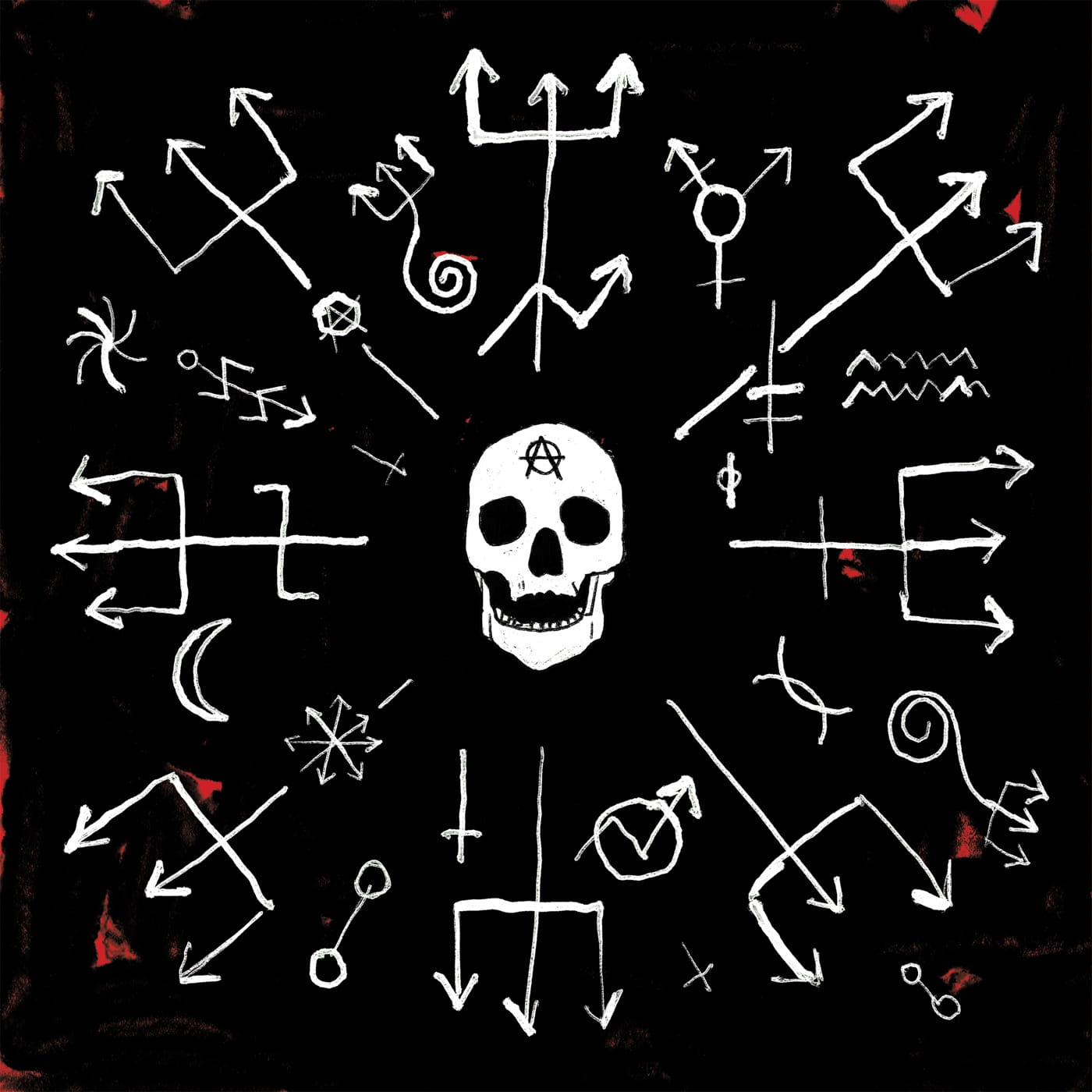
Quimbanda’s colors are red and black, the furthest from white. The same red and black anchor the anarchist banner, which Caveiras note doesn’t hurt their reading.
The political wiring is more direct than symbolic. The band’s imagery is grounded in Brazil’s military dictatorship years, but the parallels they draw run straight into the present. Caveiras started working on the record shortly after the beginning of Israel’s War on Gaza.
The lyrics of “Cadeira Do Dragão”, the album’s lead single (with a video already out), run “Finally they got me, No way out, Death sentence, Labelled as an outlaw”. They could come from a Brazilian political dissident in the early ’70s or from a Palestinian in Gaza today, arrested for nothing and labelled a terrorist. The torture methods Caveiras name on the record, Pau-De-Arara (“The Parrot’s Perch”) and Cadeira Do Dragão (“The Dragon’s Chair”), were used by Brazilian Military Police.
The band point out that Israeli prison guards rape Palestinian inmates with truncheons. “If there is a part of the world that best represents Boca Do Lixo at the moment, that is Palestine, without the shadow of a doubt.”

The indictment doesn’t stop at Israel. “A bunch of psycho Tolkien-obsessed messianic freaks are dictating the western political agenda. They are literally raping the third world, in order to steal the rare materials they need to build their precious technologies. They are then selling these technologies to crypto-fascist governments, who use them abroad to kill their enemies and make their wars more efficient, and within their boundaries to spy and hold back their own citizens, in order to gain more control over them.”
From there the band run through current examples: in the US, “antifa” labelled a terrorist organization while ICE agents shoot citizens in the streets; in the UK, supporters of NGO Palestine Action persecuted as terrorists, and the government moving to ban legal demonstrations supporting Palestine; in Italy, where Caveiras are based, parliament voting to adopt the IHRA’s definition of antisemitism, which would silence criticism of Israel. “Our sanitary and educational systems are falling apart because, apparently, there’s not enough money to fund them. And yet, Europe is encouraging new military expenses. We are living through really dark times.”

The musical method behind all of this comes partly from a moment Caveiras witnessed in Favela Rocinha, Rio de Janeiro, years ago. Two boys were doing a batucada with a bucket and a bin.
“They sounded so primal, and yet, to our European ears, so avant-garde. They made us think of Einstürzende Neubauten, although, in the framework of the so-called Third World, using waste material instead of proper instruments is nothing new. It is a practice that comes out of necessity.” The trio start composing by replicating Caribbean rhythms, twisting them until they sound right, then arranging the result into songs. Their ideas first take shape as electronic beats inside a DAW before being translated into band performances. “Our music lives off a continuous tension between the cold realm of the machines and the warmth of human interaction.”
For tracking, Caveiras wanted everything to feel live. Drums, electric bass, and guiding vocals were recorded together in the same room. Some vocal takes were captured with all three of them singing around a single microphone, going for what they call “that choir effect one might get from a cheap street recording.” In post-production, the drums got heavily processed, filtered through effects, equalized, compressed, made to sound more “alien”, but the room mic was usually left alone to keep the live feel. The reference point they cite for this approach is Beastie Boys’ Check Your Head. “Take a song like Pass The Mic, for example: the drums might sound like a sample, but they are actually live drums, recorded through a heavily compressed room mic.” Caveiras applied the same technique on “Feiticeira”, “Fora Da Ordem!”, and “Cadeira Do Dragão”. Other touchpoints scatter across the tracklist: Asian Dub Foundation behind the bassline of “Entendendo Nada”, ’90s Drum’n’Bass under the beat of “Até O Caixão”, Lee Perry dub on the coda of “Campo De Guerra” and the instrumental break of “Santo Selvagem”, Run DMC, Public Enemy and mid-eighties hip-hop in the vocal arrangements of “Exu Rei”, “Fora Da Ordem”, and “Feiticeira”, and Einstürzende Neubauten in the layered scrap-metal percussion. Late-’70s post-punk, particularly The Pop Group and the Slits, sits underneath everything.
The Pop Group connection is more than a citation. Mark Stewart, the band’s frontman, who died in 2023, was a friend of Caveiras. Guerra Total Na Boca Do Lixo is dedicated to him: “In Memory of Mark Stewart (1960-2023): maverick, mentor, friend.”
Asked about violence on the record, Caveiras don’t dress it up. “The world we live in is a violent, horrible place… Trying to reflect this violence in our art is the bare minimum we can do, it’s our small contribution to the struggle against this horrible situation. We are not interested in being background music for people’s apathy.”
They cite John Lydon. “‘Anger is an energy’, like John Lydon used to say. When we see people dancing to our music, sweating, shouting, and generally proving to themselves that they are alive, that’s when we realize we are doing a good job.”
Wyświetl ten post na Instagramie
The record has already been named record of the month by both Blow Up Magazine and Rumore, the two major Italian independent music magazines.
Guerra Total Na Boca Do Lixo arrives February 13, 2026 on UR Suoni (UR017LP), manufactured and distributed by Desslab. It was recorded by Niccolò Gallio at Umanamana Studio, with “Yoru”, “Sapo-Sapo”, and “Campo De Guerra (reprise)” recorded by Simone Vassallo at Headbanging Studio.
Mixing was handled by Edoardo Fracassi at Electric Ant Studio (with the same three exceptions, mixed by Vassallo) and Fracassi also mastered the record and co-produced with Caveiras. Serena Altavilla guests on vocals on “Santo Selvagem”. Lyrics are by Zé Caveira, music by Caveiras. Artwork is by Simone Brillarelli.
“O Terçeiro Mundo Vai Explodir!”
🔔 IDIOTEQ is ad-free, independent, and runs on one person’s time. If you want it to stay that way: DONATE via PayPal 𝗈𝗋 SUPPORT via Patreon.
Stay connected via Newsletter · Instagram · Facebook · X (Twitter) · Threads · Bluesky · Messenger · WhatsApp.