

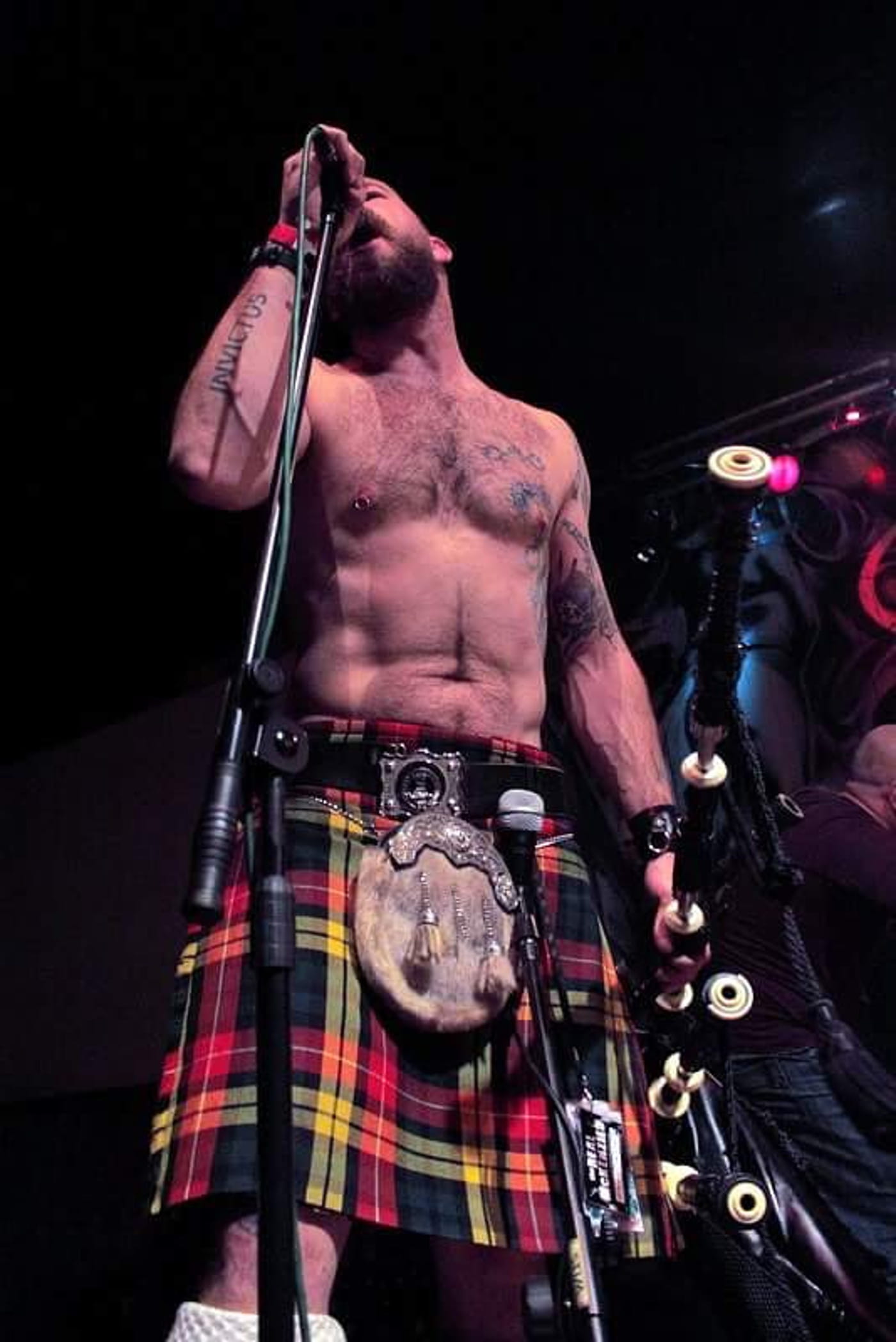
There is a very specific kind of bagpipe player who can describe his father’s formal pipe band uniform in loving detail — Royal Stewart tartan, leather belts, straps, a cairngorm brooch holding six pounds of plaid over one shoulder, gold “Pipe Major” chevrons on the tunic — and then, years later, decide the kilt is somebody else’s business.
For Gord Taylor, that somebody else is our recent guests, The Real McKenzies.
Taylor spent years helping anchor that band’s bagpipe attack, and we last caught him properly in 2014 for a long conversation about the instrument’s history, his solo work, and the strange social organism that is The Real McKenzies. Twelve years later, he is back with “Made in Hell”, an electric solo record tracked in Athens, Greece, with another acoustic record, working title “Light Treason”, already moving behind it.
The new thing is not that Taylor has stopped being a piper. He started at six, in the shadow of a father who played pipes and carried the full ceremony of that world at home. Before punk stages, Fat Wreck Chords, touring vans, and spilled fluids in Europe, there were pipe bands, competitions, parades, Saturday practices, Grade 1 standards, old judges, and the kind of rules that tell a child exactly where his chin, chest, fingers, and pride should be.
The new thing is that Taylor wants the instrument to stop arriving with a costume already sewn around it.
“My aim with my music is not to step on The McKs’ feet,” he says. “They and Fat really gave me a huge gift in the form of music-writing, performing, recording knowledge. My modus operandi is not to rely on the Scottish cultural relationship with the instrument. I no longer wear kilts. That’s a McKenzie thing. I just wanna be a Canadian dude who can write a good song on his primary instrument without connection to Scotland or Scottish culture. Just a dumb Winnipeg burnout with something musical to say.”
He is joking, but not tossing the line away. Taylor’s whole current run sits inside that sentence: a Winnipeg guy, a primary instrument most listeners already think they understand, and a refusal to let the first reaction be the last word.
“Pulling the instrument loose has been less of a task and more of a matter of course,” he says. “I’m not really trying, nor do I want, to deny Scotland its creation. I just play and write with it more selectively.”
Taylor comes from a middle-class Winnipeg family and is careful not to mythologize himself as self-made in the gutter. His father was a police officer, his mother worked for the school division, and he grew up with a perspective that often sat awkwardly inside punk rooms. He knew cops as authority, but also as parents who drove their kids to school in cruiser cars and sometimes got pulled off-route by the police radio.
“And make no mistake, I’ve met a few who really are animals in blue,” he says. “But in school, us ‘cop-kids’ tended to gravitate to one another seeing different facets to the role and reality of our fathers and mothers.”
The pipes entered through that family life before they became punk property. Seeing his six-foot-four father in full pipe band dress made the instrument feel less like a hobby than gravity.
“When a human being like that is towering over you, physically and emotionally, it’s hard to not follow in his footsteps.”
Pipe band culture trained him hard. Taylor rose to professional solo competition level and Grade 1 pipe band playing, after years of parades, contests, and immersion in what he now calls a “haughty, holier-than-thou conservatory attitude.” The Real McKenzies gave him a way out without changing the instrument in his hands. The clothing stayed similar at first, but the judge changed.
“The McKenzies allowed for straight-laced punk rock songs, direct-injected into the minds of brilliant fans who simply sought peace in camaraderie,” he says. “And that might serve as the first memory in which I felt the freedom of separating the instrument.”
That shift was already visible on The Real McKenzies’ “Westwinds”, especially in Taylor’s melody lines and lyrics on “Fool’s Road” and “I Do What I Want”. Those songs were not built around Scottish culture as much as what he calls “show biz life culture.” The band made them bigger, but the split had started.
Leaving The Real McKenzies made the split unavoidable.
“The moment was, when I left the band, I was deprived of my only remaining tribe of Scottish culture,” he says. “They weren’t around no more. That’s not an attack on them. It was me who made things the way they were. I’m in perfect agreement with ‘the show must go on.’”
The old pipe band world did not pull him back. Taylor had spent too long playing for rooms full of real people to return to competition culture with much patience.
“An audience of real people in all their emotional complexity is a far better judge than a bunch of old bow-legged codgers writing me up with a pen and paper for not playing an embellishment the way it was played in the fekking 1700s.”
The first post-McKenzies songs still leaned too close to the old role. He describes them as “lame” in the sense that they sounded like someone resting on being a former member of an infamous band. That hardened into a more useful rule: if the McKenzies did something clearly and well, Taylor would try not to repeat it.
So he stopped wearing a kilt onstage. He started refusing electric guitar and bagpipe unisons. He made sure there was more than one instrumental on his records.
That last move sounds small until you hear where he places it. Taylor brings up Cape Breton fiddler Ashley MacIsaac: a brilliant songwriter and singer, but when the instrumentals hit, they say something else entirely — Ashley knows exactly what he is doing with the fiddle.
Taylor wants that same argument for the pipes, minus the borrowed uniform.
“Made in Hell” is the first record where that argument fully leaves the planning stage. It came out in February, recorded not in Winnipeg but at Made in Hell Studios in Kalithea, a western suburb of Athens. Taylor initially thought the Athens angle might be the least interesting part of the story. Then he explained it.
“When you’re at the foot of Mount Olympus or in the shadow of the Agora, it’s hard to not go full travel blog,” he says, before doing the opposite.
The record was made with engineer David Prudent, drummer “Gorgeous” George Pliatsikas, lead guitarist Dimitris Napas, and Gleb Andreev, whom Taylor describes as a “white Flavor Flav” hype man and “a beautiful friend with a heart that stands 193cms tall.”
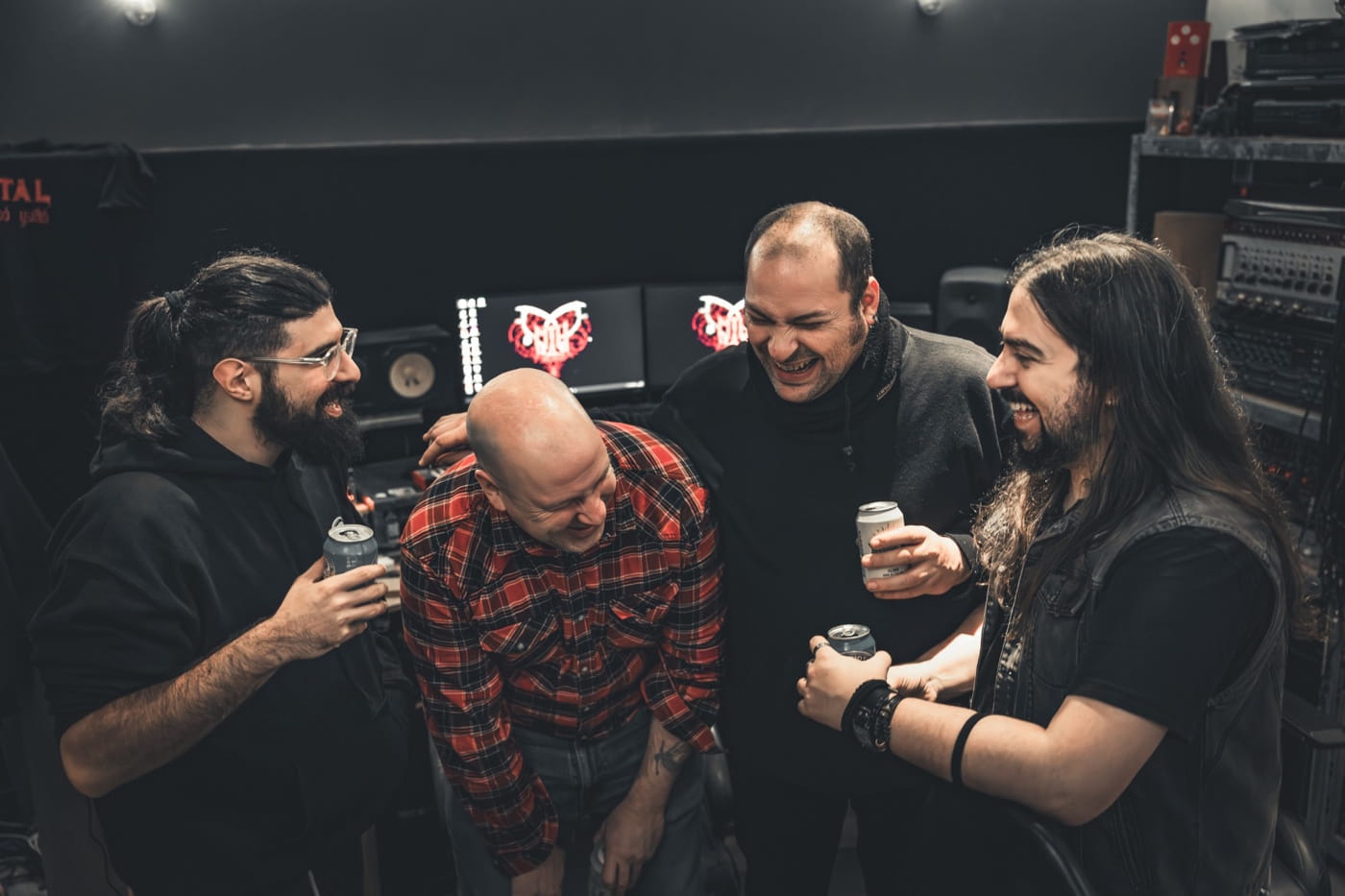
Prudent, born in Burgundy and based in Greece, runs Made in Hell Studios after years around pedal shops and hardware guitar effects. Taylor talks about him with the kind of respect usually reserved for someone who can fix your record, your amp, and the wiring in the wall.
“He knows Ohm’s Law, signal, electrical engineering, and recording better than most of us know our front door,” Taylor says. “He built much of his own equipment in his studio and is a Steinberg Cubase mastaaaah, having begun his journey with the recording software on the Atari ST in like, 1989.”
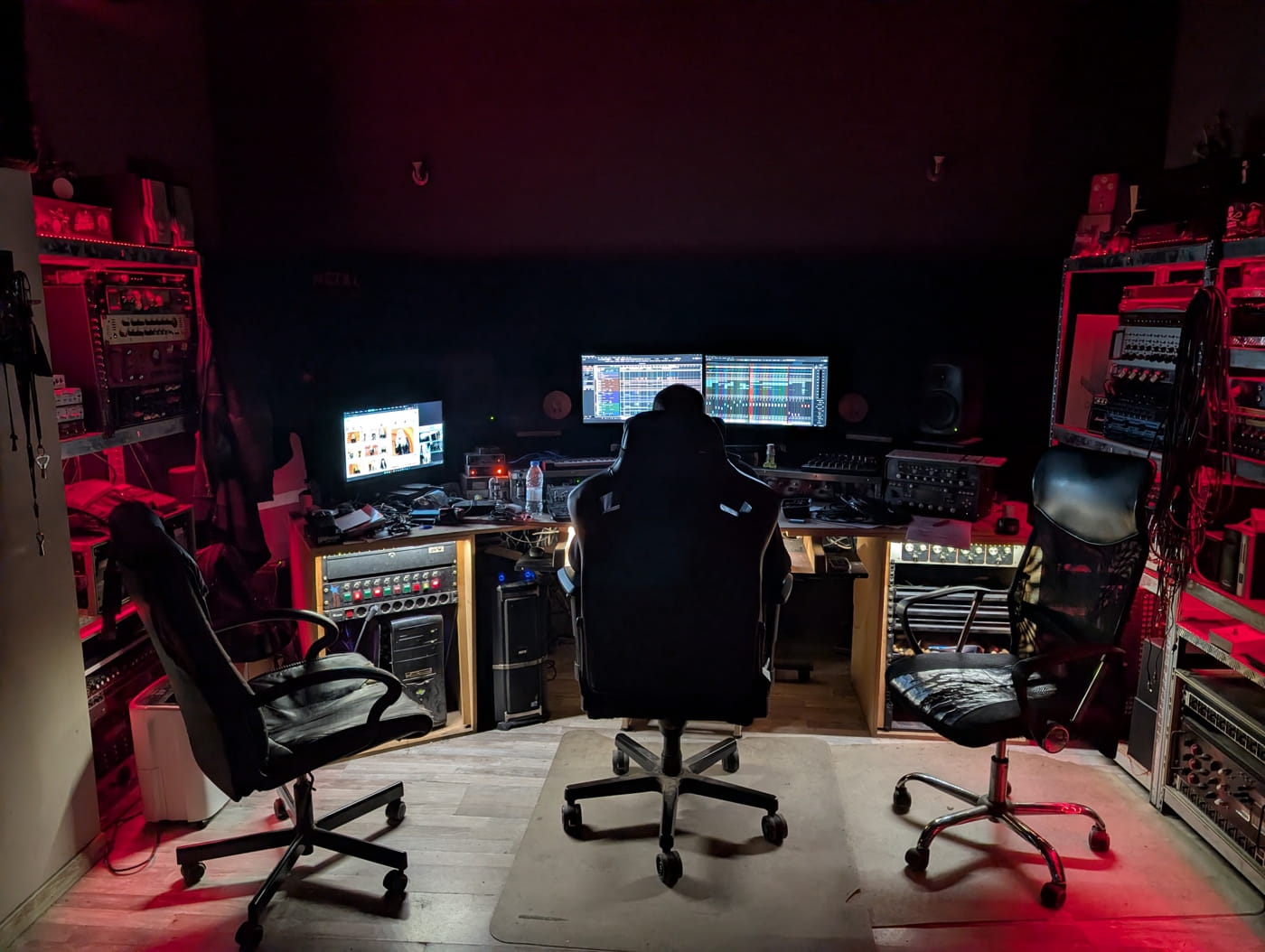
Taylor admits the first draw was the price. The reason the record carries the studio’s name goes deeper than the budget.
“It was a marriage of music and studio and it only seemed fair to share the album’s title between us.”
Athens gave Taylor distance. He likes going somewhere else to make a record because it tests whether the songs can stand when the familiar walls are removed. Sing a Winnipeg song in Winnipeg and it can come out addressed only to Winnipeg. Take it across an ocean and the address changes. The local grievance either dies there, or becomes something someone else can step into.
“I’m a fan of going somewhere to make art,” he says. “It’s a good test of the project’s purpose.”
“When you remove all familiarity with your surroundings, all you’re left with is your effort. Now you really gotta make it count.”
“Made in Hell” carries older stuff that had been sitting in his head for a while. It is the electric record, the one built around the thing he still loves plainly: rock and roll. Taylor hears it as a hard record that moves through lighter songs, modern anger, a ripping instrumental, a cover of Gordon Lightfoot’s “The Wreck of the Edmund Fitzgerald”, more anger, another instrumental, and a coarse relationship-ending hate song “for both sexes.”
“Everyone needs a hate song,” he says.
The Lightfoot cover is the album’s central flag-planting. A record about pulling the bagpipes away from Scotland peaks with one of Canada’s great shipwreck songs, and Taylor does not push back against the reading.
“Nope, you nailed my motivation to cover it,” he says. “Gordon Lightfoot has a beautiful voice. The world knows it. It’s got this ‘Soft Canadian’ quality to it. But credit where credit is due — Lightfoot was no slouch. He paid his dues both as a kid-performer in Ontario, at Westlake College of Music in California, and in writing, recording and touring for like 60 fucking years.”
Growing up, Taylor would turn the song up when it came on oldies radio. Its plain English mattered to him. No slang needed, no coded metaphor, just six minutes about 29 men losing their lives.
The cover had already existed as a McKenzies demo, and Taylor says it was one of the reasons he decided to go full speed with “Made in Hell.”
“I knew it was good. Not because of me, but because I accidentally stumbled on the effect of mixing acoustic and electric tones, and finding purely by accident, how wonderful the lyrics lend themselves to the transition to electric following the transition between the two locked in with the title lyrics ‘The Wreck of the Edmund Fitzgerald.’ And with this, I really wanted to release it before the McKenzies might release their own version haha.”
“A Canadian Love Letter to England” works from another direction. It carries the feel of an old 1950s ballad progression, the kind of thing many listeners know through “Last Kiss”, though Taylor is quick to point out the history: the song was most popularly known through the 1961 recording by Frank Wilson and The Cavaliers before Pearl Jam covered it.
“The reason, however, was a desire to combine bagpipes with it,” he says. “I got a pleasant surprise when I found that the best addition I could make to it was playing a jig. That was a neat combination — the 50s ballad and a 1-2-3, 1-2-3 time signature.”
He calls it hemiolic time, where more than one time signature moves over the beat. In practical terms, it lets a doo-wop-style kiss-off and bagpipe logic sit in the same room without turning into novelty.
The album does not spend its whole time announcing what Taylor is rejecting. He would rather describe it as ignorance used properly: avoiding Scottish folk songs, avoiding too much stuffy pipe band technique, and writing outside the habits he inherited.
“The album doesn’t insist to say away from what I’m not, nor does it insist to say what I am,” he says. “It’s just how I write now.”
“Nil to Nought” may be the clearest example of how Athens got under the record’s skin. Taylor calls it his favourite song on “Made in Hell”. It had no lyrics at first, but he liked the chord progression, the rhythm he imagined for the words, and the horn blasts — a Fat Mike move, in his mind, dating back to The Real McKenzies’ “Anyone Else”, where McNasty wrote the pipe parts and Fat Mike suggested horn-style blasts.
In Athens, Taylor was sitting in David’s studio after what he describes as a nearly catastrophic blood-pressure drop caused by Prudent’s coffee and his own Canadian arrogance. He panicked around the song while cutting tracks he understood better. On a Thursday, Prudent told him to get out of town, eat properly, cool down, and write it.
So Prudent booked him into Bouboulina, a seafood restaurant in the coastal town of Pireas. Taylor tried nearly everything: deep-fried sardines, herrings, anchovies, whole fish with heads and brains. The octopus won.
Across the water was the Temple of Poseidon. Taylor dumped everything that might belong in the song onto the page. On the train back to Exarchia, he counted 54 verses and 14 choruses.
“I think I knew from the beginning that the song was to be about how shitty things are now,” he says. “My biggest old man complaint is about the automotive industry, but so much more too.”
He does not turn that complaint into a lazy shot at younger people. He has faith in them. He sees them as suspicious, doubtful of taglines, and practiced at checking whether what is advertised is what they are buying.
“I fucking hate spin and advertising,” he says, “but something beautiful has come out of this era of treachery: it’s now easy to see how businesses come at us. And frankly, it’s weak.”
Back at his flat, a delivery scooter was on fire. The battery burned white, spat noxious smoke, and popped every few minutes, throwing things across the street. The lyric “I’ve seen lithium burning in the streets” came from that exact image. The song also tips its hat to Greek hospitality, the original form of a Latin phrase, and Marcus Aurelius’ idea that we can only change what we control.
Then there is the bagpipe solo. Taylor says it is the first recording he knows of with bagpipes played into a distortion pedal, and the first he knows of using a wah-expression pedal for a bagpipe solo.
“No Brakes” is the Manitoba song. Thirty-six days of long haul, thirty below, no brakes, and no slowing down anyway. It is not imagined.
“Yeah, that’s a trucker song written from experience,” he says. “When I did, I pictured Manitoba’s Assiniboine River Valley, The Yellowhead Highway at Binscarth and Gladstone, and those last few lights down the big double-lane into Headingley, MB.”
For Winnipeggers, Headingley is the “welcome home” from the west. Taylor loaded the song with good-old-boy trucker words: speedzone, downshift, jack-knife, pullout. Somewhere in his head, it also became a beer commercial for a Winnipeg brewery like Fort Garry or Nonsuch: a trucker fighting winter roads back to town, coming home to an empty house while the chorus rings out “Coming home to you,” kicking off snowy boots, opening the fridge, sitting in a huge armchair, and watching the Jets win in the third period.
The record is waiting for a room, and Taylor knows it. He has done this backwards — recording before touring — but the four-record year gives him enough of his own songs to fill an hour.
“I can’t say anyone’s asking me to tour it, but I would if they did,” he says. “It’s my quiet little pat on my back: ‘Whew! Finally got enough songs.’”
Live music is still the real thing to him. A record is a copy. Streaming often feels like copies of copies, with the good stuff scraped away by algorithms that equalize taste and erase the author.
“I agree with your friend. Live is where it’s at,” he says. “All of a sudden a simple audio song turns into a delight to audience’s senses. Sights, sounds, emotions, and memories. I’ve done things really backwards recording shit without touring. I may be a fucking idiot about money, but I think it’s waking something up in me. Like reminding myself what art should do, and more importantly, what shit like iTunes and Spotify can’t.”
The bloodline of “Made in Hell” is not one clean lane. In the gym over the past few years, Taylor has had Deep Purple, Me First and the Gimme Gimmes, Jim Croce, AC/DC, 8-bit music, Cock Sparrer, Lemmy, Public Enemy, Apes of the State, Ozzie, Real McKenzies, Pink Floyd, and Simon and Garfunkel on rotation.
“I mean, fuck it, you asked, I gotta be honest — I dig their harmonies,” he says.
The deeper route goes from the oldies station he loved as a young trucker, through The Doors, Pink Floyd, The Real McKenzies, NOFX, Me First and the Gimme Gimmes, and into whatever name fits the thing he is doing now. He hears it as a slide from the integrity of RMK and NOFX into “showing everything we got, warts and all” music.
Prudent’s role in Athens was not only technical. His main forte is black metal, but he grew up on punk and has a soft spot for Fat, which helped convince Taylor to buy the plane ticket. They connected within two WhatsApp conversations. Once recording began, Prudent became the guiding voice in the headphones — not literally sober, Taylor adds, since Prudent also loves cigarillos and tsipouro, but clear in the larger sense.
“From the start to finish of ‘Made in Hell’ David was the sober voice in my earphones,” Taylor says. “His big-picture guidance.”
The other record, “Light Treason”, is the opposite move arriving almost immediately after “Made in Hell”. Taylor calls the one-year double-release pace “bad planning with an opportunistic sense of motivation.”
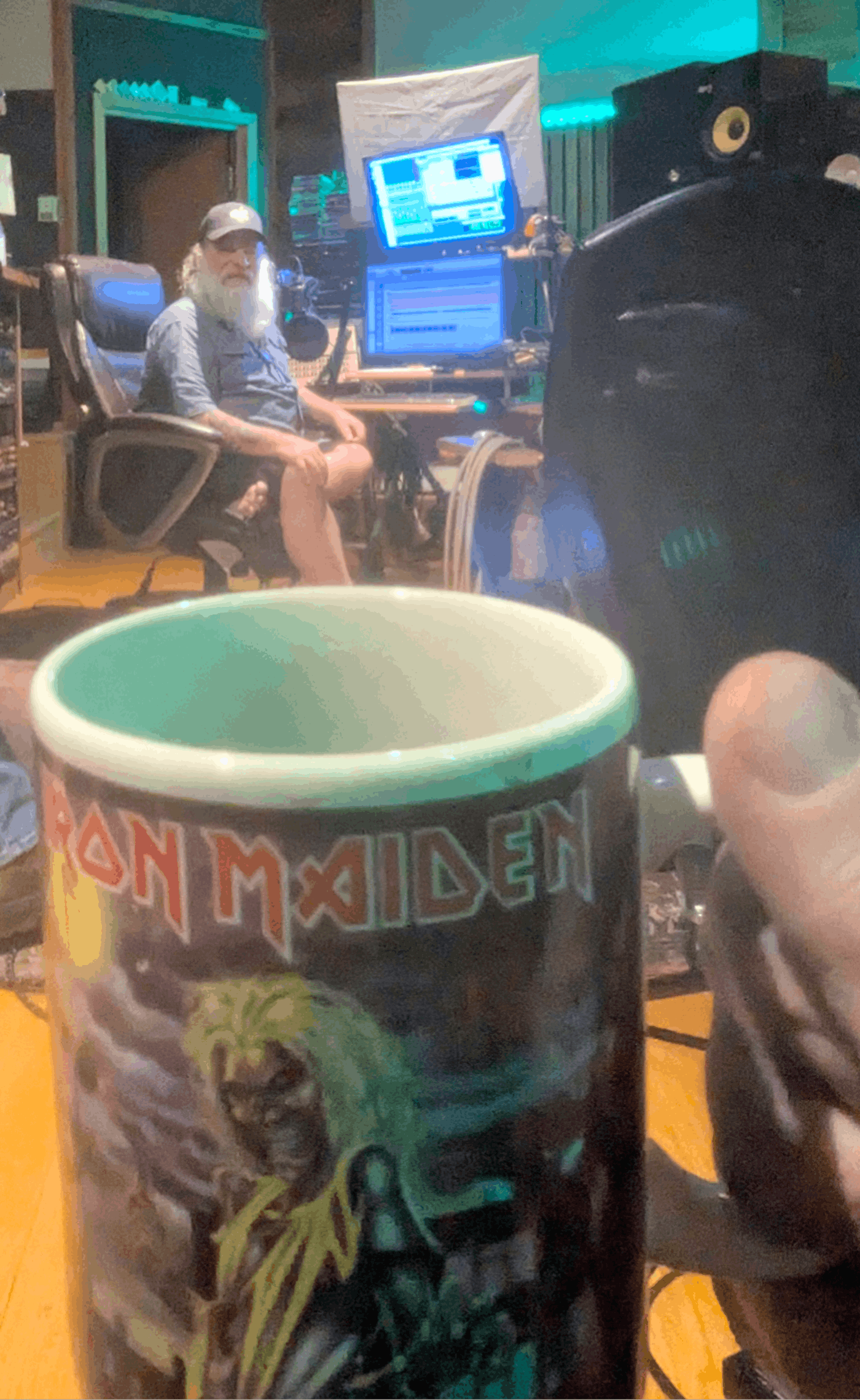
It began at Bedside Studios in Winnipeg with Len Milne, whose discipline forced Taylor into a different way of working. Taylor was used to rooms like Fat Mike’s Motor Studios and Steve Loree’s Crabapple Downs in Nanton, Alberta, where The Real McKenzies cut “Westwinds”: places that caught energy, trusted a developing song, and worked from a punk rock groove. Bedside was different. Milne’s method was not to capture the ocean moving, but to capture each wave so carefully that the ocean appeared from the detail.
“I wasn’t prepared for Len to be as dedicated to his method as he is,” Taylor says, “and especially as trusting as he is in his artists giving him exactly what they know, from their ownership of their talent, to be the most correct that the art should be. Len is there for a ready artist. I am not that thing. Ever.”
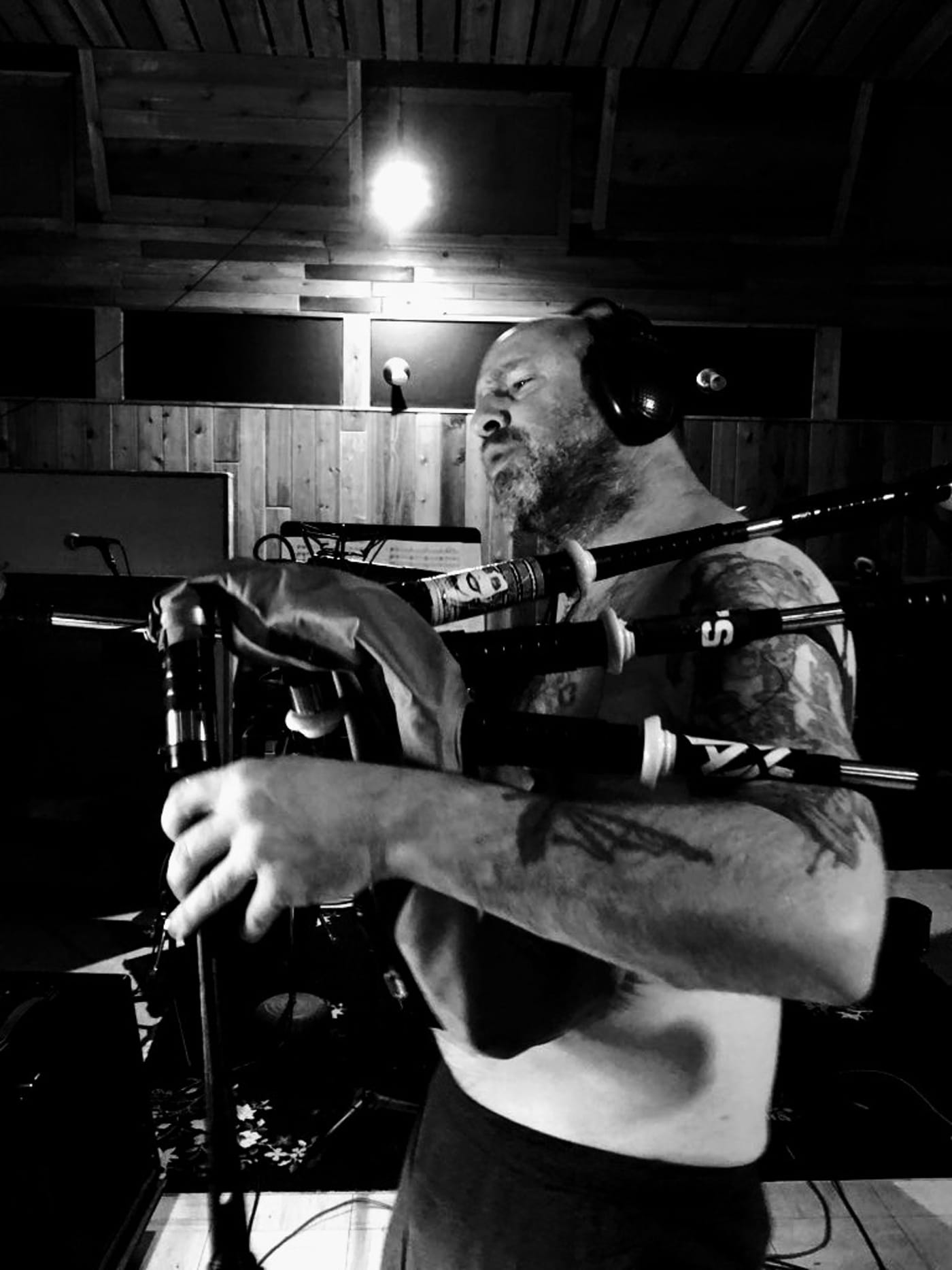
Taylor went into Bedside with only a basic notion of songs, expecting studio collaboration and engineer input to help build the final product. Milne works best when the final product is ready. The mismatch slowed everything down, but Taylor came to hear the delay as part of respecting the listener.
“If it ain’t fucking good, I’m doing it again, or writing something better.”
The acoustic record started in August 2025. By January 2026, Taylor had the five-song EP he had planned, but the slow build had worn a groove into the process. He took a break, went to Europe, and made the electric album. Part of the problem is practical: he writes faster than he books shows, and his main instrument is too loud to practice properly at home. A soundstage becomes a writing room because the bagpipes do not care about apartment walls.
“Light Treason” is mostly built from songs less than a year old. Taylor first considered calling it “Demo for the People”, then got bored of the title, partly because of what he heard as its communist undertones. “Light Treason” stuck because, he says, that will be the crime committed when the cover art is revealed.
The acoustic record is meant to strip away the power of electrons and leave melody, prose, and the right recording to carry them. Taylor wants simple instrumentation and a demo-like plainness in the content, but a strong recording representation of it.
“Life is full of scrapes and bruises and these injuries put heart into our stories,” he says. “When it’s time for me to go off to a better place, I insist that I look back on life as a participant and not just a spectator.”
One of the strangest pieces on “Light Treason” starts in junior high.
Taylor was in Grade 7 in Winnipeg, with an older sister in Grade 9, when music teacher Zane Zalis connected him with Marty Thiessen. Zalis is still in Taylor’s life; Taylor is 47 now and still has him over for fresh bread and good coffee. Back then, Thiessen was the bass player in Zalis’s band, a long-haired Winnipeg “banger” in the 1990s sense — tight jeans, Cons or cowboy boots, Guns N’ Roses, Metallica, Iron Maiden shirts, fast life adjacent to punk without being punk.
At a school concert, Thiessen played the “Peanuts” theme on bass, working melody and second line across the strings. Taylor walked up afterward, too young to understand the social hazard of approaching an older student, and told him it was rad. Thiessen shook his hand and thanked him instead of treating him like a stupid Grade 7 skater.
Three decades later, at a North Kildonan house party, Taylor saw him again. Thiessen played a basement-stage set with delays, bass expression, The Beatles’ “Blackbird”, and then the “Peanuts” piece again. He also told Taylor about Electro Quarterstaff, his instrumental band named after a weapon from the old Canadian cartoon “Rocket Robin Hood.”
Electro Quarterstaff’s cover of “Dr. Wily’s Theme” from “Mega Man 2” sent Taylor back into the music of the Nintendo he had grown up playing with his sister. He sifted through “Final Fantasy’s” “Prelude”, “Ninja Gaiden”, “Castlevania”, and landed on a theme he is not naming yet. It will be the third instrumental on “Light Treason.”
The piece began as 8-bit game music originally written for symphony by Naoki Kodaka, who worked for Sunsoft, Japan, before engineers transferred the music into 8-bit synth form. Taylor turned it into a 37-page, six-voice score for bass, violins, bagpipes, pipe band snare drums, and drum kit, using guitar tabs for reference and writing the lines into what he calls “bagpipe-land.”
Kodaka gets the writing credit in the liner notes. Taylor will credit himself only as arranger, with two new middle pieces added. He plans to send Kodaka a copy and a thank-you, and hopes he has not made “a mistake for which I have to pay a tribute of a finger.”
The next single outside “Light Treason” is “Trois Pistoles”, set to appear in French and English. Taylor is bilingual in the practical Canadian way: fluent, but not what he calls proper. Before this music run, he was a long-haul trucker with a Kenworth T680, a Cummins 15-litre diesel engine, and an 18-speed transmission, hauling between Vancouver, British Columbia, and St. John’s, Newfoundland. Empty, the truck carried 20,000 kilograms on 18 wheels; full, 40,000. Across 7,500 kilometres of Trans-Canada Highway, he crossed Quebec often enough for its language and place names to stay with him.
Trois Pistoles is a small city on the St. Lawrence River. The name translates to “Three Guns.” Taylor loved the name, then married it to a Winnipeg story from the Westbrook, a hotel in the north part of the city where, in the old days, truckers brought in things that “fell off the back of the truck” on Saturdays.
“That’s trucker-code for saying stolen,” he says. “It was a nice way to spend a Saturday. Good drink, good company, and a bit of entertainment, such as a band or barfight.”
He is careful about the town itself. Trois Pistoles has never shown him crime or underworld characters. The Westbrook did. The song is creative fiction, and that is why he is keeping it off “Light Treason.”
“Because it’s entertainment and not honesty, it doesn’t belong on ‘Light Treason’.”
The French version was translated by his ex-girlfriend, an experienced bilingual school teacher, actress, and performer. The message stays the same, but the words shift. Taylor loves how French verbs can sound to an English ear: “Êtes-vous prêt à commander?” becoming, in his comic reading, “Are you ready to command?”; “Vous avez terminé?” becoming “You’ve terminated?”
He used AI once, and only to quickly check grammar for those examples. The rest of his line remains firm: he does not use AI to problem-solve art.
The chorus uses a cast of characters based on real people, with their names swapped for Biblical ones as a nod to old ways still holding on.
Cape Breton complicates Taylor’s break from Scottish packaging without really undoing it.
He spent a lot of time there this year, including a gala dinner and concert where The Rankin Family, Bruce Guthro, and Donnie Campbell were inducted into the Cape Breton Music Hall of Fame. Taylor went in tuxedos-and-ballroom-gowns mode, which he says was proper for the Canadian legends being honoured. He also met Jenn Maclellan after getting stuck by weather while waiting for the eight-hour ferry to Newfoundland.
Taylor calls Cape Breton “Canada’s musical epicenter,” and he does not mean it as tourist copy. Nova Scotia, in his telling, breaks into several worlds: Halifax and Annapolis city folk, Yarmouth weirdos who speak Acadian and are some of the best Canadians he knows, and the island folk of Cape Breton. Before the Canso Causeway, Cape Bretoners had to fend for themselves. Taylor thinks that separation still sits in the heart of the place.
Cross the Canso Causeway and the signs are in English and Gaelic. Last names matter. Clan logic still hangs in the room.
Jenn Maclellan sits right inside that world. Taylor says she has “like five degrees” and is finishing a doctorate through the University of Reykjavik, but would rather talk her way past security in Eindhoven to sit with Fat Mike and discuss modern sexuality. That, Taylor says, is how she met his old boss.
Cape Breton gives him Scottish culture whether he asks for it or not: bagpipes and fiddles in bars, people taking the piss, Jenn’s friend Jen Sinclair drunkenly falling down the stairs at Governor’s Pub and destroying an oil heater on the lower landing. But the thing that floors him is not the branding. It is the musical detail.
He has learned that fiddle players on the island know how to alter a piece depending on which township they are playing in. The word he keeps reaching for is “lilt,” the almost impossible-to-explain feel of a piece when the right notes are played the right way for the people in the room.
“I’m not sure anyone in Canada knows this better than the Capers,” he says. “Even a modest, half-talented Cape Breton fiddler will write a melody whose musical characteristics blow away my composing ability. Shit, they’ll write some pleasant little fucking musical line that both locks in your head and introduces some creative little oddity which, over time, absolutely can not be divorced from the song.”
That does not send him back to a kilt. It sends him to school.
“Visiting The Island is like going to school for me,” he says. “I’m a conceited asshole but it’s one of the few places where I feel outclassed and I try as best I can to just shut the fuck up so that I might learn something from my betters, not necessarily about Scottish culture but about something that I’ll be lucky enough to never, ever be able to describe.”
Winnipeg still owns him.
Taylor does not hear the city as a place where musicians play at all costs, or a place where fame is the obvious prize. That is why he loves it. He remembers seeing The Guess Who in a 1,500-seat venue, with someone in the crowd spotting Burton Cummings’ cold sore and asking if he got herpes from Nicole. From the back of the room, Nicole yelled back: “Fuck you James!”
“Here in Winnipeg, your stardom only matters to people who don’t matter,” Taylor says. “We demand an experience with a stage show, not just a run through the repertoire.”
The newer artist who hit him hardest in 2024 and 2025 came from far away from all of this: Apes of the State from Lancaster, Pennsylvania. Taylor found them on Spotify while writing blunt, coarse lyrics for “Light Treason”, and he latched onto April Hartman’s way of putting human feeling before acceptable lyric-writing manners.
“I just keep listening to their talent,” he says, “and every time, I feel more and more happy to be inspired by them to overcome the weight of past experiences with the catharsis of letting it go for others to hear.”
“There’s something very pure about not sugar-coating shit and it adds credit to the final product.”
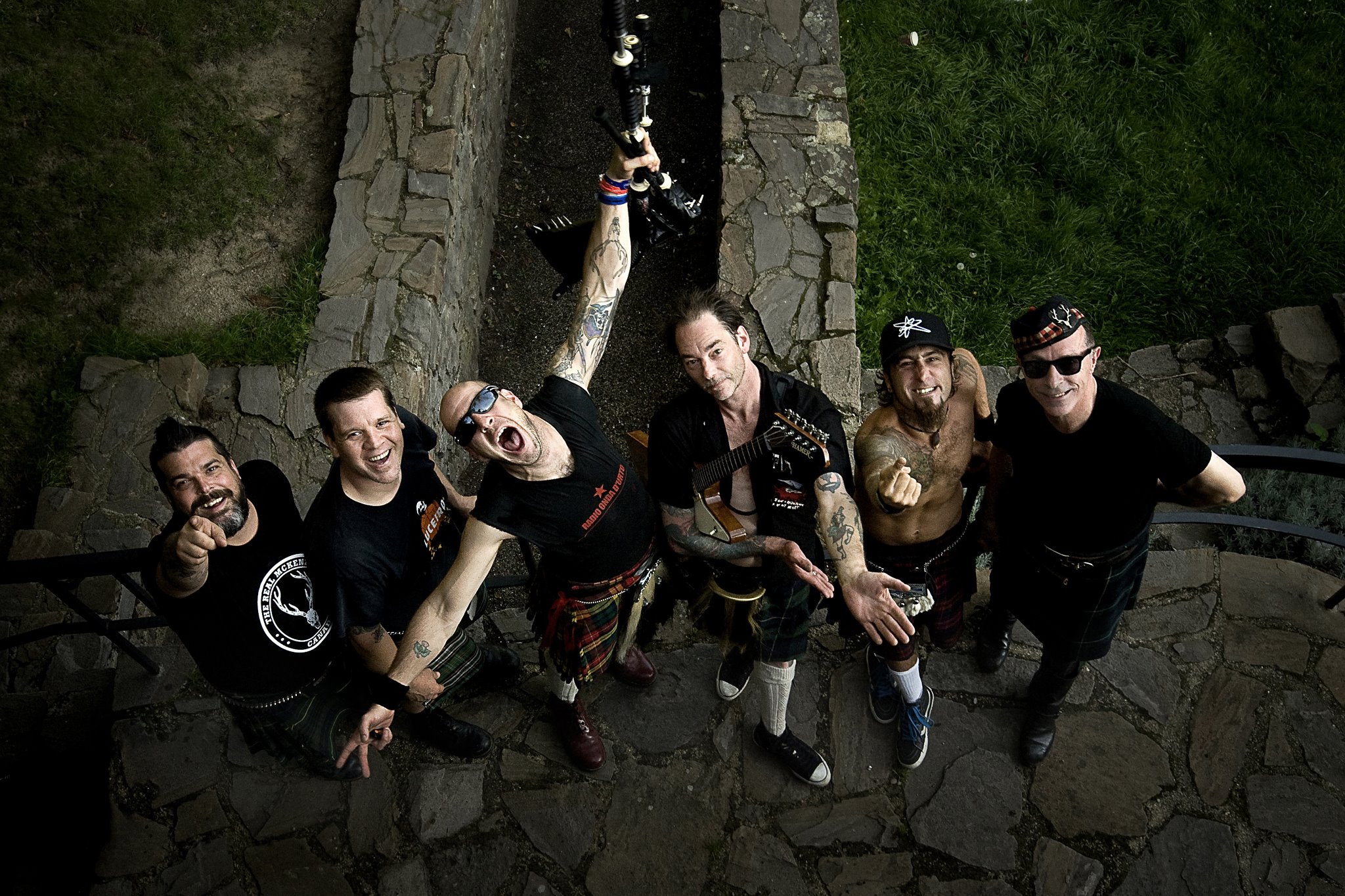
The Real McKenzies are never fully absent here, but Taylor keeps them in the right place. He is not trying to rewrite the band from the outside, and he is not trying to turn his own work into a McKenzies echo with his name on the cover. The band and Fat taught him how records get made: how to write, how to perform, how to record, how to survive a studio with a song still forming in the fog.
Taylor describes his younger self in the band as a coke-head, an “enfant horrible,” and an attention-entitled adult with a teenager’s asshole streak. He says he is still most of those things, minus the coke. Back then, he did not really know whether the best things he wrote were any good. He just had people around him telling him to keep going. Matt McNasty’s support mattered there.
“Kind of like driving a semi truck into the fog,” he says. “The gauges and dash lights all told me I was still on pavement even if I had no idea where the ditches start.”
Now the confidence is less about knowing the final product objectively and more about loyalty to the point of the project. Do not sell out. Do not use AI to solve the art. Be on time. Be sober in the studio. Serve the song, not the image of the song or the image of the composer.
Taylor is still obsessive about The Real McKenzies and NOFX catalogues, listening through both a couple times a year and still finding something to learn. He paraphrases Fat Mike’s view on influence: all artists are pulling from somewhere, because everyone is the sum of their experiences; the difference is between stealing a combination of notes and honouring the things that taught you to write.
NOFX taught him what he calls candy-coated chord changes, especially the move from the major IV to the minor iv and back to I — an imperfect plagal cadence that he says works brilliantly in punk rock. Mike also taught him organic writing: forget structure, let the song go where it wants, and who cares if it has a chorus.
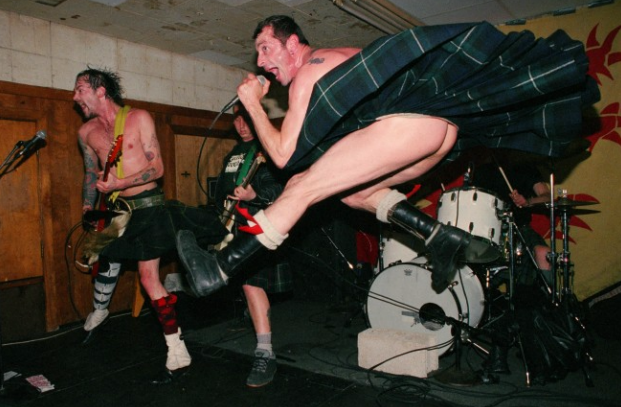
Paul McKenzie taught him wordsmithing. Taylor still loves that Paul rhymed “sea” with “do” in “Cross the Ocean.” Sean Sellers taught him “the oval,” a hard-to-explain idea about expression and timing departing from one beat and returning to the next. Bone taught him something about pentatonics by talking himself down. Taylor thinks that self-deprecation hid mastery.
“He is a master of owning a solo’s scale, then slipping in something really, really, really special even just for a tiny second,” Taylor says. “This is a philosophy of The Blues the way Americans used to play them: it’s not about which notes you play, it’s about why they need to be played.”
Bone is also, Taylor adds, a very accomplished drummer and had “gold-material comedy tapes” as a young man. Dirty Kurt and Paul McKenzie sit in his mind as opposite sides of the same coin: songwriting geniuses with different ideals, producing timeless music in different ways. Matt McNasty is harder for him to sum up.
“Matt likes to describe us as ‘The Performer’ and ‘The Smarts’,” Taylor says. “That’s a pretty good, broad catchall, but strangely, in different aspects of life, the two roles interchange between us.”
For a funny Real McKenzies memory, Taylor offers a poem instead of a neat anecdote. “The Real McKenzies in Marseilles” is dedicated to Bone, with a preface thanking him for sacrificing “the global perception of his manhood” for the comic value of the tale. Taylor adds that Bone has a beautiful wife who has loved him dearly for decades and is clearly more-than-satisfied with what is hers.
The poem also nods to “Best Day Until Tomorrow”: “Enjoy what’chas got, not what ye have not, ’tis a weak heart lamenting with sorrow.”
It remembers a rainy day after soundcheck at Le Club Molotov, with Taylor, Bone, and Boggin retreating to the van, drinking through the certainty of a bad show, and deciding they would make the best of it with “Bugger Off” and French punks in tow. Bone has to piss. The van is parked on the right side, so he aims left toward the street. On his knees, at the window, he misjudges the clearance. A cop on a bike rides into the line of fire.
“So now
Any gray day in Marseille we can say when
All a-round is dark and sick, a
Policeman there lives who would never forgive knowing
How he drank from punk-rock dick.”
Taylor is also deep into vinyl now, which has changed how he hears everything. A record ending feels to him like an enlightening lecture or a rare quiet moment. It has also changed what he asks of listeners. He does not want the bagpipes filed away as folk, Celtic, military, novelty, whatever else. He does not want to fight the reflex either.
“It would be bad form for an artist to fight a listener’s reflex,” he says.
He would rather ask for attention. A focused listen. Enough time for the thing to argue for itself. He once wanted to phone up and ask the most useful interview question available: “Which song do you just fucking hate worst on ‘Made in Hell’?”
His theory of art is not in the painting, and not entirely in the audience either. It is “in the air between the two,” built by the work, the listener, and the time passing through them.
The old album from 2013 is being remixed too. Taylor plans to gather everything into four vinyl records and release them together at the end of 2026 or the beginning of 2027: the older work, “Made in Hell”, the acoustic “Light Treason” era, and the connected singles and pieces orbiting them.
“I’m gonna die one day,” he says. “I’m almost 50 and have treated my body like a trash can for most of that. Some people, when on their death bed, begin praying and ‘buying theological insurance’ just in case Heaven exists. Legacy is kind of my way of doing the same. I don’t know what the world will look like after me, I hope it’s beautiful, but if not, releasing these four records is my way of leaving something behind just in case some shit sucks for people.”
🔔 IDIOTEQ is ad-free, independent, and runs on one person’s time. If you want it to stay that way: DONATE via PayPal 𝗈𝗋 SUPPORT via Patreon.
Stay connected via Newsletter · Instagram · Facebook · X (Twitter) · Threads · Bluesky · Messenger · WhatsApp.