
When Michael Cauldwell wanted his nine-year-old son Sami to hit the body of a guitar during a recording, Sami’s first instinct was to hold back.
Michael was listening through headphones. Sami could not hear the music, so his father directed him with one hand, telling him when to hit the guitar and encouraging him to use more force. Sami tapped it once. Then again, slightly harder.
“I’m scared I’ll break it,” he said.
They tried a few times before recording. Once Sami realised the guitar was not about to fall apart, he became more confident. With the drive pedals switched on, each hit sent out a short burst of distortion. Those hits eventually became part of “Dream Sequence“.
Sami has his own name for the technique.
“The bashing.”
That small exchange says quite a lot about Raging River/Furnace Sky, the home recording project Michael, 46, started with Sami in February 2026. They are not trying to turn a child into a technically accomplished musician, and Michael is not setting up formal lessons disguised as family recording sessions. They sit down when Sami wants to. They try things. Sometimes they find a song. Sometimes they spend time pressing keys and making noises and nothing comes of it.
The project grew partly from Michael wanting to find a creative way to spend time with his son following Sami’s autism diagnosis in 2023. Sami was seven when he received the diagnosis after a long assessment process recommended by his school. Michael is careful about how he talks about it.
“Autism doesn’t define Sami, but it does shape the way he experiences the world.”
Sami can focus intensely on subjects that interest him and can become frustrated when something does not match the version he has pictured in his head. He loves nature, numbers and patterns. Busy places can overwhelm him, and some social situations are difficult. Michael also describes him as one of the kindest people he knows.
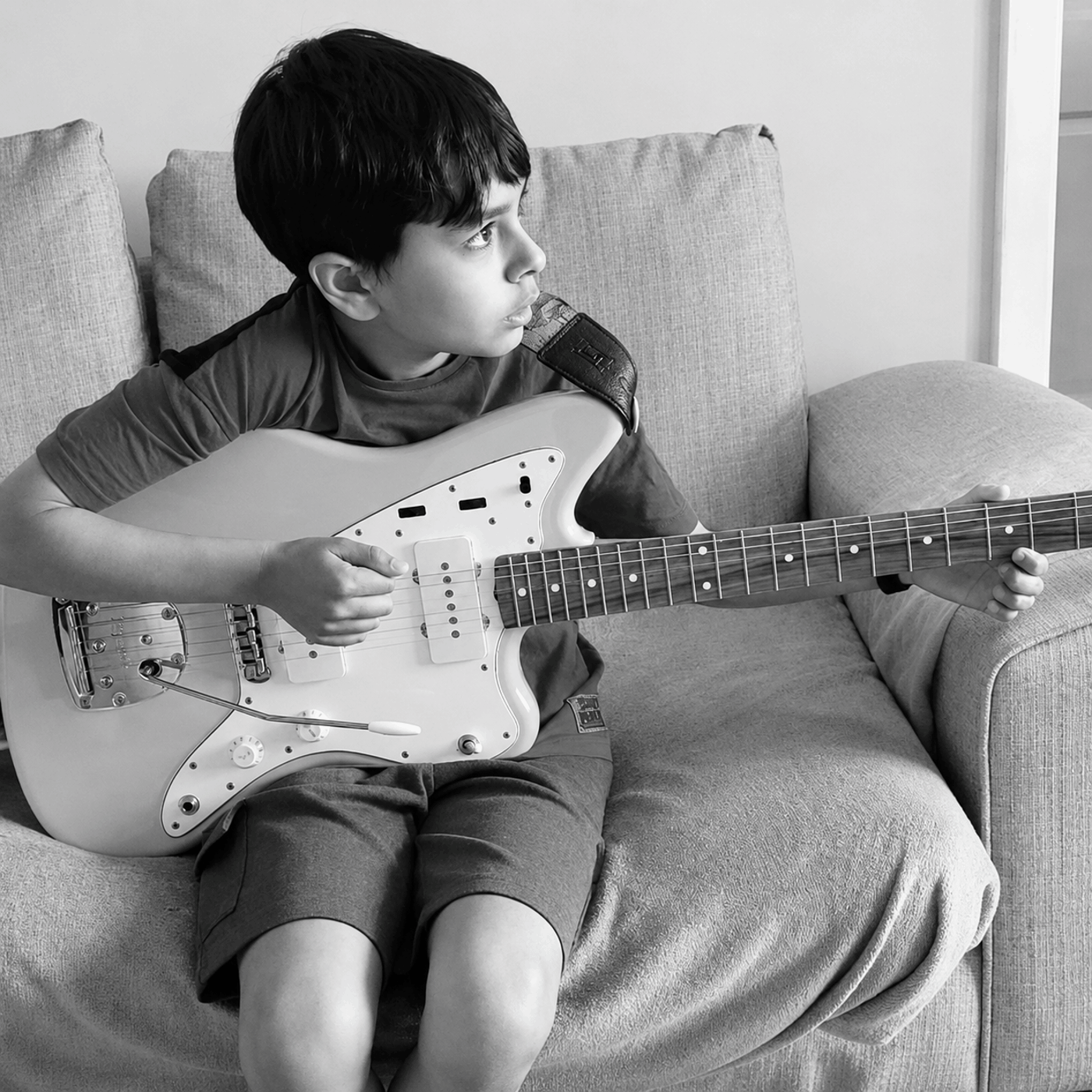
Michael never wanted the project to become a way of pushing Sami towards music. He wanted to introduce him to the part of it he had loved himself growing up: the simple pleasure of discovering that a few instruments, some curiosity and your own imagination can produce something that belongs entirely to you.
Michael had played in bands throughout his teens and twenties, but work and family eventually pushed music further into the background. His guitar spent years sitting unused. Sami had no recording experience. Michael had never really learned home recording either.
The starting point was therefore basic: a guitar, an Akai MPK Mini keyboard and a Zoom four-track recorder at home.
“We learned together by pressing buttons. Nothing is off limits.”
Their current setup remains small. Michael uses a Fender Jazzmaster, an Epiphone Sheraton, the MPK Mini, the Zoom and a few cheap guitar pedals bought through Vinted. Most sessions happen in Sami’s bedroom.
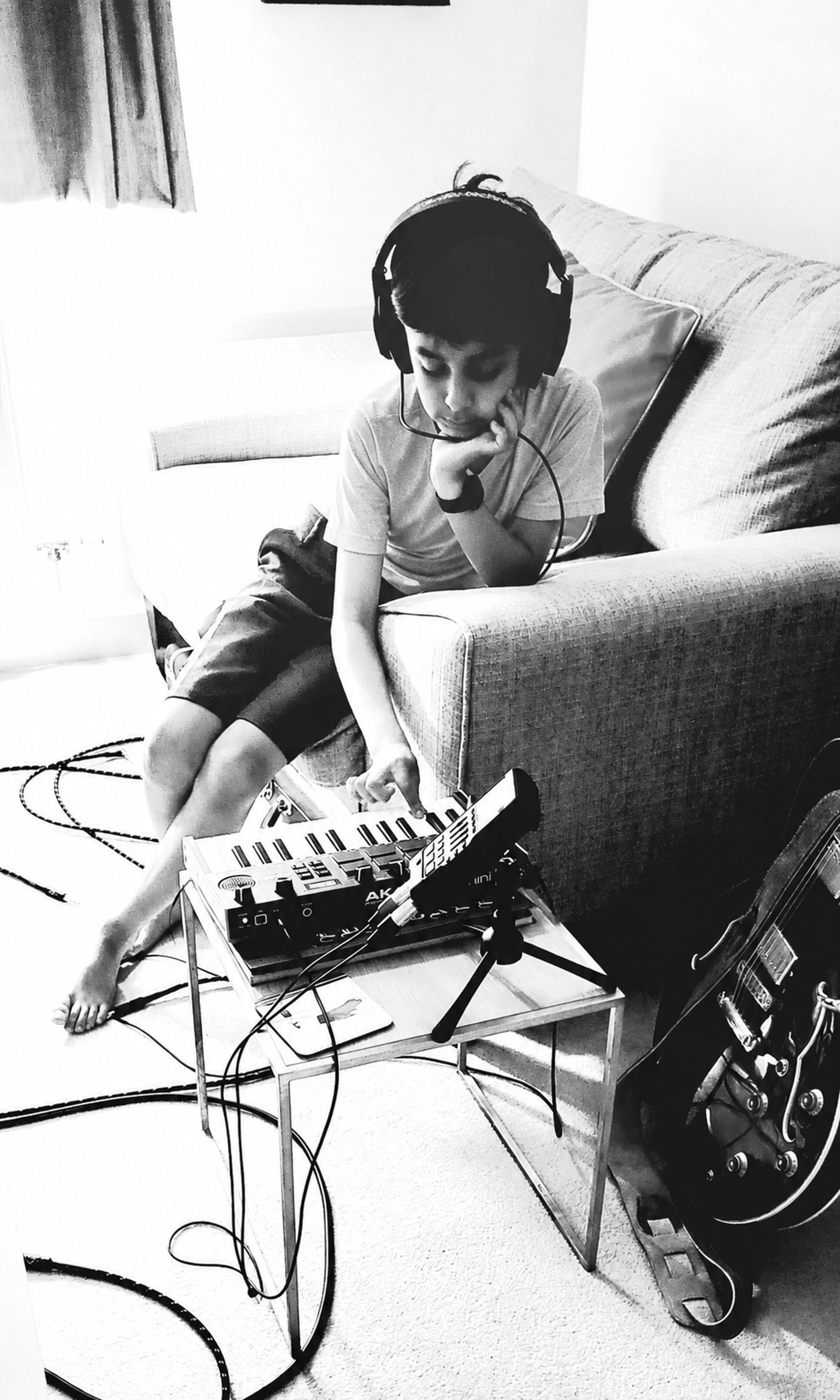
If Sami is interested, they play. If he is not, Michael leaves it alone or works on something by himself.
Sometimes Sami searches through keyboard sounds until one catches his attention. He may simply press a single note and hold it. Michael listens, adds guitar and sees whether there is enough there to continue.
“Sometimes it’s just him pressing and holding a key, with a particular sound. If I can layer a guitar on it, I’ll ask him to hold that and it can be our starting point and we build from there. Other times, nothing at all comes of it but we just mess around.”
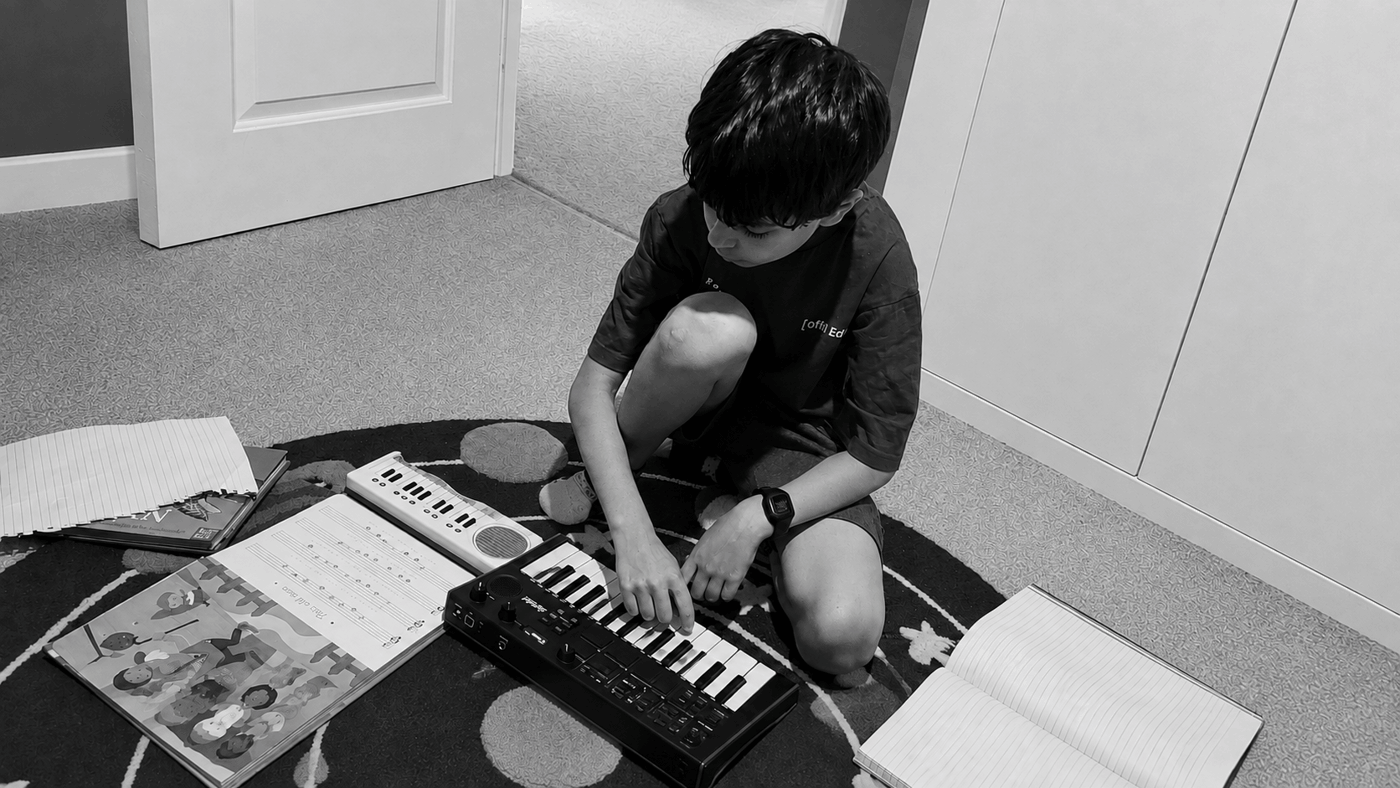
Sami is also trying to understand the keyboard in his own way. In one photograph, he has a children’s piano book open beside the MPK, using it to work out notes and memorise scales. At another point he covered the keyboard in Post-it notes so he could remember which keys he needed.
Eventually there were so many Post-it notes that they became confusing.
Michael finds this interesting because his own route into music went the other way. He learned on guitar when he was young and took lessons for a while, but reading music quickly lost him. He began playing by listening and by feel instead.
He does not want to impose either method on Sami.
“I completely let him work it out, to be honest. I do everything by feel and sound, so my encouragement was for him to do the same.”
Sami does not yet know many conventional chord shapes. When he takes Michael’s guitar, his right hand naturally finds a rhythm, but his left hand does not necessarily know where it is supposed to go. Michael sees no reason to make that a problem.
Instead, he showed Sami that an electric guitar can make interesting sounds before anybody learns how to play it in the expected way.
That idea has a history for Michael.
In 2007, he went alone to the Roundhouse in London to see Sonic Youth perform “Daydream Nation” in full as part of the Don’t Look Back concert series. He still has the ticket.
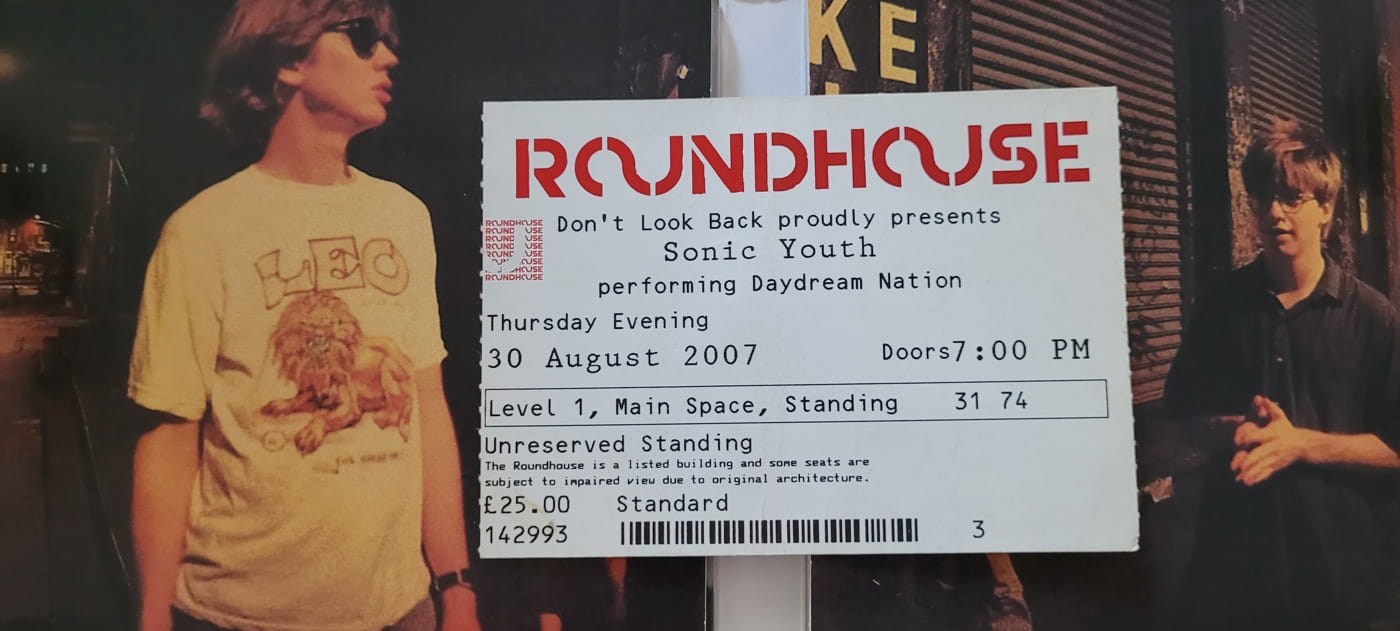
Michael lived about an hour and twenty minutes from Camden by train and had to go directly from work. He did not have time to change, so he ended up standing near the front in his work clothes.
“It was magical.”
One of the things that stayed with him was watching Thurston Moore pull strange sounds from his Jazzmaster.
Michael himself was playing in fairly conventional indie bands at the time. He did not return from the concert and immediately start attacking guitars with screwdrivers. The local venues his bands were playing would probably not have been particularly interested in that kind of experimentation anyway.
“The risk taking was minimal. Not in a bad way, but more that the places we were playing as in local venues wouldn’t have touched us had we started playing the guitars with screwdrivers.”
Almost twenty years later, Michael owns a Jazzmaster himself, and his son is learning that striking its body can be as valid as putting his fingers in the right place for a chord.
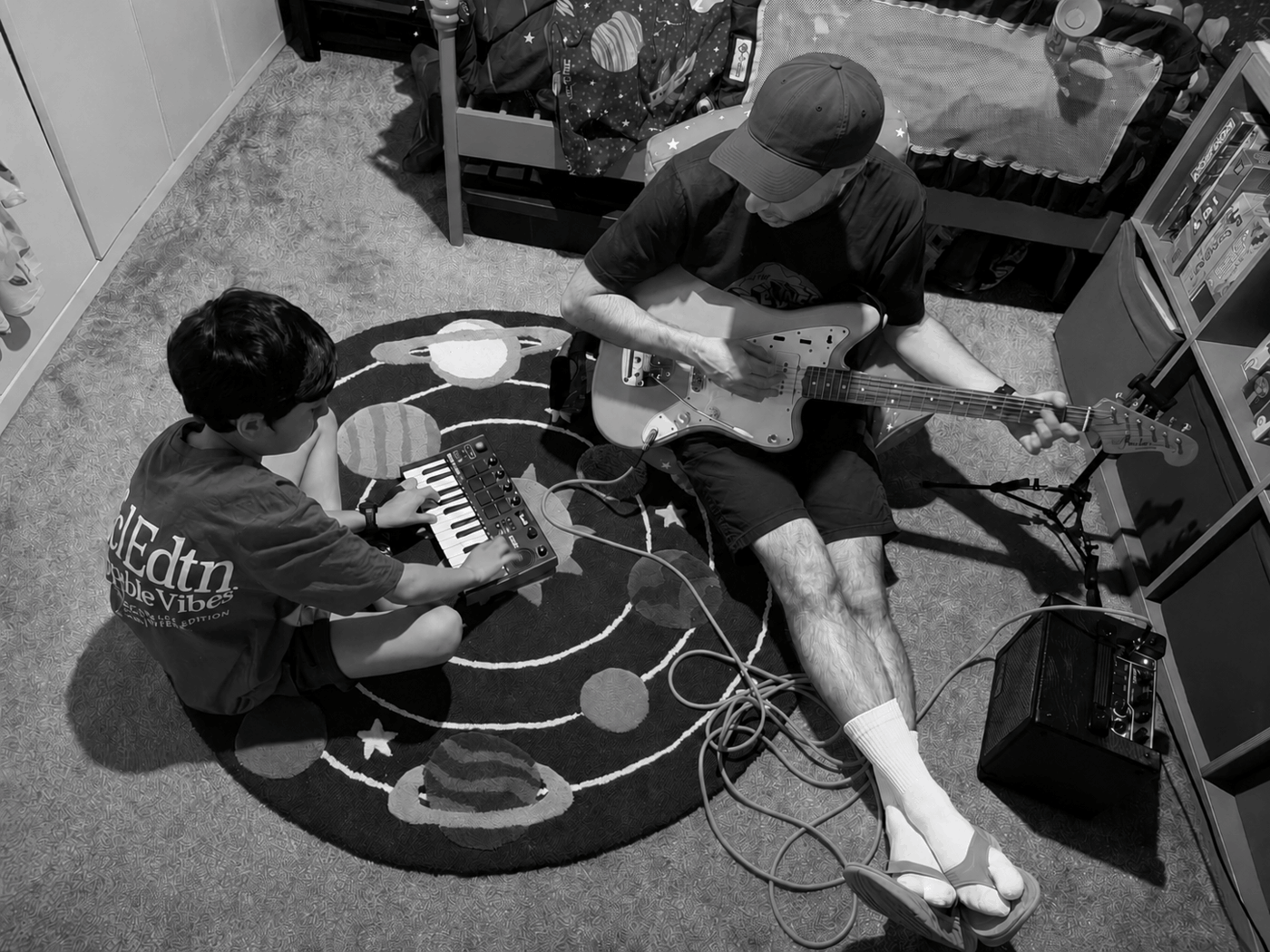
Michael had not consciously planned that connection. Watching Sami experiment simply brought the old Roundhouse memory back.
“I remember seeing Sonic Youth at the Roundhouse in London, and watching how Thurston Moore would coax these crazy sounds out of his Jazzmaster. Watching Sami in his room experimenting makes me recall that show, but also hopes he will not be afraid to experiment and see things beyond the conventional.”
That freedom also affects how Michael records.
He does not want the songs polished until every trace of the session disappears. If they make a take they like and there is a minor mistake in it, they usually leave it alone.
For Sami, this leaves space for trial and error. For Michael, it has become a kind of journal.
“I try to keep the whole process relaxed, including the recording and any mixing elements. If we find something that sticks, and then get to the point where we are ready to record it, we won’t stop the recording and go back to correct any minor issues.”
He knows they have the luxury of doing the opposite. Nobody is charging them studio time. There is no deadline. If Michael wanted to spend another evening fixing every mistake, nothing would stop him.
He chooses not to.
“In an age where almost anything can be polished into perfection with AI, I’d rather keep the imperfections. To me, that’s where the humanity and creativity lives. I’m not a fan of over produced sounding records.”
“Dream Sequence” gave him a specific reason to test that idea.
The song was written after Michael’s father died.
Michael’s father owned an old nylon-string Spanish guitar that Michael himself had learned on while growing up. After Michael left home, the guitar stayed in the attic at his parents’ house for around twenty years.
Sami had never seen it before his grandfather died.
Michael brought it down and cleaned it. He tried restringing it, but its ageing neck could not cope with the tension. Almost all the strings snapped.
Three remained.
Michael had already decided that he wanted the instrument somewhere in “Dream Sequence” as a tribute to his father. He recorded with the surviving strings.
For Michael, there was an obvious family continuity in using it. He had learned on that guitar. It belonged to his father. Now a recording he was making with his own son began with it.
“It had gone full cycle.”
Michael does not actually remember watching his father play the guitar, although other family members have told him he did.
His father had also been seriously unwell for much of Sami’s childhood. During the final couple of years of his life he was bed bound.
Michael remembers him as emotionally reserved.
“My father was pretty stoic, and didn’t offer affection easily but Sami had this wonderful innocence and natural affection so we hold those memories close.”
Michael wrote the lyrics to “Dream Sequence” shortly after his father’s death.
“I lost myself, on the way down,” he sings at the beginning.
Later, a person appears and disappears. Morning sunlight becomes harsher as the day goes on. Someone sleeps while lightning strikes. The song reaches the image of “golden static”, followed again by disappearance.
Sami does not know those details.
Michael has never sat him down and explained that the song concerns his grandfather’s death. Sami mainly understands the recording through what he hears and what he contributes.
One of those contributions began completely separately from the song.
Michael had recently bought the Zoom recorder and was trying its built-in microphones. From the kitchen, he and Sami could hear young birds in a nest outside.
Sami wanted to record them.
They went into the garden together. Sami held the recorder as close to the nest box as he could without disturbing the birds and recorded their calls.
There was a lot of background noise, so Michael could only use a small part of what they captured. It now appears at the beginning of “Dream Sequence”.
“Sami’s idea,” Michael says. “It’s lovely too, because it was done by him in a totally non-pretentious way.”
He had not sent his son outside to collect meaningful field recordings for a song about bereavement. Sami simply wanted to hear the birds again.
Only after putting the piece together did Michael notice what had happened.
“Listening back now, it adds a new significance to the piece, the new birds starting life and the lyrics I wrote after my father’s death.”
The recording carries another imperfection that Michael consciously decided to keep.
At the time, he was still learning how to export recordings from the Zoom into files suitable for uploading to Bandcamp. Some of the drum pulses in “Dream Sequence” became slightly distorted during that process.
He considered correcting them.
“But then I thought, actually, who cares.”
The extra static worked with the rest of the recording. More importantly, Michael had made it during a difficult period immediately after losing his father.
“Things didn’t feel perfect. I wanted to capture something that reflected how I was feeling, and that’s what came out.”
Raging River/Furnace Sky currently have seven tracks online. Michael does not consider them an album and has not built a running order or tried to make the songs fit a single concept.
More will be added when they make them.
The Bandcamp page is simply where the recordings live.
The first song Michael and Sami finished together was “Raging River, Burning Sky”.
It reaches further back into Michael’s life, particularly the years when he was living alone, drinking heavily and repeatedly promising himself that things would change.
Michael has been treated for depression and has struggled with alcohol and addiction. He describes writing as a way of keeping a record of those periods and getting thoughts out of his head.
The opening lyric comes directly from that time:
“I’ll take today at a glacial pace while I come up with a plan,
surveying last night’s battlefield while drinking breakfast from a can.”
The rest of the song stays close to that cycle. Tomorrow becomes the day when the narrator promises to grow and change. Today becomes another day spent inside the flat, another drunken plan and another attempt to understand why the same mistakes keep returning.
“If I could start again, I’d tell you how I feel.
Stop making all the same mistakes, trying to reinvent the wheel.”
Later, the song reaches one of its more aggressive moments:
“An afternoon session,
my mind’s a loaded gun.
Pretty soon I’m going to pull
the trigger of my tongue.
Be a man.
BE. A. MAN.”
The title arrives at the end of that passage: “I can see the storm clouds gathering in your eyes: raging river, burning sky.”
Michael cites My Bloody Valentine, The Fall and The Telescopes as important references for the track. Kevin Shields’ guitar work particularly interested him, and Michael wanted layers of distortion thick enough to start consuming the song underneath. Sami contributes keyboard parts throughout.
The song also explains why the project’s name seems inconsistent depending on where you find it.
The project is called Raging River/Furnace Sky.
The song is “Raging River, Burning Sky”.
The Bandcamp address uses another variation, ragingrivertofurnaceskies.
There is no elaborate story behind the inconsistency.
“Yeah, this is a typo that kind of stuck.”
The original name itself came from something equally ordinary. Michael and Sami were watching a nature programme, liked some of its imagery and borrowed it.
Sami does not worry much about the name.
“Sometimes he asks me to remind him what our project is called.”
Another piece, “Screaming in the Pines“, is instrumental. Michael built it around minor chords and a reverse phaser. Underneath, a heavily distorted guitar is struck instead of played conventionally, producing a continuous bed of static.
Michael had Boards of Canada and Tortoise somewhere in mind while making it, along with music for a long drive through America.
“Raise the Flag” comes from a very different place.
Michael wrote it after watching increasingly visible organised far-right activity in the UK. He had seen flags appearing on motorway bridges, marches taking place in towns and cities and political misinformation spreading online.
Michael and his wife are raising two mixed-race children. For him, the subject therefore carries an immediate family concern.
“There’s a really nasty undercurrent at the moment, and it feels like the country is turning on itself.”
The lyrics move through frustration, lost time, political anger and repeated images of flags being raised.
“I woke this morning on the heart of a whale,
So I rowed it out to sea.
All my years upon these waves,
Trying to work out who to be.”
The chorus is stripped down to one repeated phrase:
“Vitriol! Vitriol! Raise the flag.”
Later Michael writes about people following desire lines through “a self-destructive world”, watching “toxic outrage” and flags being unfurled.
The song also connects political anxiety with Michael’s own sense of getting older. A remembered phrase about embracing his forties returns in a much less optimistic form:
“‘Embrace the roaring forties.’
That is what you said.
Well, the roaring forties rose up,
Crushing me with dread.”
Near the end, he writes about “pot-bellied rodents / Who claim these streets”, before returning again to the chorus.
Michael has not explained the politics of the song in detail to Sami.
Sami does hear the songs, but lyrics are rarely the part that holds his attention. Michael and his wife have instead tried to make tolerance, kindness and compassion ordinary parts of raising their children without constantly exposing them to the fear behind every political development.
“There’s a lot of ugliness in the world but a lot of beauty too.”
Michael’s own diagnosis happened during the same broad period as Sami’s.
While Sami was going through his assessments, Michael also began being investigated for neurodevelopmental conditions. His situation carried an additional complication because Michael was adopted when he was young and does not know the medical history of his biological family.
He was assessed for autism and showed some autistic traits, but was eventually diagnosed with ADHD.
His wife’s role was decisive. Michael says that without her pushing him to get checked, he probably would never have pursued a diagnosis.
“I have quite a chaotic head, and for ages I just put that down to me being me.”
For much of his adult life, Michael had struggled with impulsivity and addiction. He could manage or ignore certain patterns more easily when he was younger. Marriage, children and other responsibilities made that harder.
The diagnosis gave him an explanation he had previously lacked.
It did not, in his view, give him an excuse.
“I’m keen not to use the diagnosis as justification for anything, more that now I have an understanding of the issue, and have tools to manage as best I can.”
Michael is now taking medication for ADHD and says it helps.
Sami’s diagnosis had another effect. It pushed Michael to learn much more about autism, primarily because he wanted to understand what his son needed from him as a parent.
The whole family is beginning to find its way into the recording setup.
Sami’s younger sister Layla is four. She regularly wanders into the room and strums the guitars simply to hear what comes out. She likes taking the MPK downstairs, putting it on the sofa and making sounds.
“Who knows, maybe one day we’ll extend the experiment to three piece.”
For now, getting Sami to explain what he is thinking while he makes music remains difficult. Michael says his son rarely verbalises his process.
His comments tend to concern other matters.
Recently, Sami asked:
“Daddy, will be on Spotify?”
Then he wanted to know something else.
“Will we make as much money as Ed Sheeran?”
Michael told him that was unlikely and asked how much he would be happy making.
“Just enough to buy my sweets.”
There is another family member waiting for every new recording.
Michael sends the songs to his mother when they finish them and waits for her opinion. She responds carefully and constructively.
Her involvement in Michael’s musical life goes back decades.
She encouraged him when he was a teenager, drove him around the country to concerts and even led campaigns at his school so Michael and his friends would be allowed to attend Glastonbury.
She introduced him to Neil Young.
Neil Young became the first artist Michael ever saw in concert.
“I’ll always be grateful for that investment and selflessness she showed towards encouraging me.”
That makes Raging River/Furnace Sky a longer family story than the simple father-and-son description suggests.
Michael’s mother helped make music part of his life. Michael learned on his father’s guitar. That guitar disappeared into an attic for twenty years, returned after his father’s death and became part of a song recorded with Michael’s son. Sami now sits with his own children’s piano book, sticks notes across a keyboard, records birds and worries that hitting a guitar might damage it. His four-year-old sister is already trying to join in.
Michael does not know where any of this is going, and he does not particularly need to.
There are seven recordings now. More will follow. There is no planned album sequence and no attempt to package what they have into something more finished than it actually is.
He would like to play live with Sami one day if Sami decides that is something he wants to do.
The more immediate hope is that music becomes useful to Sami in whatever form he eventually chooses.
Michael remembers what it gave him when he was younger. It became somewhere to put difficult thoughts, frustration and emotion, long before he had names for some of the things happening in his own head.
He sees a version of that absorption in Sami already.
During car journeys, Sami sometimes asks to listen to Michael Jackson repeatedly. Michael occasionally looks into the rear-view mirror and catches him staring through the window, completely occupied by the music.
“I understand that feeling.”
🔔 IDIOTEQ is ad-free, independent, and runs on one person’s time. If you want it to stay that way: DONATE via PayPal or SUPPORT via Patreon.
NEW: IDIOTEQ Explore 🗺️ Browse 15+ years of our archive by city, country, and style. Find artists on the world map or trace related sounds through the styles map.
Stay connected via Newsletter · Instagram · Facebook · X (Twitter) · Threads · Bluesky · Messenger · WhatsApp.