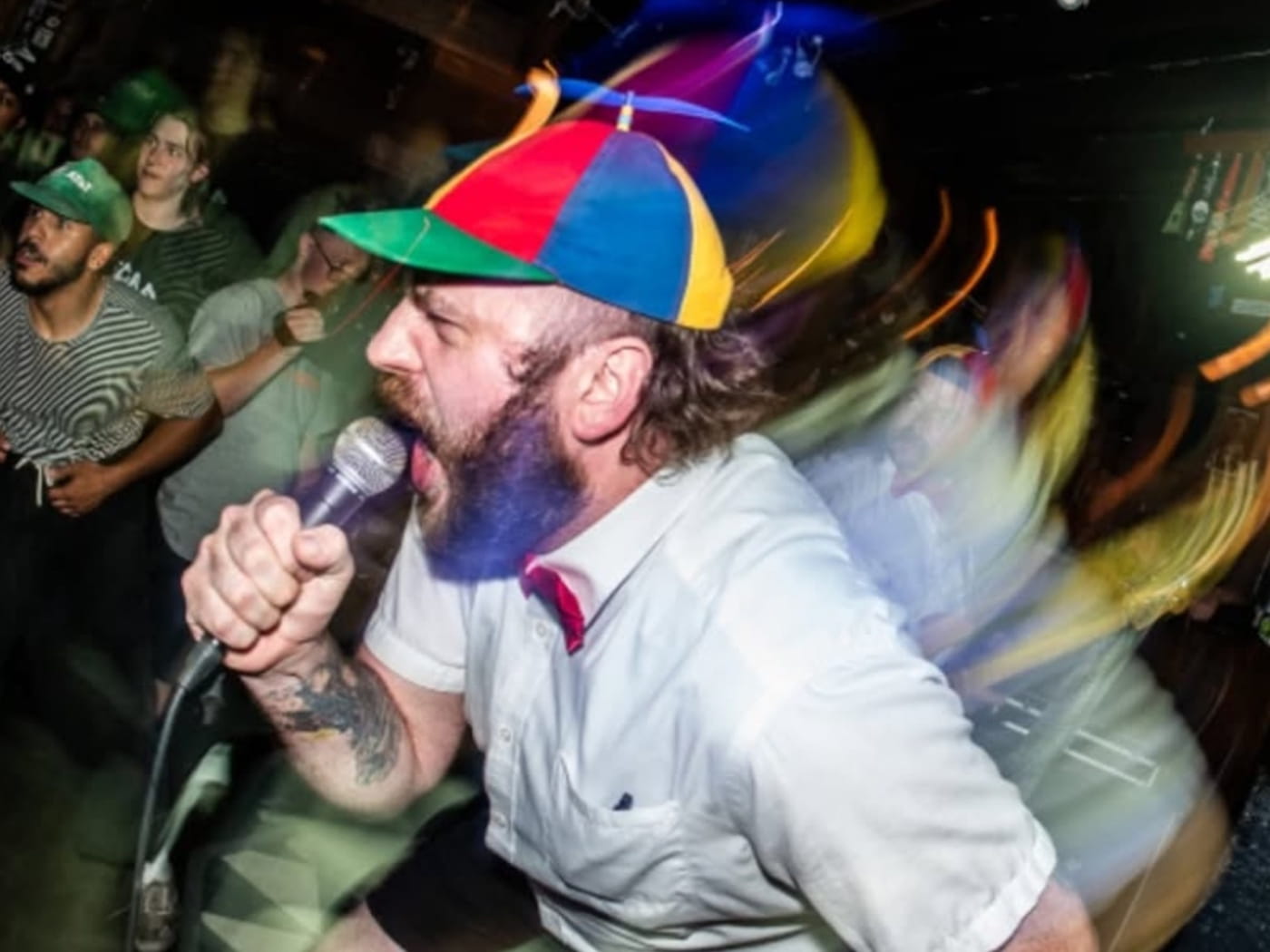

Zac Burger started The Burgers as a bedroom project in Beijing in 2019, writing punk songs that also move through folk punk, indie pop and power pop.
Seven years later, Glasgow is behind him, he has no permanent base, and the live version of the band has been cut down to Zac, backing tracks and a puppet drummer called Drummy Burger. His new video for “To Kill Takeshi Kitano” takes up an argument he had already started in Beijing about the people and systems that decide which art deserves to be taken seriously.
The Burgers have always sat a little awkwardly inside the normal idea of a punk band. Zac has spent as much time arguing with punk’s own rules as working inside them.
“To Kill Takeshi Kitano” comes from “Kick Fights to Lose“, released in May 2025 through Zac’s own Unsolicited Demos Records. It was his first collection written completely in English, issued in limited editions on CD and cassette with a behind-the-scenes zine.
The title is deliberately excessive. Zac uses one of Japan’s best-known filmmakers and actors as a name for a wider system of cultural approval. He has no interest in settling whether Kitano’s films are good or bad. His problem starts once certain artists have been watched, discussed and validated so many times that their status begins to look self-evident.
“The idea didn’t come from any single event. It has a lot to do with many very private experiences from my past, and I can’t deny that it was precisely these experiences that allowed me to understand this system of values more deeply. But my hatred of it wasn’t caused by those experiences. That hatred seems to have been rooted in my genes since birth, even before I was able to explain it in words.”
“I’ve always found it difficult to talk about those private experiences, because once I tell people about them, it’s very easy for them to reverse that relationship: to mistake the experiences that deepened my understanding of this system of values for the reasons I hate it, and then interpret my judgement as the product of personal trauma or personal grudges, rather than confront the questions that genuinely come from my instincts.”
Two relationships later deepened Zac’s understanding of the system he was already reacting against. Zac talks about the first one in metaphorical language. His words such as “defiled” and “killed” belong to his own account of what happened and of the radical change he describes in that person.
“Eight years ago, I met the most pure girl in the world. She transcended gender, species and experience. I even feel that calling her a “girl” is an insult to her. But during a devastating incident in the summer of 2018, she was defiled. In my language, she was killed. After that incident, she became the extreme opposite of what she had once been. She became one of those blind people who are obsessed with films, literature, rock music and all those great things that define value through experience.”
“She was fascinated by the depth and complexity those works gave their characters. In those works, no matter how filthy a character might be, their filth can be explained, given meaning, and even elevated into an artistic statement. Yet when facing a living, breathing person right beside her, she could reduce that person to a symbol as flat as a sheet of paper.”
Later came a five-year friendship with someone who, according to Zac, stood on the opposite side of this argument from the beginning. His friend had logged more than a thousand arthouse films on Douban, the Chinese equivalent of IMDb.
“Later, I met another person. He was the only friend who consistently stayed by my side over the following five years, although I knew from the very beginning that he stood on the opposite side from me. He had marked over a thousand filthy arthouse films on Douban (the Chinese equivalent of IMDb). He seemed to think that every additional film he marked would make him a little sexier.”
“It was a very twisted relationship. For five years, I kept trying to convince myself that if someone was willing to stay by my side, then even if his values were the opposite of mine, I should still accept him. I never demanded that he share my values. What I believed, instead, was that someone could stand on the opposite side from me and still truly understand me.”
“But in the end, that relationship ended in the filthiest possible way. I discovered that his supposed “understanding” of me had been nothing but a lie. Behind my back, he had been throwing himself frantically into that system, identifying with it. Ultimately, that system of values was sexier to him than I was, and he betrayed me for it.”
Out of that relationship came Zac’s phrase “Sexy Culture”.
“Looking back now, the only good thing that came out of that five-year relationship was that it allowed me to understand a cultural phenomenon more deeply. I call it “Sexy Culture.””
“I’ve noticed that some people are obsessed with those great films, literature and works of art, not necessarily because they love those things so much, but because liking those things makes them feel sexier themselves. As if every additional arthouse film they watch, every great artist they understand, makes them a little greater too.”
“The most interesting thing is that those things that have been elevated to greatness don’t even need to defend themselves anymore. There will always be people rushing to defend them, because denying those things seems almost like denying their own sexiness.”
Wyświetl ten post na Instagramie
The same issue came up when Zac began making “Amusement Park of Beijing“, a personal documentary. One response dismissed the idea because viewers supposedly would not learn anything from it. Another person suggested that if the film was about dealing with his own experience, he should talk to a therapist.
“Later on, I began making a personal documentary called Amusement Park of Beijing. Because it was a personal narrative, someone commented that it “sounds terrible,” that “people wouldn’t be able to learn anything from it,” and that they “didn’t know why anyone would want to watch it.” Someone even thought I was making the documentary merely to heal myself and told me to go and talk to a therapist instead of making a film.”
“This made me realise that this, in itself, is a form of narrative hegemony: Why must a person’s story allow other people to “learn something” before it has any value worth recording? Why is it preferable for someone’s experiences to represent a society, an era, a class, or some kind of larger collective experience? If my love, hatred, desires and pain belong only to me, and represent nobody else, why aren’t they worth watching?”
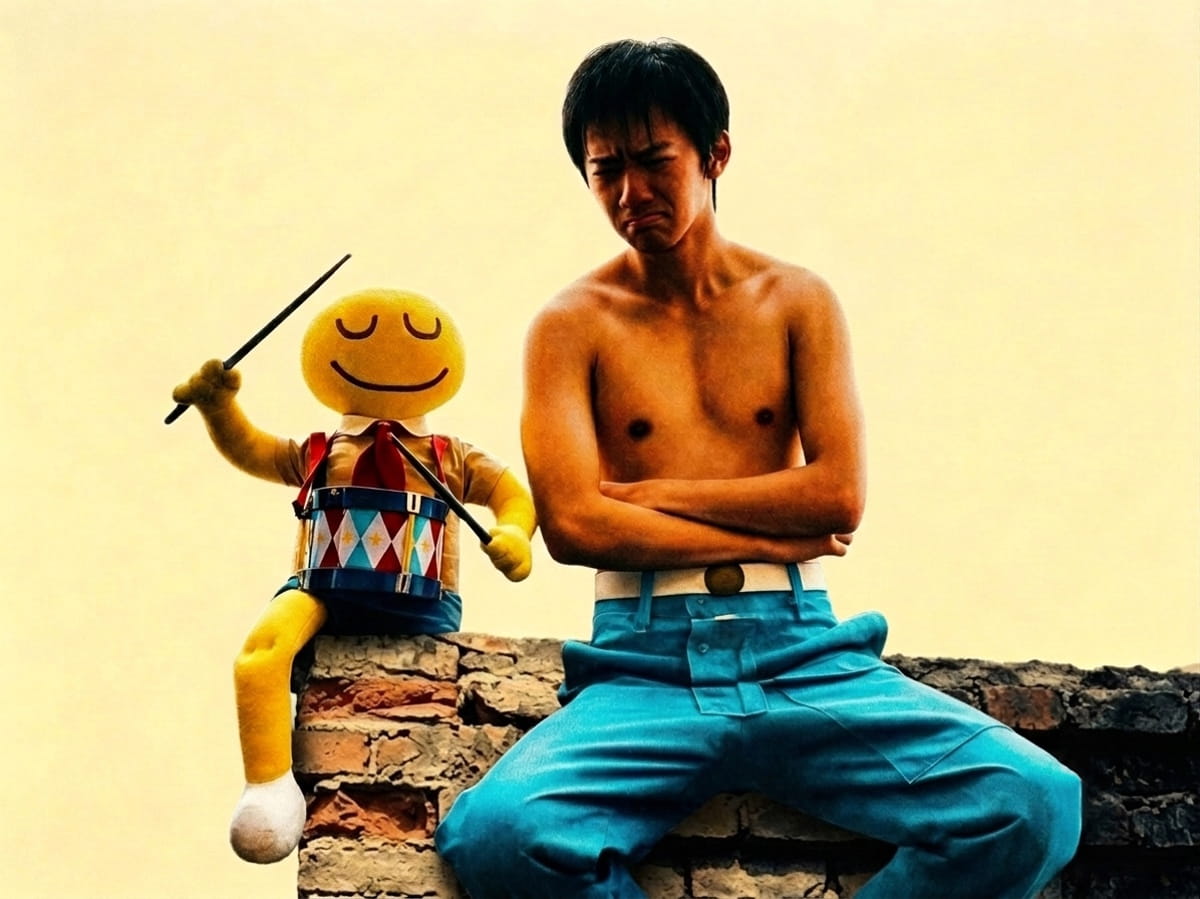
Kitano gradually became a useful name for the kind of cultural authority Zac was arguing with.
“Takeshi Kitano eventually became a very fitting symbol for this question. I don’t even care about proving whether his films are good or bad. His name has been watched, cited, interpreted and validated so many times that his greatness almost no longer requires any explanation. You simply need to know that he is “great.””
“So “To Kill Takeshi Kitano” isn’t about killing a particular director. It’s about killing the values behind that name: the system that constantly decides what is profound, what is serious, what is important, and what deserves to be understood.”
The Burgers had already put out two full-length records, “Amusement Park of Beijing” and “Stay or Run Away”, alongside “The Run Away Trilogy” EP in November 2022. Zac moved from Beijing to Glasgow in late 2023, partly because of his interest in Glasgow indie band Bubblegum Lemonade. By then, his frustration with cultural hierarchies was already in place. The idea for “To Kill Takeshi Kitano” predates the move.
“Actually, I already had the idea for this song when I was still living in Beijing.”
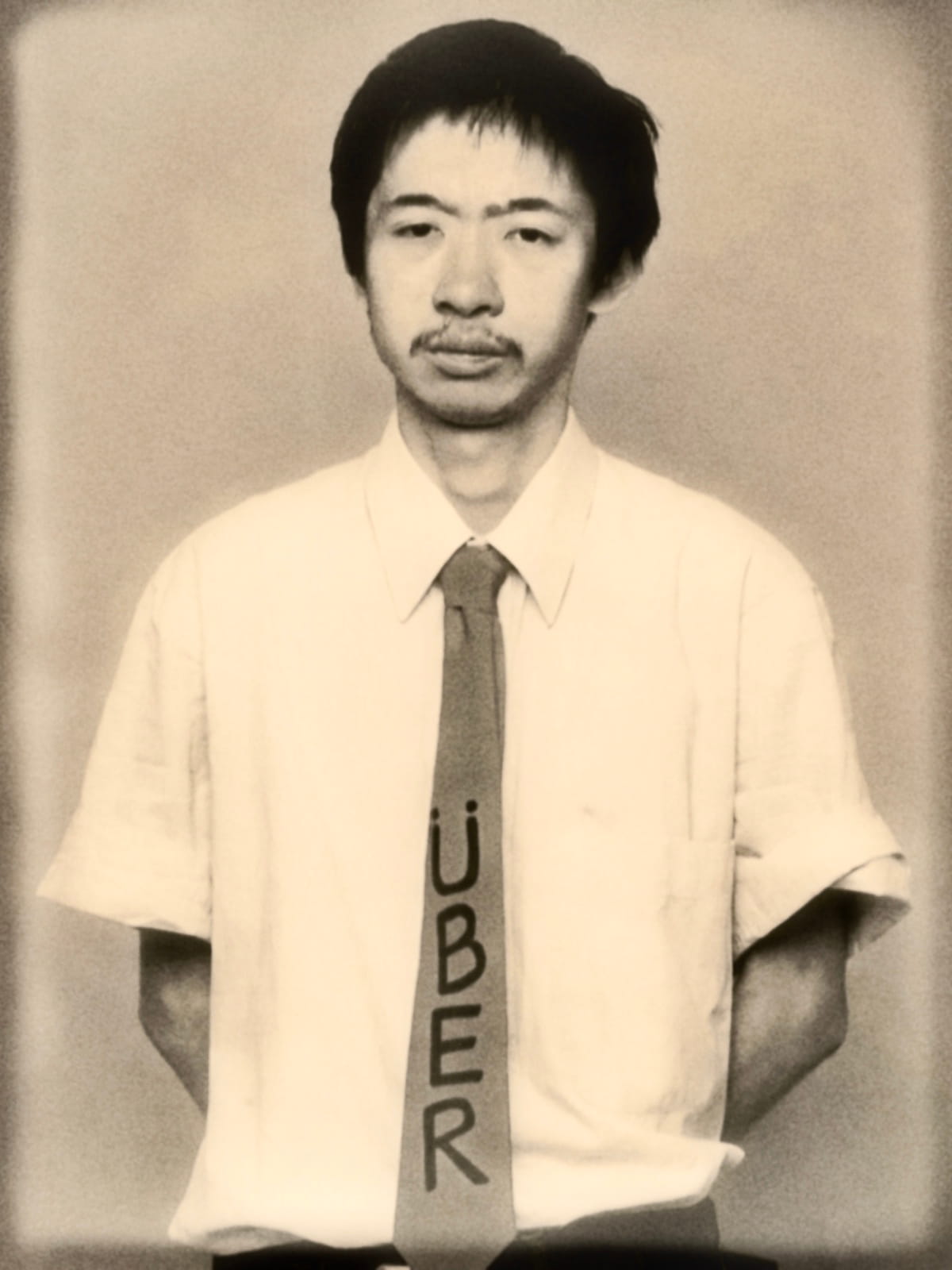
Glasgow gave him fresh examples. Zac became sharply critical of the way access and influence worked in parts of the Scottish punk scene. These are his claims about what he experienced there, and he extends the criticism beyond Scotland.
“I noticed something interesting in the Scottish punk scene: if you get promoted at a company by drinking with your boss, everyone considers it shameful. But in the independent music scene, obtaining resources through personal connections is called “community spirit.” After I raised this question, some of the people who controlled those resources started lecturing me in an extremely patronising manner and attempted to use their connections to get me cancelled within the scene. Some left-wing musicians refused to share a stage with me because of my ‘incorrectness.’”
“Of course, this problem is very common throughout the independent music scene, especially the punk scene. It’s not limited to Scotland. It made me realise that scenes which claim to be rebellious and supportive of the marginalised are often even more prone to these hidden mechanisms of power. Such scenes can accept you questioning the government, capitalism, mainstream culture, or almost any authority that has already been collectively agreed upon as something to rebel against. But the moment your questioning turns towards their own “rebellious community,” they instantly show a completely different face.”
“At that point, they won’t acknowledge that you’re questioning a mechanism of power. Your questioning will be renamed “complaining,” “negativity,” or “being judgemental of others.” Values derived from the community’s consensus automatically acquire legitimacy, while an individual’s questioning of the community itself is stigmatised as a problem with that individual’s personality.”
Wyświetl ten post na Instagramie
Joe Strummer ended up in the middle of another one of these fights. “Hypocrite Joe” criticises Strummer and what Zac sees in the mythology around him: romantic ideas about “the people”, collective solidarity and the assumption that the majority carries its own moral legitimacy.
Zac had permission from a Glasgow record shop to shoot the video there. According to his account, the shop had not asked to approve the song beforehand.
“I obtained permission from a record shop in Glasgow to film the music video for this song inside their shop. They never asked to approve the song’s content. After the music video was released, they discovered that it was a song criticising Joe Strummer, called it an “anti Joe Strummer piece,” and demanded that I take the video down.”
“I think what these examples have in common with my criticism of arthouse film culture is that I’ve never believed a subculture that calls itself marginal or underground possesses any inherent purity. On the contrary, it disguises its mechanisms of power as some kind of consensus and morality, which is even more dangerous than naked capitalist operations.”
The move to Glasgow also changed how The Burgers existed on stage. Zac had gone there hoping to build a conventional lineup and spent months trying to find musicians. Eventually he started hiring session players. One drummer ended that experiment.
“What actually made me take that step wasn’t some inspirational story.”
“It happened after I hired session musicians, only to discover that my session drummer had taken the money but still couldn’t play the songs, and even attempted to scam me out of an entire year’s session fees on the grounds that my songs criticised Joe Strummer and Takeshi Kitano.”
“I realised how ridiculous it had been for me to keep hiring musicians to perform with me just to conform to some supposed standard of what a band should be. Come to think of it, I should thank that drummer. He effectively gave me the push I needed to finally take this step and do what I should have been doing.”
Drummy Burger was already waiting in the background. Zac had drawn the character in 2020 from the shape of his own shadow, giving him one arm and one leg. He connects that body to what he calls “maimedness”, something that has also appeared repeatedly in The Burgers’ songs.
“Actually, at first it was just a last-resort solution I came up with because I couldn’t find musicians. I had even considered turning several of my dead friends into virtual band members before, but I felt that the burden was too heavy, so I abandoned the idea.”
“The character of Drummy Burger was born in 2020. He is a cartoon character I drew based on my own shadow, with only one arm and one leg. This reflects a certain maimedness I have had since birth. Maimedness is also a recurring theme in The Burgers’ songs.So when I was worrying about not being able to find musicians, I thought: why not make Drummy’s character part of this project?”
Wyświetl ten post na Instagramie
The puppet and backing tracks were hardly welcomed by everyone around him. Zac remembers several comments from people in punk.
“People where I’m from would laugh you out of the building.”
“Now you want to play to tracks like you’re Britney Spears? That’s punk as fuck, man.”
“Have fun with your stuffed animal drummer, backing tracks and empty venues.”
He dropped the idea for a while because those comments got to him.
“These are all things people said to me. I once abandoned the idea because I cared too much about what they thought, but eventually I turned their opposition into even greater motivation. The original motivation behind a lot of the things I do actually comes from some kind of revenge narrative.”
The response at actual shows turned out to be easier than the response beforehand.
“However, after I actually started performing with Drummy Burger, I found that the audiences at the shows were much more open to it than I had imagined.”
“If there has to be some kind of mission behind it, I hope to use this format to overturn the narrative hegemony that says rock music must be performed by a band.”
There is a practical reason the arrangement works too. Zac has written The Burgers’ songs alone from the beginning. They usually start with small melodies he hums while playing guitar. Other musicians can shape the performance and arrangement, but he does not see collective decision-making as a requirement for songwriting.
“From the very beginning, I started writing songs on my own. I often hear people say that a band’s music should be created by several people sitting together in a room, through the collision of their ideas. I think this is a kind of cheap romanticism, as though the more people involved in creating the music, the more authentic it becomes.”
“But even in those universally recognised great bands, most songs are primarily written by one person and then brought into their complete form through the performances and arrangements of the other members. So, writing alone and performing as a group have never been contradictory. What people are confusing is “band performance” with “collective creation.””
“And precisely because of this confusion, people seem to think that since it’s a band, every member should have a say in deciding what a song should be; if one person holds the main creative decision-making power, then he’s a dictator. But if the song was originally created by one person, changing it just so that everyone can have decision-making power is itself a compromise. Collective participation doesn’t inherently make a song better simply because it’s more “democratic.””
His own records still carry parts that came from other players. On the first album, some drum parts grew directly from things his high-school drummer improvised during rehearsals.
“All of The Burgers’ songs are little tunes I hum while playing guitar. Of course, other people can make a song complete through their own performances, but that’s an entirely different matter from allowing a collective to decide what the song should be. In fact, some of the drum parts on my first album even came directly from things my drummer improvised when we were rehearsing those songs with my high school band.”
“In reality, I’ve never had a band in the true sense of the word. If there’s anything I miss, I really miss my high school band.”
“Kick Fights to Lose” brought another practical change. Earlier Burgers releases had been written in Chinese. For the 2025 record, Zac worked entirely in English, although the first version of each lyric still forms in Chinese before he converts it into rhyming English.
“My English is very poor, so my English lyrics are first conceived in Chinese and then translated into corresponding rhyming English. My English pronunciation is also very poor. So, I’m not sure whether this sounds strange to native English speakers.”
The Burgers now take this one-person version of the band to Japan in October. The dates are Yokosuka on 17 October, Tokyo on 18 October, Kyoto on 23 October and Osaka on 24 October.
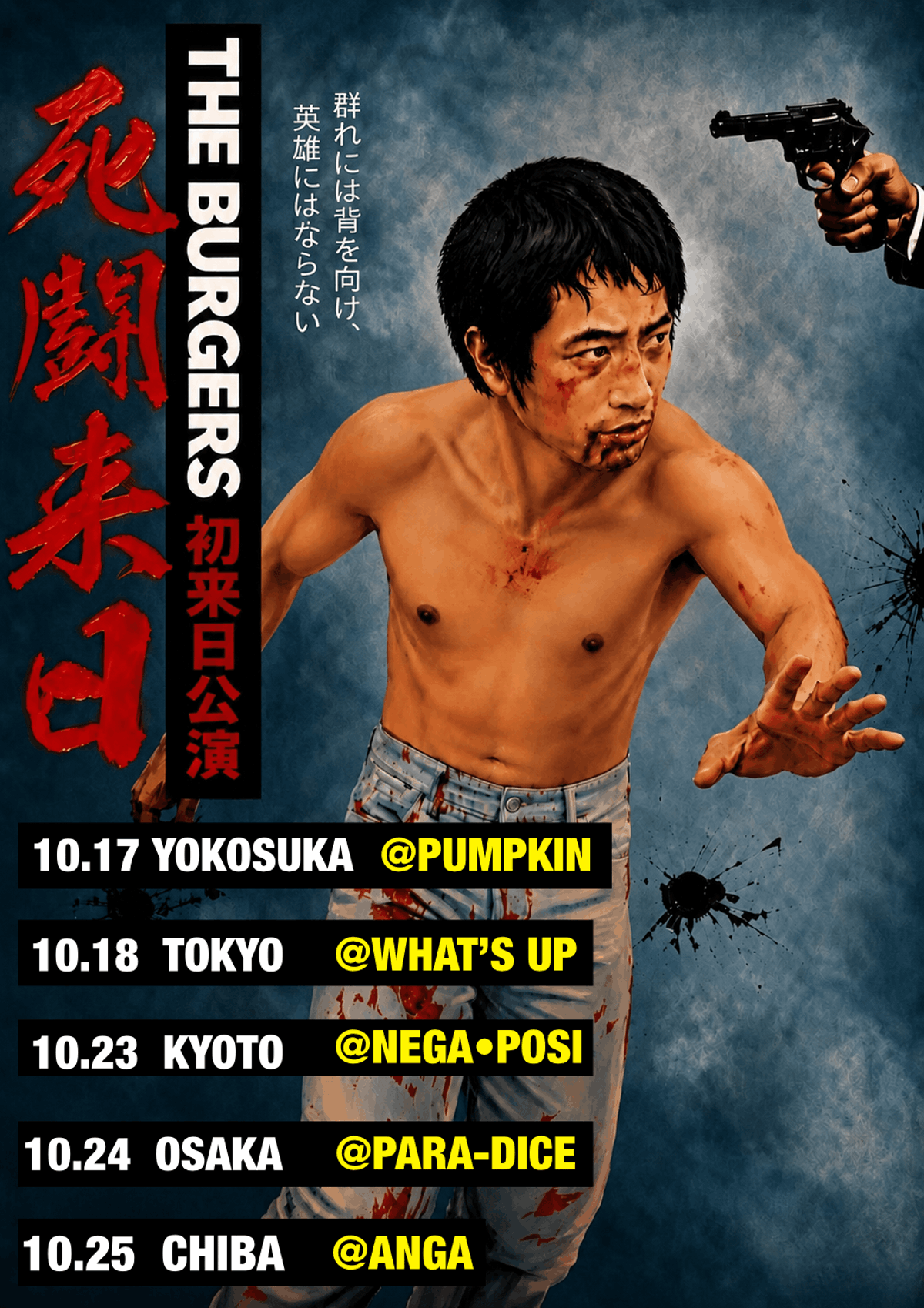
Taking a song called “To Kill Takeshi Kitano” into Japan has crossed Zac’s mind for obvious reasons. Kitano is a much more immediate cultural figure there than he is for many Western listeners.
“Takeshi Kitano may be a distant cultural symbol in a Western context, so people might not be particularly sensitive to criticism of him.”
“But in Japan, Takeshi Kitano is a household name and a figure of power. I’m not sure whether some Japanese people might find this offensive. So, I did worry that it might get me into some trouble.”
“If any of the Japanese bands sharing the bill with me happen to read this interview, I hope you won’t refuse to play with me at the last minute because of it. After all, nothing that happens would surprise me anymore.”
Wyświetl ten post na Instagramie