

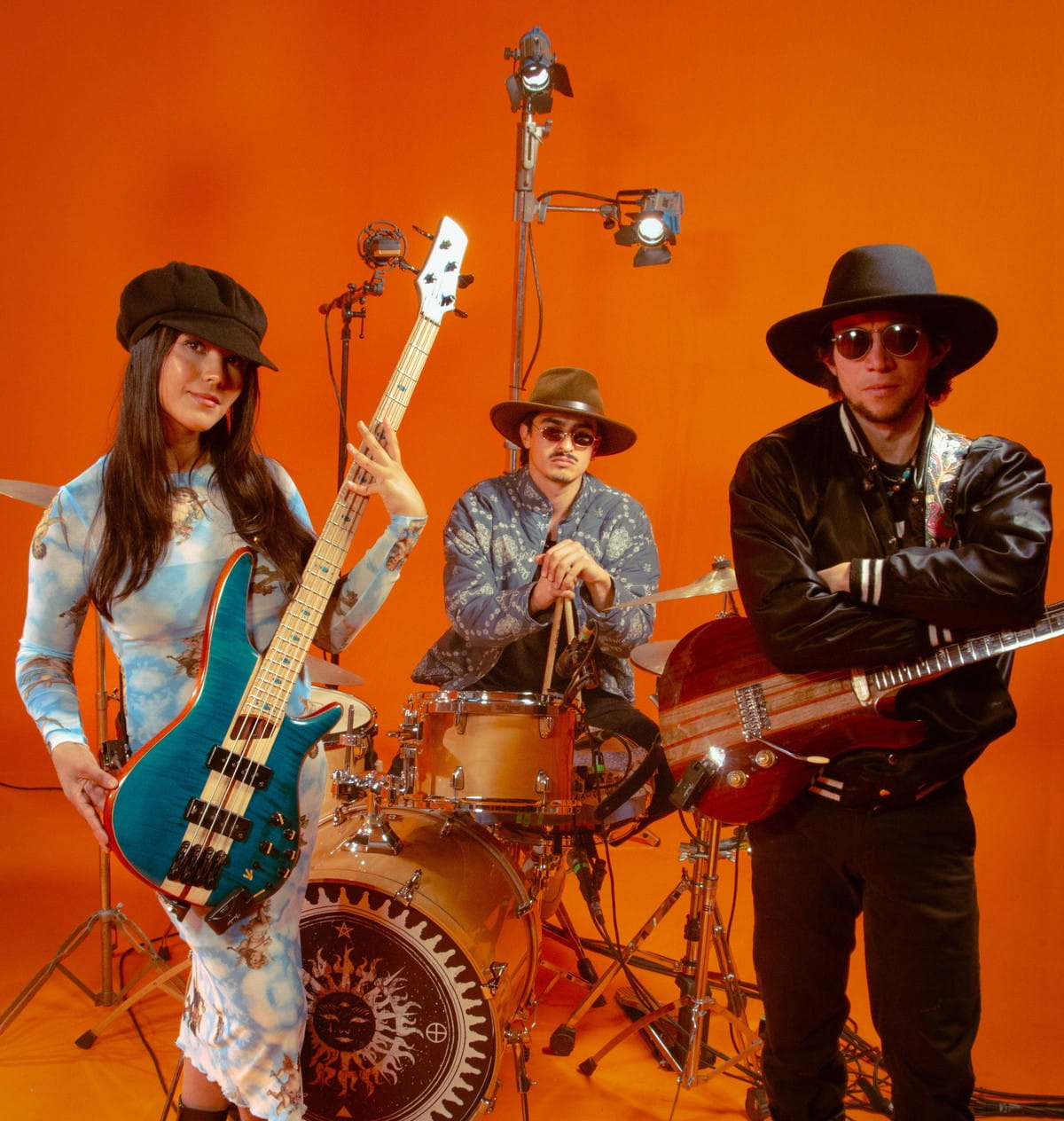
Bogotá psychedelic funk trio BALTHVS have spent the two years since “Harvest” working around a very different band routine. Bassist Johanna Mercuriana became a mother and stepped back from touring, guitarist-producer Balthazar Aguirre moved out of Colombia, drummer Santiago Lizcano kept touring, and Vanessa Muñoz covered bass during part of Johanna’s absence.
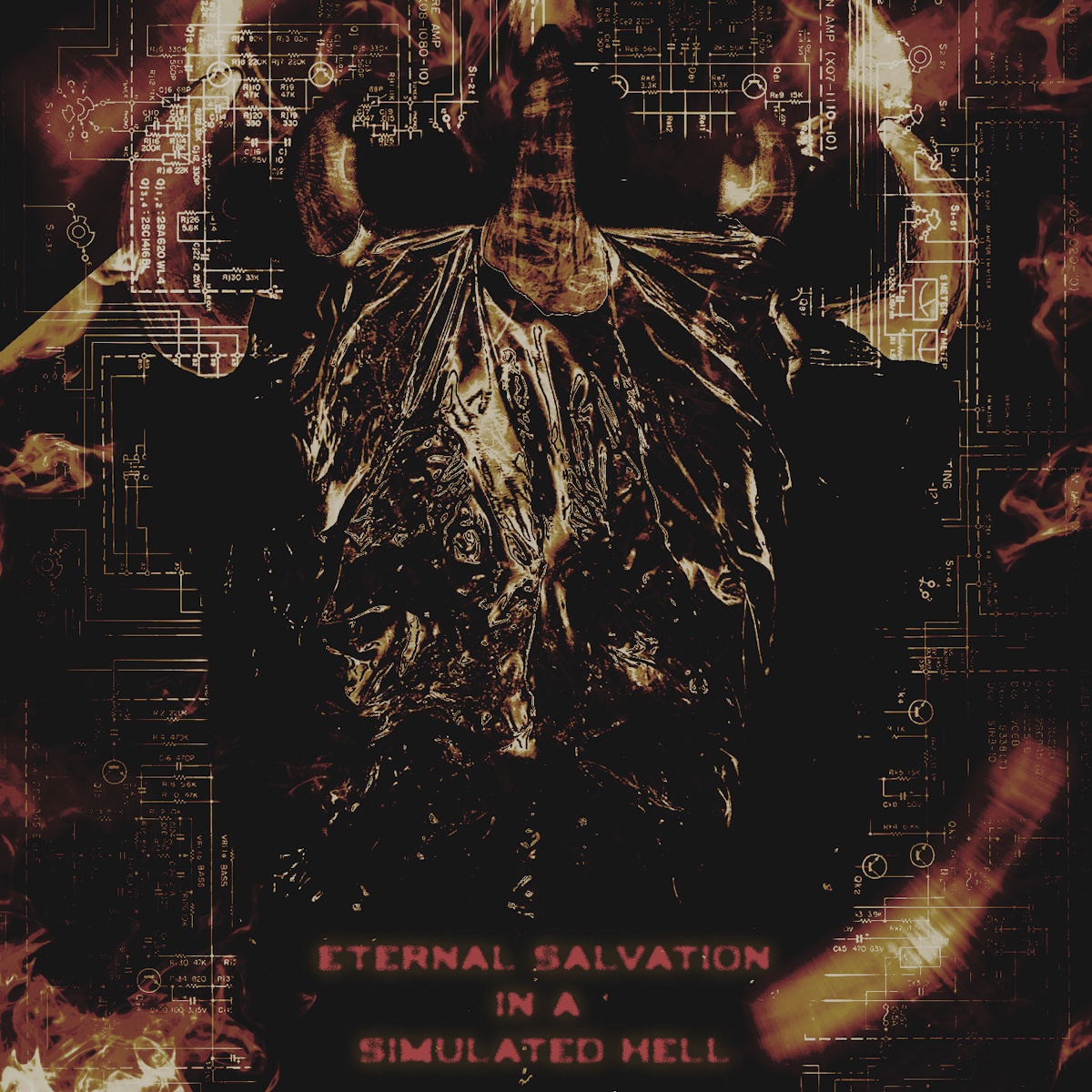
Recording for their new album “Manifest”, released today through Mixto Records, stretched across two years between international tours. Balthazar says he built five of its songs largely on his own, while another six took shape at El Paraíso, his family’s farm outside Bogotá where the band’s first album had been written and recorded.
Our last long conversation with BALTHVS came around “Harvest” in 2024. A few weeks after we published it, they played Jassmine in Warsaw on 6 November. I had already spent a lot of time with the record, but that show was where BALTHVS properly got me. It is still one of the nights from that autumn I remember most clearly, and I have wanted to see them live again ever since.
The 2024 piece also went back to the band’s start. Balthazar and Santiago had learned how to play in a band together in Aguirre Cosmico. Johanna opened one of their shows as a singer-songwriter, connected with Balthazar immediately, and the two were living together less than a month later. A Khruangbin performance they saw in 2018 helped push them towards a quieter trio setup where they could bring in their own references.
Their first records were mostly composed and produced by Balthazar while Johanna was still learning bass and handling vocals, and Santiago did not yet have a room where he could record drums. By “Harvest”, Balthazar told us, they had finally reached a point where they could “work and record together, simultaneously.” They spent a month making most of it in La Mesa among heat, mango trees, birds and a pool, with the only working air conditioning in the studio.
Johanna stopped touring while she was pregnant and during much of her postpartum period. Vanessa Muñoz took over bass on the road, including the “Year of the Snake” dates, and “Transmutations” caught older BALTHVS songs after repeated live playing had stretched them into different shapes.
Wyświetl ten post na Instagramie
Johanna had not heard as much of Vanessa’s playing as she would have liked, but the similarities were obvious to her because Balthazar had taught both of them bass in a similar way.
During that stretch the band opened up “Shakedown Street” into large jams. “Inner Hides” grew out of a jam from “All Is One”, and “LSD in Bahia”, previously an extended section of “Ojos Verdes”, became a full song.
Wyświetl ten post na Instagramie
“I really feel that she brought a very high level as a bass player, and I’m grateful for what she contributed during that time,” Johanna says.
“Manifest” was built in several configurations. Through 2025 and early 2026, Balthazar made “Kilig”, “Year of the Snake”, “Flesh and Soul”, “Eternal Flow” and “World Is (More Than I Can Handle)” largely on his own. He then brought the band’s gear back to El Paraíso. Balthazar, Santiago and Christian Cifuentes worked there on “Motion (For Ashra)”, “Sunday Forecast”, “In-N-Out”, “Pale Blue Dot”, “RARE PSALMS” and “Liminal Stages”.
Johanna arrived near the end to record vocals where needed and learn the new songs while her attention was still mostly on being a mother.
The musician credits place her on “Motion (For Ashra)”, “RARE PSALMS”, “Pale Blue Dot”, “Year of the Snake” and “World Is (More Than I Can Handle)”. Balthazar is credited as producer across the album, with longtime collaborator Cifuentes working on the sessions as producer and engineer.
The studio setup kept a lot of the road setup intact. BALTHVS tracked through the same live rigs they use on stage, including analogue direct systems from Chile’s DSM Humboldt and Fender instruments. Santiago prepared for the sessions for more than a month. He trained himself to hear a take once, identify three things he wanted to change, then make those changes on the next take.
He also worked on keeping the volume of his hits consistent, making his fills sit better in the groove and building limb independence so he could react quickly when a new idea appeared.
Wyświetl ten post na Instagramie
In the studio, Santiago found that years of improvising made it easier to test ideas quickly. He describes the band’s “non-fixed mentality” as an asset when they need to try and discard rhythms at speed. BALTHVS also make a new setlist for every show, so songs are already used to being moved around once they leave the studio.
They have taken that approach through 26 countries and four continents, including dates with My Morning Jacket and sets at Lollapalooza, Austin City Limits, Outside Lands, Electric Forest and Jam Cruise, plus appearances on KEXP, Gilles Peterson’s Worldwide Café and BBC Radio.
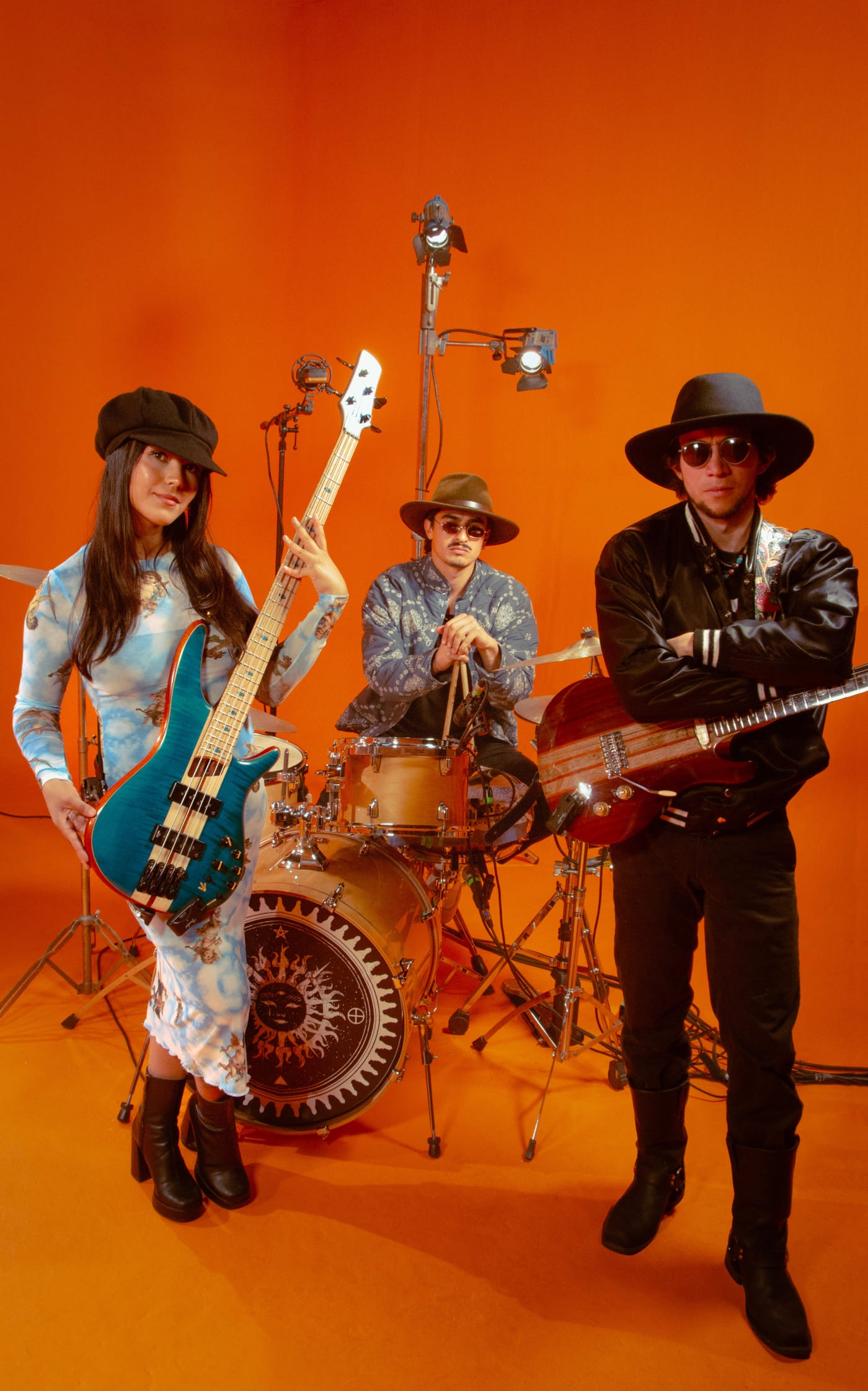
“Pale Blue Dot” was written with that live freedom built into it. Balthazar looked directly to the Grateful Dead and “Playing in the Band”.
“Pale Blue Dot was conceived as a jam vehicle, i’m very inspired by the Grateful Dead and one of their songs ‘Playing in the Band’ has this country rock opening section, then the song transforms into an open ended psychedelic jazz fusion jam which can last as much as 30 minutes, then they go back to the country song, which is crazy!”
Wyświetl ten post na Instagramie
His version uses disco as the starting point. The song can leave its main form for as long as the band and audience want to stay in the jam, then return.
“Improvisation is very important to us and the audience is a clear guiding element on how the music will be performed, it is never the same!”
Coming back meant rebuilding bass technique while learning harder new songs. Johanna had stopped playing during the last months of pregnancy, which made getting back to her previous level difficult. Her concentration moved around a lot during the postpartum period. She now feels she has the best concentration and patience she has had since becoming a mother, including patience with herself and with the band. She also feels she has more maturity now and sees some situations differently.
Wyświetl ten post na Instagramie
“Honestly, the new songs on Manifest have really challenged me technically. I’m singing while playing bass lines with so much groove, and they require almost a level of independence similar to what I imagine a drummer needs, Pale Blue Dot in particular has taken a lot of love, time, patience, and concentration from me, speaking of that, haha and I’m also really surprised by how well we complement each other.”
The band cut its touring schedule to almost half the previous pace so Johanna could stay home with her baby for most of the postpartum period. These days the three mostly see each other at shows. Balthazar no longer lives in Colombia, which leaves them with less rehearsal time and makes the hours they do get together more planned.
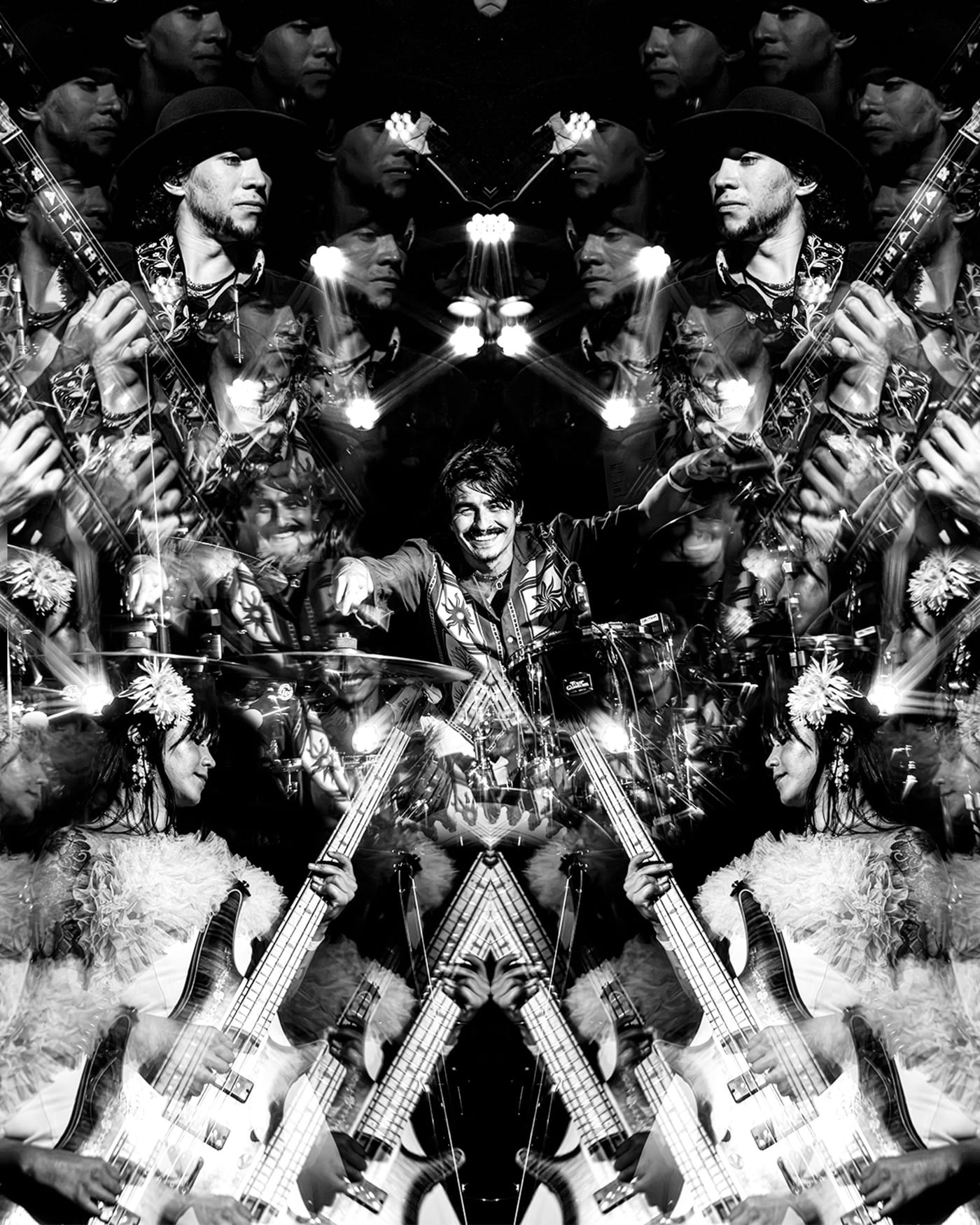
Johanna had often played an intuitive role in the writing even before “Harvest”, describing herself as something close to a musical adviser when her contribution did not appear clearly in the technical credits. Her time inside the “Manifest” sessions was limited, but “RARE PSALMS” gave her a place to change the song through vocals. She calls it the slowest and most melancholic track on the album, followed by a transformation she did not expect.
The vocal itself came out of an experiment they have used before.
“RARE PSALMS was the only song where we did an experiment that we sometimes like to do: I listened to the song for the first time with the microphone in my hand and just sang whatever came out naturally, and then later we decided what would actually stay in the song.”
Santiago’s point of comparison with Johanna reaches much further back, to the first time they ever played together in June 2020. He remembers being nervous, moving more than necessary and playing way louder than expected while his technique was still developing. He was keeping time with his head and left foot. Johanna, who already knew the songs better, looked completely different from behind the kit: “She was like floating while playing, staring at the horizon and barely looking at the bass.”
Santiago has gained more control over his body while playing. He hears more loud, physical energy in Johanna’s playing and performance now.
“Playing music is like a never-ending conversation where you can negotiate, share, receive, and send your wisdom, vulnerability, and intentions — all of that without saying a single word to your bandmate.”
Balthazar calls “Kilig” a rearrangement of a classic Eritrean/Ethiopian love ballad that he dedicated to his now wife; its writing credits also include Tekle Tesfazghi, The Ibex Band, Giovanni Rico and Selam Woldemariam. “Liminal Stages” takes the band toward jungle and drum and bass while keeping the instrumentation live. Listening back, Santiago realised his part had unconsciously picked up something from one of his favourite songs, Radiohead’s “Weird Fishes”, and Philip Selway’s playing on it.
Dembow was already inside BALTHVS on “Harvest”: “Asha” started from the rhythm because it was everywhere in Colombia. On “Motion (For Ashra)”, Santiago hears a jazzy South London beat in the intro and first vocal passage moving gradually towards dembow.
The track also interpolates “Oasis” by Manuel Göttsching’s Ashra, with Göttsching sharing a writing credit. Balthazar sees “In-N-Out” as their attempt at a bigger arena-rock sound. Johanna describes “RARE PSALMS” as slow and melancholic before its later change. Elsewhere, Bubby Wade shares a writing credit on “Sunday Forecast”, and Lorena Romero appears on “World Is (More Than I Can Handle)”. The formal credits put every lyric under Balthazar’s name.
The album title comes from the hermetic and alchemical thinking Balthazar has carried around BALTHVS for years. He treats alchemy as an internal process tied to self-knowledge and long-term commitment. Music became the thing he chose to work on with that discipline.
“Music is just a trade to test a life philosophy I picked on at some point in life: That of absolute focus and commitment on the attainment of a great work, acquired through self knowledge. I chose music as the ‘great work’ to attain, and have devoted my life ever since, in a semi monastic way. It clearly has worked and we’ve made much from nothing.”
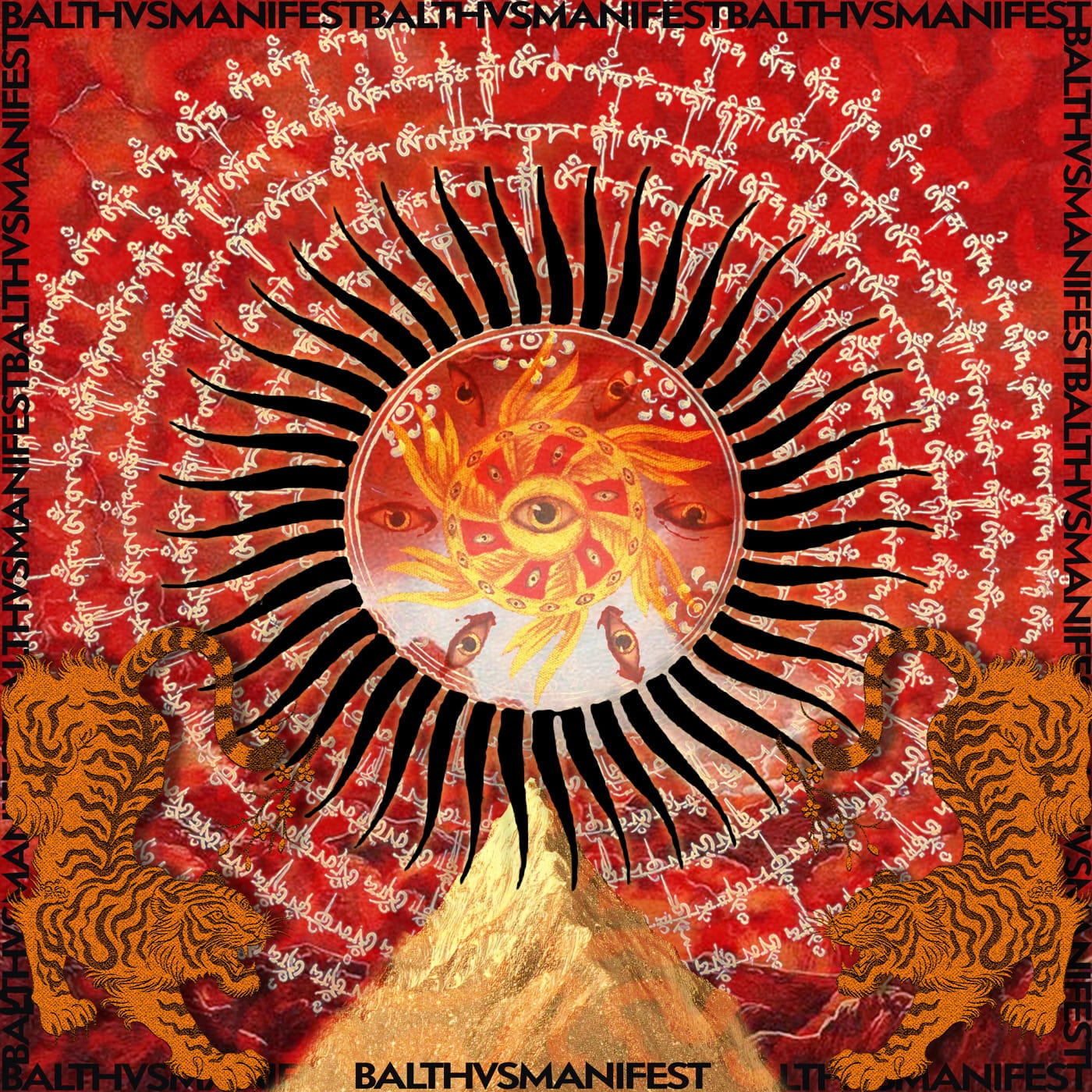
“We’re clearly manifesting that which was originally within and was intangible, it remains within but now it’s very real as well. This is the evolution of the psychedelic experience, to manifest that which has been envisioned within,” he says.
“Pale Blue Dot” comes directly from Carl Sagan and the Voyager image of Earth. The band have also described the song as a call for global unity and awareness of how precarious life on this planet is. Balthazar’s own answer goes further into environmental destruction, war, finite resources and the economic model built around continual growth.
“Yes, I am in deep pain every time I look at our eternal war with our own selves, we destroy the environment that provides everything we need, we kill everything that moves, we kill each other …we say we care about the economy yet we make this unsustainable endless growth pyramid scheme that will obviously collapse since the earth has finite resources. It’s painfully obvious to me we are all interconnected yet this idea is so foreign to most people and worryingly enough, to our leadership…”
“The song is clearly in reference to Carl and his wisdom, may we have entertainers and sages, and LEADERS, like this in our present time.”
In our earlier conversations he talked about people, animals and plants as parts of the same connected system, and in 2024 described BALTHVS as living in “a Globalized Earth”, with the internet giving them access to Vietnamese music from the 1970s, Anatolian psychedelic rock, Ethiopian jazz and obscure online genres without the old geographical limits.
In 2024 Balthazar said BALTHVS had played Rock al Parque and Festival Centro but still never really felt that they belonged to Bogotá’s music scene, because their style was not especially popular there. Much of their audience had been found abroad. He pointed us towards Bomba Estereo, Nicolás y los Fumadores and Buha 2030 when we asked what to hear locally.
After spending longer periods in the United States, Balthazar says the distance has made his own Colombian identity clearer to him. His comparison is straightforward. He calls the US “aggressive” towards itself and the environment, contrasts the material abundance he sees there with the way he sees people living in Colombia, criticises the pressure for constant consumption and growth, and thinks much of the world is trying to copy that US lifestyle. He is also struck by how many people he meets in the US are medicated in some form. He connects those observations directly to his work:
“I guess by feeling this I’ve come to realize how Colombian I really am. While this apparently has nothing to do with music, it is definitely affecting my approach to music and the business as a whole.”
Santiago thinks about travelling through rhythm. Four-on-the-floor disco, dembow, surf and rockabilly keep making people move across countries and audiences. He wonders whether some of those patterns reach much further back than recorded or written music.
“Maybe what we recognize as danceable today is not simply a modern instinct, but some kind of distant memory in the body: an ancient pulse resurfacing whenever people hear a beat and, almost before they can think, begin to move together.”
Balthazar thinks the other two may read his pursuit as selfish.
“I would believe they think it’s a selfish individual pursuit, I would say it’s an individual pursuit wanting to benefit the ‘All’.”
Wyświetl ten post na Instagramie
Johanna thinks they may miss how personal the album feels to her because she was absent for so much of its making.
“For me, Manifest is not only about the music we created, but also about everything that was happening around us during this period of our lives. So maybe they see Manifest more as the result of a particular creative process, while for me it also represents a very personal transition and a new chapter of BALTHVS.”
For Santiago, El Paraíso gave the record another meaning. He had never been part of the band when its first album was made there. Recording “Manifest” on the same farm let him finally spend time in a place that belonged to BALTHVS history before he did.
“By being there, I felt connected to a history that had begun before me, while also giving me the chance to add my own grain of sand, as we say in Spanish, to what we’re building together. In that sense, Manifest wasn’t just about keeping up the band’s story — it was also about finding my place in it and contributing to where it goes next.”
The next US run starts immediately after the album release:

October 8, Livingston, KY, Moonshiner’s Ball
October 9, Atlanta, GA, Aisle 5
October 10, Charleston, SC, Music Farm
October 11, Asheville, NC, Eulogy
October 13, Washington, DC, The Atlantis
October 14, Ardmore Music Hall
October 16, Austin, TX, Meanwhile Brewing
October 17, Chicago, IL, Ramova Theatre
October 18, Detroit, MI, El Club
October 20, Denver, CO, Cervantes’ Masterpiece Ballroom
October 22, San Diego, CA, The Holding Company
October 23, Los Angeles, CA, The Regent Theater
October 24, Felton, CA, Felton Music Hall
October 25, San Francisco, CA, The Independent
October 29, Portland, OR, The Get Down
October 30, Bellingham, WA, The Wild Buffalo
“Manifest” was released on October 7, 2026 through Mixto Records. The album is available to stream and purchase now, including on vinyl. Session videos for “Eternal Flow” and “Liminal Stages” are streaming on YouTube.