


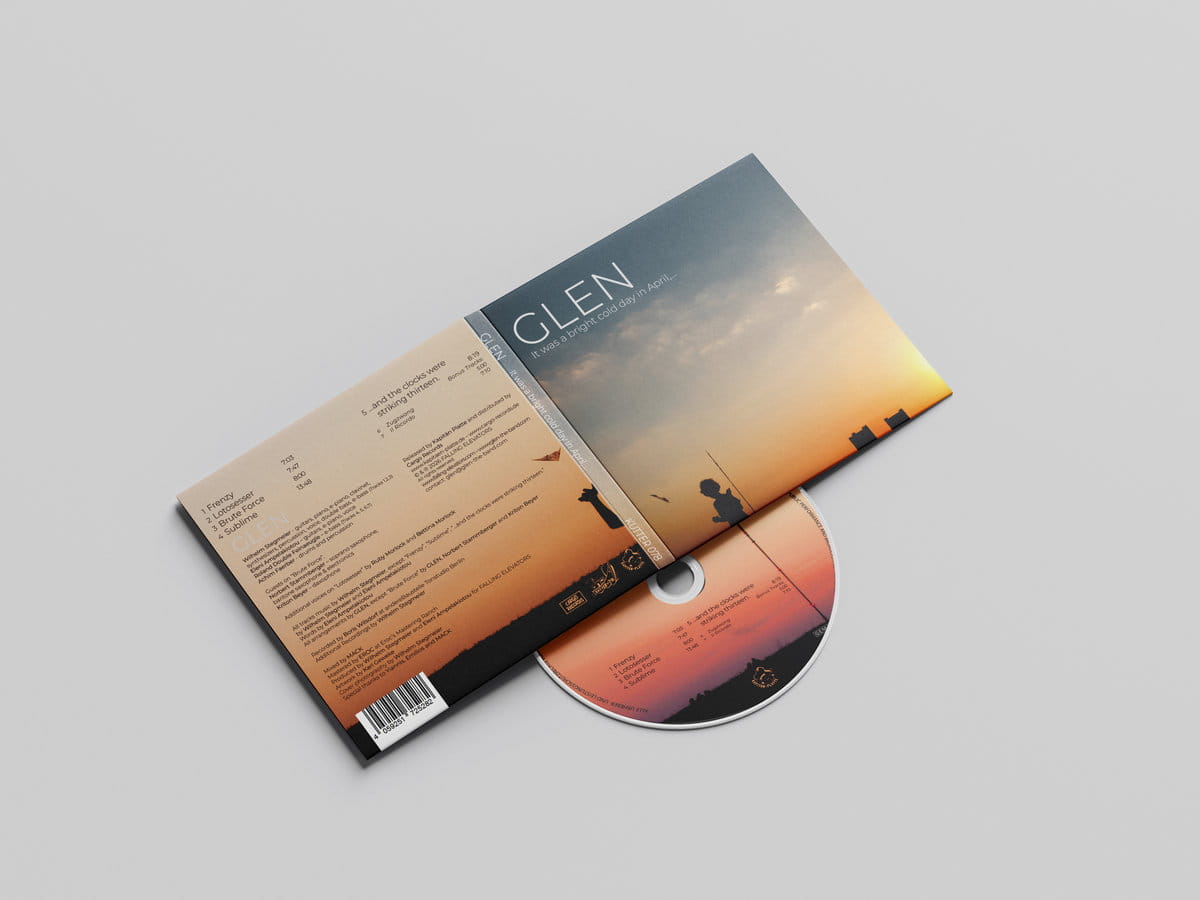
There’s a specific kind of discomfort that comes from recognizing the familiar and sensing something deeply wrong underneath it. That friction — between daily life and its concealed absurdity — is where Berlin’s Glen have planted their flag with “It Was a Bright Cold Day in April,…“, their fourth studio album, out now via Kapitän Platte / Cargo Records.
The title borrows the first half of George Orwell’s opening sentence from “1984”. Guitarist Eleni Ampelakiotou explains the pull: “When I open a book for the very first time I read the first sentence and the last sentence. And if there is a tension between the first and the last sentence I will pick the book.” The Orwell line works because of its internal split — the first half sounds casual, almost banal, like something exchanged in passing. Then comes the second part: “and the clocks were striking thirteen.” That’s where it turns. “It reveals that there is something disturbing going on behind the facade of daily life,” she says. “I am fascinated by the simplicity and complexity of this sentence, and how it creates this alarming friction.”
For fellow guitarist Wilhelm Stegmeier, it runs deeper and more personal. “Like dreaming of your apartment or your house, that you live in, and it is your home and familiar, and you think you know everything about it and then you discover that there is another room in that house, that you had no idea of. Nothing seems to happen there, but it is there.” The thirteenth hour as a hidden space. A floor in a building that doesn’t exist. That image stayed with the band throughout the recording.
The album is structured as five acts — “Frenzy”, “Lotosesser”, “Brute Force”, “Sublime”, and “…And the Clocks Were Striking Thirteen” — each with its own internal arc, its own dramatic turning points. The CD and digital editions add two bonus tracks: “Zugzwang” and “Il Ricordo”.
Glen’s lineup remains the same core four: Wilhelm Stegmeier and Eleni Ampelakiotou on guitars, Roland Feinaeugle on bass, Achim Faerber on drums. Stegmeier also plays piano, e-piano, clavinet, synthesizers, percussion, voice, and double bass across the record. “Brute Force” brings in two guests — Norbert Stammberger on soprano and baritone saxophone, and Kriton Beyer on the daxophone, a bowed wooden instrument that produces an eerie, creaking sound. Beyer wasn’t part of the original plan. “In the process of recording we attended one of Kriton’s performances and loved what he does with this very special instrument and asked him to play on ‘Brute Force’,” Ampelakiotou recalls.
Wyświetl ten post na Instagramie
Much of the stuff on this record took shape through improvised live performances in Berlin and Athens, where sound and moment converged in real time. Ampelakiotou describes the album as capturing “personal experiences, thoughts, reflections and emotional journey during the past two years” in a condensed, immediate way. “As most of the tracks emerged from improv live performances, they capture various moments, atmospheres, encounters, talks and observations in an immediate direct way.”
One thing Glen are deliberate about is repetition — not as a crutch, but as a compositional principle. Ampelakiotou frames it in terms of dramaturgy: “Repetition is one element to structure time, to experience time physically as it proceeds. You can have different experiences of time, its duration, it can expand, it can compress, it can flow.” Beyond that, she points to a kind of suction effect — how looping passages shift your focus to different elements, creating new tonal combinations each time around. “This happens while performing for us as well as for the audience.”
Stegmeier sees the album as something deliberately at odds with the current moment. “The album is a statement against the Zeitgeist, musically and mentally. About being nonconformistic, about not wanting to fit into a specific box. About having your own voice, breaking free from the grid.” He pauses on a thought that feels central: “Everything is becoming a brand nowadays. And the only way to escape this is constant transformation. And I feel our music is an expression of that constant transformation.”

“Frenzy” opens the record with manic energy. Ampelakiotou traces its origin to an unlikely source — the rhythmic hammering of paving workers. “I have been always fascinated by paving workers, by the repetitive noise they make with their hammers, while paving the street, and I wondered what goes on in their minds, as it always had a manic appeal to me.” During the recording process, she met a man who passionately loved that work. He told her that every stone he lays down and hits represents a word in his mind — so the street becomes paved with his flow of thoughts, like secret messages.
That image fed directly into the track: “Like a Moebius strip, a Moebius loop of thoughts, that haunt you, and the more you struggle to escape the more you end up in an obsessive tumultuous energy,” she says, one that Stegmeier “transformed into this polyphonic guitars of fractured melodies and noise.”
The first single, “Frenzy” dropped on January 9th alongside the pre-order launch, and now arrives with an official music video directed by Akaki Devidze in collaboration with Ampelakiotou.
“Lotosesser” shifts into something more seductive. Stegmeier calls it “like a pop track for me. A soundtrack to a nighttime ride on a lost highway. With emphasis on ‘high’. Or like the siren’s song in the Odyssey.” There’s a longing in it that draws you in — “the deceptive promise of bliss and salvation,” as he puts it. A journey from craving to what he describes as liberating transformation.
“Brute Force” is the collision point. Ampelakiotou recalls Stegmeier wanting the disruptive chords to feel like a slap. The track sets up a battle between strict rhythmic interruptions and the untamed freedom of Stammberger’s saxophone. “The intro starts with this dreamy saxophone floating through the air, while underneath a circling creaking sound is building up to the slaps of these attack heavy chords,” she describes. Underneath all of it, Beyer’s daxophone adds a layer of unease that wasn’t originally planned but became essential. Stegmeier talks about the calm middle section as “a truce to gather strength, to lick one’s wounds, but the fight intensifies again and the match remains even. The outcome is still open.”
“Sublime” is the album’s most transcendent passage. Stegmeier describes it as “oscillating between ascension and gravity, elevation and the harsh backlash of the dark piano chords. It is like the narration of a different kind of genesis, emerging from a broiling primeval mass. The guitars peel themselves out of this mass and reincarnate themselves into something new.”
“…And the Clocks Were Striking Thirteen” closes the album with something fragile rather than monumental. Its origin is a specific memory. Ampelakiotou describes a vacation on a Greek island — climbing a hill overlooking a valley stretched out to the sea, scattered with small chapels. “There was a strange kind of peaceful atmosphere in the air. A dog was barking somewhere, fragments of distant voices echoed. And then suddenly the church bells started striking. One after the other joined and filled the valley with their sound.” She dreamed of performing a concert with all those church bells — not in the massive industrial tradition of Arseny Avraamov’s “Symphony of Sounds” with its factory sirens and artillery, but something more fragile, “including these church bells, which were not thundering but frail, lamenting and warning.” The track tries to revive that moment.
The first of two bonus tracks, “Zugzwang” was names after a German word roughly meaning the compulsion to move. It has a demanding main guitar line that forces the rest of the instruments to follow. Stegmeier notes the tension that emerges when the other guitars try to play their own game around it: “There is something forceful as well as playful even ironic in this track. Once again the game of structure and free form.”
“Il Ricordo” is his homage to Ennio Morricone — not the famous film scores, but the experimental work, and specifically Morricone’s contributions to Gruppo di Improvvisazione Nuova Consonanza.
The album was recorded at andereBaustelle studio in Berlin by Boris Wilsdorf, known for his work producing Einstürzende Neubauten. The mix was handled by Mack — the same Mack who started his career at Giorgio Moroder’s Musicland Studios, worked with Marc Bolan’s T. Rex, Led Zeppelin, Rolling Stones, early Deep Purple, Black Sabbath, Sparks, and produced some of Queen’s most well-known records. His involvement across Glen’s recent output has been about preserving what they call the transparency of their sound — making sure each instrument stays present even in the most dissonant passages. Stegmeier values this specifically: “Despite the complexity of textures it is important to keep the transparency of our sound. Mack who mixed this and previous albums contributed to this specific form of clarity.”
Stegmeier describes Glen’s sonic approach through those same paradoxes that drove the Orwell reference: “The fractures between the simplicity and playfulness of childlike melodies that transform into ornaments of dissonance, noise, chaos, euphoria or moments of silence. An amalgam of dissociating elements. The music is always demanding, driving — not comforting or soothing.”
Two literary references sat with Ampelakiotou during the recording. Antonio Gramsci: “The old world is dying and the new world struggles to be born: now is the time of monsters.” And Denis Diderot: “The God of the Christians is a father who is a great deal more concerned about his apples than he is about his children.” She describes being very aware of what she encounters while recording, “because it feels like an echo of what I am experiencing in that moment.”
Stegmeier framed the current political atmosphere in blunter terms during the interview: “We are currently living in some kind of limbo, some kind of interim time. Or like stuck in a building on a floor that does not exist. A few years ago we were not able to imagine the level of absurdity the current political situation might reach. Like in a crazy movie. The album is somehow the soundtrack to this.”
The decision to include unsung lyrics — five poems corresponding to the five tracks, printed inside the gatefold — came from Stegmeier. They function as what Ampelakiotou calls “a reverb to the development of the music.” Not sung, not performed, but present as a parallel text running alongside the sound.
When asked what audiences respond to, Ampelakiotou keeps it grounded: “What we very often hear is the experience of a wall of sound that envelops the audience. There is an orchestral approach to that without losing the transparency.” People respond to the unexpected shifts — from motorik rhythms to sudden improvisations. “It is a shared experience to engage as a unit while still be recognizable as an individual force.”
Glen’s previous records — “Crack” (2017, Falling Elevators), “Pull!” (2021, Sound Effect Records), and “I Can See No Evil” (2023, Sound Effect Records) — each pushed further into broader dynamics and spatial depth. This one refines the identity further: long-form compositions that evolve organically, built around tension arcs and stark contrasts.
“It Was a Bright Cold Day in April,…” is available on standard black vinyl, a limited deluxe transparent orange vinyl, CD, and digital formats. Released by Kapitän Platte, distributed by Cargo Records.