
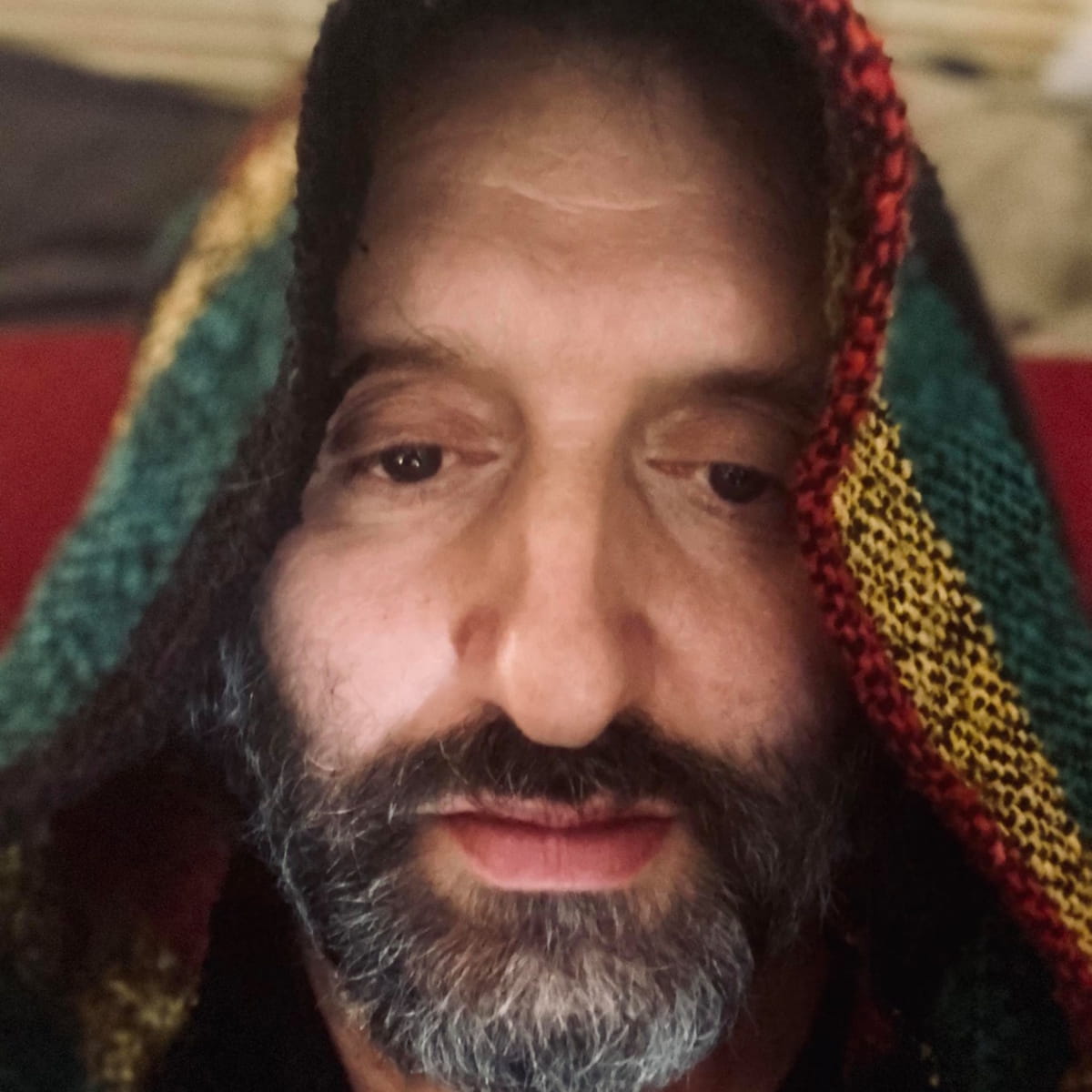
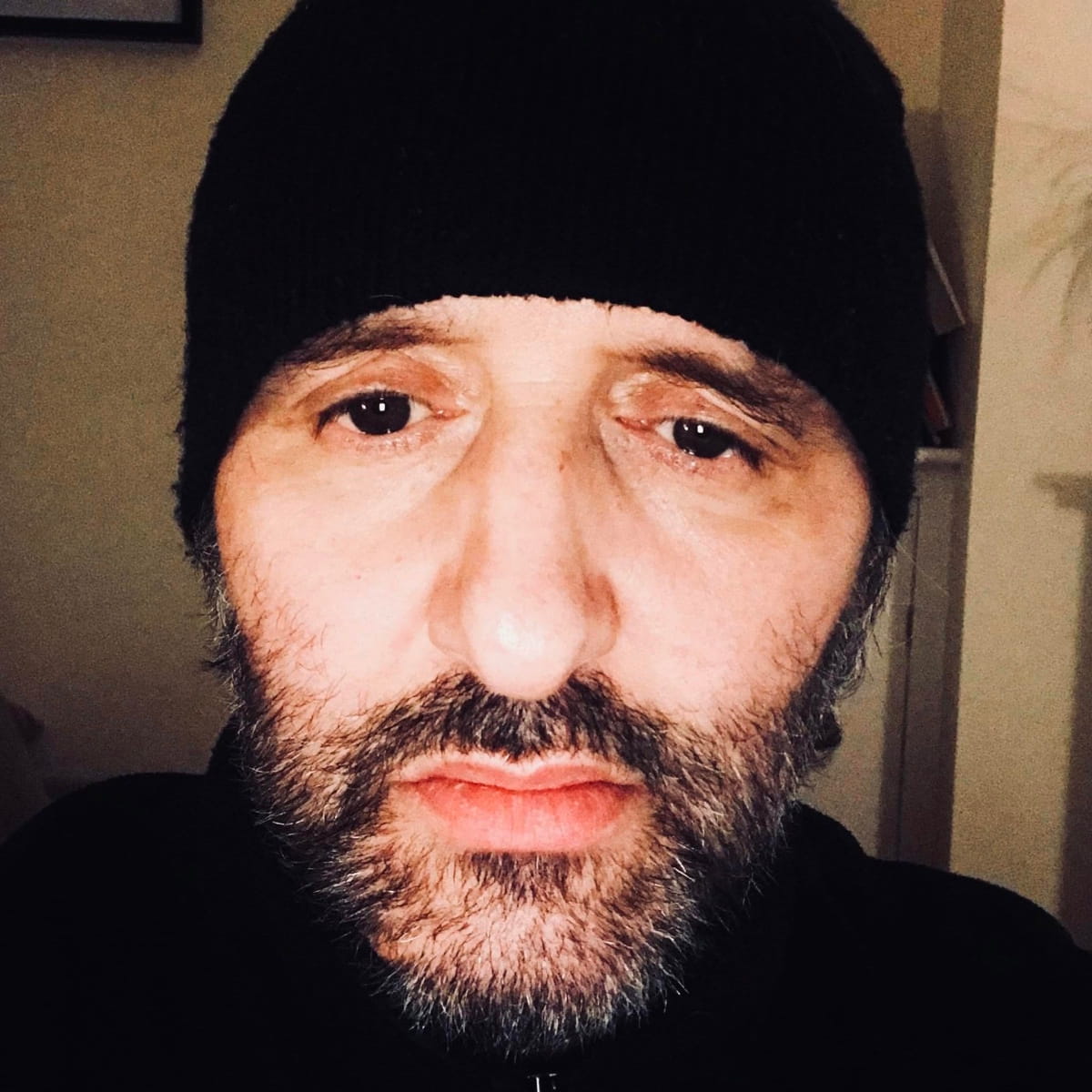
Ashley Reaks is a Harrogate-based writer, collage artist and musician who has spent the last twenty years making records and visual work on his own terms. He has twenty solo albums behind him, thousands of collages, memoirs in progress and another six records sitting on his computer. The nine-track “Post–Hope World“, released on 17 August 2026, is album number twenty and only his second full punk record after “This Is Planet Grot“.
Punk still runs through almost everything else he makes. Ashley got his first bass at 11. By 12 he was in No Reality, writing songs and playing gigs with kids around five years older than him. He was already inside a world of bands, records, gigs and art before he was properly a teenager.
“For me, punk was never just a musical style. It was an attitude — the DIY idea that you could just have a go. I was in a band before I could play three notes, and I started making collages without having the slightest idea what I was doing.”
He still likes starting with an impulse and seeing where it goes, leaving room for mistakes, accidents and ideas he could not have planned in advance. “Really, it’s the young punk in me that creates everything. The records that sound obviously punk are just the most visible expression of it.”
The full punk records have been rare partly because Ashley rarely works on one thing at a time. He has a large backlog of songs, artwork and writing in various states of completion and follows whichever one has the most energy when it is time to make something. At the beginning of 2026 he was going through voice notes on his phone, full of basslines, guitar riffs and half-sung ideas, when he found the bones of “Born Wrong”. He finished the song by the end of that day.
The rest of “Post–Hope World” followed over the next couple of weeks. Ashley remembers the process as easy and good fun. Some of his other albums involve hundreds of parts and lots of musicians. This one was mostly Ashley and Dan Mizen. Ashley wrote all the music and lyrics and played vocals, guitar and bass. Dan played drums and recorded, mixed and mastered the album in 2026. Ashley also made the artwork.
He got the bug again quickly. When he sent these answers over, another punk album was around 80 per cent written and studio time with Dan was booked for December. Ashley was hoping the gap between the two records might end up closer to six months.
Dan has been involved with almost every Ashley Reaks album since around 2008, and Ashley says working together has become easier over the years. Dan plays drums, bass and keyboards, writes, records and produces, and also works in film and radio. Ashley usually creates alone and is careful about who he lets into the process. With Dan, there is enough trust for both of them to work quickly, experiment and drop ideas that do not work. They also share what Ashley calls a particular brand of dark toilet humour and spend a lot of the sessions laughing.
“I can give him a punk album one time and some ridiculous jazz/prog/polyrhythmic monster the next, and he just goes, ‘Fine, let’s do it.’”
Wyświetl ten post na Instagramie
On “Post–Hope World“, Dan also took charge of the guitar, bass and vocal sounds. “Daddy Was” changed once the drums went down. Ashley had heard it as fairly straightforward post-punk. Dan’s part gave it the cold, mechanical feel Ashley associates with early Siouxsie and the Banshees, Killing Joke and The Sisters of Mercy. It made the song darker and heavier than Ashley had first imagined. He would sooner let Dan take a risk and end up with what he calls a “glorious failure” than have him play it safe.
Ashley knew Dan’s father, Frank Mizen, long before he started making records with Dan. He calls Frank a local musical legend in Harrogate. According to Ashley, Frank played trombone with the Jackson 5 and The Commodores, bass on “Kung Fu Fighting”, and also played with Steel Pulse. Ashley and Frank played locally under Ashley’s own name, in Blooze Doktors and Ronnie Canada and the All Stars. Ashley identifies Ronnie Canada as a former member of The Drifters.
Frank also recorded Ashley’s first recordings in the late 1970s. Decades later, Dan is recording the current ones.
Ashley writes songs much like he makes collages. He keeps scraps. Boxes hold cut-out heads, eyes, ears and lips. His music has its own pile of unrelated words, lines, chants, riffs and half-ideas. He moves things around until something works.
Wyświetl ten post na Instagramie
He got into collage because he had no conventional art technique and still says he cannot draw. After Younger Younger 28s ended, he began working the same way with music. Years of playing had turned him into what he calls too much of a “muso”. He had learned technique, but his heart was no longer in it, so he tried to unlearn some of that and get back to working with scraps. Ashley also remembers David Bowie saying something about artists being “scavengers for metaphors”, though he is not certain of the wording or attribution.
“My psyche was shattered into a million bits and I’ve spent my life sellotaping it back together, and eventually Frankenashley appeared.”
For Ashley, taking things that other people might see as ugly, boring, useless or inappropriate and putting them together has become part of both his visual art and his music.
“Third Time Lucky” took that cut-and-paste method further. Ashley originally planned it as the final song on “Post-Hope World”, then removed it before release because its more adventurous post-punk direction did not fit the rest of the record. It is not one of the nine tracks on “Post-Hope World” and will probably surface elsewhere.
The music came from another unrelated project and was cut and recut until it worked with a band. Ashley ended up with what he describes as an unsettling gothic rock song.
“Third Time Lucky” is about the suicide of Ashley’s longest-term friend, who died a couple of years ago. The two shared a similarly bleak sense of humour. The title came directly from his friend’s suicide note, with Ashley explaining the line as “this time he succeeded”. He also took Kylie Minogue’s “Lucky, lucky, lucky” line and used it as a dark backing chant.
Black humour appears throughout Ashley’s writing. “Got a Lot to Learn” and “Sneaky Cunt” use exaggerated characters, with something real underneath them. Humour can make the darkness sharper, and sometimes it is the only way he can get near something vulnerable. As a kid, he learned to get the joke in about himself before somebody else could. He would humiliate himself before he could be humiliated. Pushing something frightening towards the worst possible scenario could also make it easier for him to approach.
“War on the Home Front” needed something much plainer. The song is autobiographical. Ashley describes his childhood home as a battleground between him and his father, with Ashley representing parts of life his family did not understand or want. He wanted to say exactly what his experience had been, without a character or a joke.
He grew up as a scholarship boy in a comfortable middle-class Yorkshire family, with a conventional future expected of him. At 16, his father kicked him out into the garage. Ashley eventually had to leave with no money and very few life skills. He moved to London, lived all over the place and had 81 addresses by the time he was 30.
For the first few months after leaving home, he slept on the floor of a friend’s bedsit. The friend was also an abused kid and was already addicted to heroin. He had told Ashley that if things ever got bad enough at home, he could climb in through the window. Ashley did. His friend had very little, but gave him somewhere to sleep and the care Ashley was not getting at home.
“What I learned was: don’t judge a book by its cover.”
For years, Ashley put pieces of his own history into characters and other people’s stories. Imagination had become a private place where he could make things and be himself, and his work carried parts of what was happening before he consciously understood where they came from. As Ashley puts it, the psyche can know things long before the conscious mind catches up.
He also avoided writing directly in the first person while his father was alive. Some fear of the consequences remained. After his father’s death, Ashley felt a sense of relief and began writing his own experience more openly. “War on the Home Front” is the most direct version of that history on “Post-Hope World”.
“In dysfunctional families and systems there’s often only one narrative allowed, and feelings and other opinions aren’t particularly welcome. I’m not trying to replace that version of the family story. I just want the child’s reality to be part of it. Every song, every collage, every book is partly saying to that kid: you’re still here, you exist, you count. I believe you. It’s an act of resilience and agency.”
Ashley remembers feeling like an outsider long before any of this made its way explicitly into songs. As a kid, he had the sense that everybody else had received a rulebook to life that he somehow missed. He was drawn to surreal and absurd thinking, imagination and making things. The bigger change came in his late thirties, when he decided to commit to what he actually wanted to make and accept where that took him.
Since then, there have been twenty albums, thousands of collages and now the memoirs. Ashley thinks the lack of conventional success helped because he never had to start making things for an audience or worrying about what might sell. He began to see being an outsider as useful and kept following his own obsessions.
“I’ve always admired people who follow their obsessions regardless of whether anybody else cares. I suppose that’s where I am now. I’m nearly 60, I’m still doing it, and I’m as happy as a pig in shit.”
The video for “In With The Out Crowd” is full of people Ashley has carried with him. The Ramones are there because they made him want to start a band. Joey Ramone mattered especially. Ashley saw someone awkward, funny, vulnerable and completely himself, somebody who gave him permission to be the same way. The Ramones also celebrated and laughed at their own weirdness.
Poly Styrene appears too. Ashley remembers X-Ray Spex as doing something completely different from other first-wave punk bands, with her individuality and presence at the centre of it. Nick Blinko from Rudimentary Peni comes in through both music and art. Ashley became absorbed in Blinko’s obsessive, microscopically detailed work and remembers going to one of his exhibitions a few years ago. Getting lost in it was, in Ashley’s words, “as close as I get to tripping these days.”
Erik Satie is another favourite. Ashley loves the stories about Satie wearing a different velvet suit each day, moving from Montmartre to a nondescript suburb and walking miles every day to write music. He also brings up the story of Satie sending an obscene letter to a critic and getting jailed, though Ashley himself qualifies the story with “apparently”. The line he remembers from the letter is: “I shit on you with a great force.”
Spike Milligan, Dadaist Hannah Höch, William Blake, Francis Bacon, Ashley’s favourite painter, R.D. Laing and Nina Simone also appear. Ashley connects all of them through their commitment to their own obsessions, regardless of whether those obsessions matched what other people expected of them.
“And they were — and still are — my replacement parent figures. They taught me that the imagination itself could be the home I needed.”
As Joe Northern, Ashley played in Younger Younger 28s. Signing to V2 looked, at first, like the thing he had spent years trying to reach.
“I’d always wanted a record deal for my own songs, and suddenly Richard Branson was giving us money and we were playing Glastonbury and going on television.”
He hated the reality of it and describes himself as extremely miserable during that period. Writing songs kept getting pushed aside by promotional work.
“I remember being at the record company offices itching to write a song, and they were just planning more and more promotional nonsense. There was one day when I was on a children’s TV show and had to get dressed up as a shepherd and herd imaginary art sheep into a pen, at which point I thought, what the fuck am I doing this for?”
When Younger Younger 28s ended, Ashley was 32 and describes the aftermath as a “real dark night of the soul”. He went back to the records he had loved at 11: early Siouxsie and the Banshees, Magazine, Gang of Four, The Pop Group, Killing Joke, The Ruts and Stiff Little Fingers. He wanted to get back to making things without worrying whether they sold or even made sense. He thought he might make another two or three albums for himself. He is now twenty in, with six more sitting on his computer.
Touring with Francis Dunnery and later session work gave him a different experience of professional music. He enjoyed playing bass when the job was simply to help somebody else make their thing. He even remembers enjoying an “abysmal Christian rock album (or two)” because the people making it were complimentary, encouraging and genuinely committed to what they were doing.
“The big lesson from all of it was that independence isn’t really about being anti-industry. It’s about knowing why you’re making something in the first place. For me, that eventually became very, very simple: I just fucking love making stuff.”
The harder part was working out how to keep doing that in a world that pushed him towards fixed careers, including inside the creative industries. Ashley thinks his years living on the margins of society helped him figure it out.
Ashley calls himself a writer, artist and musician. Whatever he is making, he wants it to remain his own world. He likes artists who give you a piece of themselves, even when he does not necessarily like everything they make. His collages and writing are his alone, and increasingly he makes more of the music himself too.
He works with whatever technology and money are available. If he has £100,000, he will make a £100,000 album. If he has £10, he will make a £10 album. If a phone is what he has, he will record on the phone. He has become good at making something out of very little.
The people he does invite in matter because he trusts them to make decisions. Dan is the obvious constant. Guitarists Jamie Valentine and Nick Dunne, who died a couple of years ago, Dan’s wife Lucy Mizen and the other musicians Ashley works with understand the project, leave their egos out of it and do what the song needs. Letting somebody else make those decisions is valuable to Ashley, and, as he puts it, a relief.
“Really, DIY means I don’t need anybody else’s permission. That’s the most important thing. I wish I’d understood that when I was 14 and just carried on making my ramshackle records and disturbing collages instead of spending twenty years trying to squash myself into the shape of normal life. I won’t be making that mistake again.”
Another punk album is already about 80 per cent written. If the December studio booking with Dan goes to plan, Ashley will be back recording it only a few months after “Post-Hope World” came out.