



Gary Cherny is tired of hearing hardcore bands sing about how much they love hardcore. He thinks the community and the music has got bigger than ever, with more bands copying the same successful acts and recycling familiar lyrics about loyalty, betrayal and belonging. His Denver band Eyes Of Salt have plenty of other things on their minds. Their debut album, “Collapse Of The Infinite“, goes after class inequality, ICE and the American dream, alongside some much harder questions Gary has had to ask himself about his own beliefs, mistakes and upbringing.
It’s an eleven-track record built on fast, aggressive hardcore with melodic and metallic elements, drawing from the same musical world as Incendiary and Comeback Kid. The songs are mostly short, with the 95-second “Melt” among the most direct and “Flower of Pain” stretching past five minutes at the end. There are guest vocals from members of Ruiner, Sinking Ships, Turn Cold, The Warriors, Moral Law and Dead Hearts, each brought in for a reason connected to the song.
“Writing political hardcore in 2026 is tough,” Gary says. “We chose this route because we realized there are so many bands gaining ground that have absolutely no substance to their lyrics. It’s all been the same regurgitated “hardcore is all I ever need” and “this person stabbed me in the back” lyrics.”
He has watched hardcore grow and isn’t convinced all of that attention has brought better writing with it.
“Hardcore is bigger now than it’s ever been. There are a handful of bigger bands and everyone is just mimicking what they’re doing in hopes of blowing up. I feel like writing music with substance will set you apart from the masses”
View this post on Instagram
The record opens with “The Infinite“, repeating “Witness The Collapse” before questioning the history Americans are taught and the way wealth helps keep class divisions in place. It’s a short introduction to a record where Gary keeps returning to work, money and the people who can afford to live without worrying about either.

On “No Greater Truth“, he goes straight after the promise that working hard will eventually pay off. The lyrics put people born into wealth alongside those losing sleep, taking medication to get through the day and working without ever getting financially secure. Gary sees the system itself as the problem, with the American dream used to keep people believing they can eventually escape it.
The song contains one of the album’s stranger lines, considering everything surrounding it: “I’ve always been a sucker for a happy ending.”
For Gary, the happy ending is the system finally coming apart. That’s how he connects the song to the title “Collapse Of The Infinite”.
The anger on this record comes from ordinary things people spend most of their lives doing: working, paying rent and trying to get through another month. “The People Are Hungry” pushes that frustration into the much uglier language of “eat the rich”, with the lyrics describing hunger, kings, greed and the violent fantasy of taking back what the wealthy have kept for themselves.
“We only live in one mode and that’s survival mode. We’re tired, we’re broke, we’re angry, and we’re starving for something more.”
Stenvik Mostrom of Atlanta crossover band Turn Cold comes in towards the end of the track. Gary liked how his voice and Turn Cold’s music would fit the song, but the bigger connection was political. The two share much the same view of the ruling class. Stenvik’s verse carries that anger through images of people feeding on the wealth of those who have spent their lives exploiting others.
Money gets people fighting each other too. “Terms & Conditions” is about the stuff people put up with at work because they need their next pay cheque. Promotions, competition, sacrificing time with family, losing respect for colleagues and making decisions that go against your principles all end up in the song.
Gary knows how much a moral stand can cost somebody living from one wage payment to the next.
“We’re constantly put in positions where we have to set aside our morals and integrity because we’re afraid of losing employment. Most of us live paycheck to paycheck and losing work because of a moral dilemma can set us back so much.”
Wyświetl ten post na Instagramie
Devan Gomez and Marshall Lichtenwaldt of The Warriors both appear on it. Devan takes the part about people betraying one another to get promoted, joining Gary for the repeated passage before Marshall takes over towards the end. The Warriors have dealt with survival in their own lyrics for years, which made sense to Gary when he was looking for somebody to sing about the things people do to stay employed.
There’s another line of anger running through “Melt”, this time aimed at immigration enforcement in the United States. ICE is named directly in Gary’s account of the song, along with the people who excuse its actions by claiming to be defending their country. The lyrics bring up racism, children held in detention, border walls and the violence carried out under the authority of the state.
“No laws / No borders / No cages / No kings” is the recurring demand.
Wyświetl ten post na Instagramie
Gary takes issue with the whole political system that allows those institutions to operate. The song’s attack on patriotism also connects with the album’s opening argument about American history and the stories people have been taught to believe.
The same concern appears in “1950”, which uses a spoken sample Gary found in an online video attributed to George Orwell. Gary initially understood it to be an authentic recording made shortly before Orwell died in 1950, although the voice has not been reliably authenticated as his. No confirmed surviving recording of Orwell’s voice is currently known.
Gary connects the passage with the warnings in Orwell’s books and his own belief that many of the things Orwell feared have become familiar parts of modern political life. The date in the title refers to the year Orwell died.
Some of the beliefs Gary is challenging on the record are ones he used to hold himself.
Wyświetl ten post na Instagramie
“Hiding Behind Comfort” comes from his childhood and the Zionist views he grew up with. He now describes that upbringing as indoctrination and has spent years changing his position, eventually becoming anti-Zionist. There was a lot to question along the way, including his own prejudices and his reluctance to accept that he’d been wrong.
“It took a lot of work to go from being a supporter of Israel to an anti-Zionist. A lot of that struggle is having to come to terms with your own biases and confront your beliefs head on.”
The lyrics are pretty direct about that process, beginning with “I’m wrong / I know it” and later questioning who taught us what to think and whom to blame. Gary wanted the song to make sense to people who had gone through other kinds of personal change as well. He’s talking about the difficulty of admitting you believed something harmful, then doing the work to change.
Danny Hesketh of Sinking Ships joins him here. The part Danny sings reminded Gary of the melodies in Sinking Ships’ songs, and Danny had written about his own struggles during his time in that band. Gary liked having somebody with that background involved in a track drawn so closely from his own life.
A lesson about owning your mistakes goes back to a Ruiner show in Denver in 2007.

Gary was young when he saw the Baltimore band play. During the gig, Ruiner vocalist Robb Sullivan got into an altercation with some local people. Ruiner returned the following year, and Gary remembers Robb talking about how people should be held responsible for the things they say, even when those things come out in anger.
He remembers the ending of Robb’s speech almost word for word: “sometimes we have to pay for the shit that comes out of our mouths and that’s what this song is about, my big fucking mouth”.
“It may seem like a pretty elementary concept but I was young and the lessons I was learning through hardcore were really important at the time.”
Gary had his own reasons to remember it. He’d said things to people that he now regrets and had to accept that an apology couldn’t simply undo the damage. Those experiences became “No Redemption, No Salvation”, with Robb himself taking a guest part nearly two decades after the Denver gigs.
The song deals with living with what you’ve done, the people who have turned away and the temptation to keep apologising even when there’s nothing more to say. Robb’s verse is about the consequences of opening his mouth without thinking. The two vocalists join on the closing refrain, with the subject tying directly back to what Gary heard at that old show.

A lesson he picked up watching hardcore as a kid eventually became a song he recorded with the person who taught it to him.
That same demand for accountability turns up on “We Are Not Exempt”. Gary connected the song with the sexual assault allegations involving Cornell University students that were making news in autumn 2026. A civil lawsuit was filed over an alleged 2024 assault, and the authorities reopened the investigation. The allegations remain disputed, and they should not be treated as proven criminal wrongdoing.
Gary’s broader concern is the way men use the advantages they have over others, and the willingness of people in their own communities to ignore that behaviour.
All five members of Eyes Of Salt are straight men. Gary thinks they have benefited from that position whether they consciously wanted to or not, and he sees a responsibility to challenge men who exploit it.
“We’ll never change anything in the world if we can’t even do anything within our own communities. No man is exempt from this privilege and we need to do better about calling out the men in our lives that are taking advantage of this positions in the world.”

Alex Morales from Denver vegan straight edge band Moral Law joins the track. Gary knew Alex had strong convictions about the treatment of animals. The song isn’t about veganism, but he saw a connection between the abuse of power it describes and the way humans justify mistreating animals.
There are other kinds of personal history to deal with on the album, too.
“Flower of Pain” is about Gary’s father, and the years he spent trying to avoid becoming like him. He eventually found himself recognising some of his father’s behaviour in his own personality. Accepting that was difficult, especially after spending so much time fighting against it.
The words keep returning to the fear of becoming somebody you dislike. There’s anger towards his father, but also regret about his own behaviour and the possibility of passing that pain on.

Gary describes it as the most emotional song on the record. Derek Dole of Dead Hearts was invited because his voice and lyrical style suited what Gary was writing. Derek takes a long section near the end, asking whether he’s become the person he once despised, before the track closes with Gary’s words about carrying his father’s spirit inside himself.
It’s also the album’s longest song, giving the record a very personal ending after all the arguments about money, authority and other people’s behaviour.
One of its shortest songs carries an equally difficult personal history.
“Don’t Shed Your Tears” first appeared on an Eyes Of Salt demo and was recorded again for the album. Gary felt that it belonged with the newer songs, both musically and in what he wanted to say.

He has experienced a lot of death in the hardcore community around him, and most of those losses, he says, were suicides. He has also survived a suicide attempt himself.
“I’m a survivor of a suicide attempt and the lyrics were written from my perspective.”
The song is written from inside that experience, imagining death, a funeral, the memories people might share and the pain left behind. It moves between feeling trapped, wanting the suffering to stop and the complicated thoughts that can accompany suicidal distress. Gary has been clear that the words come from his own experience and that he’s comfortable discussing it publicly.

The band recorded the album at Green Door Recordings, where Felipe Patino engineered the sessions. Pete Grossman mixed and mastered it at Bricktop Studios in Chicago. The songs are credited collectively to Eyes Of Salt, with Gary writing the lyrics. Alongside him, the band’s current line-up is guitarists Steven Joyce and Aaron Davis, bassist Jacob Mendez and drummer Christopher Fine. The cover artwork was made by Eye Dust.
“Collapse Of The Infinite” came out through WAR Records on 24 April 2026. The original vinyl pressing sold out, and a second run of 250 copies on clear vinyl with purple splatter followed. The band also contributed “Desensitized” to a Green Day tribute compilation released by Coffin Curse Records in July (see our features covering it here and here).
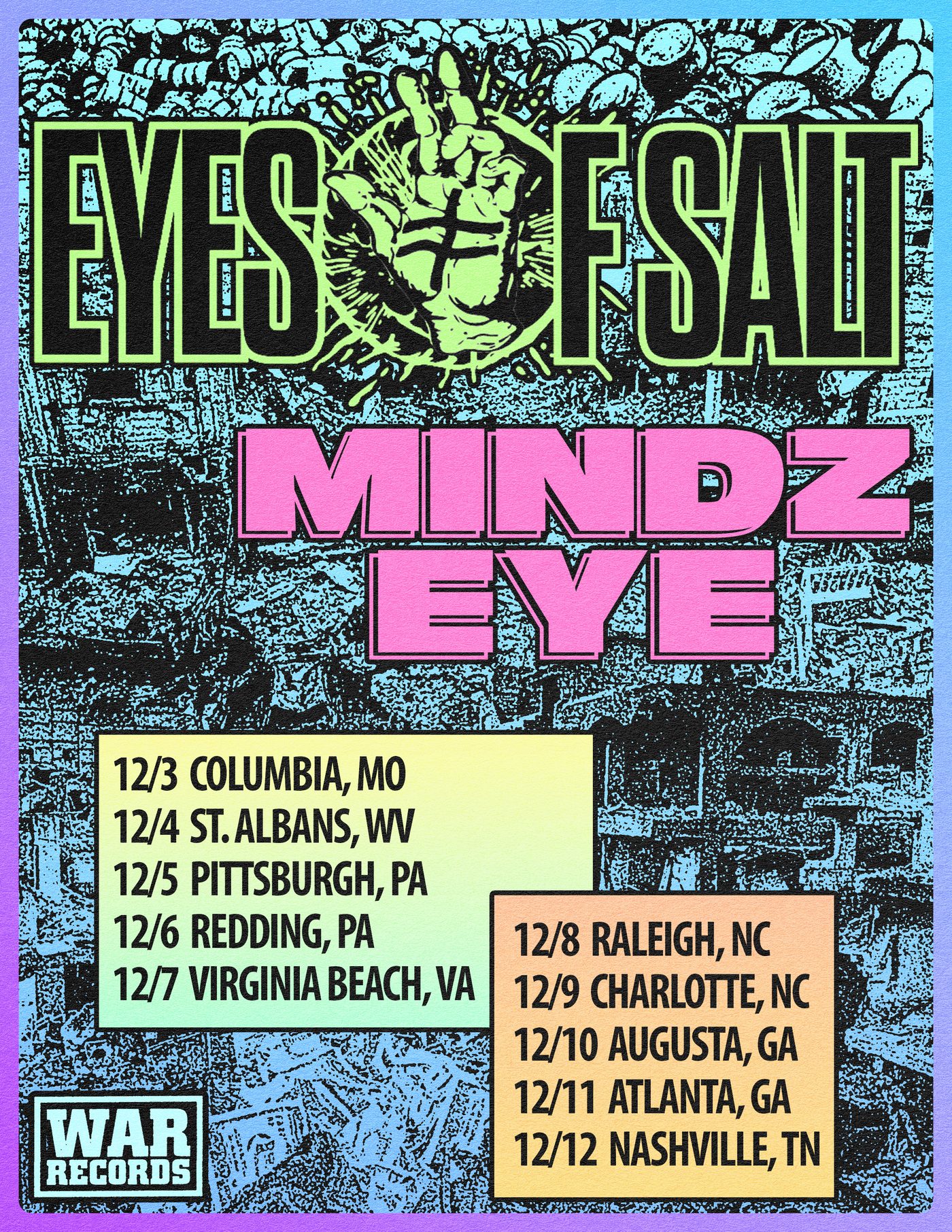
They’ve got more gigs lined up before the year is over, with a ten-date December run alongside fellow Colorado hardcore band Mindz Eye. It starts in Columbia, Missouri on 3 December, travels through West Virginia, Pennsylvania, Virginia, North Carolina and Georgia, and finishes in Nashville on the 12th.
For all Gary’s frustration with what hardcore has become, he’s still committed to writing it.
“We wanted to show that it’s still possible to write hardcore that’s heavy, aggressive, and delivers a message.”
“Collapse Of The Infinite” is out now on WAR Records. You can hear the full record and find the available vinyl edition through Eyes Of Salt’s Bandcamp.