
Long Island’s PROTEST ART make a pretty angry mix of metal and dubstep, and on “Stories From The End“, they’ve taken that sound into a fictional America that’s going badly wrong. There’s a corrupt leader called Big Mouth, a young guy named Robert trying to bring him down, and a whole lot of questionable decisions on both sides.
The person behind all this is Samuel Ashkenazy, a New York filmmaker and screenwriter who started taking music seriously during the 2023 writers’ strike and has since found himself making some very personal songs about politics, money, sexuality and the future of creative work.
The album came out back in March 2026, although Sam is the first to admit he didn’t really know how to get people to hear it. He spent a huge amount of time making the thing, put it out and hoped it would find an audience.
Several months later, with more music already underway, we’re giving “Stories From The End” a proper look, including some of the stories behind it that barely got an airing when it was released.
Wyświetl ten post na Instagramie
Big Mouth first appeared on PROTEST ART’s 2025 debut EP, “When It All Comes Crashing Down”. He was never intended to be a direct portrait of Donald Trump or any other single politician. Sam had been watching the behaviour of presidents, wealthy elites and authoritarian leaders, and wanted to put those characteristics into one fictional person.
“Part of my decision making on writing about a fictional but adjacent America is the idea that the music will live past a specific moment in time; listeners will be able to listen to the ‘Big Mouth’ story arc long after XYZ is out of office or faded from the zeitgeist.”
While touring with the earlier EP, Sam kept writing and gradually found himself with enough songs to develop that fictional America further. He also wanted to spend time inside the heads of the people he was criticising. It’s an uncomfortable exercise for someone who strongly opposes their politics, but one he found surprisingly useful.
“I think sadly all of us have a little bit of “Big Mouth” in them, and as someone so diametrically opposed to the ideologies I’m writing about, I also found it kind of freeing to allow myself into their shoes and explore what motivates them.”
Robert gave the story its second main character. He represents the resistance, a young man so convinced that he’s fighting for the right cause that he becomes willing to compromise his own principles. Big Mouth has reached the top and will do anything to protect his position. Robert wants to tear that power down, and is increasingly prepared to use whatever means are available.
Sam likes the idea that someone can listen to the record from either perspective. The songs change depending on whose story you’re following, and there’s plenty of uncomfortable behaviour to go around.
The concept-album approach has been with him for years. He grew up in a musical household, listening to Pink Floyd, Genesis and Roger Waters, and later found similar ambitions in artists such as M83. He still sits down and listens to entire albums, something he jokes is becoming increasingly rare. His family always encouraged him to think about music as a complete experience, and he wanted “Stories From The End” to work that way.
The title wasn’t settled until fairly late. He went through roughly a dozen possibilities before finding something that suited a record with multiple perspectives, all heading towards the same unhappy outcome.
“A race to the end of us.”
There’s quite a lot going on musically, too. Sam grew up listening to Black Sabbath, Marilyn Manson and Motionless in White, then got into rave culture during his late teens and early twenties. He liked how cold and harsh dubstep could sound, and thought it could work well with metal. I See Stars and Electric Callboy had already shown him some of the possibilities of bringing those worlds together.
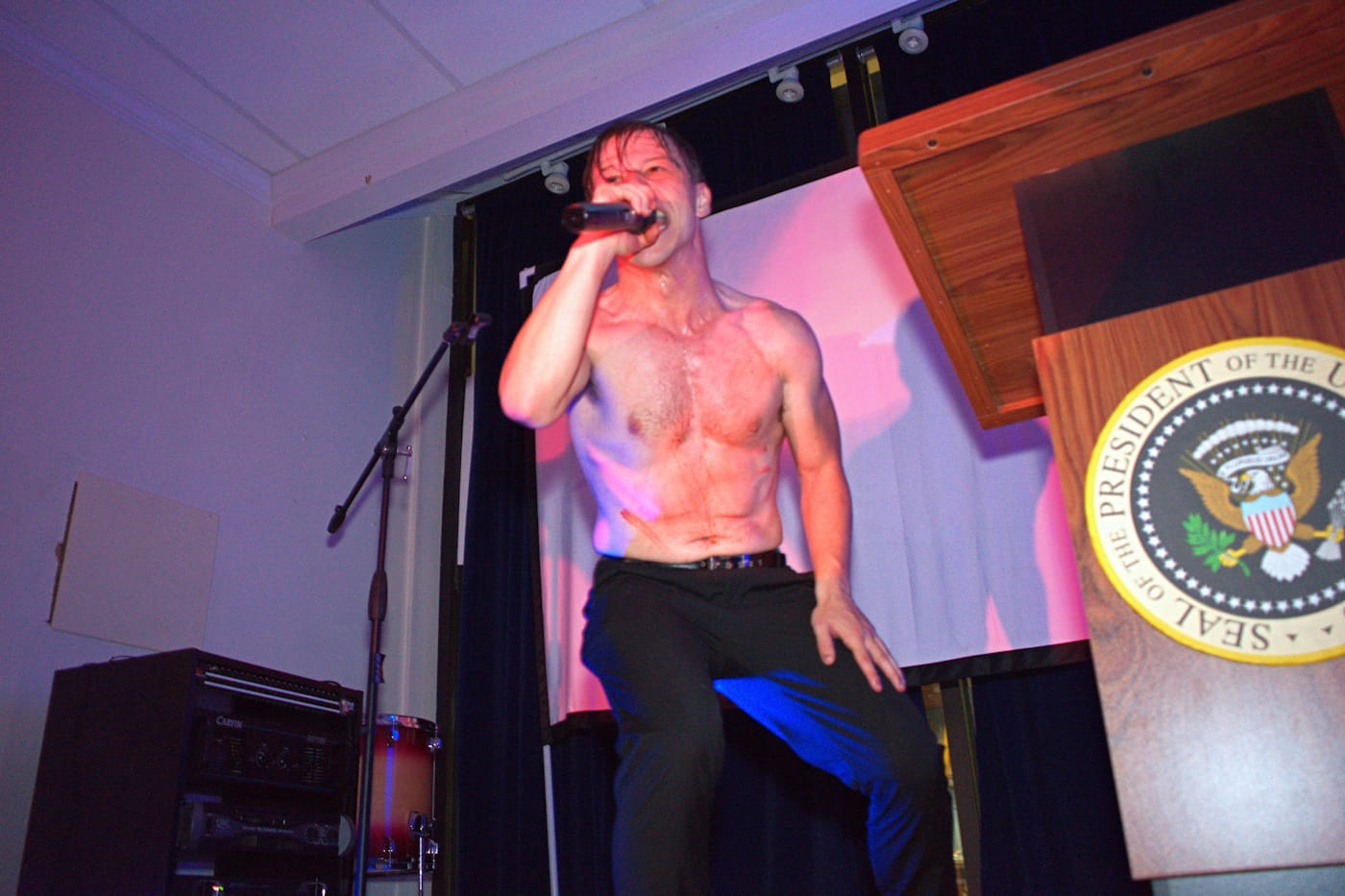
PROTEST ART use heavy guitar parts, hard electronic sounds and vocals that move between melody and outright shouting. The dubstep side brings its own rhythms and electronic drops, while the metal parts give the songs a different kind of weight. There are also simpler, repetitive hooks designed to work in a room full of people, especially on songs such as “ON TV”.
Sam starts most songs with the lyrics. Something in the news annoys him, a particular subject gets stuck in his head, and he writes about it, often quite quickly. Then comes the part that takes longer.
“I’ll hum a song for weeks trying to work out a melody until I land on one. From there, it’s time to bring it to my producer, Xavier.”
Xavier Maymi has become his main studio partner. They work together in Xavier’s makeshift home studio, and Sam describes him as a funny, slightly goofy character who’s also intimidatingly good at what he does. They’ve developed a close working relationship, spending plenty of time trying different arrangements and figuring out how each song should connect to the next.
For “Stories From The End“, they were especially careful with endings and transitions. The move from “State of the Union” into “Look Ma!” was one of the sequences they spent time getting right.
“Look Ma!” was easily the most troublesome song on the album. They worked on it for weeks, revising the arrangement again and again. Sam wanted the tension to keep increasing until the final third, where the song starts falling apart.
He also felt the lyrics needed particular care. They concern a man who’s committed something appalling, and Sam leaves the listener to make their own connections to events in American politics. During the writing period, he recalls two mass shootings and the public controversy surrounding sexual assault allegations against a nominee for US secretary of defence. Those events were very much on his mind.
Although he doesn’t perform “Look Ma!” particularly often, Sam considers it possibly the most important song on the album. It also has the largest group of contributing musicians. Jawaun Neal and Frank Saladino added guitar work, and Chris Casillas contributed the keyboard solo.
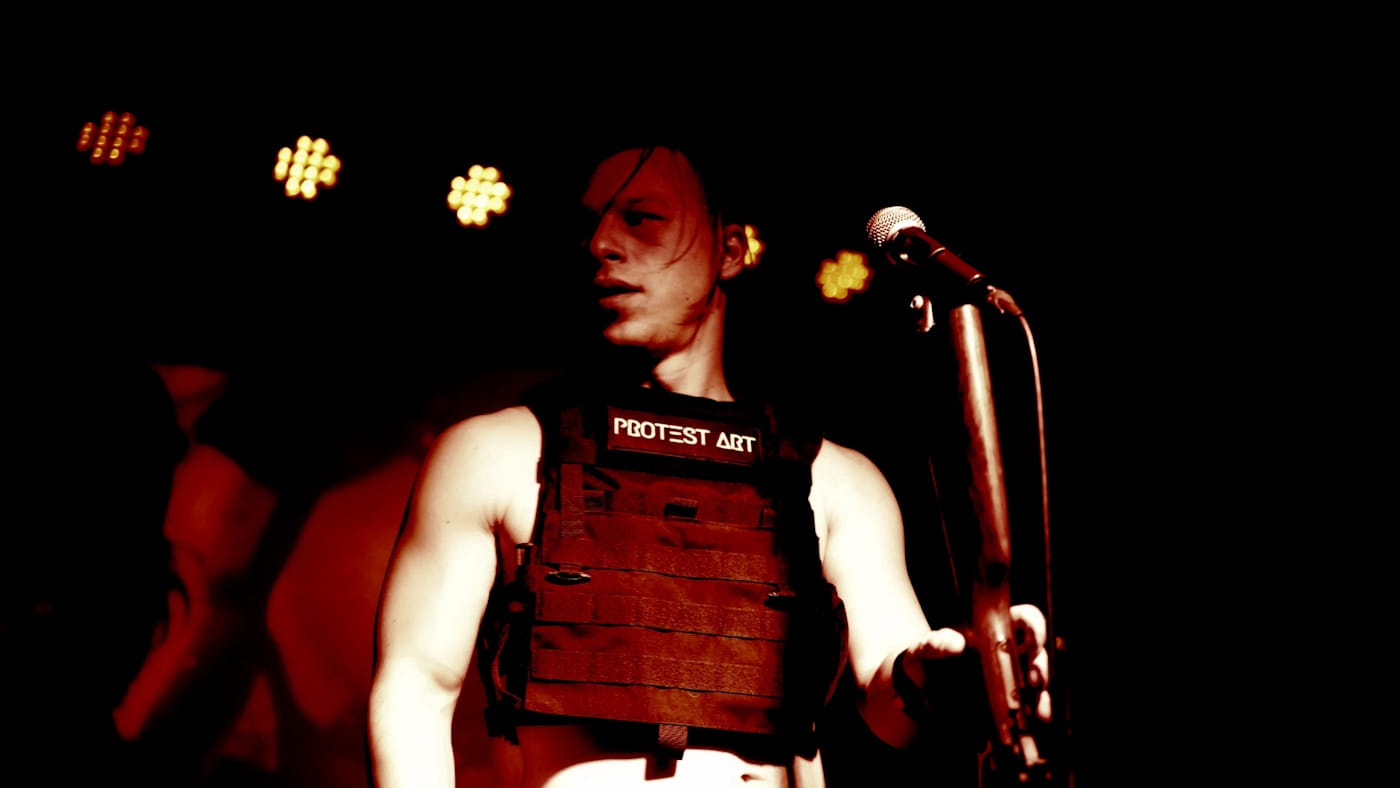
There are a few more people involved across the record. Sam wrote the songs, Xavier produced, mixed and mastered the album and played keyboards, and the guitar contributions include Frank Saladino, Joao Corceiro and Jawaun Neal. Those musicians have been important to the recordings, although none is an official permanent member of PROTEST ART.
The whole thing also received help from an unexpected corner of Sam’s professional life.
He’s spent most of his career in film, working as a sound recordist and screenwriter, and describes himself as a six-time award-winning writer. He’d had plenty of experience pitching screenplays without getting them made. This time, he pitched PROTEST ART to Jonn Kmech, one of the producers of the independent experimental horror film “Skinamarink”. Jonn agreed to invest in the album.
Sam found it pretty funny that he finally managed to secure backing for a music project after struggling for so long to get his film scripts off the ground.
“As a screenwriter, I have a dozen or so finished screenplays I poured my heart and soul into that ultimately ended up sitting on a shelf and collecting dust, and that hurts.”
Making independent films is expensive, and he’s spent years dealing with that reality. With PROTEST ART, he could fund much of the work himself, bring in other musicians when needed and actually get the finished songs in front of people.
His film experience has been useful beyond getting the album made. Sam edits the project’s content himself and comes up with the music-video concepts. He has industry contacts who can help put ideas together without completely wrecking his budget, although he freely admits that money is still tight. There are movie references he’d love to work into future videos when he can afford more ambitious productions.
Scare Works, his film production company, provided the artwork for “Stories From The End”. Jeremy Grand illustrated the earlier “When It All Comes Crashing Down” EP. The photographs supplied for this feature also came through Scare Works in association with Andromeda Productions.
The connection between film and music goes quite a bit deeper, especially when it comes to PROTEST ART’s opposition to artificial intelligence.
The project became a serious focus during the 2023 writers’ strike, when Sam’s normal filmmaking work came to a halt. He’d played around with music during high school, but hadn’t originally planned to build something like PROTEST ART. Suddenly, he had time to work on it, and plenty to be angry about.
AI was one of the major concerns around the writers’ strike, particularly the possibility of studios using generated scripts and other automated work to reduce their dependence on human writers. Sam was watching an industry he’d spent his life working in debate how much the people doing that work were actually worth.
His position on the technology is pretty uncompromising.
“AI is a weapon. It is a weapon to destabilize economies, to strip the working class of their value, identities, and purpose.”
He’s worried about the loss of jobs, but also about what happens to people who have built their lives around learning something and becoming good at it. Work, in his experience, can give people friendships, a community and a sense of achievement. He doesn’t buy the promise that everybody will happily stop working while machines handle everything.
Some of those concerns come from the way he sees himself.
“I love that I’m smart. I’m not a genius, but I’m an independent thinker who puts a lot of thought into my positions, and I love to learn new skills or knowledge that changes my perspective on something.”
The prospect of those skills becoming commercially worthless bothers him deeply. He’s spent years developing them, and learning new things remains one of the parts of life he enjoys most.
His mother taught him to value honesty, and he applies that quite strictly to his own creative work. He avoids using AI whenever he reasonably can, even if doing something himself takes longer.
Working with film has made him especially sensitive to generated images. He no longer feels entirely comfortable trusting what appears on a screen, and that bothers him as someone who makes a living creating and working with images.
“When I’m on stage as Protest Art, I can’t lie. I can’t just generate the show I want, I have to be the show I want.”
All of that fed into “Artificial Insanity“, one of the songs he and Xavier spent a lot of time getting right. They wanted the arrangement to have a heavy, punishing feel that matched his anger about what AI could do to working people.
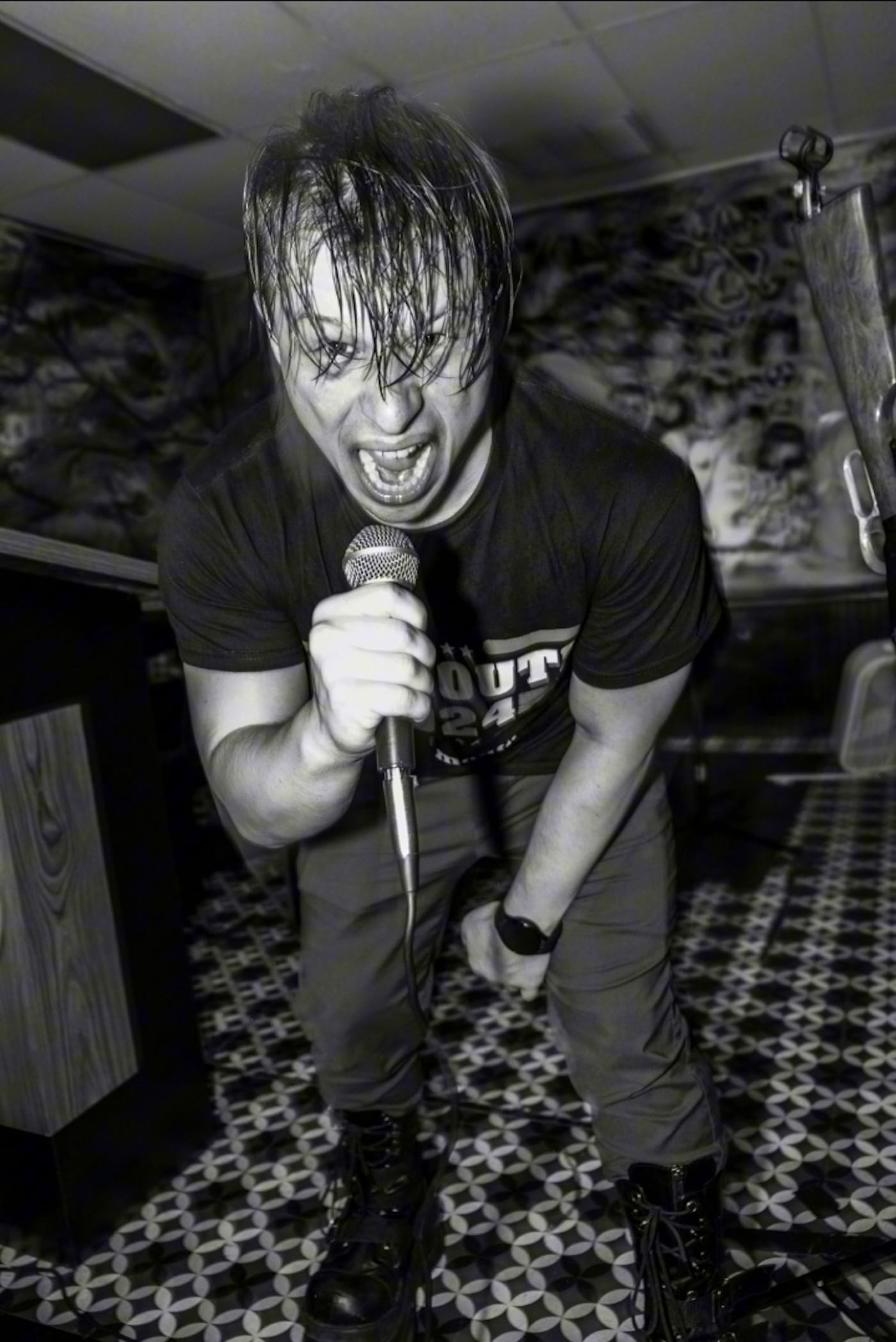
The lyrics take the subject somewhere more personal, into a relationship with a chatbot. It can give someone sexual attention, instant responses and whatever fantasy they’re looking for. Sam’s interested in what happens when that becomes a substitute for actual human company.
“But when I’m lonely she’s there to sext.”
He talks about being able to generate practically any obscene scenario you want, while knowing none of it is real. The person on the other side of that exchange doesn’t exist, and the loneliness that brought somebody there in the first place can remain untouched.
The political tracks on “Stories From The End” came out of a similarly direct response to things happening around Sam. “Inauguration”, “Executive Orders” and “State of the Union” were written with the Trump administration in mind, particularly its rhetoric and decisions affecting people already struggling financially.
Sam regularly volunteers at a local food bank. He sees people having trouble affording basic necessities, and he’s angry about cuts affecting SNAP, the American food-assistance programme used by millions of low-income households.
He’s equally upset by the reduction of funding to USAID, which supported humanitarian programmes including food supplies and medical assistance overseas. Researchers have warned that the cuts could lead to large numbers of additional deaths, although the figures involved are projections and depend on the funding scenarios being studied.
Sam takes those issues personally. He admits that he tends to carry the problems of other people around with him, even when there’s very little he can do about them.
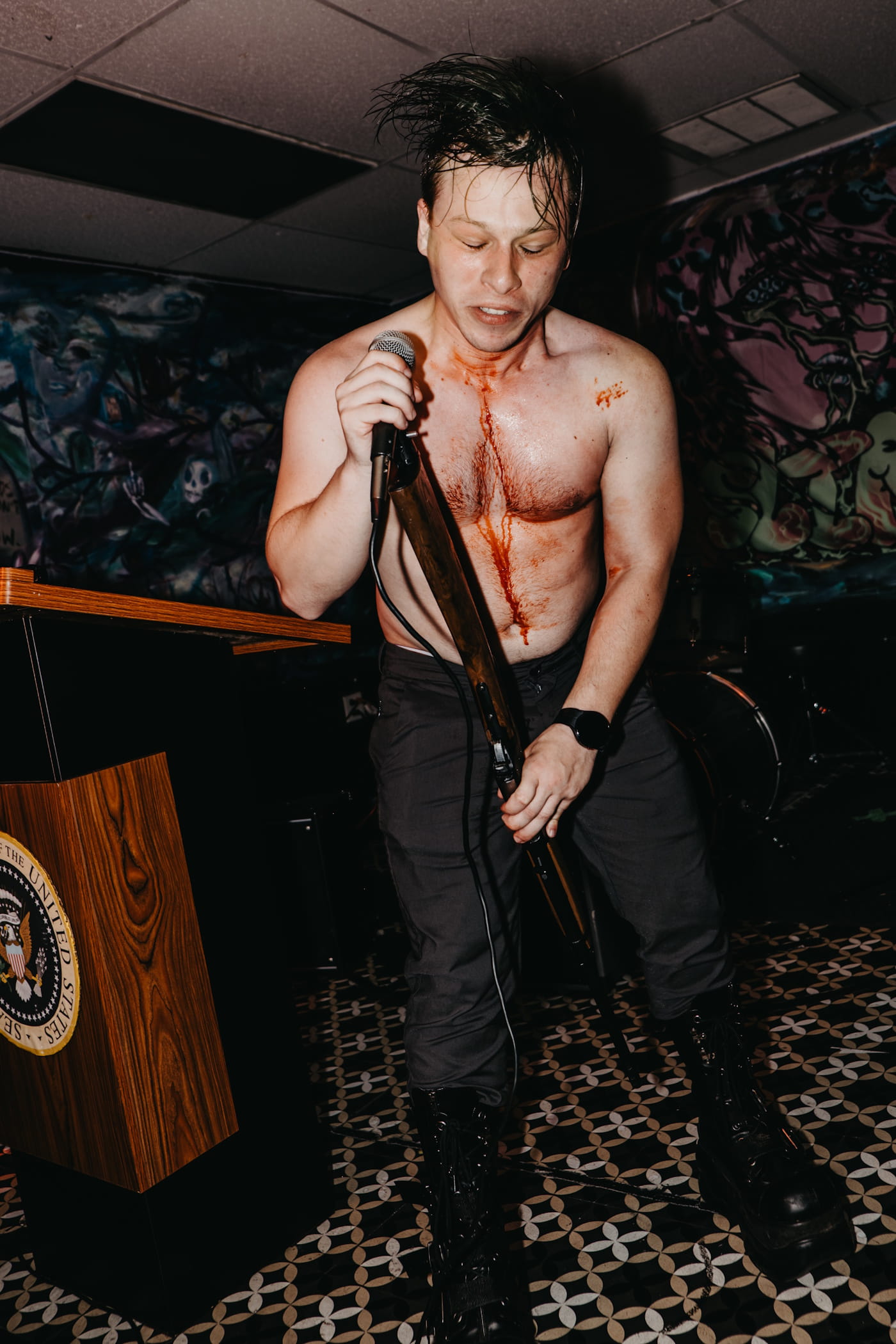
“State of the Union” also goes back to his own experience of growing up with financial insecurity.
During his high-school years, he was already dealing with the possibility of losing his home. The house where he’d spent his childhood was eventually foreclosed on. Everything inside was thrown away, including things he’d kept since he was small.
“Every lego, every stuffed animal I promised to pass down to my children if I ever have them, every drawing I ever drew… thrown out overnight.”
He remembers the feeling of never being completely secure, of constantly trying to keep his head above water financially and wondering whether the place he lived would remain his home. That feeling followed him into adulthood.
When he started writing “State of the Union”, it was tied to that history as much as to the latest political news. The economic pressure he was watching other people experience reminded him of situations he’d already lived through himself.
“Techno Fascist” has a rather different history. Sam thinks the lyrics go back to around 2018, years before either of PROTEST ART’s major releases. They originally belonged to two separate songs, which he eventually joined together.
When “Stories From The End” began taking shape, he found a place for the track in Big Mouth’s fictional America. He was thinking about wealthy technology figures who, in his view, have become increasingly disconnected from the everyday problems of the people affected by their decisions.
Elon Musk, longevity entrepreneur Bryan Johnson and Peter Thiel were among the names he brought up. Sam sees them as examples of an elite living at an enormous distance from the financial worries most people deal with.
That kind of power fits comfortably into Big Mouth’s world.
There’s another part of the record where Sam leaves the fictional characters behind and gets into experiences he’s had as a gay man in the United States.
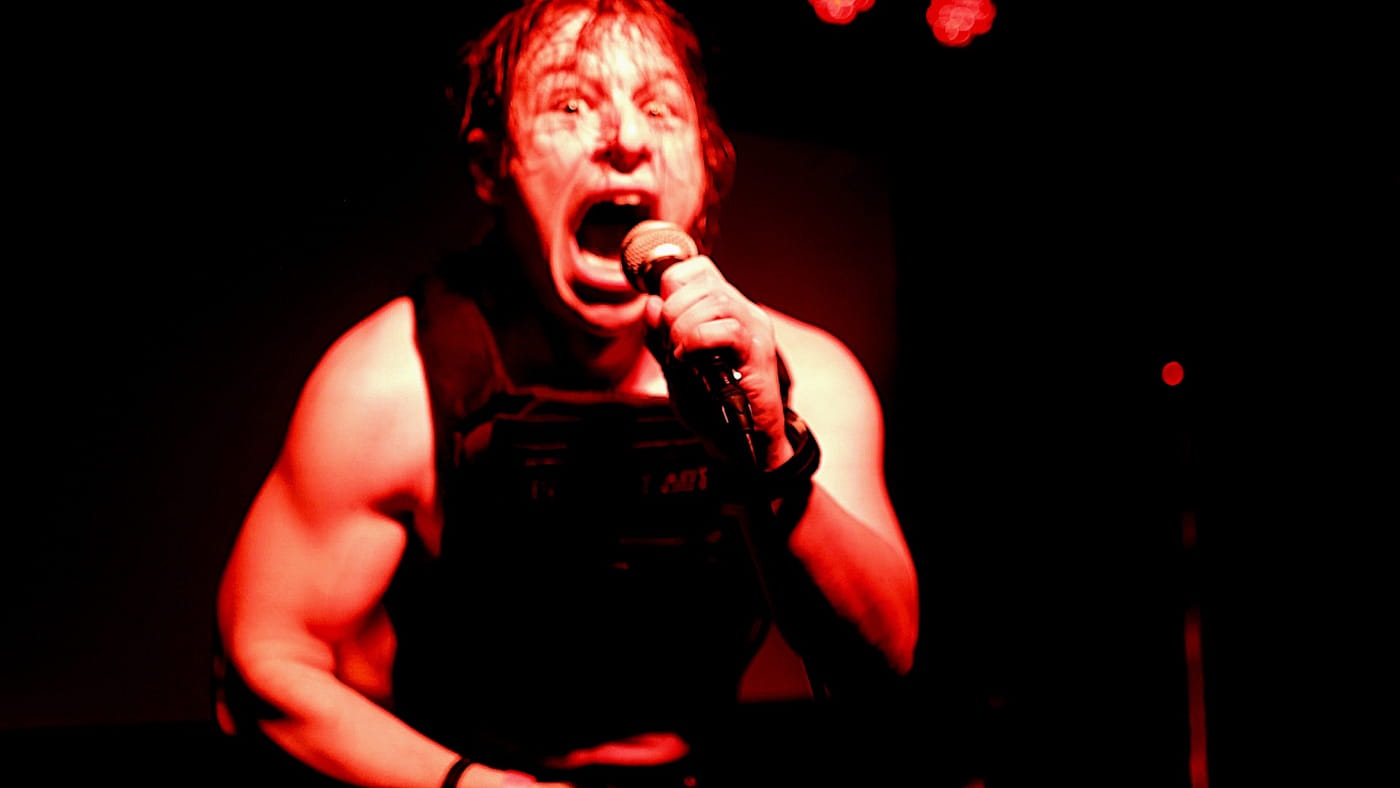
“Why Do You Care (Who I Fuck)” comes from years of watching the way people talk about homosexuality change, including some pretty grim encounters in his own life.
His first boyfriend, whom he met in high school, also came from a difficult family situation. The two connected partly because of that. His boyfriend’s mother was a chain-smoker who spent a huge amount of time watching Fox News.
When Sam met her, she already knew he was dating her son. She asked about his family, and he explained that he and his own mother weren’t speaking at the time. He had recently come out, and she’d had a difficult time accepting it.
His boyfriend’s mother responded gently, believing she was being understanding.
“Doesn’t she know that you have G.I.D.? You can’t help the fact that you’re gay, you have one less chromosome.”
Sam was stunned. She seemed to believe homosexuality was connected to a chromosomal condition, and that being gay was some kind of medical problem. The information was completely wrong, but she genuinely thought she was offering him sympathy.
He remembers that odd combination of kindness and deeply offensive misinformation. The woman was accepting him in her own way, even though she had an extraordinarily mistaken understanding of what she was talking about.
Sam connects her beliefs to the conservative television she watched so obsessively. Fox News itself later became embroiled in the Dominion Voting Systems case over false claims about the 2020 presidential election, eventually agreeing to a $787.5 million settlement in 2023.
By the 2024 election, he was encountering a nastier kind of hostility.
After Taylor Swift endorsed Kamala Harris, an old high-school acquaintance and his girlfriend shared a photograph from Swift’s appearance at an Alabama school prom in 2008. She had attended with student Whit Wright as part of MTV’s “Once Upon a Prom”.
The photograph was being circulated online as supposed evidence of paedophilia, an accusation with no credible basis.
Sam responded with a simple expression of disbelief. The reply he received accused him of being a paedophile sympathiser because he was gay, with the sender describing themselves as a former LGBTQ advocate.
“Equating the LGBTQ community with pedophelia has become the newest weapon against us,” he says.
The whole episode stuck with him. He’d grown up encountering people who had offensive misconceptions about gay men, and now he was seeing people use accusations of child abuse as a direct attack on LGBTQ people.
His anger also extends to politicians who campaign on traditional Christian family values while becoming embroiled in sexual controversies themselves. He brings up Matt Gaetz, Lindsey Graham and Senator John Kennedy in his criticism of conservative political culture and the way homosexuality is discussed publicly.
Some of the personal allegations Sam mentions about individual politicians remain contested or unsubstantiated. His larger complaint concerns the rhetoric itself, particularly when politicians present LGBTQ people as morally suspect while claiming religious authority over how other people should live.
“The hypocrisy becomes too much to bear.”
It all went into “Why Do You Care (Who I Fuck)“, a song that can also get very different responses when he performs it live.
The people Sam has worked with on the album have helped him approach some of those difficult subjects with a bit of humour, too.
“Pig Pen” is a good example. He wanted a female vocalist involved from the beginning, partly to bring another perspective into the track’s satire. Janel Monique was someone whose previous work in the metal community he admired, so he reached out on the off chance that she’d be interested.
She was.
The contribution produced one of Sam’s favourite small moments involving the record, and it had nothing to do with an audience or a review.
“Nothing beats seeing my Dad listen to ‘Pig Pen’ and watching his face every time Janel comes in and screams “WHAT?” He erupts into this huge smile.”
For now, PROTEST ART’s live setup is fairly flexible. The musicians who contributed to “Stories From The End” aren’t permanent members, and Sam doesn’t have a full backing band. He’d like to get one together eventually, provided the project keeps growing.
In the meantime, he makes full use of the electronics and approaches the shows like a metal rave. There’s a theatrical side to the performance, which makes sense given his background in filmmaking and his years spent going to raves.
The project has been appearing around Long Island and New York, with shows at Club Andromeda in Nyack and Bar Freda in Queens among its 2026 dates. Lucky 13 and The Meadows have also figured in the project’s New York live plans.
Sam admits he doesn’t have a huge number of different audiences to compare, but he has been impressed by the crowds around New York.
“Why Do You Care (Who I Fuck)” can make some people visibly uncomfortable. Others, including straight audience members, get right into it. He knows it’s a confrontational song, and he’s seen both reactions.
“ON TV” has become particularly good fun to perform because of the call-and-response. Sam gets the audience repeating the hook back at him, and before long the whole room can be singing the same words.
The song deals with media, public spectacle and the absurd things people keep watching happen around them. Its central repeated phrase, “We started watching people watch TV”, works well when a crowd starts throwing it back towards the stage.
Sam likes those moments when everybody joins in. People in the room might disagree about politics, the news or all kinds of other things, but they’re still together for those few minutes. He finds that shared experience helps with the isolation he often feels when thinking about the subjects behind his songs.
He’s also developed a line that he regularly shares with audiences, and he was particular about getting the wording right.
“we don’t have to agree but what we do have to agree on is the person standing to your left, and the person standing to your right, both politically and physically are equally worth protecting.”
That idea of finding some common ground, even with people whose beliefs he strongly opposes, is going to carry into the next PROTEST ART release.
Sam hasn’t stopped writing since “Stories From The End”. Some of the songs intended for his forthcoming EP, “Family Values“, were already being written during the album sessions. They didn’t fit the Big Mouth and Robert story, so he kept them for something else.
He’s expecting a slightly different sound and tone this time.
One of the songs is “Kim Won’t Sell To Gays“, which he’s already performed at the PRISMS LGBTQ Music Festival. The crowd heard it without knowing what was coming, and the title alone gives a pretty good indication of how directly Sam is approaching the subject.
Kim is Kim Davis, the former Rowan County clerk in Kentucky who refused to issue marriage licences to same-sex couples after the US Supreme Court legalised same-sex marriage nationwide in 2015.
Davis cited her Christian beliefs and refused to comply with court orders, eventually spending several days in jail for contempt of court. She subsequently fought legal action brought by David Ermold and David Moore, one of the couples she had turned away.
The couple won damages and legal costs, and Davis continued challenging the decisions. In November 2025, the Supreme Court declined to hear her latest appeal, leaving the lower-court judgment in place.
A further legal dispute followed in July 2026, when Ermold and Moore’s lawyers accused Davis of transferring inherited property to relatives to avoid paying what she owed. Those were allegations made in a separate lawsuit, and Davis’s representatives denied wrongdoing.
Sam sees the whole affair as a particularly ugly example of people claiming religious principles as grounds for denying services to gay couples.
He also brings up the various American legal disputes involving businesses refusing to provide wedding-related services to same-sex couples. The recurring argument over whether a person’s religious beliefs can justify that refusal makes him angry, especially when the consequences fall on ordinary couples simply trying to get married.
“You’re not who I want you to be.”
Sam means it in both directions. He isn’t the person Davis and those who share her beliefs would like him to be. Equally, they aren’t the kind of people he wishes they were.
He knows that the arguments surrounding homosexuality, religion and personal rights aren’t going to disappear because someone writes an angry song. He still hopes people might find a minimum of mutual understanding.
“Hopefully by the end of ‘Family Values,’ maybe we’ll find some sort of common ground, or at the very least, a shared sense of humanity.”
He’s currently aiming to release “Kim Won’t Sell To Gays” on 27 November 2026, with both regular and extended versions planned. The date remains a target while work on “Family Values” continues.
This time, he’s putting more thought into how the music will reach people.
When “Stories From The End” arrived in March, Sam had been so busy finishing the record that promotion barely entered his plans. He genuinely hoped the album would grow organically once it was available.
Then it came out, and he realised he hadn’t prepared much to help it along. There wasn’t a proper set of promotional assets, there wasn’t money put aside for pitching songs to playlists, and he was still trying to figure out the mechanics of getting his music heard.
“It isn’t like a movie where I can cut a trailer,” he admits.
He’d spent a long time in an industry where putting together a pitch, selling an idea and getting people interested before production were familiar parts of the job. Releasing his own album turned out to involve a completely different set of problems.
“I was so excited to share this project with the world that I never really considered, how.”
There’s a certain irony in that, given how much of PROTEST ART’s story has been about trying to get creative work made and seen in the first place. Sam still has those finished film scripts sitting on a shelf, waiting for their chance. At least this time, the songs are out there, the record is finished and people can hear what he and his collaborators have been working on.
“Stories From The End” was released in March 2026, written by Samuel Ashkenazy and produced, mixed and mastered by Xavier Maymi. The album is available through Bandcamp, Spotify and Apple Music, with further links on the official release page.