

“Point of No Return,” the debut full-length from NEKS sounds like a decision — the kind you don’t walk back from. Out September 16, the record is a collision of distance and resolve, recorded between New Jersey and Utah, mixed and produced by the band, and mastered by Mike Kalajian at Rogue Planet. The result is a set of songs that move like fault lines—dense, melodic, and heavy in the way life feels heavy now. Think of Quicksand, the controlled combustion of Snapcase, the restless urgency of Modern Life Is War. And a lot more that comes with their own style.
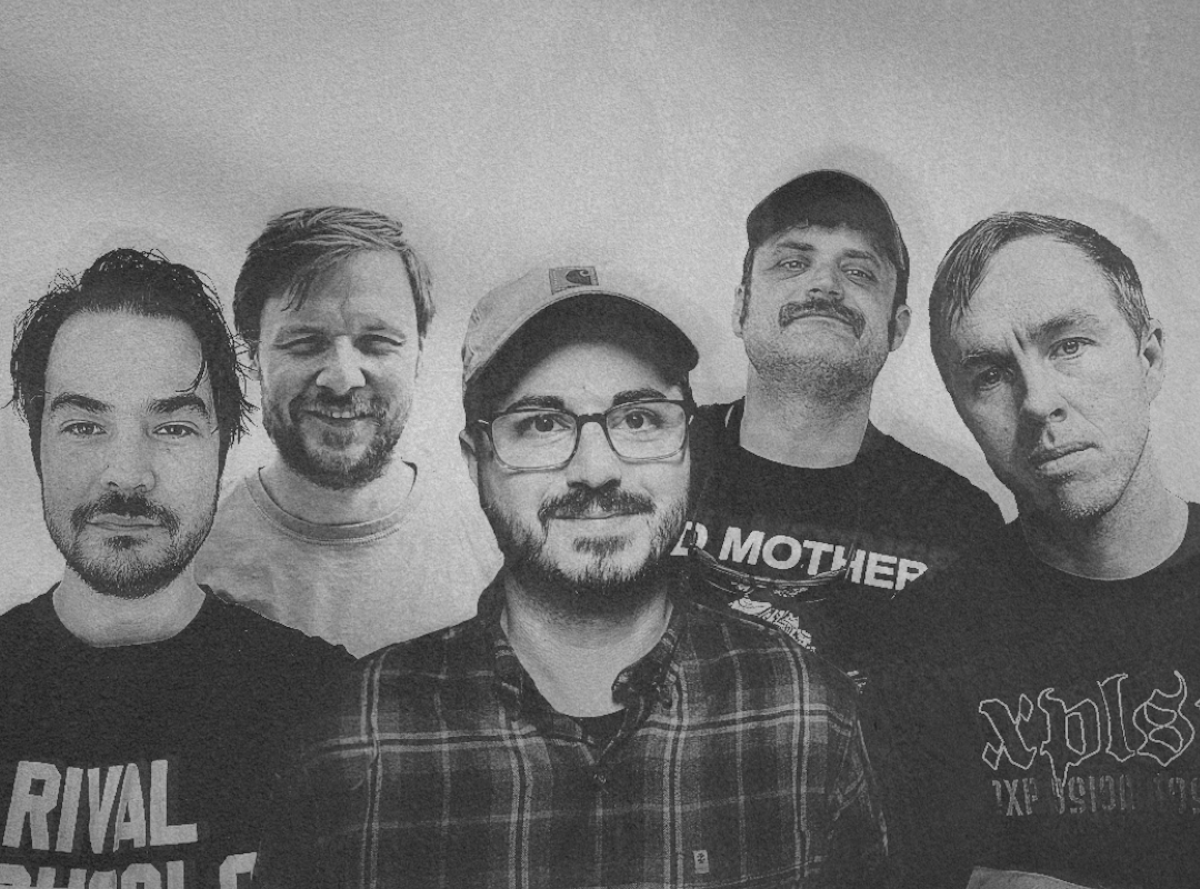
Formed by musicians scattered across Salt Lake City, Denver, New Jersey, and Spain, NEKS plays like a band bound less by proximity than by shared exhaustion. Gary Cioni (Crime In Stereo, Daytrader) steps out from behind the guitar to take vocals for the first time, joined by guitarist Matt Mascarenas (Rile, Sunsleeper, Daytrader), Wes Johnson (I Hear Sirens), bassist Robert Cheeseman (Spirits (we video interviewed Charles from Spirits 10 years ago!), Test of Time), and drummer Derrick Flanagin (Capsule, Wrong, Daytrader).
Their debut takes its cues from the double single “The Land of Plenty” and “The Rubicon,” songs that speak to a country grinding itself down under the weight of greed and apathy. Gary Cioni calls it a record born from political dread: “There has never been a greater need for political urgency than right now,” he says. “The record is my way of trying to capture that feeling.”
Five musicians scattered across time zones trying to make sense of a country they no longer recognize — and maybe finding, in the noise and frustration, a way to stay connected.
The title itself became a statement. “I kept going back and forth between calling it ‘The Rubicon’ or ‘Point of No Return,’ which really mean the same thing,” Gary Cioni explains. “In the end we used ‘The Rubicon’ for a song and ‘Point of No Return’ for the album because that phrase captured the bigger picture. For me it is about the country more than my own life. We are shifting toward something authoritarian and that is dangerous.”

Lyrically, the album stands as documentation rather than consolation. “The lyrics are definitely more about documenting the chaos and frustration than offering hope,” Cioni admits. “I carry a lot of anger about the state of our country and the direction it is heading, and writing about that felt like the most natural way to express myself.” That raw intensity translates directly into the music’s pacing and push—the sound of exhaustion turned into motion.
When asked about the record’s sequencing, Cioni notes that the order was built around energy rather than narrative. “We wanted the energy of the music to carry people through,” he says. “The opener felt obvious because the lyrics of ‘MAGAts’ introduce a lot of the themes of the record, and the closer felt obvious because ‘Eternal Servitude’ has that sense of collapse and ultimatum.”

Even across distance, the band’s cohesion came from shared experience. “We got together for a week at the start of the process to comb through ideas, arrange the ones we liked, and record drums,” Gary Cioni recalls. “After that, everyone went their own way and the rest of the project was finished via email, passing sessions back and forth. Thankfully, with three professional audio engineers in the band, it was not really a hindrance.”
Self-producing the record meant allowing imperfection to surface. “A lot of the vocals were just one take,” Gary says. “Some were even recorded on an SM58 while I was moving around the room. I wanted to let the chaos breathe and keep the energy raw.” The result is an album that feels both deliberate and unpolished, designed to hit nerves rather than smooth them out.
Though listeners draw comparisons to familiar names, NEKS never set out to emulate anyone. “Some of the comparisons are intentional, and some are coincidence,” Gary admits. “Modern Life Is War is one of my all-time favorite bands, so any influence there is completely intentional. But we had no idea what kind of band NEKS really was until we started finishing some of the songs… that process helped us understand our sound.”
The artwork—an image of a hand pressed to a head on a moving train—captures that same exhaustion and persistence. “Jordon has a way of capturing desperation and despair in images that says so much without saying anything,” Gary Cioni says. “I think the image we chose perfectly captures the vibe of the album.”
View this post on Instagram
Despite the anger running through the record, NEKS began for reasons more human than political. “As we get older, friendships become harder to maintain, and the members of this band are some of my best friends,” Cioni says. “Starting the band together gives us something to anchor our friendships in the coming years and a reason to keep the group chat going.”
And while the songs confront collapse and conflict head-on, Cioni doesn’t frame them as calls to arms or metaphors for healing. “I definitely wanted this record to be a statement about where we stand on things,” he says. “If you are a fan of Donald Trump, you should not like this record. You can fuck right off.”
The full interview below dives deeper into the album’s themes of political decay, the band’s remote creative process, the blurred line between rage and realism, and the grounding role of friendship in keeping a project like this alive.
That album title, Point of No Return, already feels like it’s putting a stake in the ground. When you were first talking about names, was there a moment where you realized this wasn’t just another record but something that needed to feel definitive, almost irreversible?
Naming this record was harder than I expected. I kept going back and forth between calling it The Rubicon or Point of No Return, which really mean the same thing, but in the end we used The Rubicon for a song and Point of No Return for the album because that phrase captured the bigger picture. For me it is about the country more than my own life. We are shifting toward something authoritarian and that is dangerous. There has never been a greater need for political urgency than right now and the record is my way of trying to capture that feeling.
View this post on Instagram
The tracklist reads like chapters of a manifesto. I’m curious how you shaped that order — did the songs fall into place naturally, or did you spend time making sure the story moved a certain way from MAGAts through to Eternal Servitude?
We did not set out for the tracklist to read like a manifesto, but I can see how it comes across that way now. When we were putting it together we actually built the sequence around the flow of the instrumentals rather than the lyrics. We wanted the energy of the music to carry people through. At the same time the opener felt obvious because the lyrics of ‘MAGAts’ introduce a lot of the themes of the record and give a sense of what is coming next, and the closer felt obvious because ‘Eternal Servitude’ has that sense of collapse and ultimatum. So even though we did not plan a manifesto, the order ended up tracing one.
A lot of the lyrics seem to wrestle with violence, inequality, and disillusionment. Do you see these songs more as snapshots of a collapsing world, or as ways to carve out some kind of meaning while everything unravels?
The lyrics are definitely more about documenting the chaos and frustration than offering hope. People who know me well know I am not a man of many words and I often struggle to communicate my emotions directly, so the lyrics are intentionally non-personal. I carry a lot of anger about the state of our country and the direction it is heading, and writing about that felt like the most natural way to express myself. That anger also drives the music—the intensity, the pacing, the way the instruments push forward—it all feeds off that same energy.
View this post on Instagram
When you were working on “The Land of Plenty” and “The Rubicon,” did you ever have moments where the themes felt too close to home, like you were crossing into something almost too personal to put out there?
These songs are definitely the most personal on the album from a lyrical perspective, but I think they reflect how so many of us are feeling right now. We are all overworked and underpaid, struggling for basic human rights, while corporate interests and greed continue to make record profits. The Rubicon in particular deals with global warming and how corporations shamelessly pollute the planet while telling the rest of us we need to do more. It is all bullshit.
Gary stepping into vocals after years of being on guitar — how did that switch reshape the way you wrote songs? Did it open up unexpected doors, or did it bring new kinds of pressure into the room?
My day job is producing records for other artists, so with NEKS I kind of assumed the role I usually do in most of the records I make, taking ideas from other people and helping shape them into something tighter and more polished. The vocals were honestly an afterthought in the original sessions. Once we had the instrumentals sorted out and recorded, I really started to think about the vocals. Typically, I would start with a theme for what I wanted the song to be about, then figure out the melodies, and for the most part the lyrics came last.
Since you’re spread out between Jersey, Salt Lake, Denver, and even Spain, the way you create isn’t exactly the classic “five guys in a basement” setup. How has that long-distance process changed the way you build trust in the songs, or the way you argue about what matters in them?
We got together for a week at the start of the process to comb through ideas, arrange the ones we liked, and record drums. After that, everyone went their own way and the rest of the project was finished via email, passing sessions back and forth. Thankfully, with three professional audio engineers in the band, it was not really a hindrance to the process. That said, there were definitely gaps in productivity since everyone had other commitments, but overall it worked because we all knew how to handle the technical side and trusted each other to get it done.
Recording across New Jersey and Utah, mixing it yourselves, mastering with Mike Kalajian — that’s a lot of different sonic spaces coming together. Were you chasing a unified atmosphere from the start, or did you want that tension of different rooms bleeding into each other?
To be honest, I did not really think about the different rooms when recording. Everything was recorded in great sounding spaces, and that alone made it easy to tie it all together. It is very common for me to record a record across multiple locations, so I never really thought twice about it. I just focused on doing my job.
There’s a rawness in the sound that makes me wonder — how much did self-producing allow you to lean into imperfections and let them breathe, instead of sanding them down?
I tend to be a perfectionist when it comes to editing and cleaning up other people’s records, but with this one I really tried to let things be. A lot of the vocals were just one take, and some were even recorded on an SM58 while I was moving around the room. I wanted to let the chaos breathe and keep the energy raw.
People keep drawing comparisons to Quicksand, Snapcase, Modern Life Is War. Do you feel connected to that lineage, or do you see this band as something less about reference points and more about building your own vocabulary?
I think some of the comparisons are intentional, and some are coincidence. We have gotten a lot of Snapcase comparisons, but to be honest I had not really listened to them until people started telling me we sounded like them. On the other hand, Modern Life Is War is one of my all-time favorite bands, so any influence there is completely intentional. We had no idea what kind of band NEKS really was until we started finishing some of the songs. A lot of the vocals were done a full year after the instrumentals, and that process helped us understand our sound. To be honest, I cannot wait to write more music now that we actually know what kind of band we are. That process really shaped our own vocabulary because we were figuring out what this band could be as we went along rather than trying to fit into a pre-existing mold.
Derrick and Robert both come from backgrounds that thrive on speed and chaos. How much of that seeps into NEKS, even when the songs lean more into bleak melody?
Many of the song ideas started around a drum idea and ultimately played a big role. They both wrote a handful of guitar parts as well.
View this post on Instagram
That cover image — the hand pressed to the head on a moving train — it feels like a moment of exhaustion and motion at once. What made that shot resonate with you enough to anchor the whole record around it?
I love that cover image so much. Jordon (@morongod on Instagram) has a way of capturing desperation and despair in images that says so much without saying anything. I think the image we chose perfectly captures the vibe of the album.
Thinking about your own local grounds for a second — when you’re back home, who are the bands or scenes that keep you inspired? Maybe some names people outside wouldn’t stumble on unless you pointed them out.
In Salt Lake City, Nadezhda, Worlds Worst, Last, and Pushing Up Daisies are all putting out great music. – Matt Mascarenas
And looking at the last year or so, what new artists or records from 2024 and 2025 knocked you sideways? Stuff that maybe doesn’t get enough light but deserves it.
I really enjoyed the new Drug Church and Love Letter records, as well as new releases from bands I have loved forever like The Hope Conspiracy and MLIW.
When you’ve lived through multiple bands and different eras of hardcore, do you find yourself carrying ghosts of those old projects into NEKS, or does this band feel like a clean slate in a way you haven’t had before?
NEKS definitely feels like a clean slate in a lot of ways. I have never started a band that truly was not ambitious. In the past, I always started bands with the hope of ‘making it,’ touring full time, and really doing the thing. NEKS was different. As we get older, friendships become harder to maintain, and the members of this band are some of my best friends. Starting the band together gives us something to anchor our friendships in the coming years and a reason to keep the group chat going and stay in each other’s lives. We would still love it if other people connected with what we were doing and wanted to see us live, but that was never the main point.
Do you think about legacy at all? Like how this record might sit next to the chapters you’ve already been part of with Crime In Stereo, Daytrader, Rile, Spirits? Or is it more about the here and now and not looking back?
It is definitely about the now. Crime In Stereo is still a band, for a lot of the same reasons we started NEKS. But I do not hear or see a connection between NEKS and any other project I have personally been involved with over the last 20 years.
Since the record deals with collapse and conflict, I wonder — do you ever feel like making music in itself is an act of resistance, or is it more of a release valve just to stay sane?
I think a lot of it is responding to my own emotions about the world around us. I definitely wanted this record to be a statement about where we stand on things. If you are a fan of Donald Trump, you should not like this record. You can fuck right off.