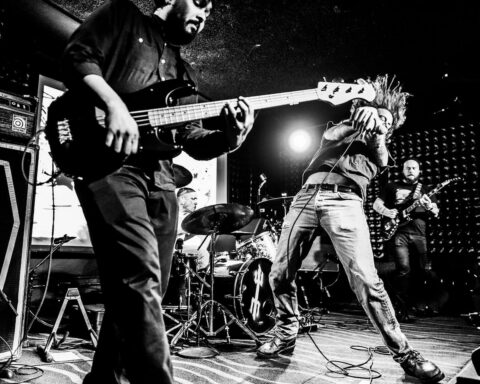

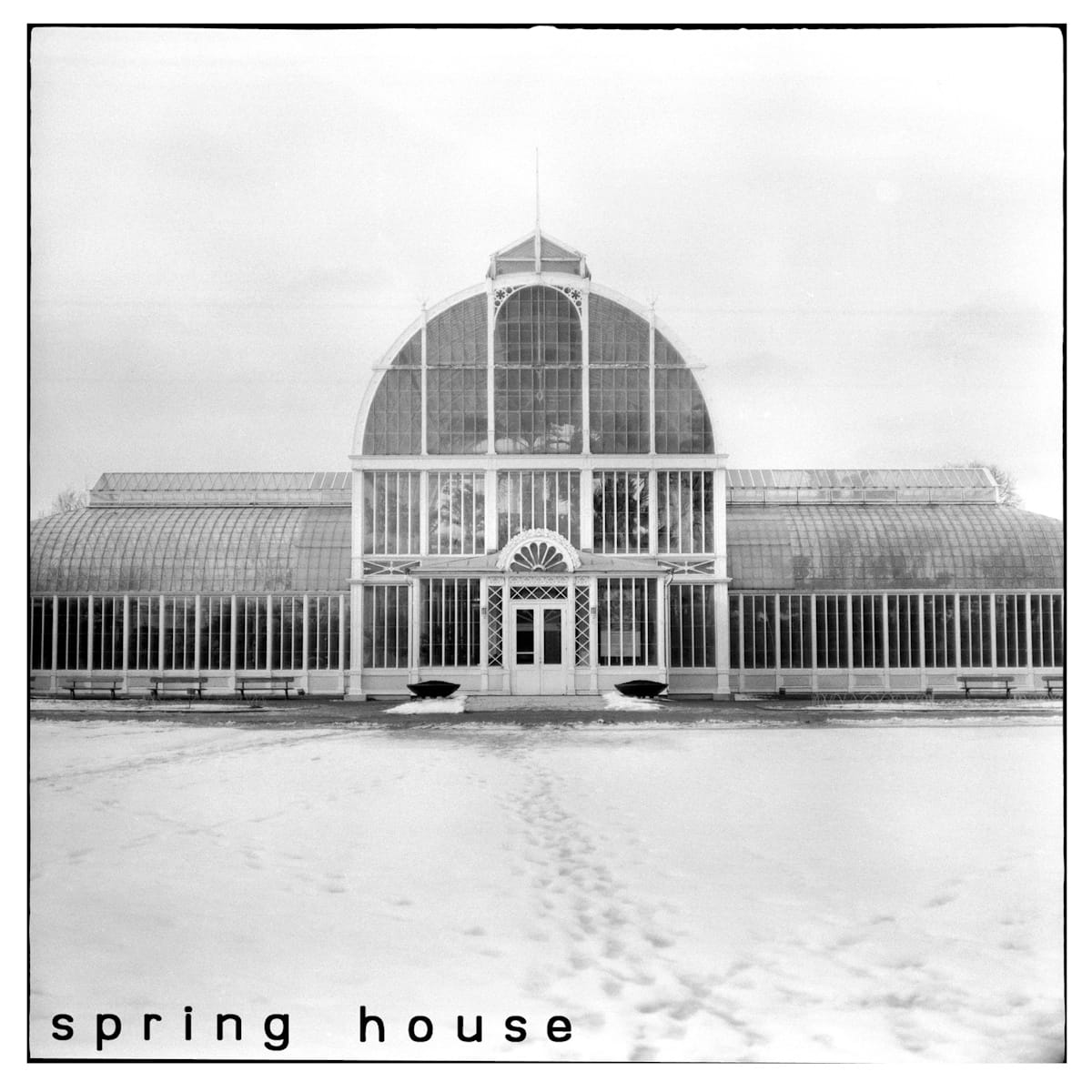
There’s a photo of a glass house full of palm trees, taken in deep winter in Gothenburg. It sits on the cover of spring house’s self-titled LP, a quiet contradiction before you even press play. The band name suggests something seasonal, maybe even soft. The image says otherwise—warmth held inside something fragile, surrounded by cold.
spring house is a new Detroit band made up of people who have already done this before—members of Blue Skies Burning, Coalition, First Comes Second, and Thera—but nothing here leans on legacy. The record, eight tracks recorded at I/O Detroit with Patrick Sheufelt and mastered by Jason Livermore at the Blasting Room, feels more like a reset than a continuation.
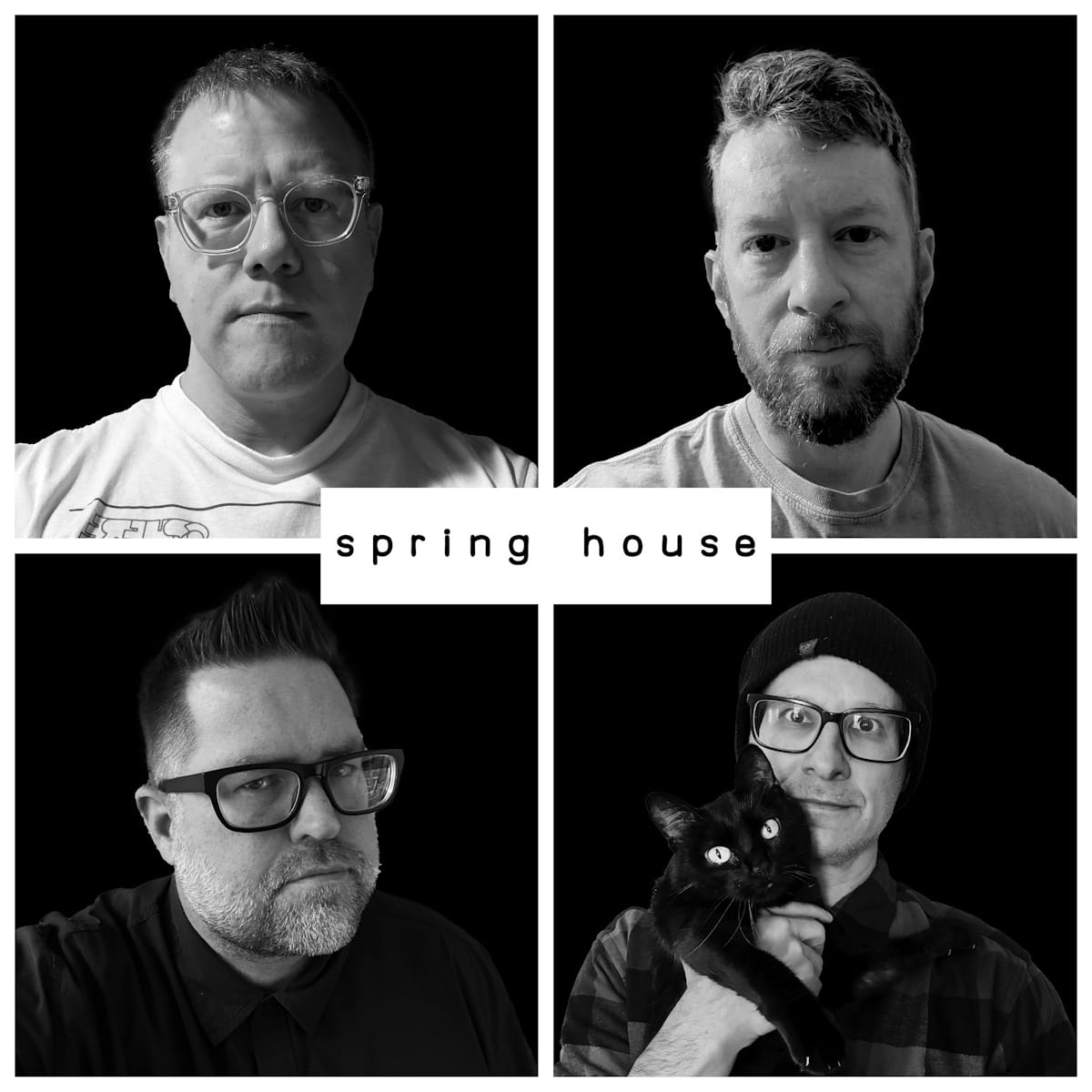
“As the lyricist of the band, I definitely gravitate to and draw more inspiration from Dischord Records,” says Scott Sheridan. “The expansive and diverse sound found within the Dischord catalog immediately spoke to me when I discovered the label in the late 80’s. It opened my mind to a diversity of sound under the punk and hardcore umbrella that I didn’t know could exist.”
That discovery wasn’t about picking a lane. It was about realizing there didn’t have to be one. “From the raging sounds of Teen Idles, Youth Brigade, and Minor Threat to the more mature sounds of Dag Nasty, Rites of Spring, Embrace, Ignition, and Soulside, it taught me that punk and hardcore isn’t limited to just one sound or one approach. It’s whatever you want it to be.”
That idea—hardcore as something elastic—runs through the whole record. It’s there in the pacing, in how songs shift between push and restraint, and in how the band talks about writing.
“Starting a band in your 40s out of records you’ve listened to for decades is drawing from so many influences and experiences that it feels hard to express it all,” says drummer Joshua Beausoleil. “I can recall how it felt to be given a copy of Rev 50 or when my boss at Borders Books and Music told me I should check out Dag Nasty. This was music that resonated with the younger me because it felt vital and engaging in a way that MTV or radio at the time was not.”
That sense of possibility stuck. “When you realize that these bands weren’t significantly older than you, it makes a lot of things feel possible. These bands were exploring new sounds and evolving—hardcore was more than one specific set of rules and it was all hitting at the same time.”
Wyświetl ten post na Instagramie
The way spring house writes now reflects that. There’s no strict blueprint, no attempt to recreate a specific era. “I really don’t like overanalyzing and want the songs feel like we are on the same page,” Joshua says. “So the main conversation is more about the right now and what the goal is more than anything else.”
Still, the past shows up in the details. Scott points to the way their different backgrounds push the songs around. “Especially with our guitar player, Paul, who comes from a metal background, he definitely adds a unique perspective when he brings riff ideas to the practice room. From there, we all have a hand in shaping and organizing those riffs and ideas into songs.”
What they land on is a kind of balance that doesn’t feel forced—melody, weight, and movement without locking into one tradition. “Our strength lies in creating a dynamic post hardcore sound that has varying elements of metal, traditional hardcore, and emotional rock.”
The record moves fast—by design. “I wanted the record to feel immediate and ideally 20 minutes or less—no filler and constant energy,” Joshua says. That decision reshaped songs as they came together. “The Sound of Union was originally much slower but ended up better as a fast hardcore song. CIV’s Set Your Goals was an inspiration for the drum parts.”
“Thoracic” almost went the other way. “We wrote an intro that felt long,” he says. “Scott vocal parts completed the song and made it whole.” It’s one of the tracks where the band leans furthest into post-hardcore’s groove, pulling from Supertouch, Quicksand, and Soulside—bands they come back to often.
Scott hears it as a turning point. “The diversity of sound and the rhythmic dynamics of Thoracic complement the darker, introspective themes of mortality found within the lyrics. I have a feeling that the sonic direction of Thoracic will also be a harbinger of our future sounds.”
Those lyrics aren’t abstract. “Thoracic is about my brush with mortality after being diagnosed with multiple blood clots in my arm and lungs and the physical and mental after effects resulting from the subsequent surgery.”
Elsewhere, the scope widens without losing that personal edge. “Collective Ruin is about the dysfunctional family that my Mother grew up in and how that experience haunted her throughout her life. My grandmother attempted to kill my Mother twice when she was an infant which resulted in my Grandmother being committed to a mental hospital.”
“A Perpetual Beat” stays closer to the present—“the mental health battles of juggling stress and anxiety in our modern world and the continual search for peace and simplicity.” “Empires Expire” is more direct: “the evil and inhumane aspects of the Trump administration.”
And then there’s “Vista,” which sits somewhere between those poles. “Its original inspiration was an Abhinanda song and John and Paul really perfected it up with their parts,” Joshua says. “It’s my favorite song on the record.” Scott hears something else in it too. “My favorite passage of Vista is the intro guitar riff which incidentally has a strong reference to ‘The Wait’ by Killing Joke.”
The band’s references don’t stay in one place. Scott keeps three records close when writing: Ignition’s “Machination” LP—“the imperfections… the most endearing quality”—Swiz’s “With Dave” 7”, and Chain Of Strength’s “What Holds Us Apart” 7”, specifically the original mix. “The vocals are perfectly mixed as they lie just beneath a massive wall of guitars and pounding percussion.”
Joshua’s list moves differently: Supertouch’s “The Earth is Flat,” Government Issue’s “You / Joy Ride,” Speedway’s “Paradise,” and Fireside’s “Uomini D’onore.” Different eras, different approaches, same underlying pull—songs that don’t sit still.
Wyświetl ten post na Instagramie
Even the recording process was about keeping that sense of immediacy intact. Budget kept them local, but the choice worked in their favor. “I/O Detroit is very much local and Patrick understood what we were going for in the process,” Joshua says. “He helped translate the songs into a collection that honored our desire for it to sound human.”
“Patrick was a joy to work with… a very passionate, creative, and encouraging studio engineer.” – says Scott. Small adjustments during tracking pushed the songs further than expected—“subtle changes/additions which really brought out more power and immediacy in a few of our songs.”
Wyświetl ten post na Instagramie
Mastering with Jason Livermore tied it back to something older. “My very first show was the Descendents 30 years ago so it felt full circle,” Joshua says. “Since he also does their records as well as co-owning the studio with Bill Stevenson.”
Wyświetl ten post na Instagramie
Outside the band, Detroit is still moving. “There’s a lot to name,” Scott says, listing Clockface, Big Life, Love Fool, Bad Beat, Sin To Live, Pillar of Light, Buried Lights, Few & Far Between, Pluto’s Kiss, and Kings Command.
Most shows orbit around Edgemen Screen Printing—run by Jimmy from Bad Beat—or pop up at Refuge, a skate shop where longtime promoter Eric Z has started booking again. Beyond that, clubs and art spaces pick up the slack when they can.
spring house are just stepping into that circuit now, gearing up for their first shows.
🔔 IDIOTEQ is ad-free, independent, and runs on one person’s time. If you want it to stay that way: DONATE via PayPal 𝗈𝗋 SUPPORT via Patreon.
Stay connected via Newsletter · Instagram · Facebook · X (Twitter) · Threads · Bluesky · Messenger · WhatsApp.