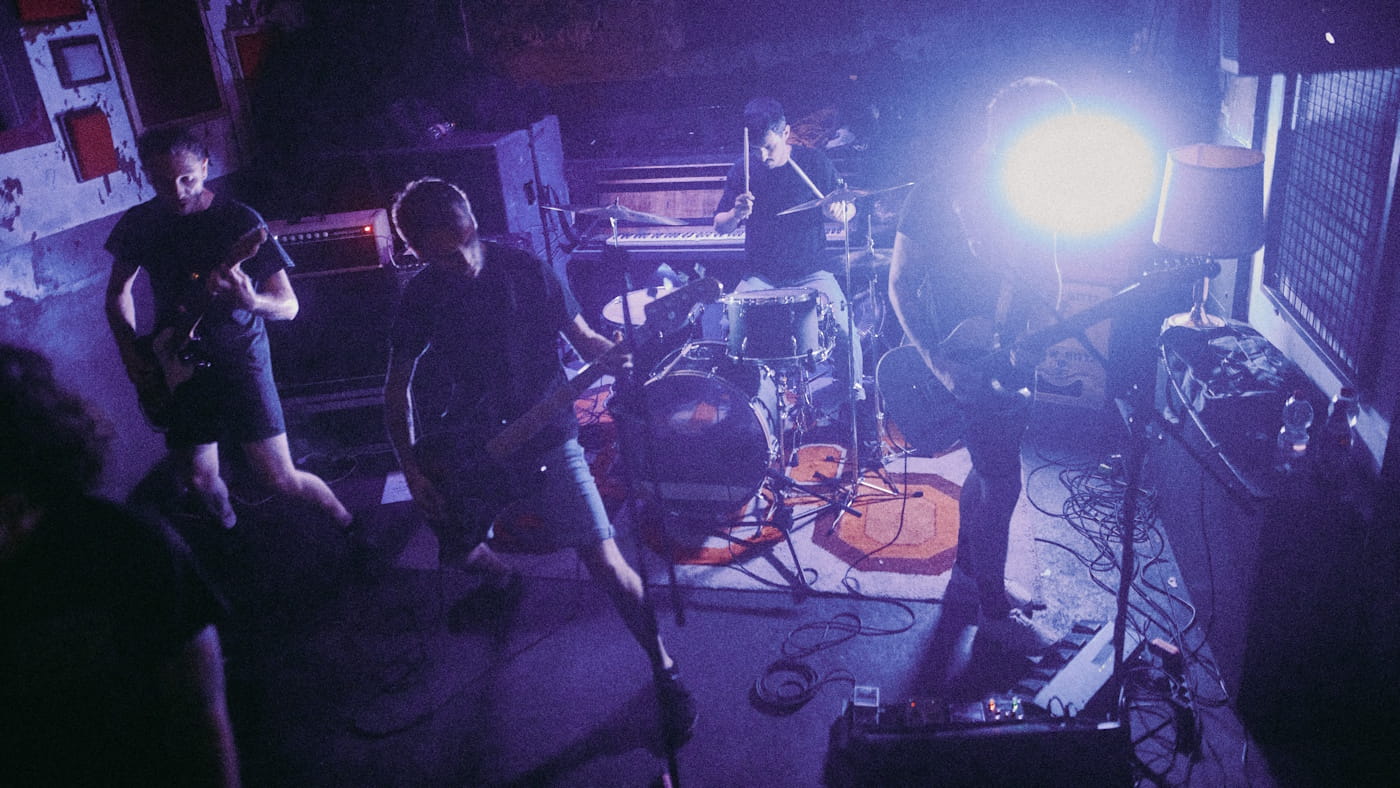

Mike Bromberg says he was lucky. Born in New York when the hardcore scene was happening, young enough to be right in the middle of it—shows, bands, records, fanzines, the whole structure of a community that actually functioned. He had a zine called Bullshit Monthly and a band called SFA. In mid-1989 he came out as gay in the pages of his own publication. By the end of 1988, SFA had deteriorated into back-and-forth arguments with his bandmate Brendan, so he left, hitchhiked around the country for a couple months, came back, and started writing new music. That became GO!
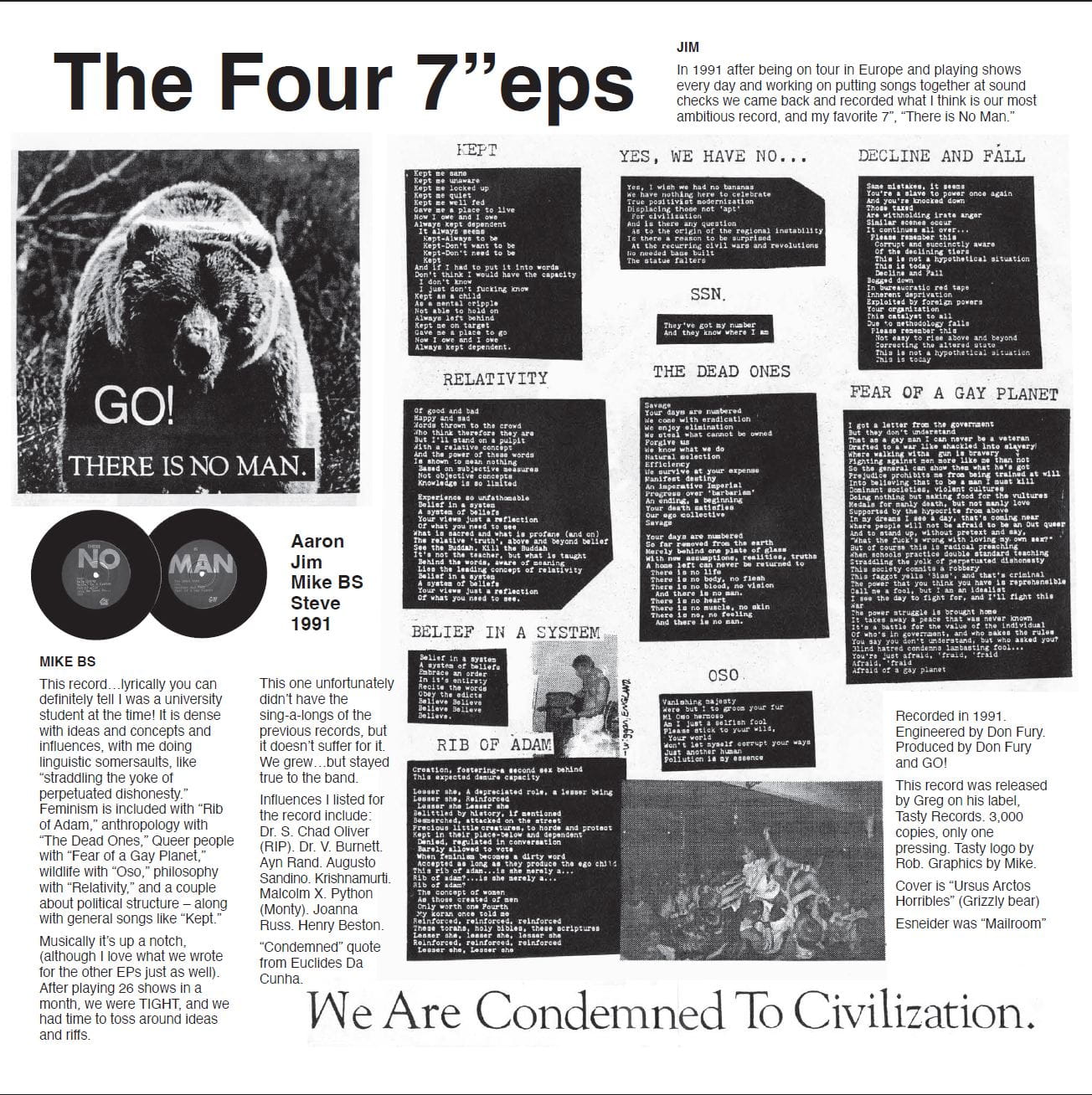
Between 1989 and 1991, GO! put out four 7″ EPs, toured the US and Europe, played a lot of shows, broke up multiple times, and cycled through four bassists and four drummers plus various fill-ins.
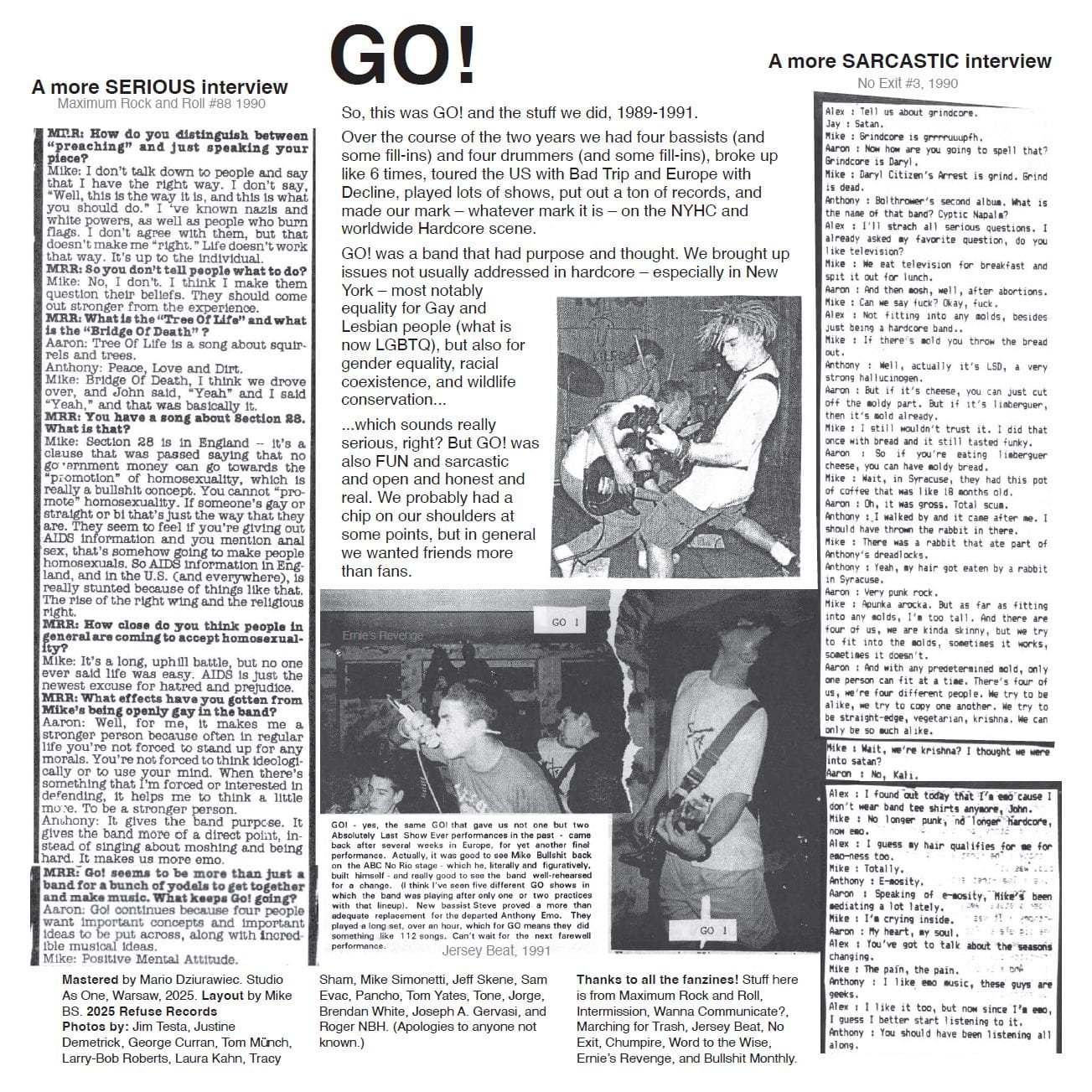
They were part of the ABC No Rio scene alongside SFA, Born Against, Rorschach, and Citizens Arrest. The band addressed topics that weren’t standard in New York hardcore—gay and lesbian rights, feminism, racial equality, wildlife conservation—but they weren’t solemn about it. “GO! was also FUN and sarcastic and open and honest and real,” the booklet states. “We probably had a chip on our shoulders at some points, but in general we wanted friends more than fans.”
In 1995, Epistrophy Records compiled the four 7″s and some demo tracks onto an LP/CD called “Existence.” The cover showed a polar bear and her two cubs walking across ice, light blue background, subtitled “Musings on the Need to Be.”
That compilation is how most people encountered GO! It’s been out of print for decades. The label found some extra covers a while back and considered repressing it, but then Robert from Refuse Records suggested redoing the whole thing—new package, gatefold cover, proper documentation for a generation that mostly hasn’t heard of the band. Mike wasn’t sure a gatefold was even possible. Turns out it was.
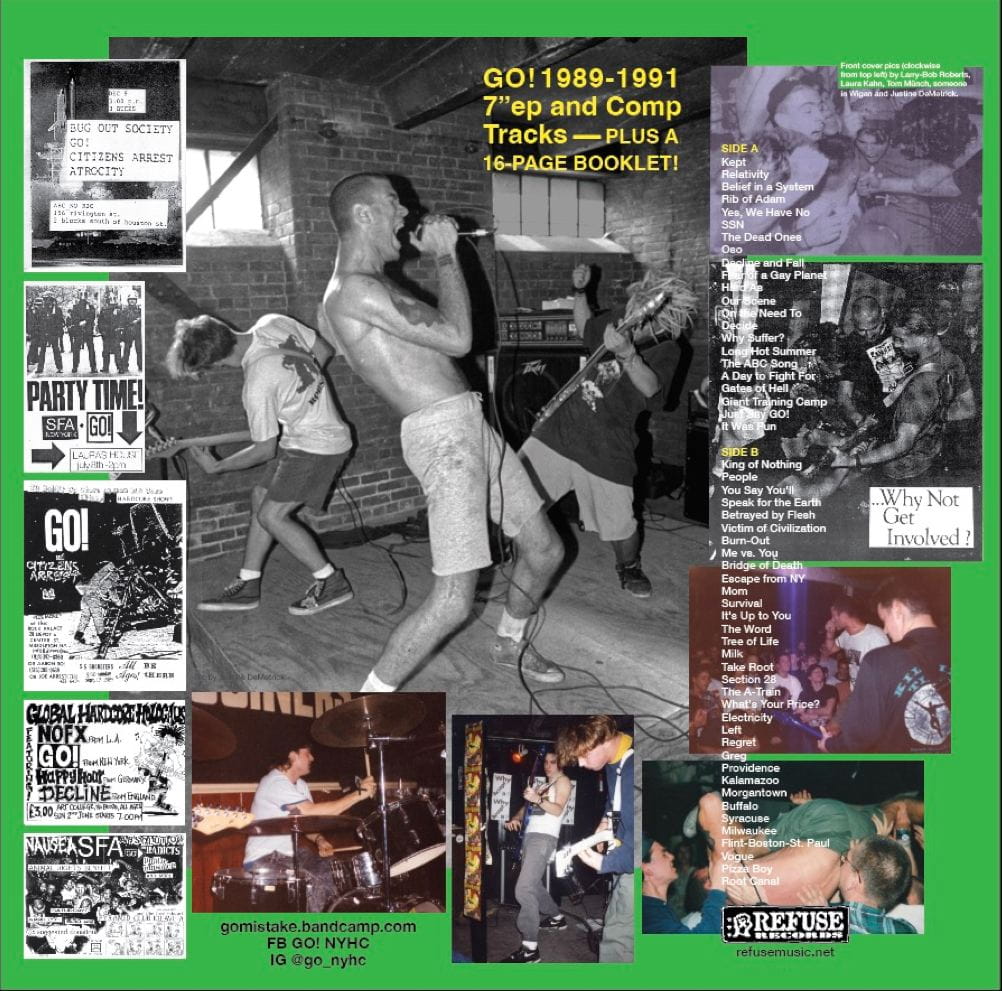
“Just Say GO!” collects 56 tracks from that same period: the four 7″s (“And the Time is Now,” “Your Power Means Nothing,” “Why Suffer?,” “There is No Man”), the split with Bad Trip, and songs from various compilations. No black vinyl—clear and blue pressings only, a nod to the Infest 7″ on clear and the “Slave” LP on blue.
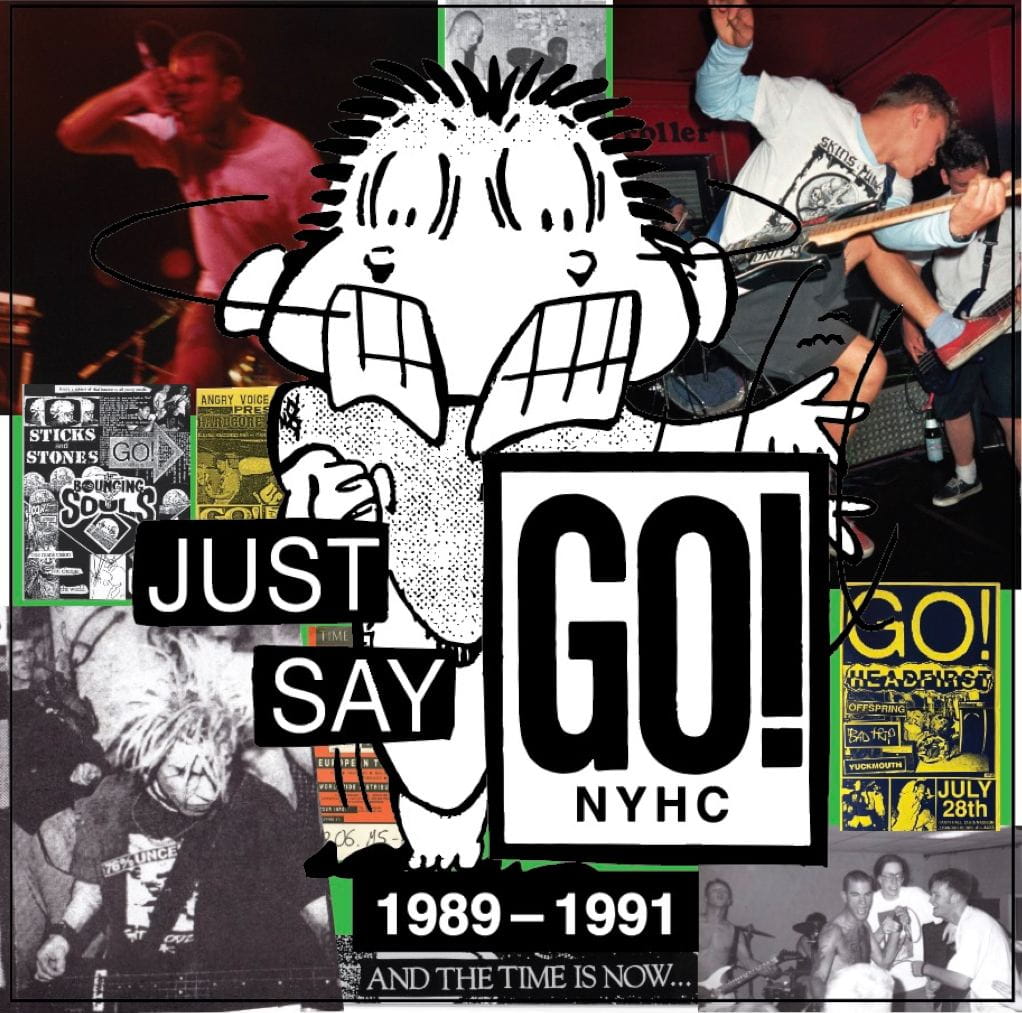
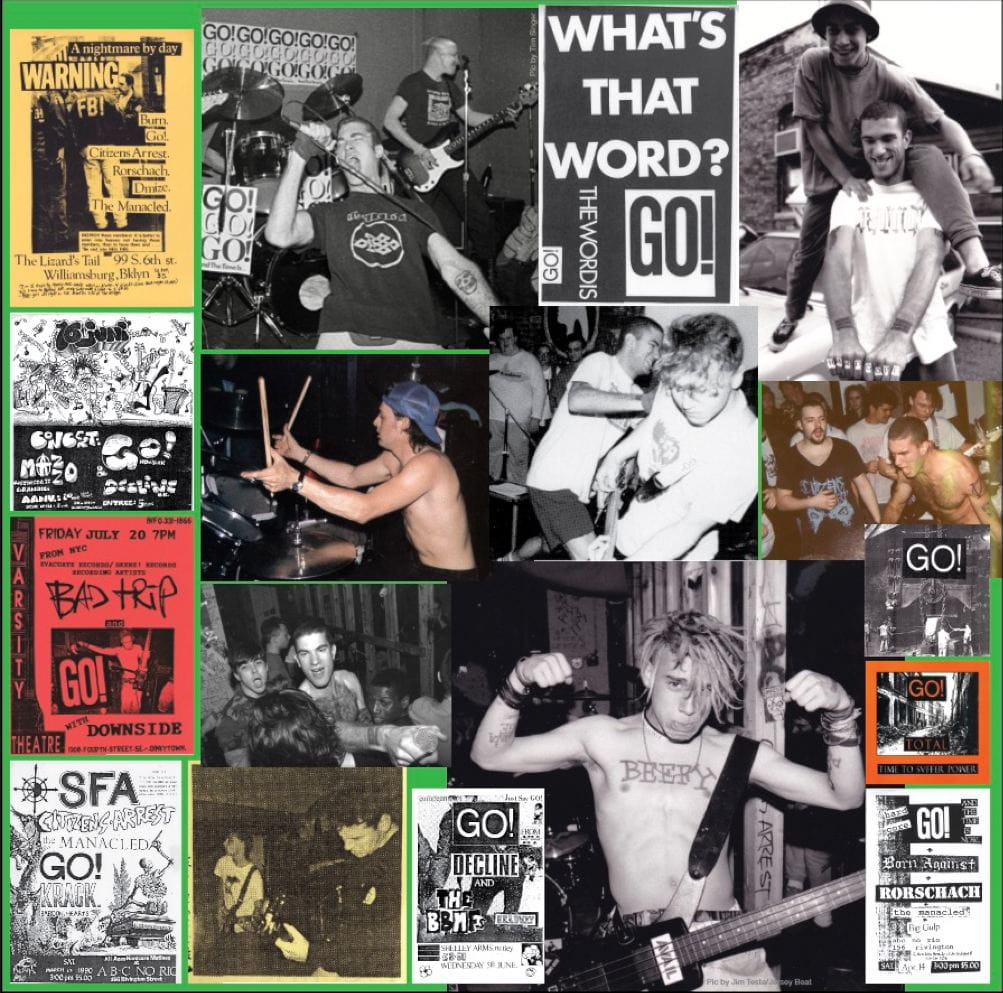
The gatefold and 16-page booklet lay out the full story with flyers, photos, set lists, fanzine interviews, and quotes from band members past and present. Mike’s been a graphic designer for 29 years and says he spent at least 50 hours putting it together. The covers are dense collages of show flyers and record sleeves and live shots, the band’s cartoonish logo—a face with huge teeth and the word GO! in block letters—appearing repeatedly across different contexts.
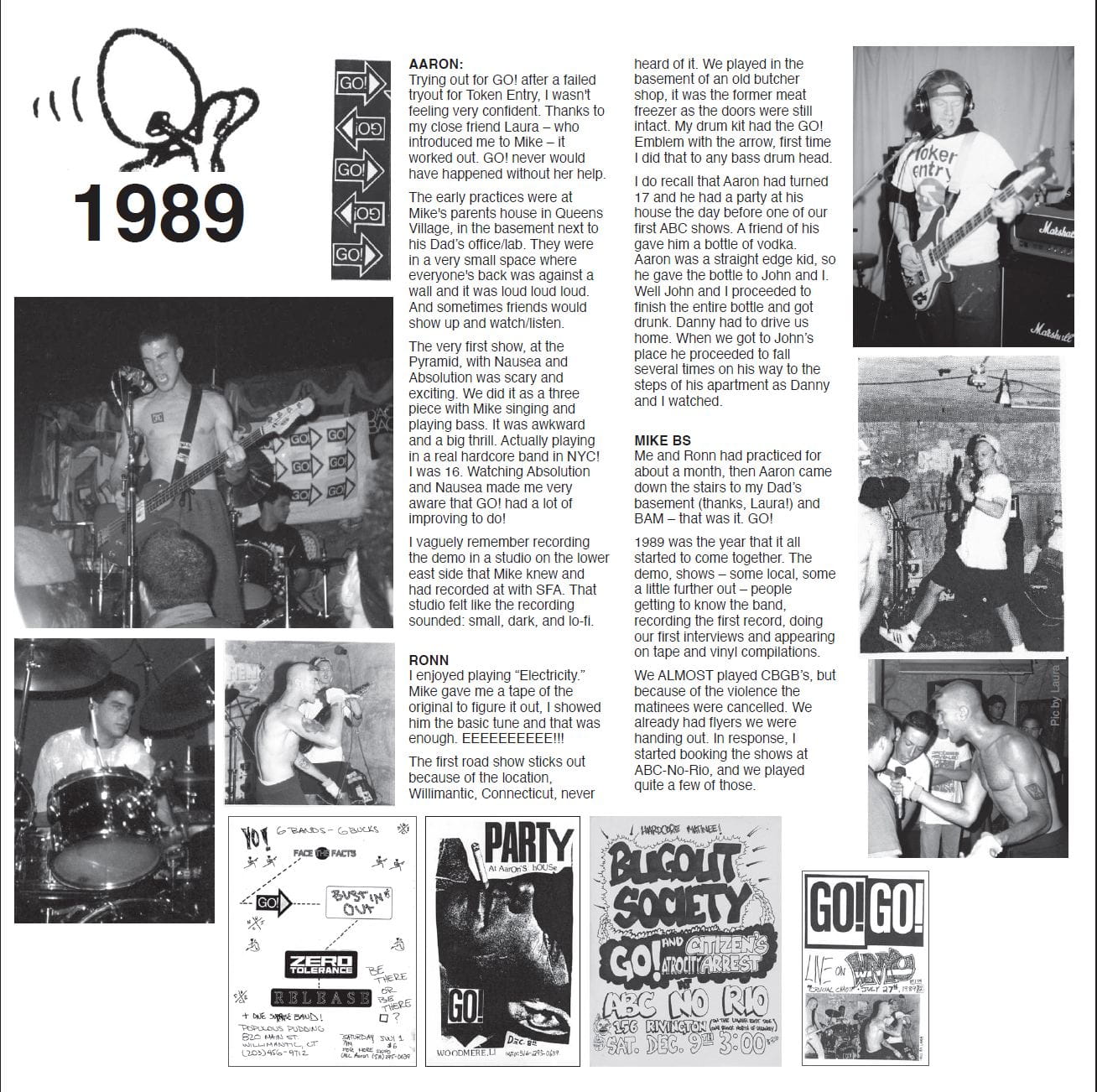
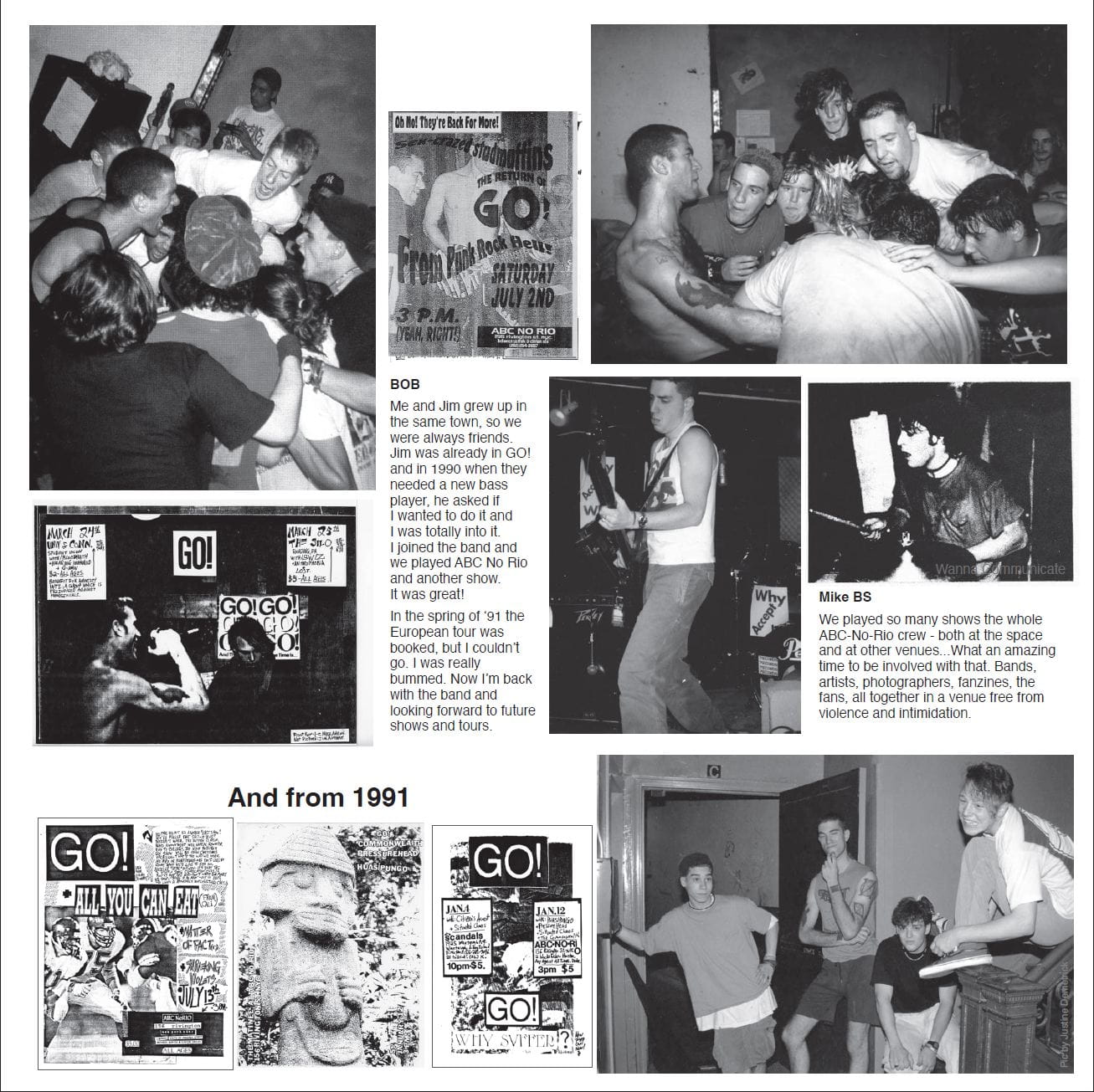
The band started in Mike’s parents’ basement in Queens Village, next to his dad’s office. Aaron, the guitarist, was 16 and nervous about the tryout. He’d just failed an audition for Token Entry. Laura Kahn, a mutual friend, brought him over. “He was so nervous it was kinda cute,” she writes.
“He wanted to make a solid impression. I had also brought him to audition for Timmy Chunks but ultimately, GO! was the perfect fit.” Aaron remembers the space being extremely small, everyone’s back against a wall, loud as hell, sometimes with friends watching. The first show was at the Pyramid with Nausea and Absolution—Mike singing and playing bass as a three-piece. “It was awkward and a big thrill. Actually playing in a real hardcore band in NYC! I was 16. Watching Absolution and Nausea made me very aware that GO! had a lot of improving to do!”
The demo was recorded in a small, dark studio on the Lower East Side that Mike knew from SFA. Aaron says it felt like the recording sounded: “small, dark, and lo-fi.” Ronn, the first drummer, remembers playing “Electricity“—Mike gave him a tape of the original, he showed Mike the basic tune, that was enough.
Their first out-of-town show was in Willimantic, Connecticut, in the basement of an old butcher shop with the freezer doors still intact. Ronn had put the GO! emblem with the arrow on his bass drum head for the first time. He recalls Aaron’s 17th birthday party the day before an ABC No Rio show: Aaron was straight edge, so he gave a bottle of vodka to Ronn and John, who finished it and got drunk. “When we got to John’s place he proceeded to fall several times on his way to the steps of his apartment as Danny and I watched.”
Mike started booking shows at ABC No Rio after CBGB matinees got cancelled because of violence. The band had already printed flyers. The early ABC shows were in the basement—concrete dust everywhere, a sketchy broken stairway, someone always falling down it, equipment that barely worked, often no PA or a tiny inadequate one. Aaron: “We were especially close to members of Citizens Arrest, Rorschach, SFA, Bugout Society, and then from touring together, Bad Trip. To the point that at times it seemed like one big band.”
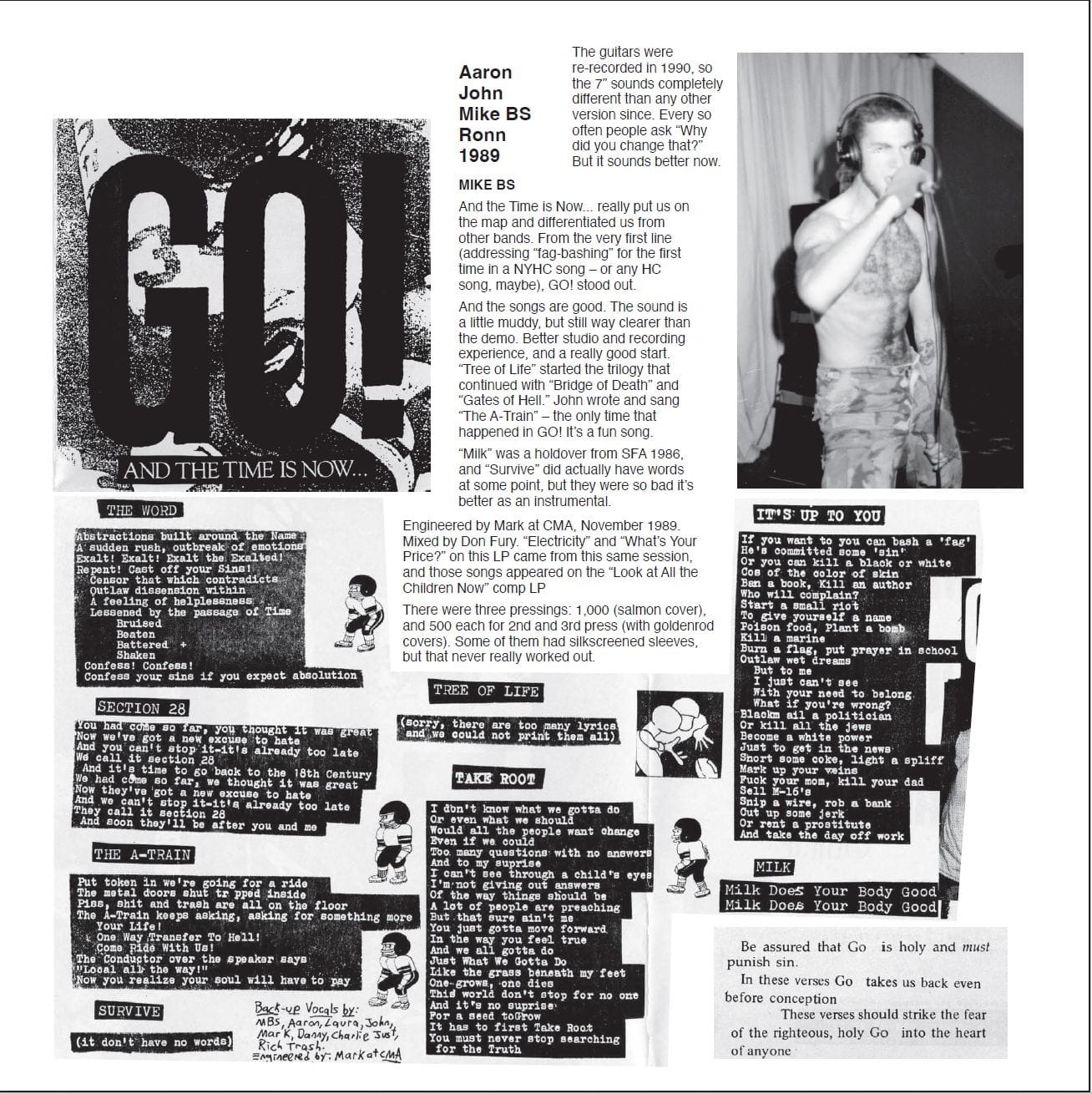
“And the Time is Now” was their first 7″, recorded in November 1989, engineered by Mark at CMA, mixed by Don Fury. Three pressings: 1,000 on salmon-colored covers, then 500 each for the second and third on goldenrod. Some had silkscreened sleeves, but Mike notes that never really worked out. The guitars were re-recorded in 1990, so the original 7″ sounds completely different from any other version. Mike: “Every so often people ask ‘Why did you change that?’ But it sounds better now.”
The record opens with a line addressing fag-bashing, possibly the first time that appeared in a New York hardcore song, maybe in any hardcore song. “GO! stood out,” Mike writes. The songs are good, the sound a little muddy but way clearer than the demo. “Tree of Life” started a trilogy continued on later records with “Bridge of Death” and “Gates of Hell.” John wrote and sang “The A-Train,” the only time that happened in GO!. “Milk” was a holdover from SFA in 1986. “Survive” originally had lyrics but they were so bad it became an instrumental.
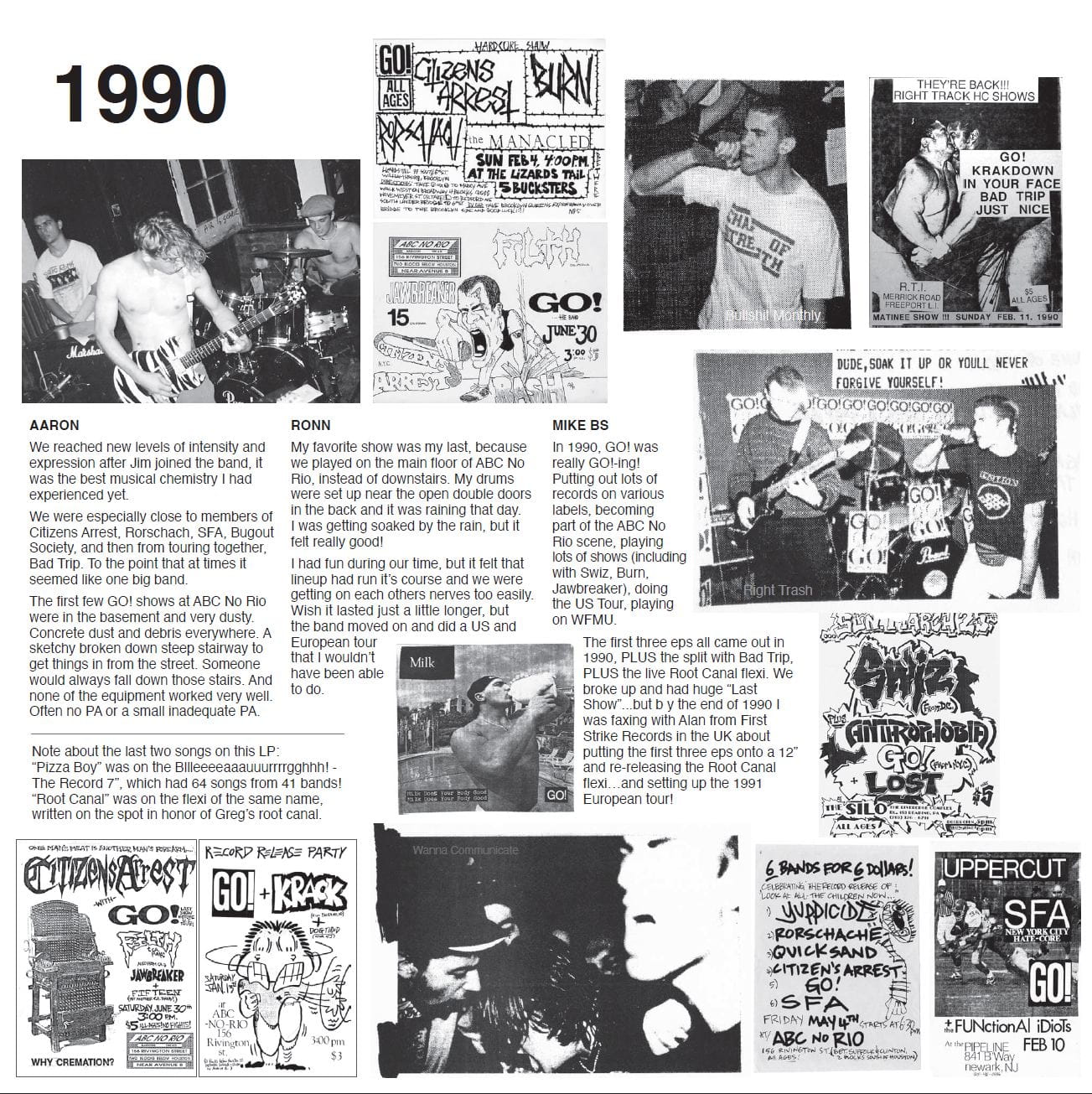
In 1990, after Jim joined on second guitar, Aaron says the band reached new levels of intensity and musical chemistry. They put out three more EPs that year plus the split with Bad Trip and a live flexi. They played shows with Swiz, Burn, Jawbreaker, broadcast on WFMU, broke up, had a huge last show, then by the end of the year Mike was faxing with Alan from First Strike Records in the UK about compiling the three EPs onto a 12″ and setting up a European tour for 1991.
The 1990 US tour started the day after Aaron graduated high school. They didn’t have a drummer lined up for the whole tour. Jim played one show, then had to go back to New York.
Jay covered shows before Minneapolis. After that, nothing lined up. They found Ethan in Minneapolis through Jeff Skene. Ethan was in a metal band called Gneissmaker when Jeff called and said GO!’s drummer had bailed in Pittsburgh, handed him a cassette with 25 songs, told him if he was up for it he could record with them and hit the road. Ethan: “I did my best to absorb the tracks in record time. I met the band for the first time right outside the studio. Somehow, we managed to record a few songs—and even wrote one on the spot.” That same day they recorded “Left,” which Aaron calls one of his favorite cuts of all time.
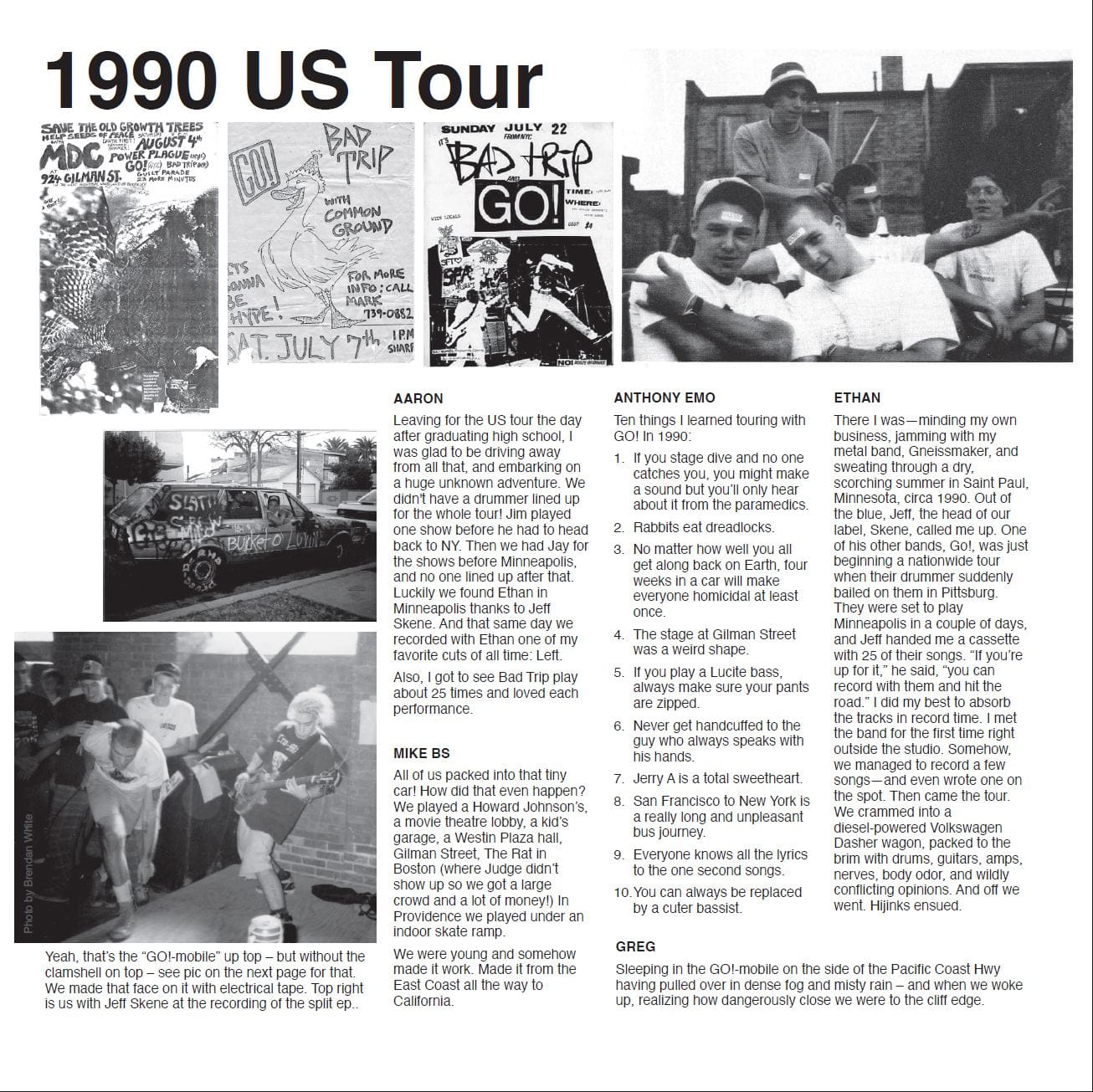
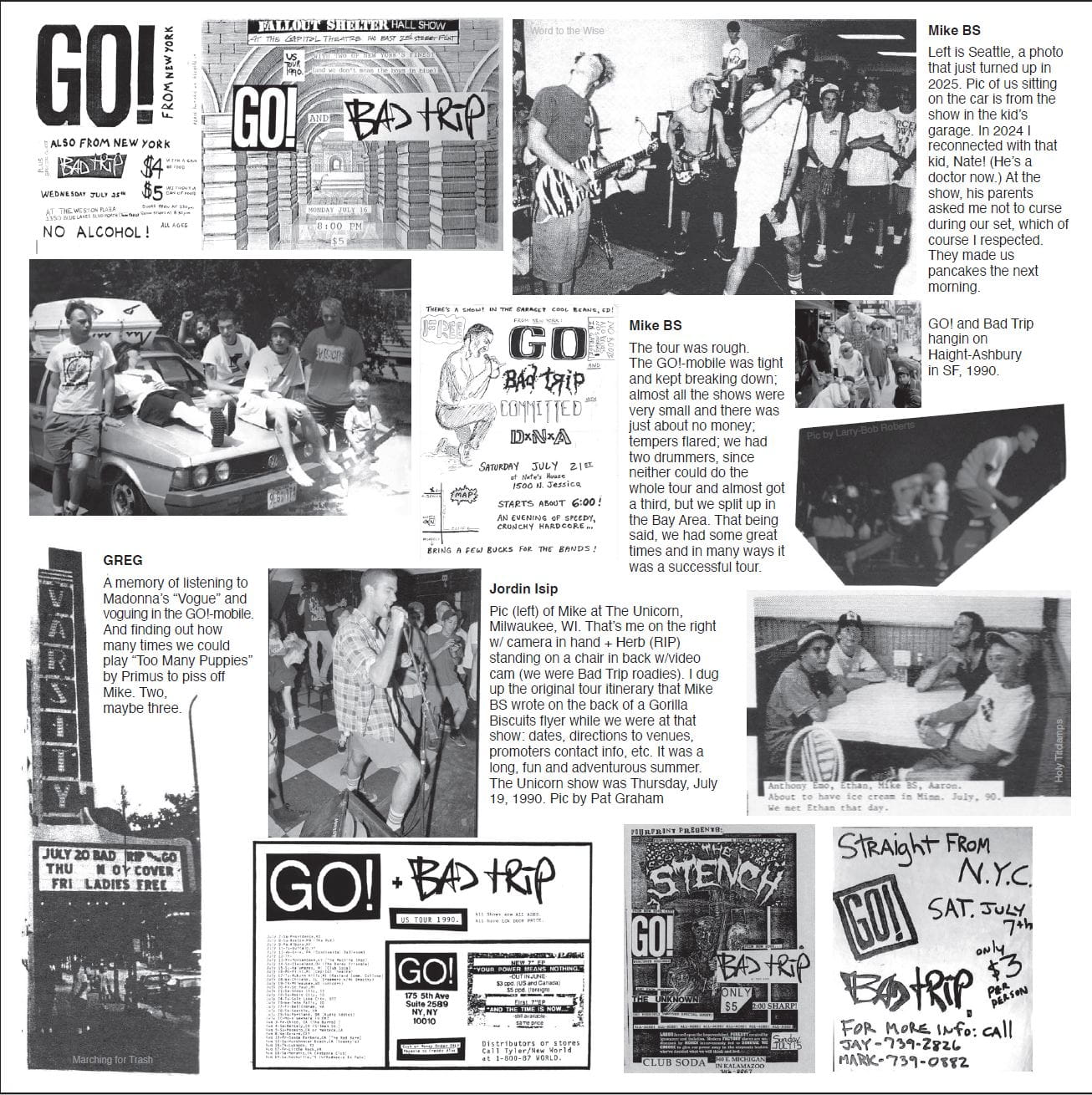
Anthony Emo, who played bass on part of the tour, lists ten things he learned: “1. If you stage dive and no one catches you, you might make a sound but you’ll only hear about it from the paramedics. 2. Rabbits eat dreadlocks. 3. No matter how well you all get along back on Earth, four weeks in a car will make everyone homicidal at least once.” They were all packed into a tiny Volkswagen Dasher wagon. Greg mentions sleeping in the GO!-mobile on the side of the Pacific Coast Highway in dense fog and rain, waking up dangerously close to the cliff edge. Someone had made a face on the car with electrical tape. They listened to Madonna’s “Vogue” and vogued in the van. They tested how many times they could play “Too Many Puppies” by Primus before pissing off Mike. “Two, maybe three.”
They played a Howard Johnson’s, a movie theater lobby, a kid’s garage, a hall at a Westin Plaza, Gilman Street, The Rat in Boston where Judge didn’t show up so GO! got a large crowd and actual money. In Providence they played under an indoor skate ramp. In South Dakota, the kid whose garage they played—Nate, who’s a doctor now—had parents who asked Mike not to curse during the set, which he respected. They made pancakes the next morning. The tour was rough. The car kept breaking down, shows were tiny, there was almost no money, tempers flared, they had two drummers since neither could do the whole tour, almost got a third, then broke up in the Bay Area. Mike: “That being said, we had some great times and in many ways it was a successful tour.”
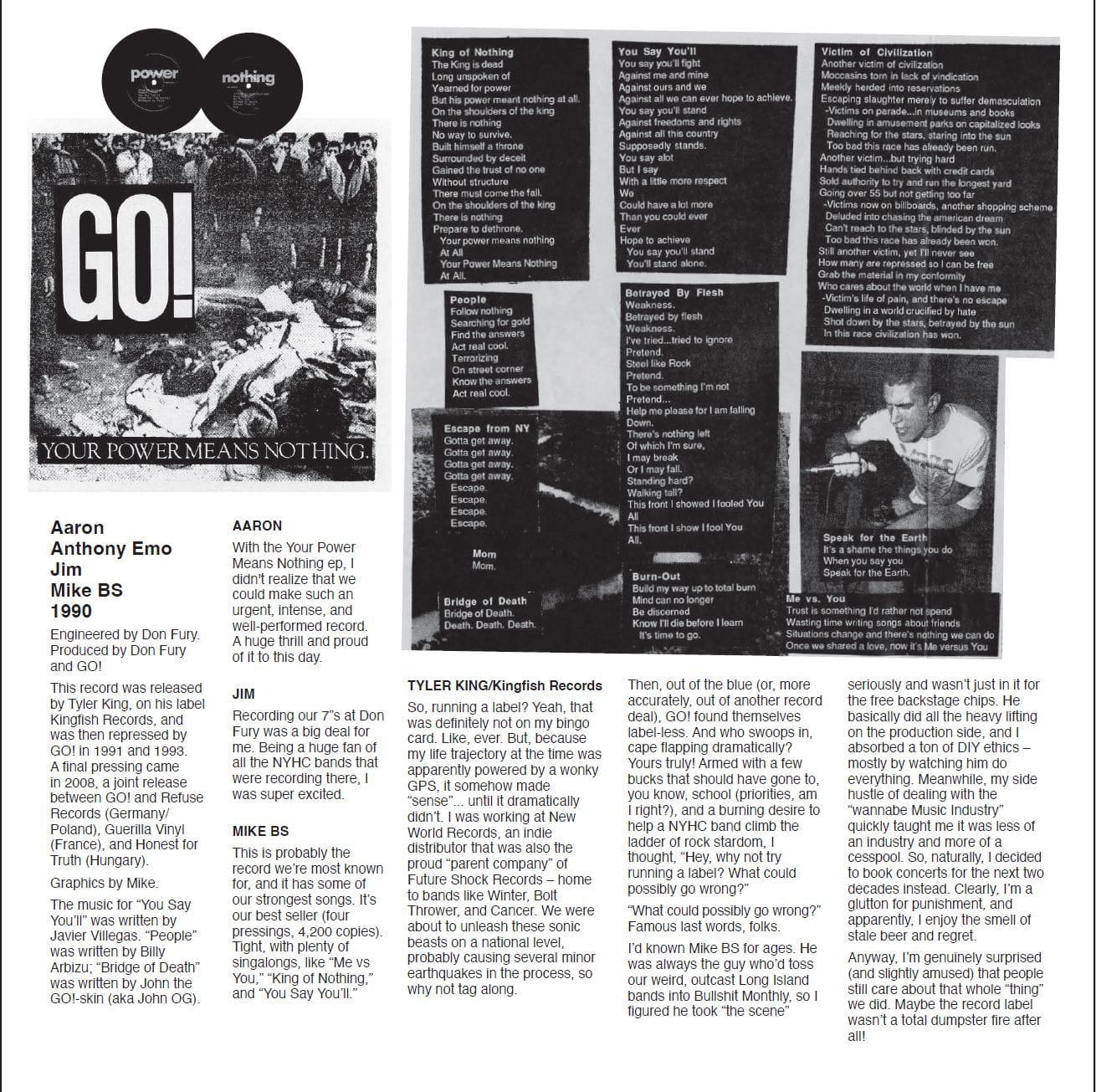
“Your Power Means Nothing” came out on Kingfish Records, run by Tyler King, who worked at New World Records, an indie distributor that was also the parent company of Future Shock Records.
When GO! found themselves without a label, Tyler stepped in with money that should have gone to school. “Armed with a few bucks that should have gone to, you know, school (priorities, am I right?), and a burning desire to help a NYHC band climb the ladder of rock stardom, I thought, ‘Hey, why not try running a label? What could possibly go wrong?'” Mike handled production, Tyler dealt with the music industry side, which he quickly learned was less an industry and more a cesspool, so he booked concerts for the next two decades instead. This is probably the record GO! is most known for. Four pressings, 4,200 copies. Tight, with singalongs like “Me vs You,” “King of Nothing,” “You Say You’ll.” Aaron: “I didn’t realize that we could make such an urgent, intense, and well-performed record. A huge thrill and proud of it to this day.”
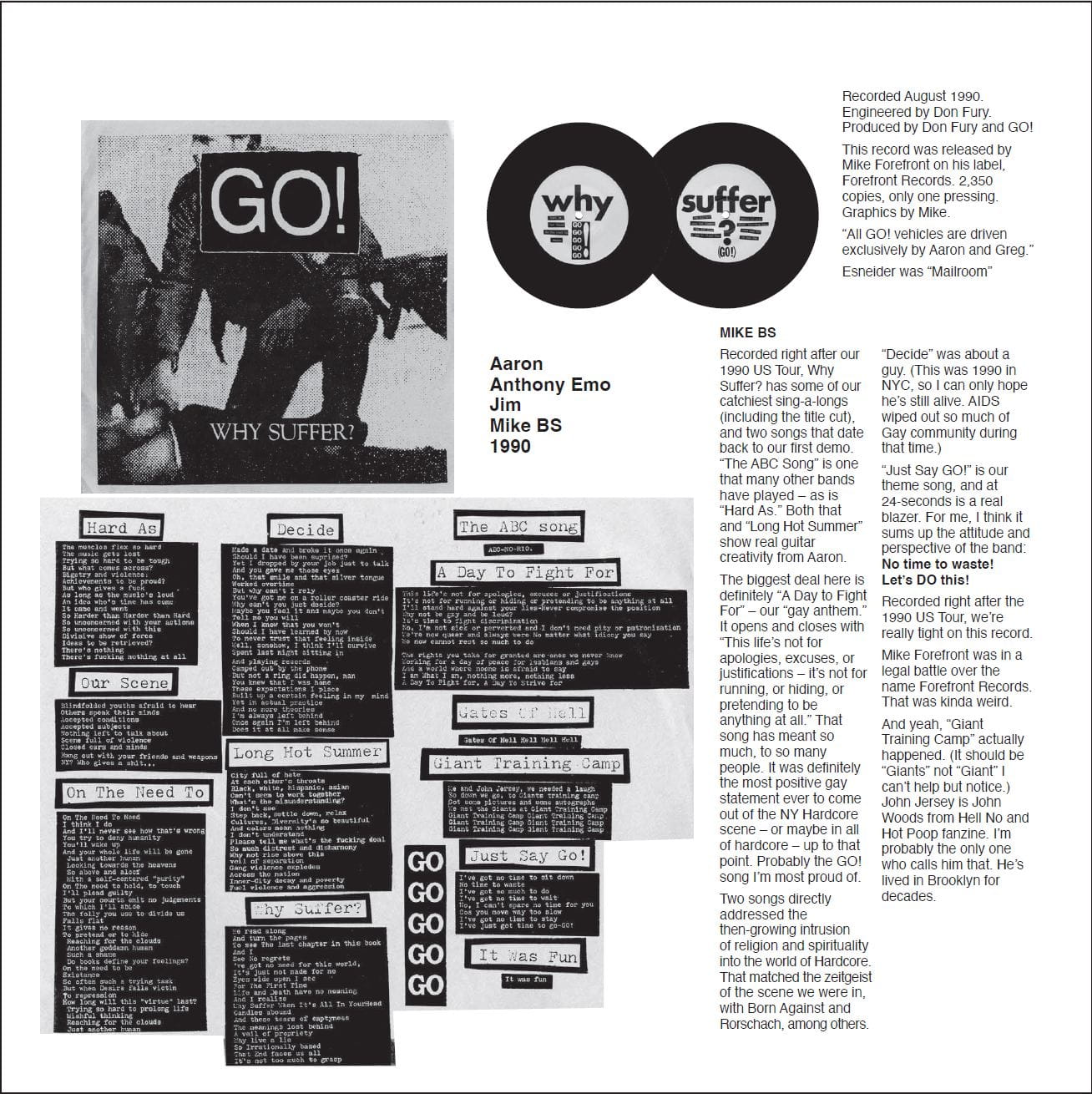
“Why Suffer?” was recorded right after the US tour in August 1990, engineered by Don Fury. Released by Mike Forefront on Forefront Records, who was in a legal battle over the name at the time. 2,350 copies, one pressing. This one has some of their catchiest singalongs, including the title track, and two songs from the first demo.
“The ABC Song” and “Hard As” were both covered by other bands. “Long Hot Summer” shows guitar creativity from Aaron. The biggest deal is “A Day to Fight For,” what Mike calls their “gay anthem.”
It opens and closes with: “This life’s not for apologies, excuses, or justifications – it’s not for running, or hiding, or pretending to be anything at all.” Mike: “That song has meant so much, to so many people. It was definitely the most positive gay statement ever to come out of the NY Hardcore scene – or maybe in all of hardcore – up to that point. Probably the GO! song I’m most proud of.” Two songs directly addressed religion and spirituality creeping into hardcore, matching the zeitgeist of the scene with Born Against and Rorschach. “Decide” was about a guy. Mike: “This was 1990 in NYC, so I can only hope he’s still alive. AIDS wiped out so much of Gay community during that time.”
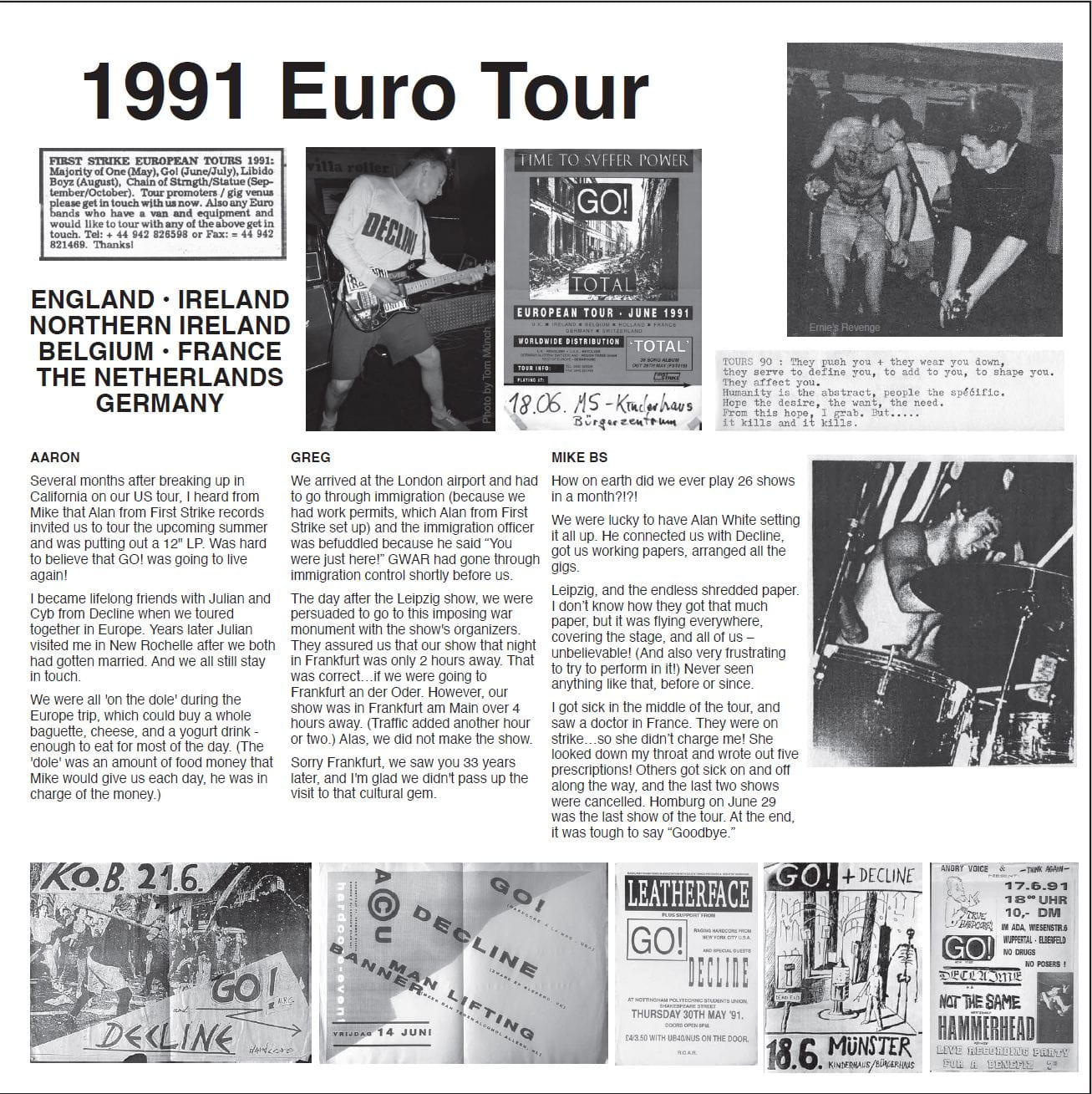
Several months after breaking up in California, Mike heard from Alan at First Strike that they were invited to tour Europe and he was putting out a 12″ LP.
Aaron: “Was hard to believe that GO! was going to live again!” In 1991 they played 26 shows in a month—England, Ireland, Northern Ireland, Belgium, France, The Netherlands, Germany. Alan White set it all up, connected them with Decline, got working papers, arranged the gigs. The shows were larger than in the US, people knew GO! and were really into them. They got real food, drink, a place to stay, actual money. Mike: “That was new! It felt like being a rock star!!!” The Paris show was in a tiny club, maybe 50-60 people, jam-packed, their only show in France. A couple people had driven eight hours to see them.
Greg remembers going through immigration at the London airport—the officer was confused because “You were just here!” GWAR had gone through shortly before. The day after the Leipzig show, they were taken to a war monument, assured the Frankfurt show was only two hours away. It was Frankfurt an der Oder they were talking about. The show was in Frankfurt am Main, over four hours away. Traffic added another hour or two. They didn’t make the show. “Sorry Frankfurt, we saw you 33 years later, and I’m glad we didn’t pass up the visit to that cultural gem.”
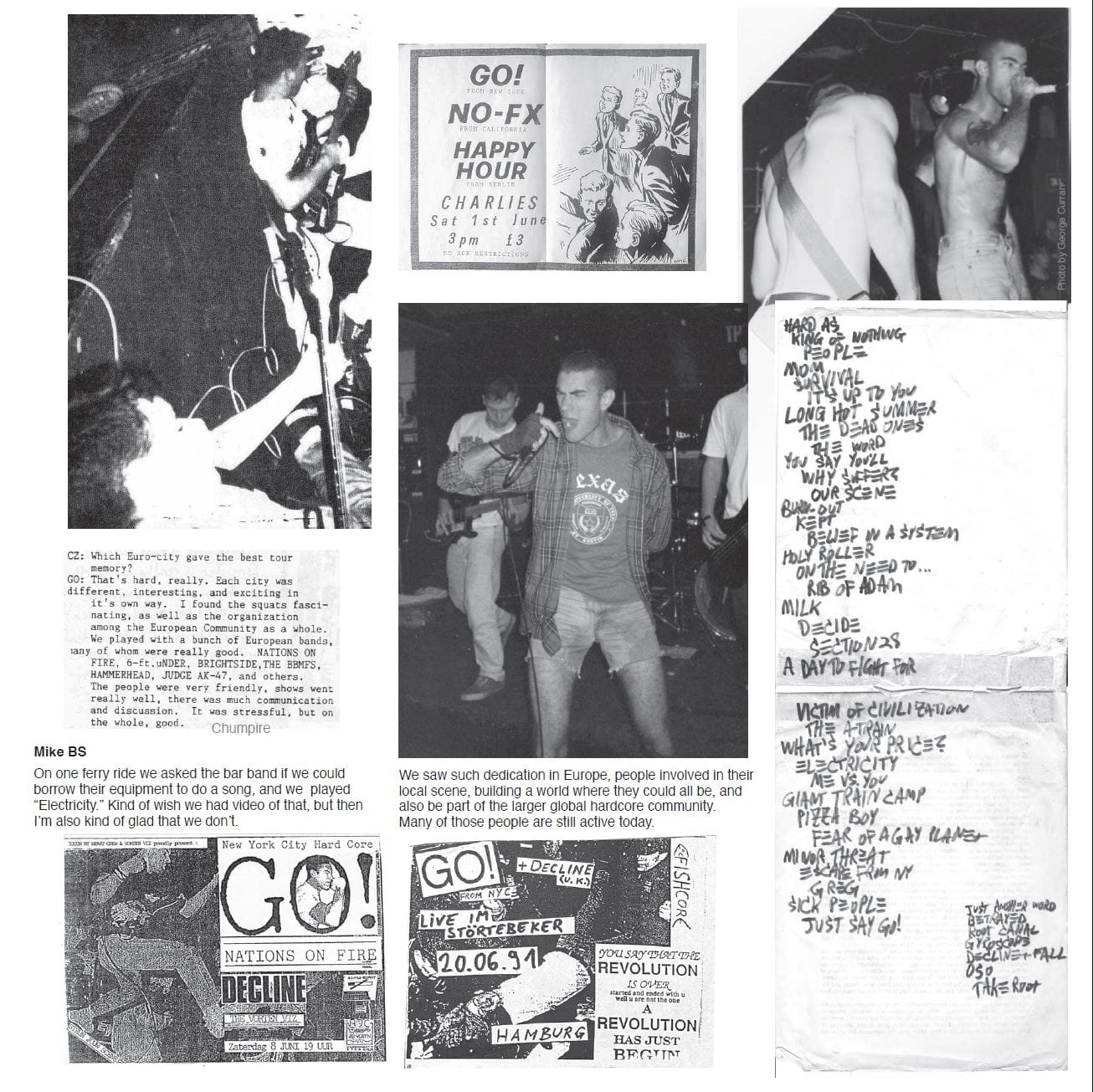
Leipzig was endless shredded paper flying everywhere, covering the stage and everyone. Mike: “I don’t know how they got that much paper, but it was flying everywhere, covering the stage, and all of us – unbelievable! (And also very frustrating to try to perform in it!) Never seen anything like that, before or since.” He got sick in the middle of the tour, saw a doctor in France who was on strike so didn’t charge him, looked down his throat and wrote five prescriptions. Others got sick along the way. The last two shows were cancelled. Homburg on June 29 was the final show of the tour.
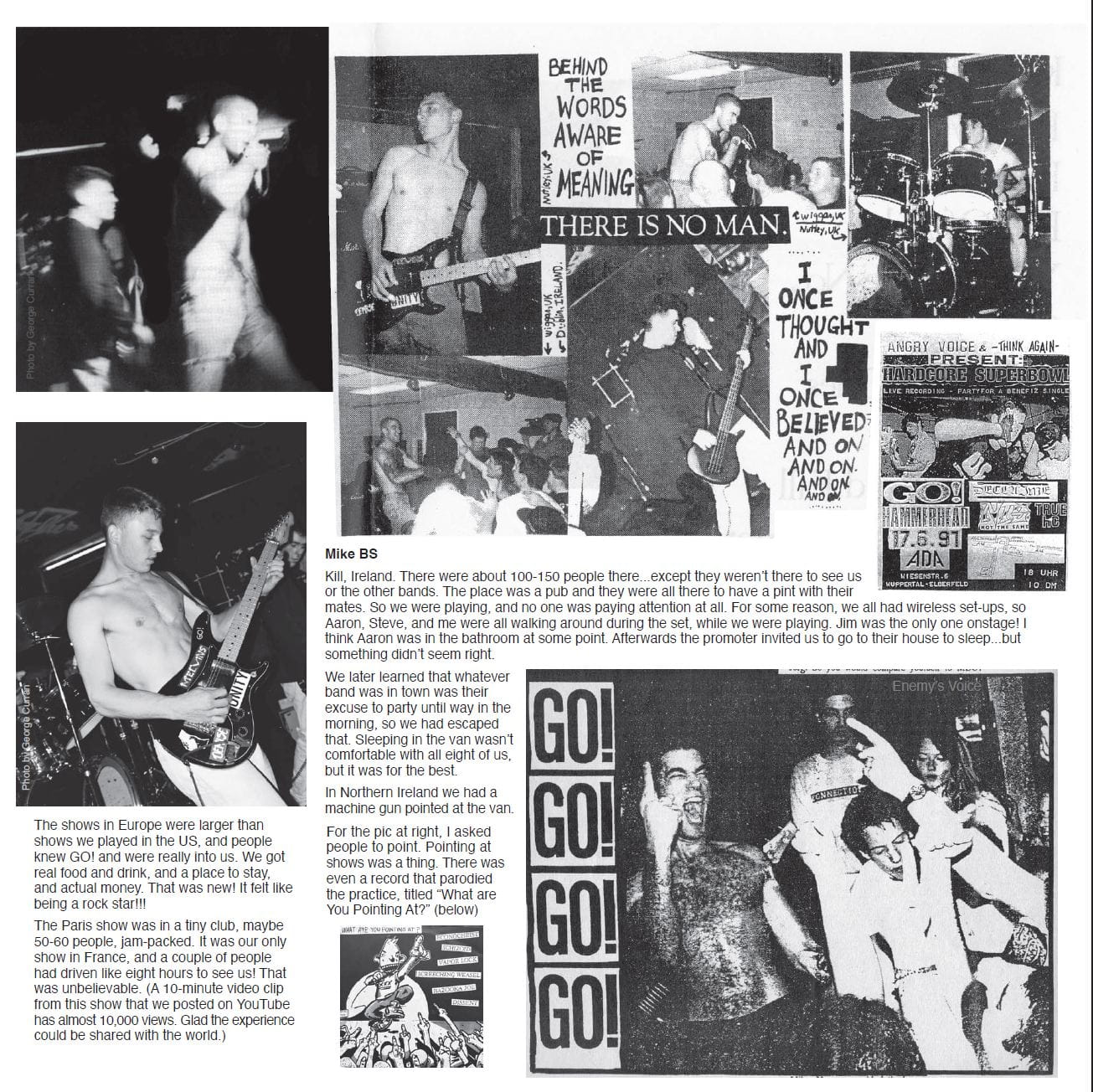
On one ferry ride they asked the bar band if they could borrow equipment to play a song, did “Electricity.” Mike: “Kind of wish we had video of that, but then I’m also kind of glad that we don’t.” At the Kill, Ireland show, there were 100-150 people who weren’t there to see them or the other bands—it was a pub, they were there for a pint with their mates. For some reason everyone had wireless setups, so Aaron, Steve, and Mike walked around during the set while Jim was the only one onstage. Aaron was in the bathroom at some point. The promoter invited them to sleep at their house but something didn’t seem right. They learned later that whatever band was in town was the excuse to party until morning. Sleeping in the van with all eight of them wasn’t comfortable but it was for the best. In Northern Ireland they had a machine gun pointed at the van.
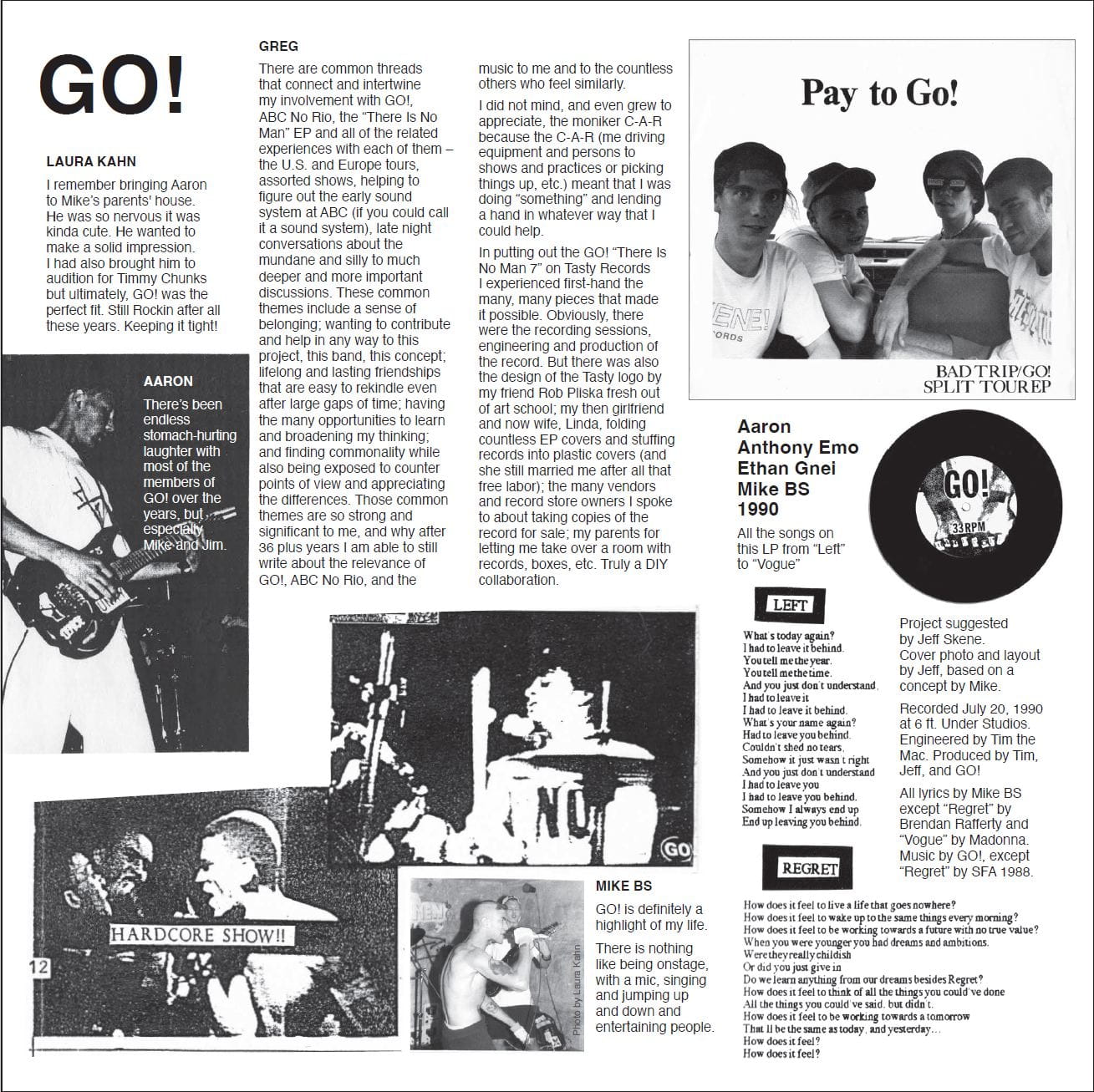
After the tour they recorded “There is No Man,” released by Greg on his label Tasty Records. 3,000 copies, one pressing. Greg: “In putting out the GO! ‘There Is No Man 7’ on Tasty Records I experienced first-hand the many, many pieces that made it possible. Obviously, there were the recording sessions, engineering and production of the record. But there was also the design of the Tasty logo by my friend Rob Pliska fresh out of art school; my then girlfriend and now wife, Linda, folding countless EP covers and stuffing records into plastic covers (and she still married me after all that free labor).” Jim: “After being on tour in Europe and playing shows every day and working on putting songs together at sound checks we came back and recorded what I think is our most ambitious record, and my favorite 7″.”
Mike: “This record…lyrically you can definitely tell I was a university student at the time! It is dense with ideas and concepts and influences, with me doing linguistic somersaults, like ‘straddling the yoke of perpetuated dishonesty.'” Feminism with “Rib of Adam,” anthropology with “The Dead Ones,” queer people with “Fear of a Gay Planet,” wildlife with “Oso,” philosophy with “Relativity,” political structure, general songs like “Kept.” Musically tighter after playing 26 shows in a month. “This one unfortunately didn’t have the sing-a-longs of the previous records, but it doesn’t suffer for it. We grew…but stayed true to the band.” Influences listed include Dr. S. Chad Oliver, Dr. V. Burnett, Ayn Rand, Augusto Sandino, Krishnamurti, Malcolm X, Monty Python, Joanna Russ, Henry Beston. “Condemned” quote from Euclides Da Cunha.
Greg talks about common threads connecting his involvement with GO!, ABC No Rio, the “There Is No Man” EP, the US and Europe tours, helping figure out the early sound system at ABC (if you could call it a sound system), late night conversations.
“These common themes include a sense of belonging; wanting to contribute and help in any way to this project, this band, this concept; lifelong and lasting friendships that are easy to rekindle even after large gaps of time; having the many opportunities to learn and broadening my thinking; and finding commonality while also being exposed to counter points of view and appreciating the differences.” He grew to appreciate the nickname C-A-R because driving equipment and people to shows and practices meant he was doing something, lending a hand.
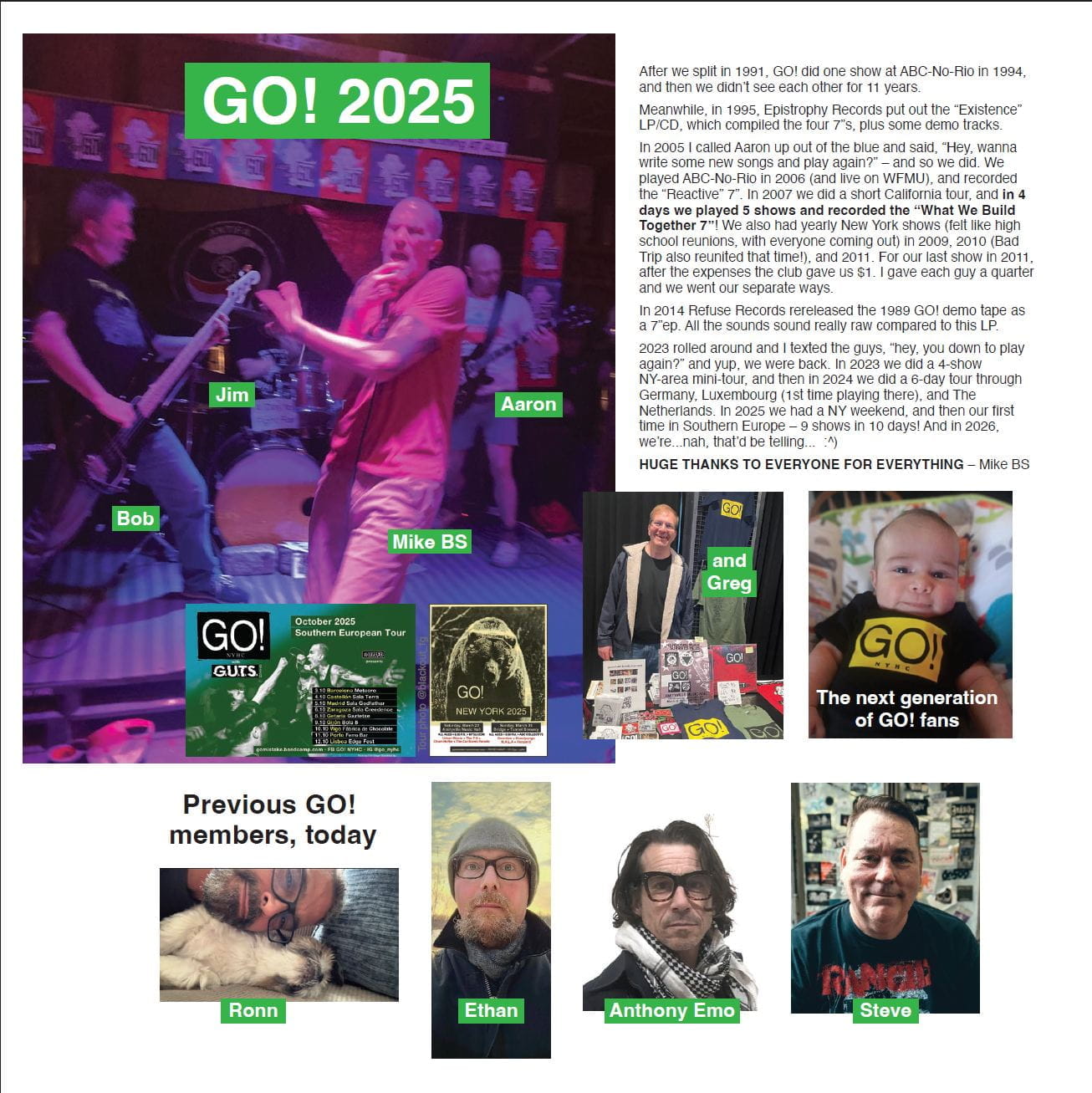
After they split in 1991, GO! did one show at ABC No Rio in 1994, then didn’t see each other for eleven years. In 1995, Epistrophy put out “Existence.”
In 2005, Mike called Aaron out of the blue: “Hey, wanna write some new songs and play again?” They played ABC No Rio in 2006, broadcast live on WFMU, recorded the “Reactive” 7″. In 2007 they did a short California tour—five shows in four days and recorded the “What We Build Together 7”. Yearly New York shows in 2009, 2010 (Bad Trip reunited too), and 2011. After the last show in 2011, the club gave them $1 after expenses. Mike gave each guy a quarter and they went their separate ways.
In 2014, Refuse Records rereleased the 1989 demo as a 7″ EP. In 2023, Mike texted the guys asking if they wanted to play again. They did a four-show New York area mini-tour, then in 2024 a six-day tour through Germany, Luxembourg (first time playing there), and The Netherlands. In 2025, a New York weekend, then Southern Europe—nine shows in ten days.
Mike: “Those four 7″s… They mean the world to me. I’m so proud of that, what we accomplished. I always felt that if I never recorded anything else – which I thankfully did, with other bands and also with GO! later on – if that was all I had ever done I’d be cool with that.” Aaron: “There’s been endless stomach-hurting laughter with most of the members of GO! over the years, but especially Mike and Jim.” Mike: “GO! is definitely a highlight of my life. There is nothing like being onstage, with a mic, singing and jumping up and down and entertaining people.”
The gatefold unfolds into a document of a specific time and place where a group of people in their teens and early twenties made something that mattered to them and, as it turned out, to other people too.
Fifty-six tracks, blue and clear vinyl, no black. The songs are fast, most under a minute, some under thirty seconds. The production got better as they went along but never lost the directness. The lyrics address things plainly. The delivery is tight, economical, built for small spaces and loud volume. It comes from 1989-91 but Refuse pressed it in 2025 because those years are thirty years gone and the original compilation has been unavailable. This version exists so people can hear it now.
Keep in the loop!
🗞️ Subscribe on Substack
🔔 Join our Messenger and WhatsApp
📜 Get daily news via Instagram Stories
Your support keeps us alive!
IDIOTEQ is a one-man DIY operation, tirelessly spotlighting the local cultural scenes and independent bands that often go unreported elsewhere. Born in the early 00s, this platform has been committed to giving hard-working artists the high-quality coverage they truly deserve.
No ads, no distractions—just pure inspiration and a genuine focus on independent artists and their stories.
Please consider helping keep IDIOTEQ ad-free and in tune with the indie scene by donating today.
DONATE via PayPal 𝗈𝗋 SUPPORT via Patreon
100% of the funds collected go toward maintaining and improving this magazine. Every contribution, however big or small, is super valuable.
Your support ensures that we continue to be a place where you can discover, learn, and get inspired, without any advertising noise. Thank you for being a part of this musical journey.