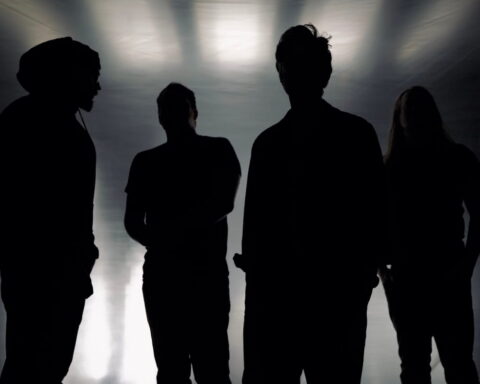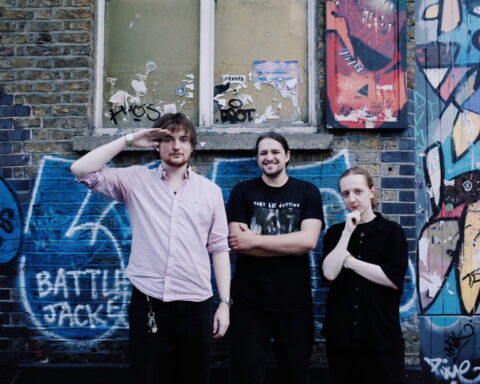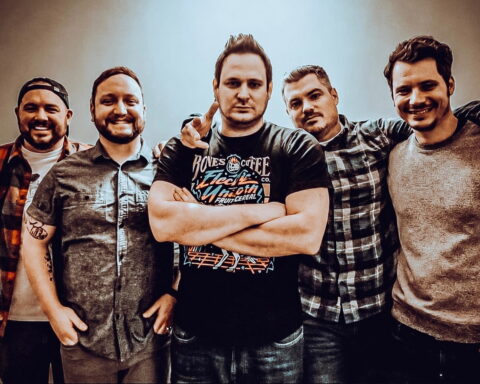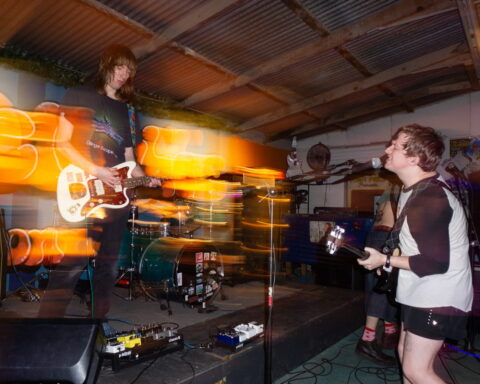


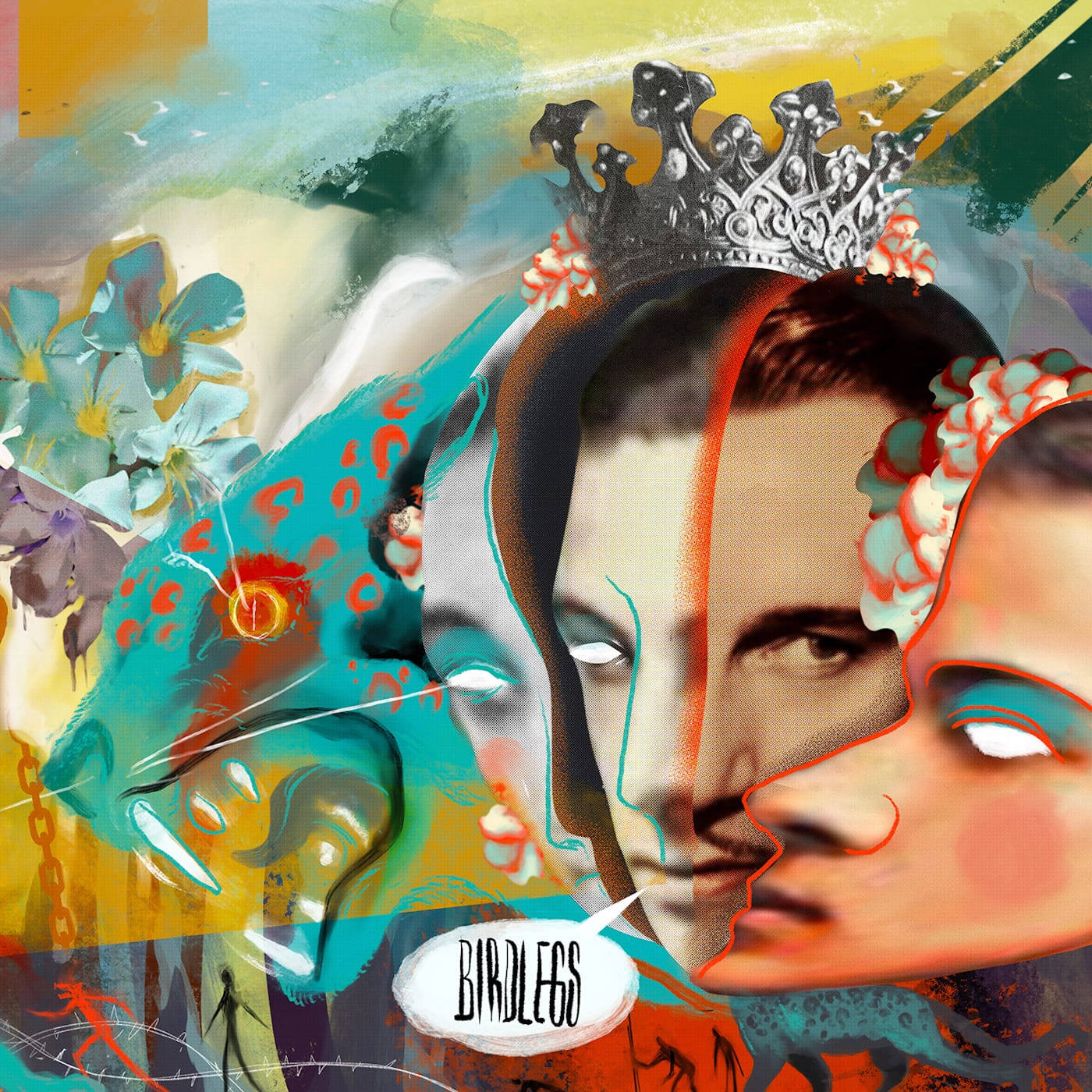
The phrase “Ape Cave” doesn’t sit as metaphor until Eric Ozenne pins it down to something specific: two father figures, addiction, absence, a pattern that repeats unless it’s broken. That sits at the center of Birdlegs’ debut LP “Visions Beyond The Ape Cave,” due April 10, 2026 on Revelation Records, and it explains why this band doesn’t feel like a reunion of familiar names. It feels like unfinished business carried forward.
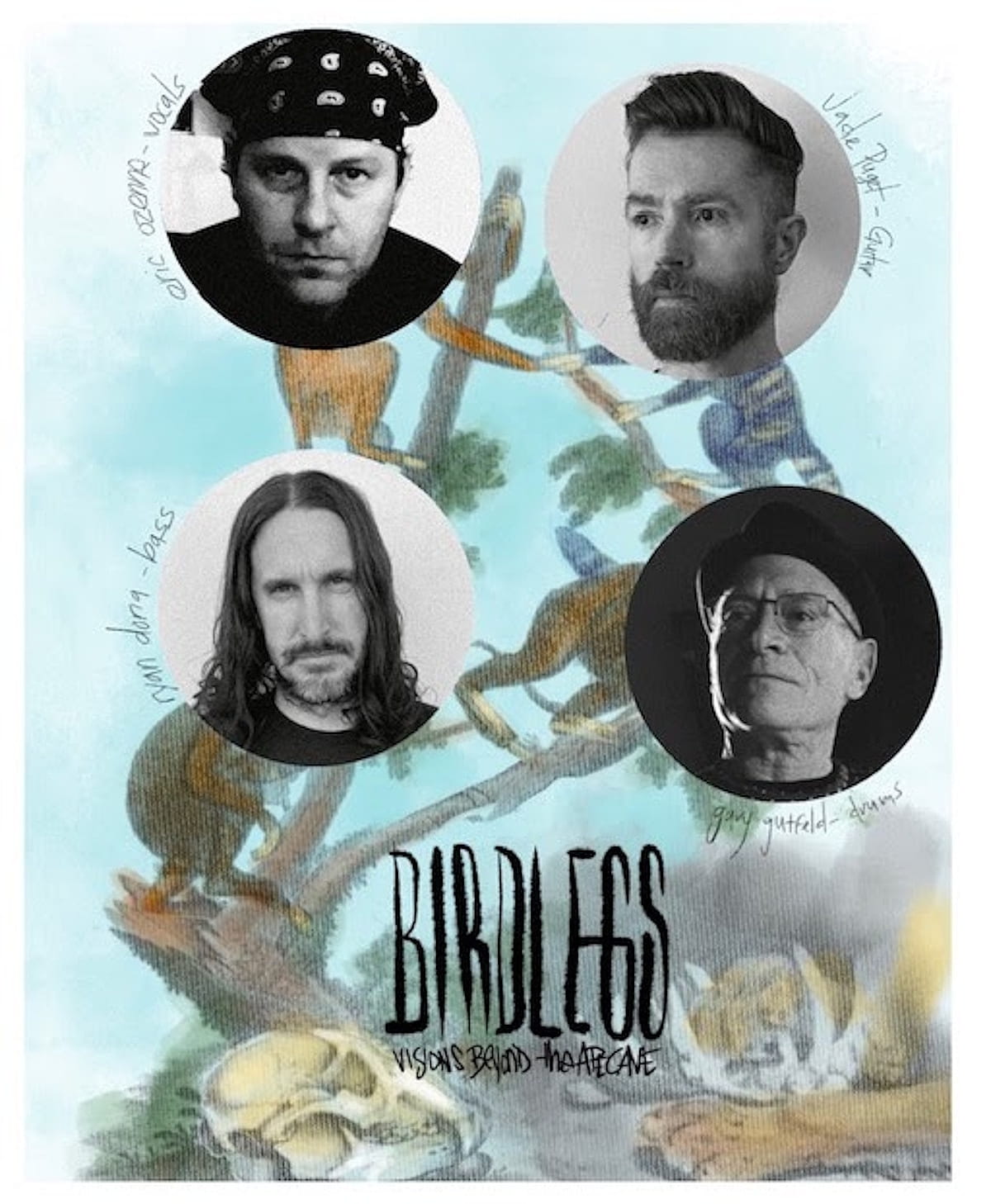
Birdlegs bring together Ozenne, Jade Puget, Gary Gutfeld, and Ryan Doria—four players tied to the East Bay’s late ’90s circuit, when bands overlapped across Redemption 87, the Nerve Agents, AFI, Corduroy, and Hi-Fives.
That period wasn’t cleanly defined. Gary describes it as “being on autopilot,” juggling multiple bands while living in Berkeley, even playing two headline shows in one night—Hi Fives at Gilman and Redemption 87 at Berkeley Square. The end didn’t arrive as a moment; it came when venues disappeared and touring bands stopped passing through.
Eric’s version of that timeline is less gradual. He left for the Marine Corps and came back in 1994 to a scene already shifting under the weight of Nirvana’s aftershock. Green Day and Rancid were on MTV. Labels were circling. He was sleeping on friends’ couches—Andrew Atai from Screw 32, Sarah Tassione from Thrasher Magazine, Scott Goodell from Dance Hall Crashers—and watching a new order take shape. DIY still held: living room shows, amps held upright mid-set, 7-inches sold from the trunk of a car. At the same time, corporate attention was creeping in. That tension—DIY urgency against outside pressure—defined the decade.
By the end of the ’90s, the tone had darkened. AFI, Tiger Army, and the Nerve Agents shared stages and an aesthetic that leaned into that shift. “It felt electric,” Eric says of those years, pointing to a tight network of bands and audiences, held together by figures like Steve List. Then it broke. The Nerve Agents dissolved around 2001, just as AFI and Tiger Army were expanding outward, and 9/11 cut across everything. For Eric, that was the line where one era stopped.
Wyświetl ten post na Instagramie
But Birdlegs doesn’t attempt to recreate that period. The starting point was deliberately loose. Jade and Eric agreed early on: keep it rooted in hardcore, but leave everything else open. Ryan and Jade wrote separately, then watched the songs align once Eric and Gary locked them together. Ryan describes it as a blank canvas—shared playlists stretching from hardcore staples to film scores, odd combinations tested over phone calls. Eric would throw out directions like merging Hildur Guðnadóttir’s “Joker” score with D.I.’s “Hang Ten In East Berlin,” and Ryan would come back with something that held.
Gary didn’t approach it as a concept exercise. “The songs led me otherwise,” he says. After years of playing without much attachment, this project reset his focus. It took time to rebuild stamina, but once the songs took shape, the feel followed naturally.
The result moves fast but doesn’t sit in one place. Jade’s guitar work circles back to the darker edge of AFI’s “Black Sails In The Sunset,” though here it’s less about revisiting a tone than pushing it into new contexts. Ryan’s bass—especially on “Emergence”—cuts through with a style rooted in the same scene he grew up learning from, now played alongside the people who shaped it.
“Mind In The Margins,” the first single, shifts the focus outward. It doesn’t shout at social media as a surface-level problem. It sits in the fatigue of it. Ozenne frames it directly:
“Frustrated by the destabilizing force of social media and its intentionally addictive program design. The question that the song ‘Mind In the Margins’ asks is ‘do you mind?’ being clueless to what is happening to you when you use social media apps? ‘Do you mind’ that society is being shaped by unscrupulous characters who hold so much power? ‘Do you mind your mind being syphoned and sculpted for profit and experimentation?”
He doesn’t separate anger from exhaustion. Both are there. The issue isn’t just usage—it’s the structure behind it: systems built to keep people engaged long enough to extract data, sold onward for profit. Most users don’t understand the mechanics. That gap is where the frustration sits. “Would anyone want to sign up for that?” he asks. “I dont think so.”
He doesn’t expect those systems to disappear. “We are too deep.” What’s missing, in his view, is regulation—especially as A.I. expands into surveillance, military use, and state-level monitoring. He points to ICE funding facial recognition and social media tracking as examples of how quickly that infrastructure is being normalized.
Hardcore, for him, still carries a function inside that environment. It’s where questions get asked directly, whether that’s End It’s “Pale Horse” pushing listeners to examine their own commitment, or 7Seconds forcing a shift in how young men saw women. Those moments changed behavior. That’s the standard he’s measuring against. “I am not just venting,” he says. “I am screaming for change and if I reach just one, then yes, one will do.”
Gary cuts in with a single response: “I do mind.”
Wyświetl ten post na Instagramie
The album title pulls both threads together—personal history and collective pressure. The “Ape Cave” stands for inherited damage: abuse, neglect, the expectation that men suppress emotion until it distorts them. The record pushes against that, not as a statement of willpower, but as a decision to interrupt those patterns. “This is not a song about willpower,” Eric says. “It’s a commitment to myself… to rise above, own, and move beyond an ugly past.” Every track traces back to that idea of pushing past what was handed down, whether individually or as a group.
Wyświetl ten post na Instagramie
Revelation Records sits as more than distribution here. Gary grew up on the label’s catalog and approached the recordings with that weight in mind. Jade describes joining that lineage as an honor. Eric’s connection runs deeper—Youth of Today’s “Break Down the Walls” set a direction early on, and his history with the Nerve Agents already intersected with the label. This time, it feels different. “More like being part of a family,” he says, after the label chose to take the band on the strength of the finished recordings.
The physical release comes in two pressings: 440 copies on burgundy marble, and 210 on jade, exclusive to Revelation’s mailorder.

The East Bay context hasn’t settled into nostalgia either. Gary still goes to shows, though he points out the steady loss of venues, especially all-ages spaces. Jade sees a current generation—Knocked Loose, Drain, Angel Du$t, Scowl, Turnstile—running alongside older names like Agnostic Front, Gorilla Biscuits, and 7 Seconds, with no clear separation between eras.
Eric lists a spread that cuts across scenes: Living Eyes, Raised Wrong, End It, Dry Socket, Instant Ruin’s “Arbitary Arrest,” Caged View, Early Grave, Drug Church, NIIS, Gumm’s “Beneath the Wheel,” The Start Today EPs, Big Laugh. Closer to home, he points to Deseos Primitivos’ “Lineas de Muertas,” Stand Tall, Minus Numbers, Altar, Seized Up, Urban Sprawl, and a wave building again across the Bay Area. Ryan adds Destiny Bond, Ursula, and Lockslip to that list, alongside Turnstile’s push into wider territory and the return of Bane and letlive.
Birdlegs sits inside that movement without trying to define it. The record holds together because of what’s being worked through—past damage, current systems, and the decision not to let either set the outcome.
Below, the full conversation expands on the East Bay years, writing process, the meaning behind “Visions Beyond The Ape Cave,” social media’s grip, working with Ryan Doria, Revelation Records, and the current state of hardcore.
You all came up in the East Bay in the late ’90s, running in overlapping circles — Redemption 87, The Nerve Agents, the early AFI and Corduroy / Hi-Fives world. That scene had a very specific energy and a very specific moment. I’m curious what it actually felt like on the ground back then, and whether there was a point where you realized that era was over, or if it just quietly dissolved while everyone was looking the other way.
Gary: For me it was being on autopilot. I ended up quitting my career job and moving into a sublet apartment in Berkeley. I was playing in a few bands at the same time. Mainly Hi Fives and Redemption 87, but I was also doing a few other punk bands.
A very memorable night, a real fun one that I would never have thought of happening. I was headlining 2 shows on the same night. With the Hi Fives playing Gilman and Redemption 87 playing Berkeley Square. I was lucky they were close by in distance.
I was able to continue playing after Redemption 87 broke up, touring with the Hi Fives in Europe and Japan. I didn’t feel any impact of the scene slowly disappearing until the clubs started closing and all the bands stopped coming around. It was a unique situation. I wish it was documented better. It was a great time.
Eric: Oh man! It was 1994 when I returned to the East Bay from my stint in the Marine Corps. Previous to that I grew up in the East Bay going to shows mostly from 1985-1989, then I went on my hero’s journey from there. You know, Like Luke Skywalker.
What I had come back to was a really different energy in 94’.
I had returned and Green Day and Rancid were on MTV, which would have been unheard of the years before, but Nirvana in those early 90’s grunge years, really broke open the floodgates and major record labels were now panning the East Bay for gold. I had personally missed a whole time period of music in the East Bay that claimed Econochrist, Blatz, Jawbreaker, and Filth. I was home on leave and was fortunate enough to catch Rancid opening at the Cattle Club in 93’ with Inside Out. Alloy, and Iceburn.
The tone for what I had walked back into, I feel like was set by that period of East Bay punk from 1989-1994.
I was flopping on Screw 32’s Andrew Atai, Sarah Tassione from Thrasher Magazine, and Scott Goodell (Dance Hall Crashers) living room couch.
I was coming in on what was turning out to be a new re-ordering of the East Bay hardcore punk scene. A.F.I. pre-Jade Puget were just coming into their headling role as the East Bay punk scenes darling. At that time I was hanging around as a roadie with Screw 32 and at a Pill Hill living room show in Oakland, I met A.F.I. while holding up Mark or Geoff’s amp in the living room because it kept falling over while they were playing. I think afterwards they were selling 7”’s out of the back of Adam Carson’s car…someone in the bands car. That was the energy though, it was DIY energy, shows in living rooms, selling 7” records from the trunk, but the excitement around the level of talented and amazing bands that was happening was incredible. A.F.I., Screw 32, Big Rig (Jessie Michaels), Rancid, Tilt, Spitboy, Green Day, Oppressed Logic, Link 80, Goodfellas, Ned Kelly, so many amazing and passionate bands. This was all happening while corporate profiteering loomed large. That spectrum of DIY to major labels really was the defining tone of 90’s the East Bay scene. Looking back, it was just an inevitable transition. Change is inevitable. What I loved about that time was the youthful urgency and for me there was reemergence into Redemption 87 from Unit Pride, then on to what felt like a blossoming of sorts into the Nerve Agents. The tone of 1990’s pop culture got really dark. Everything from hardcore, to comic books, movies, television, I feel like that tone became somewhat heavier as the 90’s moved along. By the time the Nerve Agents started in 1998 there was a return for me to more of my earlier punk and goth roots. At that time, I had accumulated a number of friends who had similar interests; Jade and Dave in AFI, Nick 13 of Tiger Army, Kevin, Tim, Dante, Andy in the Nerve Agents, and Ryan Mattos who roadied for us at the time. It felt like there was a lot of drawing from one another and our influences, but none of us were doing the same style of music.
I feel like we all just looked up and here we were at the tail end of the 90’s moving into a new century and we were all leaning in the same direction and inspired by a number of the same things and it was much darker than I feel like any of us set out to do or become. To me our three bands; AFI, Tiger Army, and the Nerve Agents were linked in a lot of peoples minds because we played a ton together and there was the darker inspiration we drew from that was notable lyrically, visually, in tone. It makes sense. In the East Bay we had such an incredible community of people who came out to the shows, thank our lucky stars for Steve List. (Suggested reading: Davey Havok wrote about Steve Lists impact on the East Bay music scene in ‘Heaven is A Photocopy’on his Substack Jan. 14, 2026). There was such a positive energy at these shows during this time. It felt electric. In the East Bay, Second Coming, Powerhouse, All Bets Off, the Groovie Ghoulies, Scissorhands, the Lab Rats, so many bands and we saw a ton rise up during this time. Many of them were tied closely together from this really positive scene that was happening between 1998 and 2001.
Then suddenly it felt like a corner was turned and it had changed. A whole new chapter was emerging with AFI and Tiger Army both blowing up considerably. The Nerve Agents unraveling and then breaking up. That last year 2001 felt amazing and then strangely coming off the Nerve Agents ‘Spirit of the Streets’ tour with F-Minus, Agnostic Front, the Business, and a stint with TSOL, 9/11 happened. For me as much as I loved the Nerve Agents, it just felt like we were done and that an era had ended.
Jade: I moved to Berkeley in 1994 to go to university but I was more interested in going to shows. The Bay Area scene was so vibrant and alive, so many great venues, so many great bands. I had started going to Bay Area shows in the 80s but most of those local bands from back then had graduated to a bigger stage, Green Day, Rancid, Jawbreaker, Samiam, etc. and there was a whole new scene of local bands like AFI, Screw 32, and The Swingin Utters that were taking their place. Once I was in AFI and touring all the time I sort of lost the thread of the scene because I was never around to go to shows, but I know some great music continued to come out around then, most notable The Nerve Agents.
Birdlegs pulls from that foundation but clearly isn’t trying to re-stage 1997. When you started writing together, was there a conscious decision to avoid nostalgia, or did the songs just naturally land somewhere else? I’m thinking especially about Jade’s guitar work here — it has that dark, almost gothy bite from the Black Sails In The Sunset days, but it’s doing something different in this context. How did you figure out what this band was supposed to sound like versus what it could have easily defaulted to?
Gary: I was happy for the opportunity to play fast hard music again. I have been playing off and on, but I had no real passion for any of the projects I was doing. Once we started bringing the songs together. Everything came back as far as my drumming goes. It took a little while to get in shape and build my chops up. The songs led me otherwise. I was not really thinking about what we were going to sound like. From my experience it’s the members that make the feel and sound of the songs.
Jade: Eric and I had a conversation early on where we discussed keeping an open mind as to what directions we could go in this project. The idea was basically anything goes but keeping it fundamentally rooted in hardcore. Ryan and I wrote songs independent of each other but they mesh seamlessly on this EP, due in no small part to Eric and Gary being the glue and providing the musical commonality.
Ryan: When we started writing there wasn’t a clear direction, which was exciting. We had a blank canvas and we could do whatever we wanted. There was the intention for it to fit into the realm of hardcore, as Jade mentioned, that much we knew. We shared a playlist with hundreds of songs for inspo – with all the usual suspects and then some others all over the spectrum (various genres, movie scores, etc.). Eric and I would chat on the phone collaborating on songs, pulling different elements from different pieces to see what we could come up with. It was a very creative process that we both thoroughly enjoyed.
The album title — Visions Beyond The Ape Cave — is a hell of a phrase. It sounds like it could be a sci-fi novel or a manifesto. Where does that come from, and how does it connect to what the record is actually about? There’s usually a moment where a title clicks and suddenly frames the whole thing. Was there a moment like that here?
Eric: Oh so true! My mind often seems like a sci-fi novel in progress and then you add that to our current day reality that is strangely mirroring a sci-fi novel, well…maybe the title of this record ‘Visions Beyond the Ape Cave’ is no real surprise?
In ‘Visions Beyond the Ape Cave’ The idea of the ‘Ape Cave’ is a metaphorical way of painting in two male father figures in my life who were so challenged by their own demons of drug and alcohol use and mental illness, who had become so twisted up and incapable of being there for my family and I. The ‘Ape Cave’ represents abuse, oppression, its neglect, and its a stand in for how men are raised in our society to be disconnected from their emotions, told they need to provide and protect, be tough, don’t show weakness, essentially twisting many of them into crushed versions of who they genuinely would be otherwise.
In this song, I am calling on myself to move beyond these experiences that I was raised in. calling myself out to recognize the patterns of reaction; paralysis and appeasement or running away that keeps coming up for me. Leaning in and making the choice to resist faulty narratives, as they work against who I know myself to be. This is not a song about willpower, but rather a turn towards commitment to myself and to take action, to rise above, own, and move beyond an ugly past and its lingering effects versus letting it control me. For me to do so, means I can have a chance to thrive as a human being, blemishes and all. I am more than all of that garbage from the past.
The whole of this record lyrically falls under the umbrella of this song. In the most simple terms the album and its title ‘Visions Beyond the Ape Cave’ is about individually and collectively rising up and pushing back so that the ability to thrive can exist. All the lyrics of the songs on this album can be traced to the core idea of the title track. Was it intentional, no. Maybe I just liked that it sounded like a sci-fi novel?
Mind In The Margins” goes after social media in a way that feels more exhausted than angry — like the frustration isn’t new anymore, it’s just grinding. Eric, you talked about the song asking whether people even mind what’s being done to them. Do you think most people genuinely don’t notice, or do they notice and just feel powerless? And does making a hardcore song about it actually change anything, or is it more about venting for your own sanity?
Eric: I think it’s both I am angry. I am exhausted. Are people becoming addicted to their phones? Its now a known thing that this was the intent behind social media program design; to psychologically find a way to keep people engaged on their phones longer and more often, so these companies can harvest more data off of people and in turn sell it to advertisers. Not many people know that these kinds of processes are taking place behind their constant use of social media platforms.
It does make me angry that this is being done to people. Sure we have the freedom to choose, but what if we are not really understanding what is happening to us when we use our devices? Would anyone want to sign up for that? I dont think so.
I dont see these tools going away. We are too deep. This is the path unfortunately. That being said, where the hell is the regulation on social media and A.I.? We have an administration that is focused on power and wealth at the expense of caring for the common good of humanity. In fact, this administration nurtures along and has expedited the rise of A.I., to include the weaponization of it in the military. Look how ICE is spending money on social media monitoring tools and things like facial recognition, thats A.I. I suppose that we can sit back and shrug our shoulders and just let it happen to us knowingly or unwittingly. Its overwhelming, yeah and exhausting, and anger inducing.
The everyday people I encounter in my life and hear talking about tech progress enjoy many of the positives and dont really know much, if anything, about how all of it works. I mean really, who does? What we do know though, is pretty scary that so much power is being used to exploit users of social media platforms and internet search engines for profit. I dont think most people would want to be exploited for profit? Do you? I mean, would you mind if that was happening to you? I encourage everyone who hasn’t seen the documentary called ‘the Social Dilemma’ to go watch it. It’s a legit documentary by people who created and helped create search engines and social media program design. It’s enlightening and frightening.
The song Mind In the Margins is a critical take and and a question posed; do you mind your mind being out in the margins, while you are being psychologically manipulated by tech companies who are profiting off their exploitation of you, while at the very same time creating a culture that is more polarized, more dishonest, more anxious, depressed, paranoid, and addicted?
Hardcore for me has always been a rich genre and a community where voices get raised, hard questioning occurs externally and internally, and the pushing back against the status quo and injustice thrives. So to answer your question; making a song that asks hard questions, well, that is the very essence of change in and of itself. Look at the End It song ‘Pale Horse’ “Will your dedication falter or will it survive?” Thats a song that raises important questions to who is listening. Likely if that hardcore song speaks to you, you may be mulling over that question in the song, asking yourself “when my numbers called will I charge straight ahead, willing to stand for whats right?” An important one for me growing up was seeing how many people were never thinking of females as anything but objects of desire and not equal to males, until 7Seconds comes along and says “Hello people! ‘How Do You Think You’d Feel?’ pointing out that ‘Girls are just the same as you. You’re no smarter. You’re no better’ and puts thoughts of equality on the table for all of these male listeners I grew up around, making us all ponder? That is hardcore. That is questioning that can lead to change, so yes, I think hardcore songs can change things. Whether its planting those seeds upon first read of the lyrics or stirring up a collective that takes to action, or sends someone to start a band or run for city council. I have seen hardcore songs inspire volunteerism on Sea Shepherd ships, turn people straight edge, become feminists, quit their jobs, aspire to something more and begin to build more positive narratives about themselves, including not feeling like they are alone.
So much change can happen by writing a hardcore song. Will this song bring the power of tech companies to heel? Highly unlikely. It could start someone to rethink their own use of social media and maybe it has the affect to raise the fires of activism in someone to work towards regulation of social media. Who knows. I will say this though, I am not just venting. I am screaming for change and if I reach just one, then yes, one will do. No kidding.
Gary: I do mind.
Eric: Right on Gary!
Ryan’s in the mix here from Overexposure and Pressure Cracks, which adds a different rhythmic and sonic DNA to the thing. How did bringing him into this particular lineup shift the dynamic? Was there stuff that clicked immediately once the four of you were in a room, or did it take some adjusting to find where everyone fit?
Gary: From the first measure of music when Ryan and I first met up. It was like I had played with him before. It felt so natural and we got along well very quickly. That is a good analogy – “It just clicked”. Ryan is very talented. We ended up writing a song instantly in a down time just goofing off. On our first rehearsal. I believe very strongly that without Ryan, this may not have happened.
Eric: This band started with Ryan, who was writing the initial songs for the band for about 3 or 4 months before Jade came in. The two of them bring such different writing styles to the table. Its been amazing to have both their styles in these songs blending what is now our sound on ‘Visions Beyond the Ape Cave’. Ryan brings a pretty gritty punk/hardcore sensibility and talent to his role in the band. Listen to his bass on ‘Emergence’ its such a stand out piece on this record. Its so good.His creative flexibility in working out songs was so cool. I would say something like, “take this ‘Joker’ movie score track by Hildur and see if you can cross it with D.I. ‘Hang Ten In East Berlin’, like really nutty mash-ups. Ryan would go away come back with really incredible songs. We had a ton of fun doing all that. He fit right in. When all 4 of us came at the songs eventually, it all just came together nicely.
Ryan: You guys are too kind!
I have wanted to play this style of bass on a record for so long. I learned bass in the late 90’s/early 2000’s by playing along to songs by The Nerve Agents, AFI, Rancid, Good Riddance, etc. All bands with amazing bass players and coincidentally (or maybe not), all from the same scene. It’s been an absolute pleasure playing with Eric, Jade, and Gary. I’m so excited for everyone to hear it and look forward to working on our next record!
Putting this out on Revelation Records is a statement in itself — that label carries a specific weight in hardcore history. What does it mean to you personally to land there with this project, and did the label’s identity shape anything about how you approached the record or how you want it to exist in the world?
Gary: Revelation has always been a label that put out my favorite hardcore bands. I always wanted to be on the label. When we started this project, I didn’t think it was ever about getting signed. The first goal is to write good songs and get them recorded. It’s only after that the thought of how we can get this out to an audience (the correct audience) Then it’s what would be the best label to distribute and that we fit into their catalog of other bands and music.
The opportunity to get on Revelation, I know for myself I felt I had to play to a certain level of quality to get an opportunity to get on such a great label as Rev.
Jade: I was ecstatic to find out this was coming out on Rev. They’ve put out so many crucial albums, albums that were hugely influential and important to me so to be a part of that legacy is an honor.
Eric: As this question comes up in this interview, Youth of Today ‘Break Down the Walls’ just came on. If you could see me laughing right now [laughs]. This song came out on Revelation Records so long ago, but this band, this album on Rev, pretty much set me on course for this interview. Their thoughtful lyrics and passion towards positive change in society resonated with me as a teen. Rev has so many bands like that; Gorilla Biscuits, early Sick of It All and Warzone, Bold, Burn, Farside, Plane ton A Chain, SPACED, Torso, Urban Sprawl, Ignite, and so many others. This label has been inspirational in its output over the years, its care and respect for the bands it has and does call its own. My own coming up in the hardcore scene, this was the label I had always hoped to be on and almost was with Unit Pride so many years ago. The Nerve agents who I was in had a home with Rev beginning in 1998 and that was super exciting. With Birdlegs though, the feeling of being appreciated enough as a new band to be brought into the Rev fold for our first album, feels really special, feels more like being part of a family this time. We let the label hear our album recording and they ended up bringing us in after they all heard it and agreed to take a chance. Stoked that they did.
Lastly — you’re all people who’ve been deep in underground music for decades now. What newer bands or projects from the last year or two have genuinely caught your attention? Stuff from 2024, 2025 — doesn’t have to be hardcore specifically, just anything that made you stop and pay attention. And more broadly, what does the current state of the East Bay or Bay Area scene look like from where you’re standing?
Gary: I still go to shows quite a bit still. It’s getting harder to find new bands without going out to see older bands and have newer bands supporting them. There are a lot of clubs that are either shut down already or have a target on them. Specifically, all ages clubs. I like Urban Sprawl and Planet on a Chain, as far as newer bands go. I had the opportunity to see them supporting a H2O/Gorilla Biscuits show. I have not seen such an amazing show like that in a while.
Jade: It’s incredibly affirming to see how vital hardcore is now, there are so many bands taking the musical form in varied and creative directions and the feeling around it is so exciting. And it’s a time where you can see the current generation of bands like Knocked Loose, Drain, Angel Du$t, Scowl, Turnstile, etc. playing concurrently with Agnostic Front, Gorilla Biscuits, Sick of it All, Judge, 7 Seconds, and Youth of Today. As for the Bay Area scene, I’m sure it’s still strong as ever, although since I’ve lived in Southern California for 20 years, I’m no authority.
Eric: I was fortunate enough to see Living Eyes and Raised Wrong this past fall that was amazing! Gorilla Biscuits just came through with Ignite, these guys are all playing in 2026 with so much of the same energy and passion for what they do as if it were the 80’s or 90’s. Portland Straight Edge legends Rise Up opened that show.
Last couple of years to now? Listening to End It. Dry Socket. Instant Ruin new album ‘Arbitary Arrest’. Caged View’s album from last year. Early Grave, who I think are from Philly? I mean, Drug Church is just really amazing, always. NIIS out of Los Angeles. Some great records came out in the last year; ‘Beneath the Wheel’ from Gumm is a pretty awesome record. The Start Today EP’s. Big Laugh.
Bay area? First if all where did Khiis go? I am still wondering. Deseos Primitivos ‘Lineas de Muertas’ EP. Stand Tall is awesome Bay Area hardcore band. Definitely check out Bay areas Minus Numbers from old friend Dennis Remsing, thats a fantastic album. Altar another new Bay Area band reminiscent of earlier 90’s, similar to Undertow or Strain. You have Scowl, Seized Up, and Urban Sprawl out in Santa Cruz. San Jose has really come up over the years with hardcore bands. The diversity within hardcore is incredible right now. It feels like the Bay Area scene is at the beginning of another whole new wave of hardcore coming in. There was kind of this pandemic wave of really awesome bands. Now a whole new crop is starting to emerge again. Its always exciting times.
Ryan: These guys took all my answers, but just to reiterate: End It, Scowl, Drug Church, Angel Du$t, Drain are all crushing it! I’ll add to the list Destiny Bond from Denver. Turnstile is pushing hardcore to new limits and they are so deserving. I’m very excited that Bane is playing again! Letlive is also touring, which is always an amazing show. I have to give a shoutout to my CA friends in Ursula (OC) and Lockslip (LA) – Incredible and powerful female-fronted hardcore bands that should be on everyone’s radar. Hardcore is alive and well.
🔔 IDIOTEQ is ad-free, independent, and runs on one person’s time. If you want it to stay that way: DONATE via PayPal 𝗈𝗋 SUPPORT via Patreon.
Stay connected via Newsletter · Instagram · Facebook · X (Twitter) · Threads · Bluesky · Messenger · WhatsApp.