

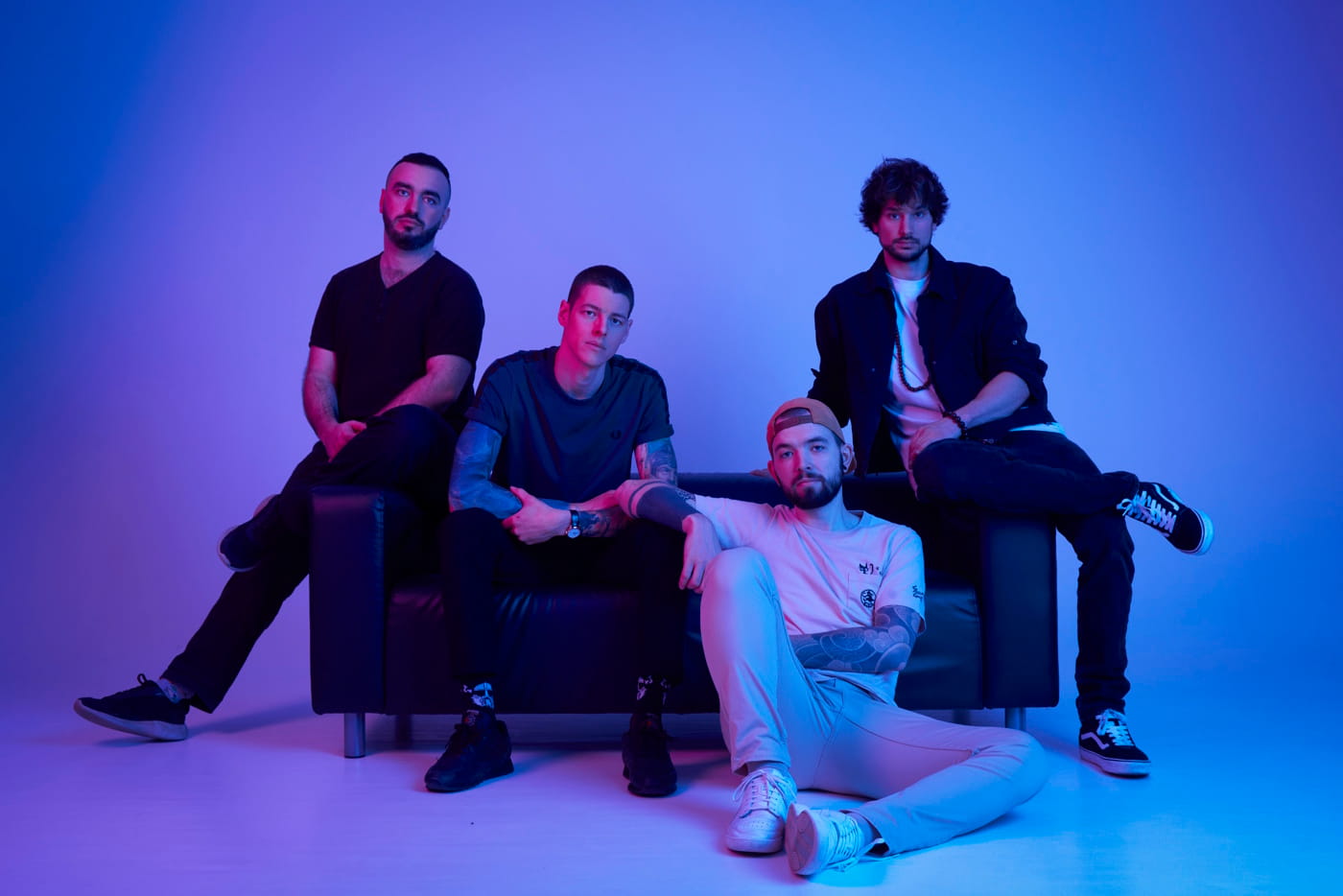
Every record hubris. have made until now lived inside Greek mythology. “White Shores” doesn’t. The fifth album from the Swiss post-rock band starts somewhere quieter: the home studio of composer and founder Jonathan Hohl, a $150 Fender amp on the floor, a reverb pedal and a delay pedal plugged in, and the first chords he wrote after his grandfather died. Those chords became the opening of “Death“, the band’s new single, and the foundation for everything that followed.
“‘Death‘ is the song that started it all,” Jonathan says of the new track. “It was the first piece I composed after my grandfather passed away, and those opening chords became the foundation for the entire album. I’ve always seen our records as a single body of work rather than a collection of separate songs, and this album is no exception.”
“White Shores” arrives on 10 September 2026.
After four albums shaped by Greek myth, Jonathan turned to the other source he keeps returning to: Tolkien. Not the swords and the maps so much as the part of the legendarium where Tolkien thinks about mortality and immortality. In Middle-Earth, elves who can’t die call death the “Gift of Men”. A gift, not a curse. It flips the Western default that death is purely tragic.
“The Hobbit was my very first exposure to literature as a child, and after Peter Jackson’s original film trilogy, I became completely obsessed with Middle-Earth,” Jonathan recalls. The album title comes from Frodo’s departure at the end of “The Lord of the Rings”: “the grey rain-curtain turned all to silver glass and was rolled back, and he beheld white shores and beyond them a far green country under a swift sunrise.” In the wake of his grandfather’s passing, that image became the conceptual ground of the album.
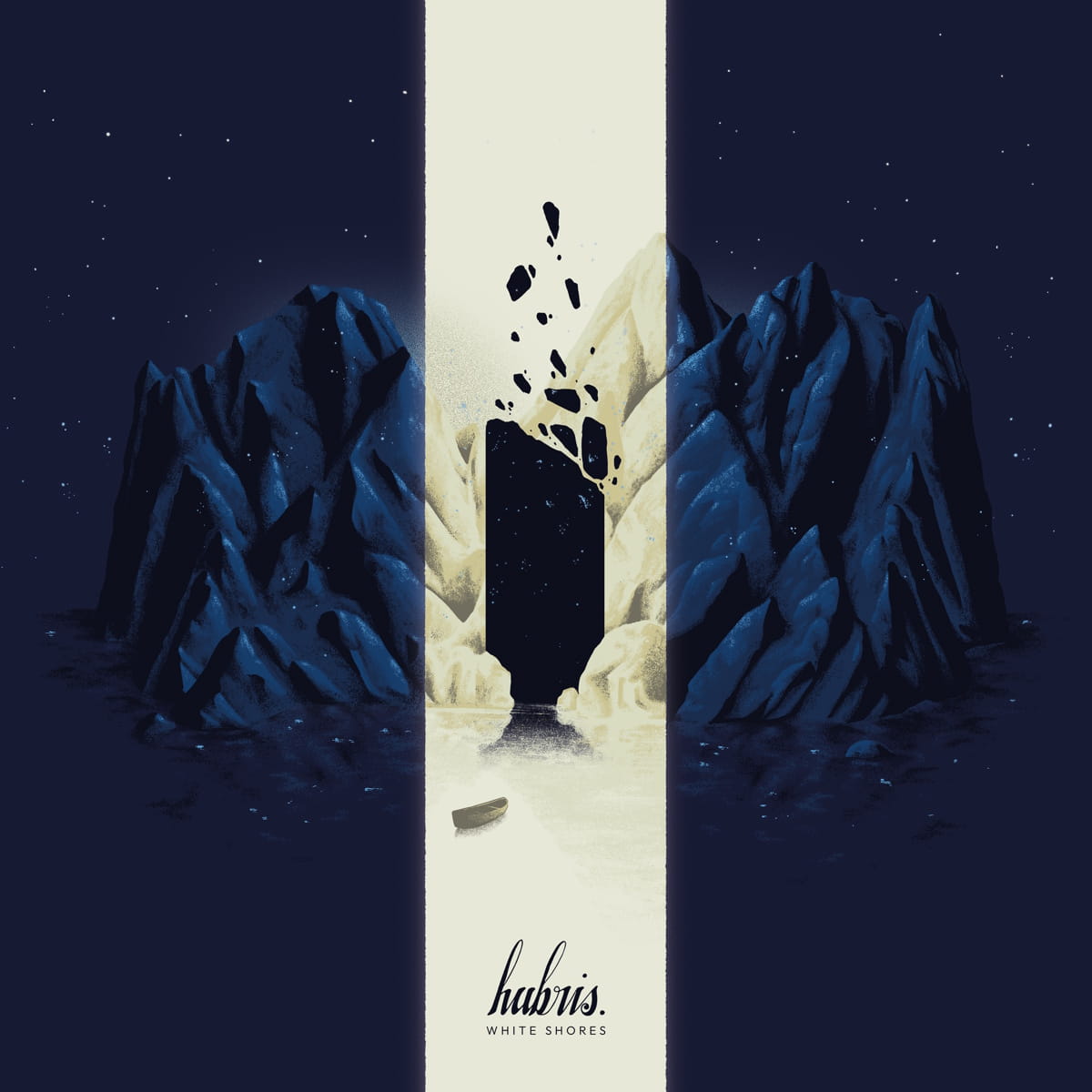
The five movements of “White Shores” each represent one word in a sentence: Death. Is. Just. Another. Path. The line comes from Gandalf to Pippin in the third Peter Jackson film, spoken in what looks like their last moments together. Five movements, five words. They also map onto Elisabeth Kübler-Ross’s five stages of grief: denial, anger, bargaining, depression, acceptance.
“Each track was written at a different stage of my grieving process,” Jonathan says. “The songs reflect my feelings in those moments as well as the evolution of my understanding of ‘death’ as a concept. A major influence on that perspective was Tolkien’s work, where elves consider the mortality of men a ‘gift’. This album became a way of exploring that idea and it all started with this song.”
That Tolkien thread runs deeper than one album. Jonathan put together a list of the books, films, songs and paintings that have shaped him most, and a striking number of them circle back to death. “Not in a creepy-gory way, but in a spiritual and philosophical way,” he says. “Growing up as a catholic, the idea of the afterlife that was presented to me, although desirable in theory, did not seem appealing to me, and I think I have been chasing a more fitting alternative through art ever since.”

The list includes the predictable and the unpredictable. “The Silmarillion” is on there. He read it after years of being a LoTR obsessive, and the scale of Tolkien’s legendarium only deepened the love. So is Duncan Jones’s 2011 film “Source Code”, which most LoTR fans wouldn’t necessarily place next to Frodo. “A lot of people expect my favourite movie to be one of the LoTR from Peter Jackson’s Trilogy, and of course it is, but an equally influential movie to me was Source Code. This is a fairly ‘unknown’ movie to most people, but this is my example of a perfect movie. It’s perfect in all senses.”
“Mary Shelley’s “Frankenstein” got him reading at 18, when a class forced him to. He still remembers being excited to come back and discuss it. William Morris’s “News from Nowhere” and H.G. Wells’s “A Modern Utopia” both turned up in his master’s thesis on utopias and dystopias. He preferred Morris’s countryside farming utopia, considered backwards by his contemporaries but, to a modern reader who’s watched what heavy industry and tech actually did, almost perfectly idyllic. Wells sits on the other end: the high-speed travel and modern communication devices he imagined did get built, just in the worst possible way.
Voir cette publication sur Instagram
Cormac McCarthy’s “The Road” arrived without warning. “Nothing could have prepared me mentally to read this masterpiece. This single-handedly created a small side of me that is pessimistic and a little bit of a ‘doomer’. This is also one of the only examples I have where the movie is just as good as the book.” Ray Bradbury’s “Fahrenheit 451” sits in the same dystopian corner, with an extra wrinkle: governments don’t need to burn books anymore, because people are putting them down on their own.
The visual entry on the list is René Magritte’s “Empire of Light“, surrealism with one foot still in the recognisable. The musical entries are two: The Evpatoria Report’s “Cosmic Call” and Esbjörn Svensson Trio’s “Tuesday Wonderland“.
“Cosmic Call” is the song Jonathan says still lives in his memory at the exact moment he first heard it, the one that pushed him toward playing post-rock professionally. “Tuesday Wonderland” was the jazz he didn’t know he was looking for, a post-rock-sounding gateway into a world he’d had no real desire to explore before.
Alex Garland’s “Ex Machina” is on there too: small-set, almost theatre-like, the kind of film that either started or consolidated Jonathan’s distrust of technology. “Wall-E” makes the cut as the animation entry, picked over earlier Disneys for its dystopian setting. The list ends, by choice, on Richard Curtis’s “About Time”, because everything before it felt too grim. “In reality I have a large-ish optimistic side,” Jonathan says. The way the film treats death sits with him.
Voir cette publication sur Instagram
That sensibility, the pull between the doomer and the optimist, runs through the construction of “White Shores” too. Jonathan writes everything alone, at home, with the cheap amp and the two pedals. 99% of what he writes starts on guitar. He builds the demos out as far as he can take them before anyone in the band hears a note: MIDI drums, layered guitars, bass tracked himself (“I’m not a bass player but I play the bass, an important distinction”), pads and synths he feels matter to specific sections. He likes having something more developed than a simple riff before opening it up to the rest of the band, partly because the deep involvement in the demo makes him less hurt if the song gets dropped later.
The band took it from there. Drummer Léo Juston was given the option of receiving fully empty tracks with no rhythmic reference, just guitars and bass and synths. He chose the versions with the programmed drums, and rebuilt his parts on top. Bassist and synth player Lucien Leclerc reshaped most of the synth and pad work, the area Jonathan describes as Lucien’s speciality. Few of Jonathan’s original synth tracks survive to the final mix. The ones that do tend to get reworked into something more polished. Léo also handles percussion across the record, and percussion runs through almost every passage of “White Shores”: shakers, tambourines, smaller textures that thicken the spaces between the louder moves.
A hubris. song reads more like a contour map than a pop structure: long flat passages climbing into dynamic peaks, with shakers and tambourines threaded through the quieter sections so the rhythm never fully empties out. The internal language of the songs leans functional too.
Where most bands have a verse and a chorus, hubris. have a “Part 1” and a “Heavy Part 1”. Most of the work happens remotely, demos pinged between four people, opinions stacked up, sections revised. Once everyone signed off on the demo version, the band returned to La Fonderie Studio in Fribourg, where they’d already tracked three of their five albums, and re-recorded essentially the whole thing over a week. Peter Miles mixed it at Middle Farm Studios. Former hubris. drummer Nathan Gros mastered it. Matthieu Grillet completes the lineup.
The previous single “Is” already pointed at where the record was heading. “Death” is the entry point: the song that started everything, the first piece of music Jonathan wrote after the loss, the chord progression that the entire album grew from. Listen to “Death” here: https://www.submithub.com/link/death. The video for “Is” is online here: https://www.youtube.com/watch?v=xfntIDJcv-s. “White Shores” will be available to pre-order soon.
The band have lined up a European release tour starting in Switzerland on 25 September and running through France, Spain, Portugal, the UK, the Netherlands, Belgium and Germany into mid-October.
25.09 – Fribourg, CH @ Fri-Son
26.09 – Barberaz, FR @ Brin de Zinc
28.09 – Valencia, ES @ 16 Toneladas
29.09 – Madrid, ES @ Wurlitzer Ballroom
30.09 – Porto, PT @ Maus Habitos
01.10 – Santiago de Compostella, ES @ Moon Music Club
02.10 – Lugo, ES @ Sala Clavicémbalo
07.10 – Nantes, FR @ The Black Shelter
09.10 – Leeds, UK TBA
10.10 – Manchester, UK @ Deaf Institute
11.10 – London, UK @ The Grace
12.10 – Bristol, UK @ The Gryphon
13.10 – Birmingham, UK @ The Rainbow
15.10 – Eindhoven, NL @ Altstadt
16.10 – Vlaardingen, NL @ De Kroepoekfabriek
17.10 – Antwerp, BE @ Djingel Djangel
18.10 – Hamburg, DE @ MS Stubnitz
“White Shores” is out 10 September 2026 via hubrisband.com.