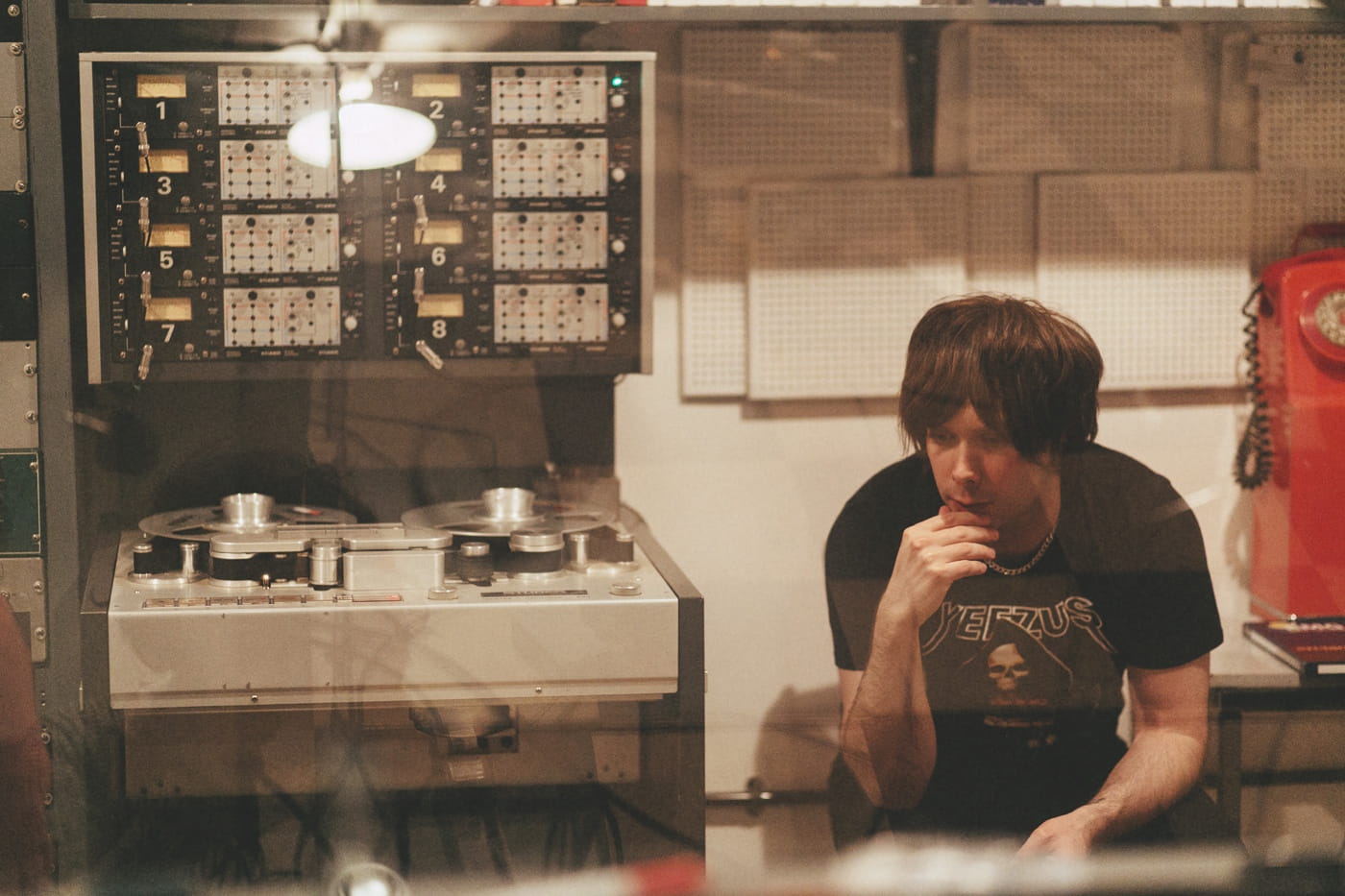



Every weekday morning, Jack Grisham gets on a call with Paul Roessler. Fifteen minutes some days, close to an hour on others. They start with aches and complaints, walk deeper as the call goes, and usually end on something unsolvable and philosophical enough to leave them both questioning their own existence until the next morning, when they start with the aches and complaints again. It was on one of those calls that Paul, resident producer of Kitten Robot Studios and a former member of The Screamers and 45 Graves, asked Jack whether aging had ever influenced his writing. For decades, the honest answer had been no.
“Pieces of the Sun” is what happened when it started to.
The song is the debut single from Jack Grisham and the Life Undone, the new project from the former T.S.O.L. and The Joykiller frontman with Berlin-based musician Lars Triesch. The self-titled album lands July 10 on Lost in Berlin Records. Just don’t call it a band. “We’re a couple of friends who made a cool record,” Jack corrects.
The track opens on a fast guitar figure that doesn’t pause to set the scene. It moves at the tempo of ’90s guitar pop and stays there, closer in spirit to the Britpop-adjacent stuff Jack sent Lars as early references (The Who, The Damned, Adam Ant, Siouxsie and the Banshees, The Stranglers, Dylan, The Beatles) than to any hardcore reference in the room. “At the risk of pissing people off, I think the ’90s were a good time for guitar-driven pop songs,” Jack said. “This record was a sort of a redo of my teen years minus the drugs and the alcohol. In the ’90s, I was touring the world with The Joykiller and I guess some of that bled in.” The redo doesn’t touch the emotional weather. “The redo was only about the sound. Not the emotional climate of the times.”
The song itself came out of that morning call with Paul. “Lyrically, ‘Pieces of the Sun’ was an idea that came from Paul Roessler,” Jack said. “We were talking about getting older and he asked if aging ever influenced my writing. Before I wrote this song, it hadn’t. I write song lyrics like a kid going through his first break-up. I didn’t think I was gonna live this long. I’m years past my expiration date.”
He’s said versions of that line before. The more private version comes without the punchline. “I’m not sexy. Say what you want, but dancing, singing, posing, and playing music is a human mating ritual. Attraction. If you’re doing it for the love of playing then you don’t need a stage or a crowd. If you want to be adored, admired, put coin in your pocket, you need to get out and shake that ass. I don’t need adoration. I won’t sell myself for a couple of bucks. I don’t think I’m other than a fat old dude with a shit load of scars trying to be relevant.”
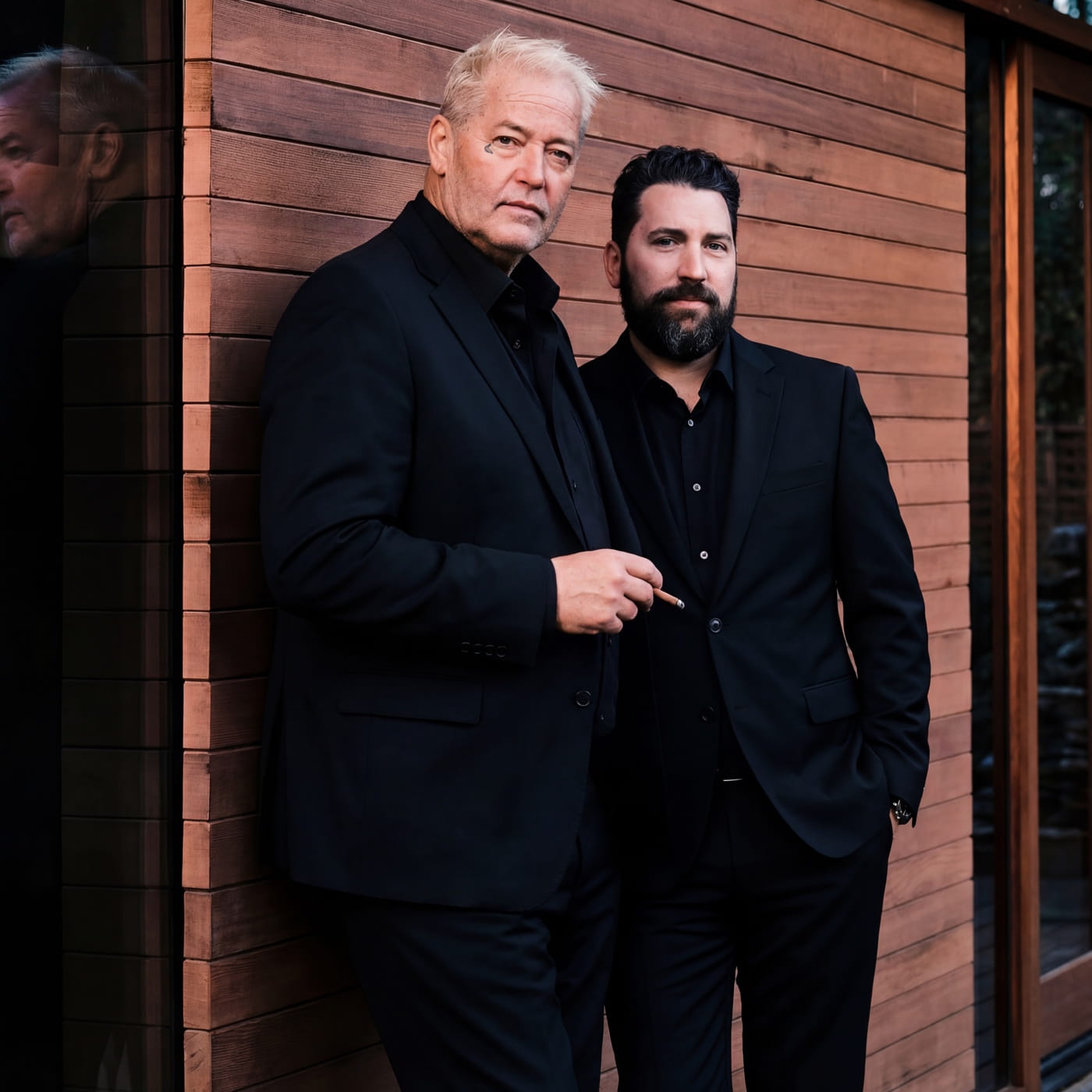
The origin of the project is a Punk Rock Museum meeting in Las Vegas. Lars was there researching an Edward Colver photo book. Edward is friends with Jack. Introduction, chat, the well-worn “we should make a record” got said out loud. Neither will admit who said it first. Jack swears it wasn’t him, because he’d recently walked away, again, from what Hunter S. Thompson called “a business that is a cruel and shallow money trench, a long plastic hallway where thieves and pimps run free, and good men die like dogs.” Thirty-seven years sober and he still forgot, apparently, how to stay away from things that hurt him.
Lars had been away from music for a decade and a half. His last band, Profession Reporter, wrapped in 2009 when he moved from Koblenz to Berlin with his then-girlfriend Sara, an art student headed for Amsterdam. She became his wife, then his daughter’s mother a few weeks into the move. In 2010 he started Original in Berlin, a vintage furniture and design shop that grew from a 500-square-foot corner to a company with ten employees. Playing music wasn’t a priority.
Before all that, there was Koblenz. “For such a small-town environment, the Koblenz/Neuwied scene was unusual, even for Germany,” Lars said.
“It was exceptional and outstanding, with around 100 to 200 people in the scene, and frankly, everybody had sex with everybody.” Charles Bukowski had been born just down the road by the Rhein. Toxoplasma had left their 1981 mark. Local bands ran the length of the map. Schlagbolzen, The Loners, Barseros, My Lai, Off Side, Lars’s own bands The Jerks and The Blast Offs, and especially Hammerhead, whose record “Stay Where the Pepper Grows” he still counts as one of his top five HC records. They soaked up VHS Flipside videos, “Suburbia”, “Another State of Mind”, and Minor Threat live at the 9:30 Club. They threw parties in a WW2 bunker that had been turned into rehearsal rooms, 100-square-foot spaces holding 40 to 50 people dancing pogo to Minor Threat, Black Flag, T.S.O.L., and Angry Samoans.
They were middle-class suburbia kids from conservative homes. Koblenz was a Bundeswehr garrison town. They were drawn to US punk more than UK punk. SST, Dischord, Lookout. “That whole American energy, faster, rougher, more direct, felt closer to what we were looking for at the time.”
Kurt Ebelhäuser was the guy who broke Koblenz internationally. His band Blackmail was the biggest indie band the city produced, and he and his brother Carlos built Tonstudio45, the first proper recording studio in town. “Kurt and his brother Carlos Ebelhäuser were the most talented musicians I’ve known personally,” Lars said. He’d cut his first 4-track punk 7″ with Kurt in 1997, with The Blast Offs. Thirty years later, Kurt would produce Jack Grisham and the Life Undone.
Kleinmachnow, outside Berlin, is where the album lives. Lars’s house there was designed by Ray Kappe, the Californian architect. That reference is not a coincidence. “My love for California and the US had been there since I was a young teenager. I had a 1956 Chevy Bel Air when I was 18, and a few years later a 1960 Oldsmobile 98.” He was reading Kerouac, Burroughs, Ginsberg, Jack Black, and Raymond Chandler alongside his beloved Russians. At twenty, he visited California and SST Records for the first time. Taschen Books, based in Cologne about an hour from where he grew up, put on shows. He found the Julius Shulman books and was blown away by Californian modernism.
Then a circle closed. Jürgen Nogai, the German photographer who worked with Julius Shulman for the last fifteen years of Shulman’s life, became a friend and shot Lars’s house for most of the magazines it appeared in. “This California dream I had absorbed through books, records, cars, and films somehow came all the way back to Kleinmachnow and then into the music, with a guy whose full range I honestly had no idea about.”
That guy being Jack. “Jack is an extraordinary songwriter, with such a natural feel for structure and harmony. He always comes up with these incredibly cool vocal lines, and I had no idea how much talent he had in that direction. Of all the great characters who came out of the early California punk scene, I couldn’t imagine anyone else for this record but Jack Grisham.”
The record started slow. Jack and Lars wrote via Zoom, 6,000 miles and nine hours apart. The first few weeks went to translation problems. Germans don’t have a B note in the scale (they call it an H) and don’t understand why Americans call a bald man “curly”. Once the vocabulary got sorted, the songs started coming. The connection didn’t cooperate.
“Oh, that was very frustrating sometimes,” Lars said. “In the beginning, we both thought the system just wasn’t working. There was this delay of two or three seconds, so Jack would say ‘stop,’ and I would keep playing for another few seconds. He thought I couldn’t hear him, or that I wasn’t reacting, and then he would start screaming at me. Jack can be short-fused sometimes, especially if he thinks the person on the other side of the screen doesn’t understand what is going on. But then we figured out it wasn’t me being slow or not listening. It was just the delay. Once we understood that, we learned to work around it, with patience, and also with a few breakdowns.”
Jack’s version, shorter: “The three second delay drove me crazy.”
What worked, both times, was a stripped test. “Jack called it a ‘happy birthday’ version,” Lars said. “Every good song should work with a single instrument and vocals. Without a production, without effects. Just a very pure melody and a vocal line. It felt like we weren’t trying to make a nostalgic punk record. That was the point where I thought: okay, we’re onto something here.”
The plan had been Kurt at the boards. Kurt was booked months in advance, so he introduced Michel Wern, an engineer and co-producer he’d worked with for years. Then a scheduling accident that apparently hadn’t happened to Kurt in fifteen years happened. The band he was meant to be recording had to cancel because of a member’s health issue. Kurt and Michel both showed up in Kleinmachnow.
“The energy between the two of them was incredibly positive,” Lars said. “We laughed a lot, even though we were working under serious time pressure every day from around 10 in the morning until 2 at night, because Jack was only in Germany for a limited time. My thing with Kurt is very old and emotional. There is trust, history, and a shared language from way back. Michel came into that as someone newer, but not as an outsider. He understood Kurt, he understood the room, and he brought a very calm, precise energy to the recording.”
The basement studio in Kleinmachnow is loaded floor to ceiling with Neumann gear. They cut thirteen tracks in ten days, October 17 to 29, 2025. Trevor Lucca (D.I., Lovecrimes), known for his onstage work with Dick Dale and T.S.O.L., played guitar. Michel handled backing vocals alongside his engineering. Kurt took guitar, bass, keys, and vocals as needed. Lars played drums, guitar, and sang. Jack fronted and played harmonica.
Then LA. “There were a couple of vocal tracks that I wasn’t happy with, so I redid them up at Kitten Robot, Josie Cotton’s studio where Paul is the resident producer,” Jack said. “And if you’re at Paul’s studio, you’d be stupid not to squeeze him for a couple of piano tracks, an organ pass, and a shitload of backing vocals from Paul and the engineer John Miller. We sent those tracks back to Berlin and Producer Kurt, and engineer Michel gave them the okay.” Andy Jung mastered.
“Church Bells“, one of the tracks touched up at Kitten Robot, is out now as the album’s second single.
Thirteen made the cut. They’d started with sixteen. “I’m not sure how many songs we’d started and canned. Some of them good.”
The album covers a wide arc. There’s the ’90s guitar pop pulse of “Pieces of the Sun“.
There’s “Anthem“, which is exactly what it sounds like on the tin.
Wyświetl ten post na Instagramie
“Pain Goes Around” is an altrock singalong. “John Says” is a midtempo ballad. “Angel Funeral” is an acoustic paean with an Americana lean. “Lazing In The Bed All Day With You” is the album’s rocker, the one Jack says has been running through his head when he’s doing a hundred down the Coast Highway on his bike. “Black Ties” and “Phone Call” are the ones he reaches for when the mood is quieter.
Wyświetl ten post na Instagramie
“I think the beauty of this record is in its diversity,” Jack said. “A song that stands out today might be skipped this evening. My favorites change with my moods.”
The subject matter runs deeper than the tempos suggest. “Many of the songs are about sobriety, especially the society of those in recovery,” Jack said. “‘Angel Funeral’ is about the death of my first wife from an overdose. ‘Pain Goes Around’ is my being sober and still dealing with mania and depression. I’m unmedicated bipolar and it can get pretty dark sometimes. ‘Dull Boy’ is about isolation, as is ‘Darker Side Of Nowhere’. ‘These Things’ is my argument in favour of the flesh and that if ‘God’ didn’t intend us to enjoy it, it wouldn’t be here. I’m an agnostic that studies scripture. The line ‘I’m gonna walk up to your mind…’ is in reference to me arguing with those who study their bibles or try to preach in public. I often confront them.”
His present wife shows up more than once. On “Phone Call“, the line “I wake up with the stars against my face” is literal. She has a star tattooed below her eye and he has the moon below his.
Jack does not think of himself as being in a scene anymore. “I’m an isolater,” he said. “I’m not really in the scene. I don’t go out, don’t like social media, and I live in fantasyland. I don’t think punks should be seen after they turn 30. They should still record, but not tour. Rebellion and youth are a couple I enjoy seeing as they stroll down the boulevard. Rebellion and middle, or old, age is like one of those creepy, she married him for the money arrangements. However, in this case it’s the old rocker who hooks up with rebellion to stay valid.”
Wyświetl ten post na Instagramie
The cover art started as a workaround and turned into the concept. Craig Barker, known as Skibs, is painting the album cover in oil. Oil paintings take a long time and the record was already mastered. Rather than sit and wait, Lars asked Skibs for progress updates and the singles got their artwork from the stages of the painting.
“Suddenly it all made sense: The Life Undone,” Lars said. “Using the first three singles to show three different stages of the painting felt completely right. It wasn’t just a workaround or a teaser strategy. It became part of the concept. You were seeing the artwork come into being while the record itself was being introduced. That felt like a perfect fit, almost like a finger-joint connection between the music, the title, and the visual process.”
Wyświetl ten post na Instagramie
The title came from Jack. Lars left the explanation to him.
“The Life Undone works two ways, possibly more,” Jack said. “If you were in therapy, to undo a life is to break it down, dissect it, examine it in pieces and hold it up to the light. ‘Here is what I am, where I’ve been, what I’ve done or wish I had done.’ If I were to look to the future, step out of the grey that I’m often mired in, ‘a life undone’ is a place where there is more on the horizon. It’s not over yet. New pages are still being written. A man I once knew told me that ripe fruit rots on the vine. It’s a reminder to stay green and always keep growing.”
Which brings the “not a band” line back around. Jack’s protection of it isn’t about aesthetic distance. “It’s really about me being burned out and disdaining connection. I’d often remind Lars that I just want to make a record. No live shows, no videos, just make this record and walk away.”
Some things can be written across 6,000 miles, Lars said. Some things only get solved knee-to-knee. What survived the delay were the ideas, the parts, the feeling of the songs. What only got solved in the room was the shape. After months of Zoom, Lars flew to Orange County and sat with Jack in his office for a week. Trevor Lucca joined.
“That was where we could finally look at each other, stop immediately, change something in the second it happened, and decide what the songs really were.”
Sixteen came into the room. Thirteen came out.
Jack has done two recent interviews around the project. He sat down with Steev Riccardo on the Blowing Smoke with Twisted Rico Podcast in May, talking through time, reinvention, the “not a band” framing, and “Pieces of the Sun”.
He also joined Scott O’Brien in June for a longer conversation covering punk rock, AI, out-of-body experiences, and the state of the music industry.
🔔 IDIOTEQ is ad-free, independent, and runs on one person’s time. If you want it to stay that way: DONATE via PayPal or SUPPORT via Patreon.
NEW: IDIOTEQ Explore 🗺️ Browse 15+ years of our archive by city, country, and style. Find artists on the world map or trace related sounds through the styles map.
Stay connected via Newsletter · Instagram · Facebook · X (Twitter) · Threads · Bluesky · Messenger · WhatsApp.