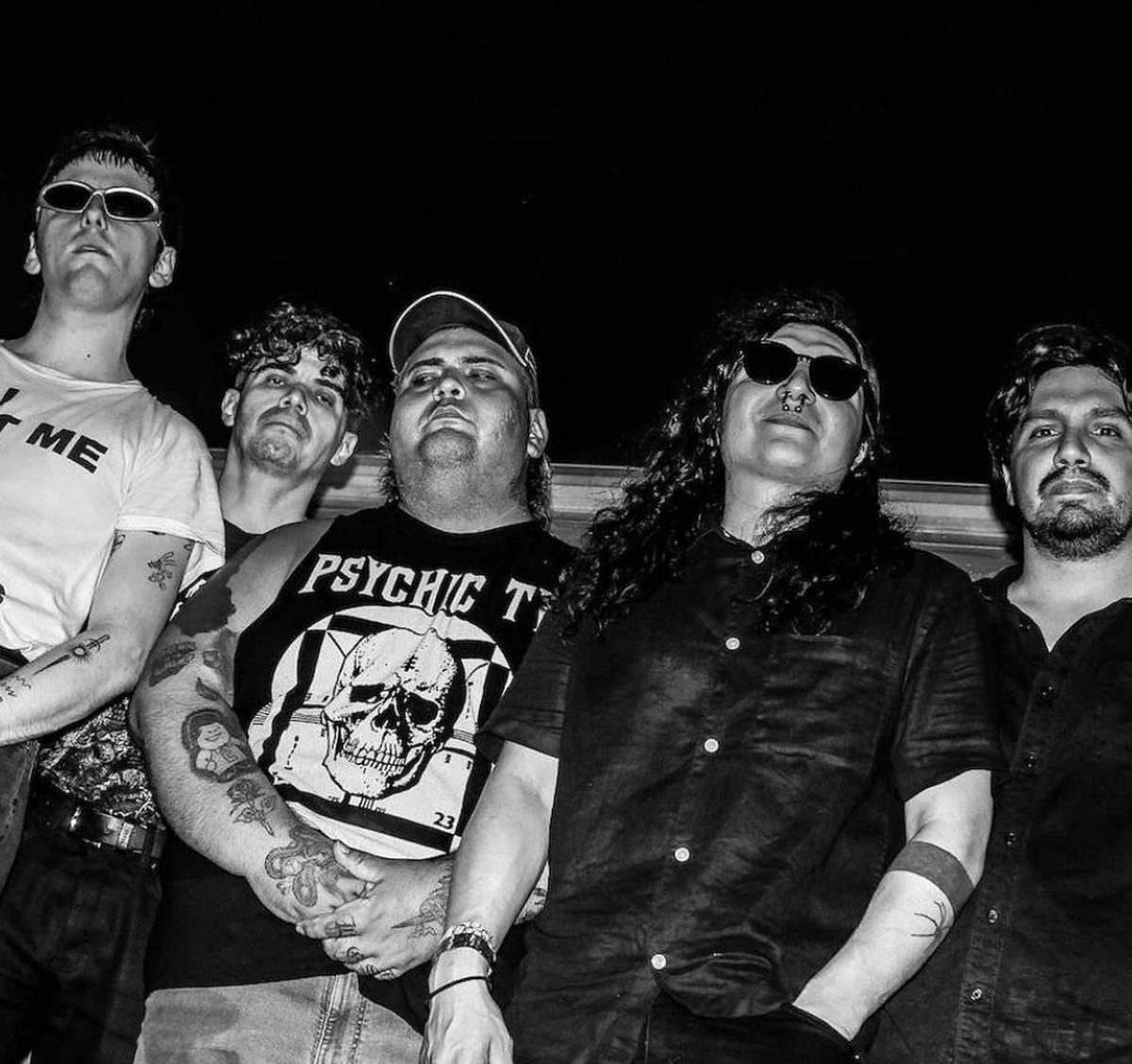


God Mother have been making an unruly kind of hardcore in Stockholm since 2012, pulling grindcore speed, crooked mathcore riffs, sludge and death metal into a unique blend of energy that regularly change direction before you’ve had much chance to get comfortable.
Their third full-length, “Köttvärld”, gets through twelve tracks in about 25 minutes. There’s a saxophone going increasingly berserk towards the end, an ambient piece that bassist Daniel Noring had sitting around for years, and a fair amount of the furious playing that made the four-piece such a nasty live proposition in the first place. At the centre of it all is vocalist Sebastian Campbell’s growing irritation with the way technology is being sold to people, especially the suggestion that creating something ourselves is an inconvenience we should be happy to get rid of.
God Mother were already heading into this territory on 2024’s “Sinneseld”. Its 47-second “Human+” dealt with AI and the search for something genuinely real while inhabiting what the band called a “walking fleshsuit”.
The accompanying track-by-track explanation went through the pleasures and compulsions of being alive, from eating and sex to intoxication, aggression and the endless desire to experience something with the intensity of a first time. “Köttvärld”, Swedish for “Meat World”, takes that earlier fascination with being human considerably further.
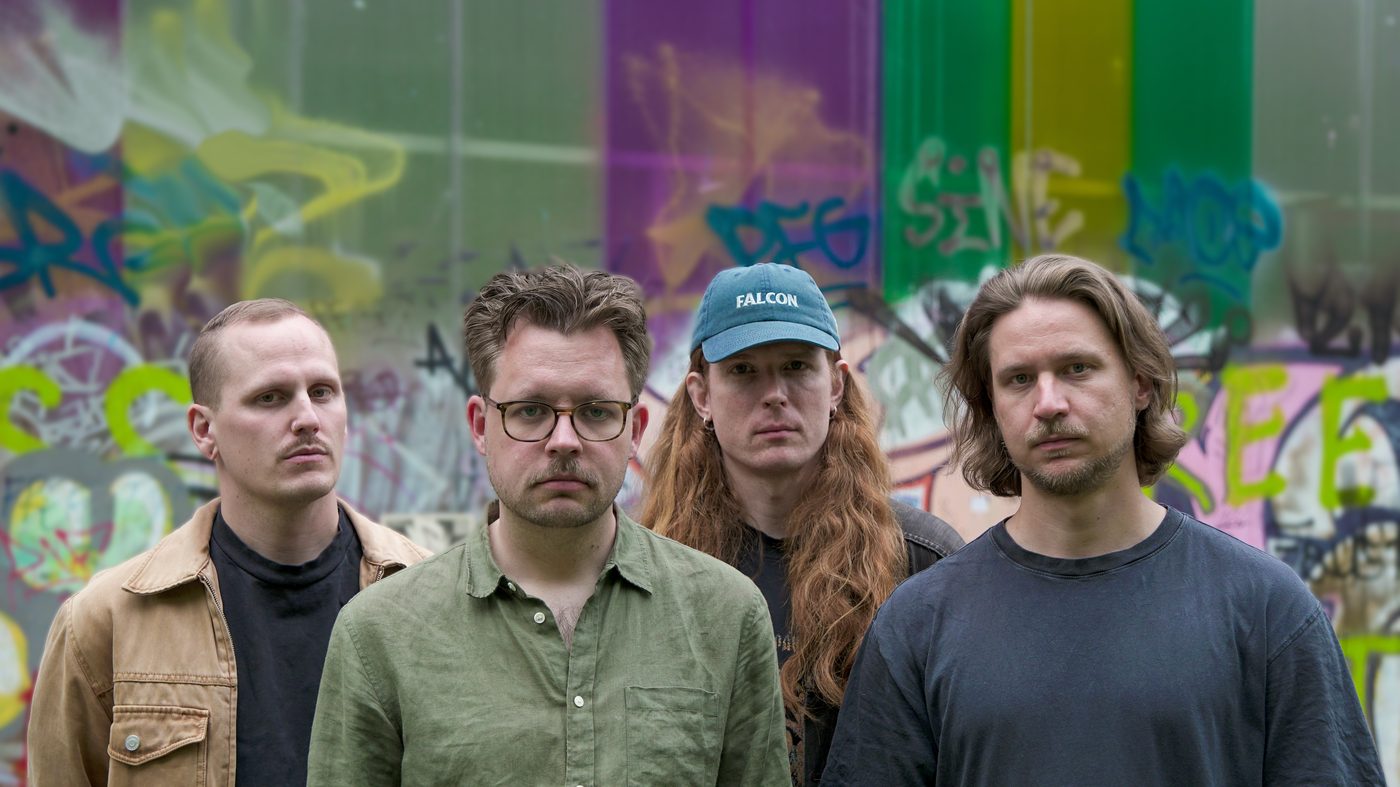
In our new conversation with Sebastian, Daniel and guitarist Max Lindström, the time between those two records comes up almost immediately. Much of “Köttvärld” was written while artificial intelligence was becoming an ordinary subject of conversation at work, at home and within music itself. Sebastian grew up during a period when new technology meant easier access to records, recording tools and ways of making art. He’s finding the current enthusiasm for automating those same activities increasingly hard to stomach.
“Indeed, in the meantime between writing and releasing these two releases, the conversation of AI, its hype and ‘innovation’ went from ‘am I going to lose my working job’ to ‘they are not even trying to hide the accumulation of profit and destroying the planet with it’.”
He has children of his own now, and the argument also concerns the future they will have to live with.
“Personally, in my daily life to what I try to achieve in my life here and seeing a future for my own children, it has been such a wake up call from growing up in the 90’s of what technological steps forward for the big masses used to be (digital music availability, creative software of producing music & arts and so on) to the constant assurance from sellers that we need automation and slop, that the struggle and joy of creating something can be bypassed just for the result. That it is something we need to remove to go faster to something that is supposed to be at a certain level – that you and I did not even get to decide was at a scale of ‘good’ or ‘bad’.”
That frustration has some history within God Mother. When we interviewed Max around “Vilseledd” in 2017, he talked about how useful basic digital pre-production had become for the band. They were still writing songs together in their rehearsal space, then recording rough versions to catch mistakes before going into a studio. Even something as simple as the guitar and bass playing different notes after a thousand rehearsals could be caught and fixed. A technical tool was helping four people make the music they wanted to make.
The present-day conversation around AI is a long way from those rough demos. For Sebastian, what bothers him is the promise that the actual process of learning, struggling and making decisions can be skipped altogether.
“Köttvärld” takes its name from the Swedish word for the flesh-and-blood world we all inhabit. The English translation is accurate enough, although Sebastian finds it faintly ridiculous.
“Somewhere where our song ‘Human+’ was written about; of the genuine human experience whether positive or negative in extremes, I firmly believe that we need to live our lives for what it is without the modern rejection and missing conversation about mortality. It is something precious that we are capable of so many things yet not too far from where we evolved from.”
“Meat World in English almost sounds like a carnivorous fast food restaurant, in Swedish it paints the world in a different, sickenly hue as if -everything- is made of meat. Which it is, of sorts.”
Mortality is something Sebastian wishes people would talk about more openly. He has grown increasingly conscious of how much attention is spent inside digital systems that know how to reward basic human impulses. Notifications, accelerated videos and the constant invitation to keep watching are everyday examples. He worries about what this does to the small social interactions through which people maintain actual relationships.
“It can be as simple as our minds being reward-seeking. We are bombarded with notifications or shortened, sped-up videos to keep attention – maybe declining small cues for social interactivity.”
The targets of his criticism are fairly specific, too.
“‘They’, for me, is either brands, company oligarchs, their investors, adverts and so on. In metal/hardcore/punk, it’s easy to lean into the -Stick it to the ‘Man-‘ sometimes where that can be abstract. For me it’s being seen as data, a number, a profit, an end to means.”
“We are social animals, and desire to maintain strong relationships that matter to us.”
The Spotify question gets awkward quickly for a band operating on their own. God Mother need people to find their music, and Spotify remains an enormous discovery tool, however much Sebastian dislikes the company’s business practices and what its founder has chosen to invest in.
Daniel Ek’s investment firm Prima Materia led a €600 million funding round in Helsing, a German defence technology company, in June 2025. The news prompted criticism and music boycotts from artists concerned about the connection between streaming income and military technology.
Sebastian has other complaints about Spotify, including its royalty system and what he considers an inadequate response to AI-generated music. God Mother have encountered another artist using their name to publish ambient tracks with titles that, in Sebastian’s view, borrow familiar metal terminology. He suspects AI-generated music is involved, although the identity and production methods of that other act haven’t been independently established.
Spotify has introduced rules addressing AI impersonation and mass-uploaded music spam, including measures announced in September 2025. Sebastian remains unhappy with the larger situation.
“At the same time, it is the most common app from where I know and traverse, connecting to other platforms and reaching people for our music that would probably never discover us in the first place.”
God Mother continue using a service Sebastian strongly objects to because it reaches listeners the band would struggle to find otherwise. They put considerable effort into directing people towards Bandcamp, where they have greater control over how their music and merchandise are sold. Sebastian uses Qobuz for his own streaming.
“Our phones track where and who we are, who we communicate with by app developers, platform providers, and data brokers. The short answer is that living ethically is doable, but difficult and takes the privilege of having time, money or even will to explore that solution. We try to direct and use Bandcamp for everything we can control in music, though they take their own cut in both physical merchandise and digital streams. Personally I use Qobuz for ease of streaming, but I can’t decide what people use to live their life.”
There’s also a personal history of changing one’s mind running through “Köttvärld“. Sebastian has spent time reconsidering “Open Vein”, one of the album’s shortest and most aggressive songs, after recognising how much severe climate anxiety had affected his thinking when he wrote it.
The lyrics include anger at human destruction and consumerism. Reading them again after recording, Sebastian wondered whether some passages made human beings sound inherently destructive, with capitalism almost an inevitable outcome of human nature. He had been consuming information about individual carbon footprints and was increasingly bothered by how much responsibility that approach placed on ordinary people.
“It’s been a process to write lyrics and find myself in what I believe in while also conveying some sort of message. When I read the lyrics again after recording ‘Open Vein’, some parts may come across as the anti-humanistic or misanthropic point of view where human is the bad seed of the world where capitalism would be its natural course for a society, but at the point of writing I had severe climate anxiety and was only reading sources with the idea of a climate/carbon footprint, which in turn was originally coined by Big Oil – more specifically the company British Petroleum.”
The history of that term is a little older than BP’s involvement. The concept existed before the oil company’s campaign, but BP and advertising agency Ogilvy did popularise the calculation of personal carbon footprints in the mid-2000s, encouraging consumers to examine and reduce their individual emissions.
Sebastian has become increasingly critical of how that message apportions responsibility. It sits alongside his anger at extreme wealth and pollution, and his own earlier tendency to turn some of that frustration against himself.
His concerns about corporate power also leave space for writing about trauma and different kinds of self-medication. “Köttvärld” has plenty of both. “Enabler”, for instance, contains the lines “It is to eat up / Or be eaten” and “What is it like to destroy yourself / For the world to fill in”, with a repeated sense of trying to become somebody else and consuming things to ease the pain. The lyrics give the record a personal ugliness alongside its anger at technology and the world outside.
The music rarely stays in one place long enough for any of this to turn into a straightforward lecture. “Open Vein” starts with grinding guitars and a frantic drum attack, and “Dopamine Wire” keeps the speed up. Then “Fault” pulls everything down into a slower, bass-heavy passage with sparse guitar and a cowbell before the drums get considerably busier again. “Almost Intelligent” has the staggered riffs and abrupt rhythmic turns that connect God Mother to mathcore, while “Limbless” gets from its punkier beginning to a far heavier section in barely a minute.
View this post on Instagram
Later on, “Bloat Leech” opens into brighter guitar chords. “Tin Gloss” makes its point with short, dissonant riffs and double-kick drumming. The album’s longest song, “Meat World”, gives the repeating guitars and saxophone enough space to develop beyond the quick attacks that dominate much of the tracklist.
It’s an interesting return after “Sinneseld“, also because that EP had already shown God Mother having some fun with more conventional rhythms. “Big Things Coming” started from a Max riff that reminded the band of a Cartoon Network sketch. They enjoyed arranging something direct and relatively uncomplicated, with Pissed Jeans among the inspirations and Sebastian trying a vocal approach he hadn’t previously recorded with the band. The song took aim at a world where people are measured by their output.
Sebastian still considers it probably their most commercial-sounding song.
“Interestingly enough, ‘Big Things Coming’ is probably our most commercial sounding song compared to the rest. There are some regular 4×4 beats throughout this song and a couple of others. Köttvärld has ‘Almost Intelligent’ and ‘Limbless’ in that direction, but we mostly feel that Köttvärld as a whole is the pendulum swinging back, at least not direct 90* degrees but back to a more intense and experimental metal / hardcore area. We might not re-visit that direction, but time will tell.”
Chad Kapper’s appearance on “Almost Intelligent” goes back to an existing friendship. God Mother had been in contact with the musicians behind Frontierer and their earlier band Sectioned for years, and toured with Frontierer around the time of the “Obeveklig” EP. Daniel already knew Chad’s voice would fit the song.
“We toured with Chad’s band Frontierer around the time we released our EP Obeveklig and we have been in contact with them and their band prior to Frontierer, Sectioned for a very long time, we love them to death and all of them are incredible persons and musicians, we love Chad’s intense voice and we knew that his contributions on ‘Almost Intelligent’ would make it more relentless and push the song to the next level, basically we didn’t need to give him any directions at all he totally knew what the song needed, thank you Chad!”
The instructions were much more particular for Martin Savage Hildebrand, whose saxophone appears on the closing “Meat World”. Martin has played with A\VOID and MARTIN SAVAGE GANG, and contributed to the debut EP by Viagra Boys. Daniel knows him through Stockholm’s underground and was happy to let him take the part somewhere increasingly odd.
“Same thing with Martin, fantastic musician, he have contributed a lot to Stockholm’s underground scene and he plays in a lot of great bands such as A\VOID and MARTIN SAVAGE GANG to name a few, i think we basically asked him not to play slick saxophone and also that we wanted the sax to get crazier the further it gets into the track, we are so happy we with the result, thank you Martin!”
“Healer Lodge” has a rather different background. Daniel had already written and mixed it a few years before “Köttvärld”, drawing on time spent playing in ambient bands alongside God Mother. Michael was working out the album’s running order and wanted a quiet passage between two of the songs. Daniel sent it to the others, everybody liked it and the recording went on the album as it was. There was no reason to put it through the mixing process again.
Daniel’s recording work is part of a much bigger DIY operation. God Mother wrote, performed and produced “Köttvärld” themselves, with tracking spread across Soundtrade Studios, Studio Ovett, Hermitage Recording and Total Recording in Stockholm. Michael mixed most of the album at Total Recording, Daniel handled “Healer Lodge”, and Magnus Lindberg, known for his work with Cult of Luna, consulted on the mixes and mastered the record at Redmount Studios.
View this post on Instagram
Staffan Birkedal is another regular collaborator, and considerably closer to the band than a name on a studio credit might suggest. He’s a friend who knows their working habits, has recorded them before and has even filled in on guitar. For Daniel, that familiarity is useful when the four musicians already have very specific ideas about how their songs should sound.
“When it’s time record an album we usually have a very strong idea how we want the finished recording to be and sound, both me and Michael have worked with audio production for a very long time and all of us knows what sounds we want to capture, we experiment a lot in the the rehearsal space with sounds and how to capture it, for every release we feel that we are getting closer to the ideal sound for our band and the people we work with understands us better for each time as well.”

Staffan knows what God Mother want before they need to explain everything from scratch. Magnus has another advantage: he works locally, which means the members can sit beside him and talk through changes as they’re happening.
“Staffan is a close friend to the band and he has even filled in on guitar in the band, he has full understanding of what we want and has a good set of ears that we really trust, he also of course a great recording and mixing engineer.”
“Magnus resumé speaks for it self, i think he is best mixer/master engineer we have here in Sweden, a big reason why we started working with Magnus is that he is located in Stockholm, we can sit in the studio while Magnus works and we feel that we can express our opinions and ideas directly.”
And there is the fairly universal problem of several musicians being completely convinced that their own suggestion is the right one.
“The greatest thing to work with people outside the band is to have someone to help us navigate when there are two very strong opposing ideas against each other haha.”
Even after fourteen years, God Mother’s songwriting routine remains surprisingly close to what Max described to us in 2017. Songs still commonly begin with an idea brought into the rehearsal room, then get developed by all four members. More complete pieces are fine-tuned there too. Everyone has more commitments now, including families and other projects, and Sebastian thinks their time together has made them more focused.
“Mostly, it is the same. We have more things in our hands with family, other projects and life in general – but the process mostly stays the same with someone coming up with an idea that’s worked on organically in the rehearsal, or fine tuned if it’s a more finished piece. I’d say we are more of a focused group now since we have done it for fourteen years counting this year.”
The way they release records has also come back into their own hands. “Köttvärld” is self-released, with the band handling physical orders, packaging and shipping. The whole process has remained something they enjoy being involved in, even during the period when Party Smasher Inc. helped them reach a much wider audience.
The partnership with Ben Weinman’s label began after God Mother sent “Vilseledd” to several labels they admired. Ben was interested but initially reluctant to commit. They asked about supporting The Dillinger Escape Plan in Stockholm and ended up playing Gothenburg too. After those shows, he decided to work with them. When we caught up with Max in 2017, he was explicit about how much promotion and distribution had improved through Party Smasher.
The attention lasted well beyond that release. Daniel is grateful to both Ben and Anthony Gesa for introducing God Mother to listeners who are still following them today.
“We are super grateful for everything Ben and Anthony (Gesa) did for us at Party Smasher Inc. We definitely got a lot of attention back then and reached a lot of people that are still interested in what we are doing that we wouldn’t be able to reach if we hadn’t worked with Party Smasher Inc, we can’t thank them enough.”
The old phrase about The Dillinger Escape Plan’s torch being passed to God Mother has followed them for nearly a decade. Daniel has a fairly relaxed view of it.
“The ‘torch officially passed’ line I think (even back then) was a bit exaggerated, but it helped us a lot haha.”
Through Party Smasher, God Mother retained some ability to distribute “Vilseledd” themselves, especially at shows. Sebastian says they have always enjoyed keeping track of a release from the first song idea to the finished record arriving in someone’s hands.
“With Party Smasher, we still had an agreement in the deal to distribute some for ourselves, at least Vilseledd physically at shows and at a small number. We have always had a good grip on every step from the writing of a song to it being put on a physical record, packed and shipped properly so it has been something we just liked to keep in ‘our house’ so to speak.”
They’re open to distributors again when it makes sense. For now, packing the vinyl themselves suits them.
The Party Smasher association also shaped how critics heard God Mother. In 2017, Pitchfork reviewed “Vilseledd” and praised its range while questioning how much of the band’s personality was still tied to Converge and The Dillinger Escape Plan. Zoe Camp singled out the Converge-like movement of “By the Millions” and “No Return”, as well as the record’s black metal connections, before finding considerably more promise in the closing “Burdenless”.
Max has never had much trouble with those comparisons. He loves both bands, and the list of possible reference points could just as easily stretch to Cult Leader, Refused, Breach or Neurosis. He also questions how realistic it is to expect musicians to sit down and consciously create something groundbreaking.
“To us it felt like a compliment as we both love those bands. Many critics leaned heavily into TDEP influence as we were on the same label at the time but you could probably say the same thing about Cult Leader, Refused, Breach and Neurosis.”
“The reviewer is looking for something groundbreaking that pushes the genre forward. But making that type of music doesn’t necessarily make it more enjoyable and is also extremely hard to intentionally do.”
“Seeing how few hardcore albums even make it onto Pitchfork, we take the review with high regard. We must have done a lot of things right to get the attention, even if it is a mere 6.4 instead of a 10. Looking back, I don’t think much has changed, what influences us is still the current taste across four people and what we enjoy doing at the moment.”
Four people, their current tastes and whatever they can make work together in a room. There’s something refreshingly ordinary about how Max describes a band whose records contain so many abrupt changes and difficult arrangements.
One self-imposed restriction has survived every release since the beginning, though. “Maktbehov”, “Vilseledd”, “Obeveklig”, “Sinneseld” and “Köttvärld” all have exactly nine letters. It started as a restriction the band enjoyed and has become a useful visual reference across their records, as well as a source of jokes that presumably work better in Swedish.
“We love working with that limitation – I like that there is a definitive and clear direction of what we are moving with graphically and sort of a ‘branding’ I suppose. It’s a good base for jokes based on that too in Swedish.”
“Köttvärld” was released independently by God Mother on 25 September 2026. The complete album is available to stream and download through their Bandcamp, where the band also sell a limited 500-copy 12-inch pressing in Galaxy Candy and black vinyl, with packaging and shipping handled directly by them. Following their October European dates, God Mother are due to celebrate the release at Stockholm’s Hus 7 on 7 November, alongside Svart Samtid and Denim Demons.