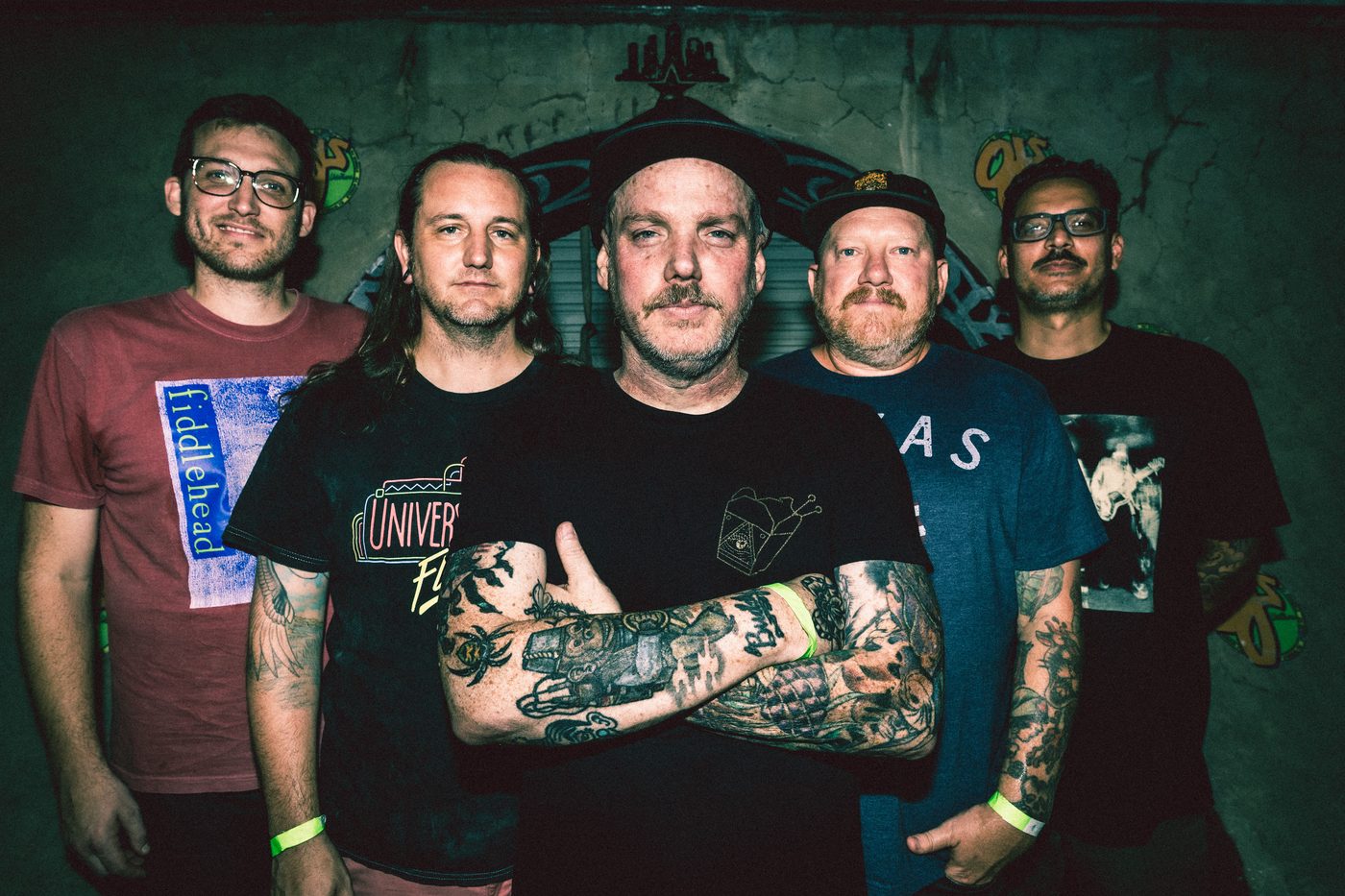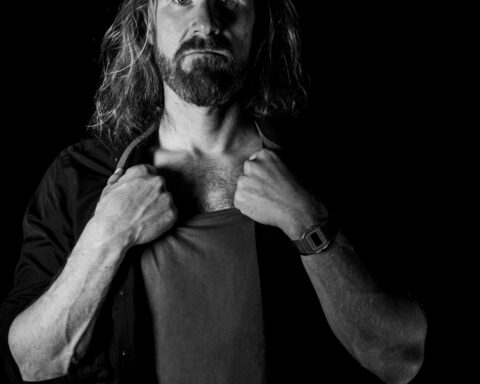

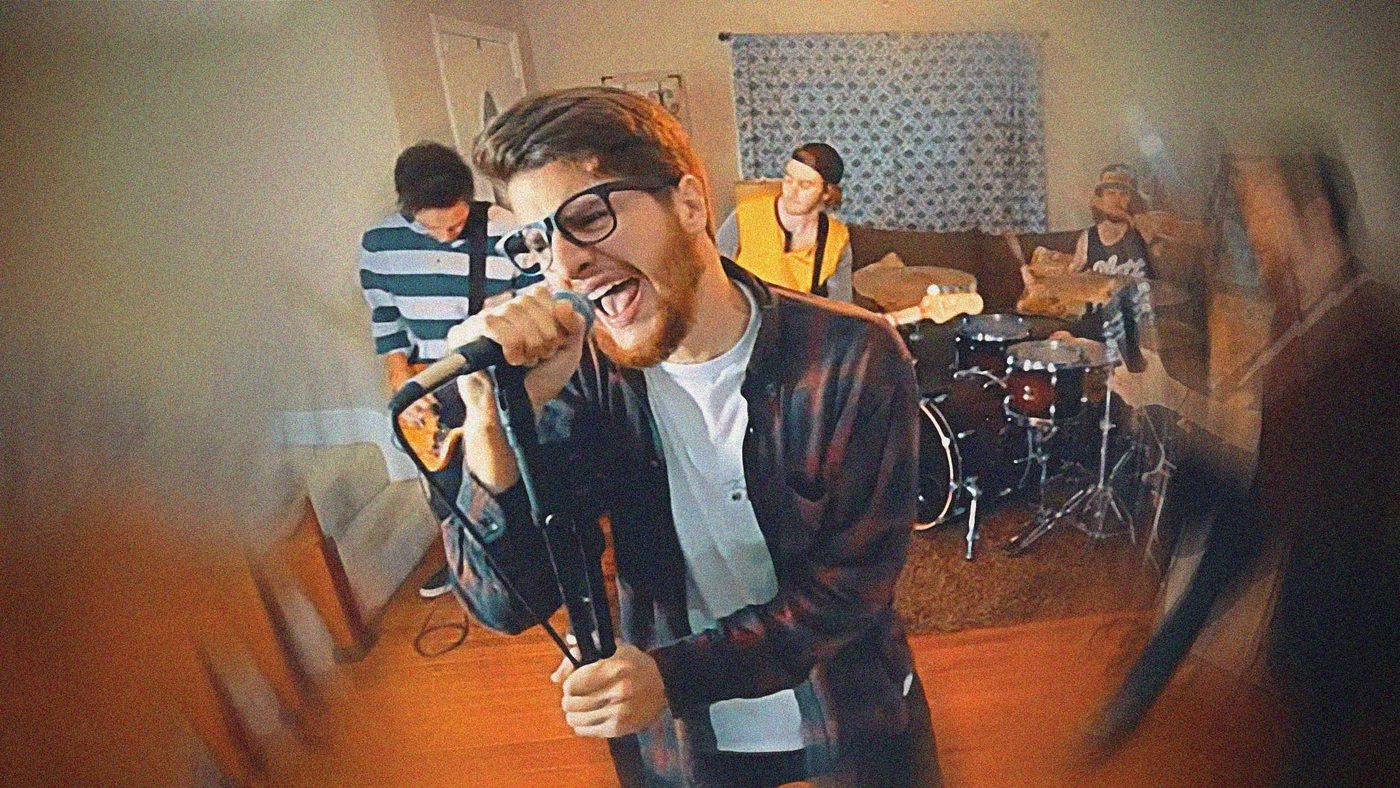
I love the sheer pop punk energy of “Still Posi“. Sunrise Skater Kids open “Friendworld” with a gloriously cheerful chorus about burying your head in the sand, ignoring climate change, pretending your student debt doesn’t exist and blocking anyone who might ruin your day.
There’s something ridiculously enjoyable about that old pop punk rush, especially when the guy singing along is such a spectacular idiot. It’s the kind of energy that reminds me why I fell for this music in the first place.
And that’s only the beginning. Across ten songs, Sunrise Skater Kids have brought back the pop punk, easycore, emo and ska comedy of “Friendville”, now with a generation of ageing scene kids, expensive reunion tours, AI-generated rubbish and people who can’t afford somewhere to live. The songs are still stuffed with ridiculous characters and self-aware jokes, but Jarrod Alonge has quite a bit more on his mind these days.
Jarrod created Sunrise Skater Kids in 2015 as one of several fictional bands appearing on his comedy album “Beating a Dead Horse”. The following year, a fan-funded debut called “Friendville” turned the parody into a proper full-length record, with guest appearances from JB Brubaker of August Burns Red, Cody Carson of Set It Off, Patty Walters of As It Is and Johnny Franck of Bilmuri. It reached number one on Billboard’s Top Comedy Albums chart, number 12 on Top Heatseekers and number 37 on Top Independent Albums.
A decade later, “Friendworld” picks up the same idea of letting ridiculous people sing their own ridiculous beliefs with complete sincerity. The targets have changed considerably, though. Jarrod has spent those ten years watching the music he grew up with become increasingly attached to its own past.
“The pop punk ‘scene’ as we know it today is less a physical scene and more a shared cultural vibe or idea, like the Christmas season. Hardly any of the songs or albums at the center of it came out this decade. MGK was close but that’s about it.”
He sees most of the online conversation returning to older bands, anniversary tours and the memories people have of being teenagers at Warped Tour. It’s a familiar complaint, although Jarrod is careful about how far he takes it.
“Nobody seems to be celebrating or supporting what young, new artists are making in 2026, and I’ve always felt that folks are still chasing whatever high they had as a high schooler at Warped Tour. That’s not to say there aren’t any young bands doing something interesting this year, but rather the general focus of the ‘scene’ as it exists currently on the Internet.”
“However, I’m a victim of the same social media algorithms that have splintered listeners off into their own bubbles, so I could have a totally inaccurate read on this.”
It’s a fair admission. The stuff an algorithm keeps pushing towards somebody who grew up with MySpace and Warped Tour won’t necessarily tell them much about what younger bands are doing at local gigs. Jarrod is mostly interested in the behaviour of his own generation, including the habits he’s picked up himself.
That brings us to “Destroy Pop Punk”, the album’s closer and probably its most pointed joke. The song takes the old “Defend Pop Punk” slogan and turns it into a complaint about people who happily spend a fortune on another anniversary show while admitting they wouldn’t pay to watch a new local band. The narrator has grey hair and a bad back. He remembers climbing over heads at Warped Tour when tickets were cheap, and now he’s ready to spend far more money to feel the same way again.
The joke is that Sunrise Skater Kids are doing exactly what they’re criticising. “Friendworld” is a long-awaited sequel to a much-loved record from 2016, complete with familiar characters, recycled references and an ending designed to reward people who remember the original.
Jarrod was well aware of that contradiction.
“I mean, the last show I paid good money for was literally My Chemical Romance. Nostalgia is extremely compelling, and I think by putting SSK in the center of the joke it allowed me to approach listeners with empathy rather than condemnation.”

He’s a father of two now, with limited spare money and time. If he manages to get out to a gig, choosing a band he already loves makes sense to him. The problem gets harder when he looks at what it costs musicians to keep playing and how much money the biggest operators make from concerts and venues.
“It’s possible that this wouldn’t even be a real issue if living expenses for artists didn’t exceed their wages, live events and venues weren’t monopolized, people actually had time outside their jobs and responsibilities for music, etc.”
There’s a whole argument about the economics of touring and local music sitting behind a song whose chorus cheerfully announces that millennials will pay to revive a dead scene.
The nostalgia joke runs through the album in other ways. “Pit Pontiff” follows “Friendville” favourite “Pit Warrior”, sending a Chicago hardcore musician on a mission to get the Pope’s blessing for his scene. His reasoning is wonderfully stupid. The Pope comes from Chicago, supports the White Sox and therefore might enjoy Fall Out Boy. Surely there’s at least a small chance that he knows how to throw down in a mosh pit. The song eventually imagines a house show at the Vatican, complete with deep-dish pizza and a crowd climbing over one another.
“Trigger Warning 2: Patriotic Boogaloo” directly follows “Trigger Warning”, and “Sen Bolo” revisits the fictional Star Wars character from “Rylo Ken”. Even “Destroy Pop Punk” ends with a stream of lyrical callbacks to “Friendville”, dragging old jokes, characters and phrases back into the present. The band know their listeners will recognise them. They’re counting on it.
Jarrod admits that the shift towards wider subjects wasn’t something he mapped out at the beginning. He was 23 when the first album came out. He’s 33 now. In that time, becoming a parent, working through countless creative projects and watching American politics get stranger have all affected what he wants to write about.
“I was an edgy anti-capitalist progressive at 23 and somehow the domestication of fatherhood by 33 has radicalized me even further.”
He reckons the pop punk scene alone hasn’t supplied enough fresh material to justify another ten songs built around the exact same targets. So “Friendworld” spends a lot of time with the people who grew up around that music and the world they’re dealing with now.
“Still Posi” is a perfect introduction to this version of Sunrise Skater Kids. Its narrator has decided that happiness requires a total refusal to engage with reality. Global health crises, protests, starving children, politics and even a suspicious mole on his hip are all somebody else’s problem. He insists that silence is harmless and ignorance is a perfectly reasonable coping strategy. As long as he can stay cheerful, nothing else deserves his attention.
It’s a great piece of pop punk absurdity, with that bright, instantly familiar energy working against lyrics about a guy who has essentially decided to stop caring about other human beings. And then, just as the song seems finished, Clay Agnew introduces himself as the new vocalist and wonders what happened to the previous guy.
Clay knew from the beginning that replacing an established voice in a project with such a dedicated following would invite comparisons. The line makes the situation part of the joke before anyone else can.
“Oh, I knew immediately after joining that I’d be compared to the previous vocalist, and that’s completely fine. It’s natural for an existing fan to say ‘This guy is the replacement? He better do a good job,’ and I don’t blame anyone if they’re not into the new sound versus the old one.”

Fortunately, he says, the response has been supportive. And although he’d originally expected to sing and occasionally suggest an idea, he ended up doing considerably more work on the record.
Jarrod already had most of the songs and characters worked out when they started collaborating. He wrote the album and handled its main production, building demo instrumentals and rough arrangements for Clay to develop. Clay would add guitars, synths, effects and other production ideas, sending the songs back and forth until they were happy with them.
“Jarrod would create demo instrumentals of the songs to get the rough ideas across. I’d then start layering other production like extra guitars, synths, effects, etc. And we would just go back and forth like that, pitching ideas and locking them in.”
One of the early turning points was “Boybandin‘ Up“. Jarrod had arranged its original sections, then Clay handled the recording and production himself. Will Carlson ultimately mixed and mastered the finished track, but Clay’s work showed Jarrod that he could bring much more to the project than vocals.
Clay had also planted the idea for “Skabidi Toilet“. He suggested making a ska parody, and Jarrod returned with the concept of an ageing punk musician desperately trying to speak the language of Gen Alpha.
The finished song is loaded with Minecraft, Roblox, doomscrolling, algorithms, sigma jokes, random internet slang and increasingly incomprehensible references. Dylan Anderson supplies the horns, giving the track an actual ska element underneath all the digital nonsense. At one point, the narrator starts worrying about his ageing body and digestive system. By the end, he finally admits that he has absolutely no idea what he’s saying.
It’s a familiar online embarrassment: somebody who has already aged out of a trend trying desperately to convince younger people that he’s still part of it. Sunrise Skater Kids make him sing an entire ska song before he admits defeat.
One of my favorite tracks, “Featuring Travis Barker“, does something similar with the older generation’s obsession with authenticity. The narrator is a self-appointed pop punk gatekeeper who believes that owning a CD before somebody else was born gives him permanent authority over the genre. He demands that newcomers name three songs, recite lyrics and list band members’ hometowns. Eventually, he’s asking for their pets’ names and their tour manager’s home address.
His ridiculous sense of ownership comes with a nastier side, including outright sexism and contempt for younger fans who discovered the music on their phones. He’s convinced that punk began in 1999 and that being born before then makes him its rightful guardian. All of this is delivered in the style of a modern, Travis Barker-associated pop rock single. The title itself is another dig at a period when Barker’s involvement became a recurring selling point in the genre.
Clay plays that sort of character differently from the relentlessly cheerful guy in “Still Posi”. He leaned into specific vocal personalities for “Featuring Travis Barker”, “Trigger Warning 2” and “Sen Bolo”, although most of the singing across the album uses his normal voice.
The change of pace becomes even stranger on “Homeless Millennial”. The narrator starts out looking for a five-bedroom house in a desirable school district, only to discover an asking price of $1.5 million and expensive homeowners’ association fees. He lowers his expectations to an 800-square-foot bungalow from the 1930s, complete with a mouldy basement, then gets outbid by somebody with family money.
Things go badly from there. The housing market sends him into a fantasy about Soviet communism, complete with Russian lyrics and an excerpt from the Soviet national anthem. By the final verse, he’s living in a tiny shack under a bridge in Baltimore, still dealing with rent and a landlord. The song’s escalating stupidity has plenty of actual frustration underneath it. Jarrod was writing about people who have done what they’re supposed to do financially and still can’t buy a home.
“Trigger Warning 2: Patriotic Boogaloo” gets much uglier. The first “Trigger Warning” mocked a different sort of fragile political personality. This time, the narrator is an angry American man whose worldview is gradually taken over by conspiracy theories, right-wing ultranationalism and an online community that agrees with everything he believes.
It begins with a backyard barbecue, the price of eggs and a private Facebook group. Soon the guy believes Pfizer built the moon, reality itself is a psychological operation and podcasts selling supposed freedom have access to secret knowledge. He spends money on political merchandise, repeats claims he can’t verify and learns to dismiss any inconvenient evidence. When someone asks about files that might implicate his preferred political figure, the answer is simple: if his guy appears in them, the files must be fake.
The song eventually turns into a confrontation over somebody calling the Gulf of Mexico by its old name. From there, the conspiracy language accelerates into a jumble of QAnon references, election denialism, anti-vaccine claims and political threats. Michael Martenson contributes additional vocals to the track, helping populate its argument with more than one character.
The ending also openly points out that the song is using the same formula as its predecessor. Jarrod has no interest in pretending otherwise.
That kind of self-awareness gets even more ridiculous on “Sen Bolo”. The acoustic emo character from “Rylo Ken” is back, this time complaining about the handling of the Star Wars sequel trilogy and the endless spin-offs that followed. Emperor Palpatine’s return, Rey’s powers and the franchise’s increasingly tangled storytelling all become targets.
Eventually, the character stops being angry enough to maintain the parody. He’s tired, emotionally detached and unable to find much nostalgic pleasure in the franchise. He even starts complaining about the song he’s currently singing, admitting that he planned a bigger callback to “Rylo Ken” before losing interest. By the final chorus, he’s accusing himself of wasting a sequel, just like the people he’s been mocking.
“Boybandin’ Up” takes aim at a different part of the music business. Its fictional young pop rock group cheerfully admits to having a huge team of songwriters, a manager interested primarily in money and a marketing operation built around cultivating obsessive relationships with young fans. The lyrics pull apart recognisable boy band language, from promises of romance to carefully choreographed performances and the pursuit of ever larger online followings.
The song also mocks the industry’s rush to chase K-pop’s success. Its narrator treats Asian markets as another potential source of money, throwing around references to different national pop industries and dreaming of a BTS collaboration. The supposed romantic sincerity of the boy band becomes increasingly difficult to maintain when the singer keeps reminding his fans to buy merchandise, generate views and hand over their parents’ money.
Clay recorded and produced this song after Jarrod supplied the initial arrangement, and that experience changed how the two worked together for the rest of “Friendworld”. What began as a fairly traditional writer-and-vocalist arrangement gradually turned into a genuine songwriting and production partnership.
“Jarrod and I both have different strengths in songwriting that play off each other nicely, and I’m excited to be working on more ASAP,” Clay said.
Will Carlson had been involved during the earlier stages, co-producing and handling the mixing and mastering on several of the first songs. As the project slowed down for various reasons, Will became busier with Bilmuri and other larger artists. Clay took on most of the remaining mix and master work, trying to maintain the character of Will’s earlier contributions.
Will mixed and mastered “Still Posi”, “Homeless Millennial” and “Boybandin’ Up”. Clay handled the other seven. The recording credits also bring in Josh Manuel on drums for “Still Posi”, Doug Andreasen for additional engineering on several tracks, Dylan Anderson’s horns on “Skabidi Toilet” and Michael Martenson’s additional vocals on “Trigger Warning 2”. Their contributions sit inside a record whose songs Jarrod wrote and produced, with Clay increasingly involved in getting them finished.
And then there’s “Slop”.
The song gives an eager creator an AI chatbot willing to do absolutely everything necessary to make a hit. The human asks for a song that will make them rich. The bot immediately agrees, studies successful records, copies familiar patterns and offers to remove every difficult part of writing. No drummer, no studio, no collaborators to deal with, and no need to learn anything. The machine repeatedly congratulates its user for having wonderful ideas and offers to regenerate the work until everybody is happy.
The funniest part is how closely the chatbot’s speech resembles the friendly, endlessly encouraging language people have become used to hearing from AI tools. Clay had to perform those responses himself, which turned out to be unexpectedly difficult.
“I think the hardest vocal parts for me to nail were actually the AI chatbot voice lines in ‘Slop.’ It’s such a specific inflection that is very unnatural to the way I normally speak. We could have easily used an actual AI voice to do those parts, but that would be incredibly lame and I’m happy to say the entire album is AI-free.”
Jarrod later clarified exactly what that means. No generative AI audio, music, vocals or other AI-generated creative work was used in the finished record. He sampled the familiar notification sound directly from the ChatGPT app, and he used Gemini during research to collect examples of the stock phrases chatbots tend to repeat. He ultimately used very little of what Gemini suggested.
He compared the process to a comedy sketch borrowing the familiar sayings of a public figure. The artificial intelligence was a subject to study and imitate, with the creative work remaining in human hands. Some of the dialogue was also inspired by an Instagram creator who makes short videos built around the phrase “AH, great prompt”.
Jarrod’s worries about AI go well beyond people using it to make cheap songs. He’s sceptical of the idea that human creativity is about to become obsolete, although he has much stronger concerns about the corporations controlling the technology and the ability of governments to protect people from its misuse.
“Personally I think that whole debate is a distraction from what actually scares me about AI, which has more to do with how tech oligarchies intend to use the technology and our government’s total inability to react and adequately protect its citizens.”
With “Slop”, he was especially interested in creators handing over the difficult parts of their work. Those are the bits that teach people how to write, play, arrange, produce and improve. Giving them to a machine can leave somebody with a finished product and very little understanding of how it was made.
The chatbot in the song eventually starts talking about the listeners themselves. It claims people skip songs after eleven seconds, demand constant new releases, want everything immediately and expect the music to remain personal and heartfelt. They also claim to love underground music while failing to spend any money supporting local bands.
The bot thinks it can satisfy most of those demands. It can make things fast, supply endless content and tell the person using it that they’re a wonderful artist. The final exchange gets particularly nasty when the chatbot casually offers to generate intimate images of the user’s ex-girlfriend and threatens humanity immediately after congratulating them on their supposed masterpiece.
There’s an obvious connection to the earlier complaint about expensive reunion shows and local bands struggling for attention. “Slop” also has the creator himself asking to become rich without doing the work. Everybody wants something out of music, and the people who actually write and play it are stuck dealing with those expectations.
For Jarrod, making “Friendworld” brought a rather different set of problems. He’s open about the production taking much longer than planned. At first, he wanted a bigger release than “Friendville”, with intricate music videos, more guest appearances and a larger promotional campaign. He kept adding work to a project that was already taking too much time.
He’s been dealing with perfectionism and a tendency to make projects bigger than they need to be for years. A previously unrecognised attention disorder made those habits harder to manage. Meanwhile, he had other creative work in progress, a pseudo-record label to run by himself, a house to buy and renovate, and two children to raise.
“It’s a combination of way too many (mostly mundane) variables that compounded over a very long period, but I can probably narrow it down to this: Ever since I started producing videos and music as a full-time gig I’ve always struggled with perfection and overscoping projects.”
Eventually, with the tenth anniversary of “Friendville” approaching, the sensible move was to finish the record they actually had. The huge videos and elaborate rollout were scaled back. Jarrod had been interested in releasing music directly to listeners for a long time, and this gave him a chance to try it.
“I’ve wanted to do the direct-to-consumer thing for a super long time but was too scared to actually do it, so I figured this was a good opportunity.”
That decision gave “Friendworld” a relatively quiet arrival for a record that had taken years to complete. It was released independently as an exclusive digital download on 21 September 2026, just before the end of summer, following an earlier promise that it would arrive during the season. The wider streaming release followed on 2 October.
It’s quite funny that Sunrise Skater Kids have spent years making a record about nostalgia, overworked musicians, manipulative marketing and audiences expecting endless content, only to release it after Jarrod finally admitted that the original plan had become too much to finish.
By the time “Destroy Pop Punk” reaches its closing stretch, the jokes about expensive reunion tours give way to one familiar line after another from “Friendville“. For people who remember that album, it’s a pretty shameless little reward. Sunrise Skater Kids have spent ten songs making fun of the habits that keep older music alive, then happily joined in themselves.
And I still want to go back to “Still Posi“. I can enjoy the joke, recognise the absurdity of its narrator and still get caught up in that familiar rush of pop punk energy. A decade after “Friendville“, these songs are a reminder of why that music was so much fun in the first place, even when the people making it are taking the piss out of everyone listening.
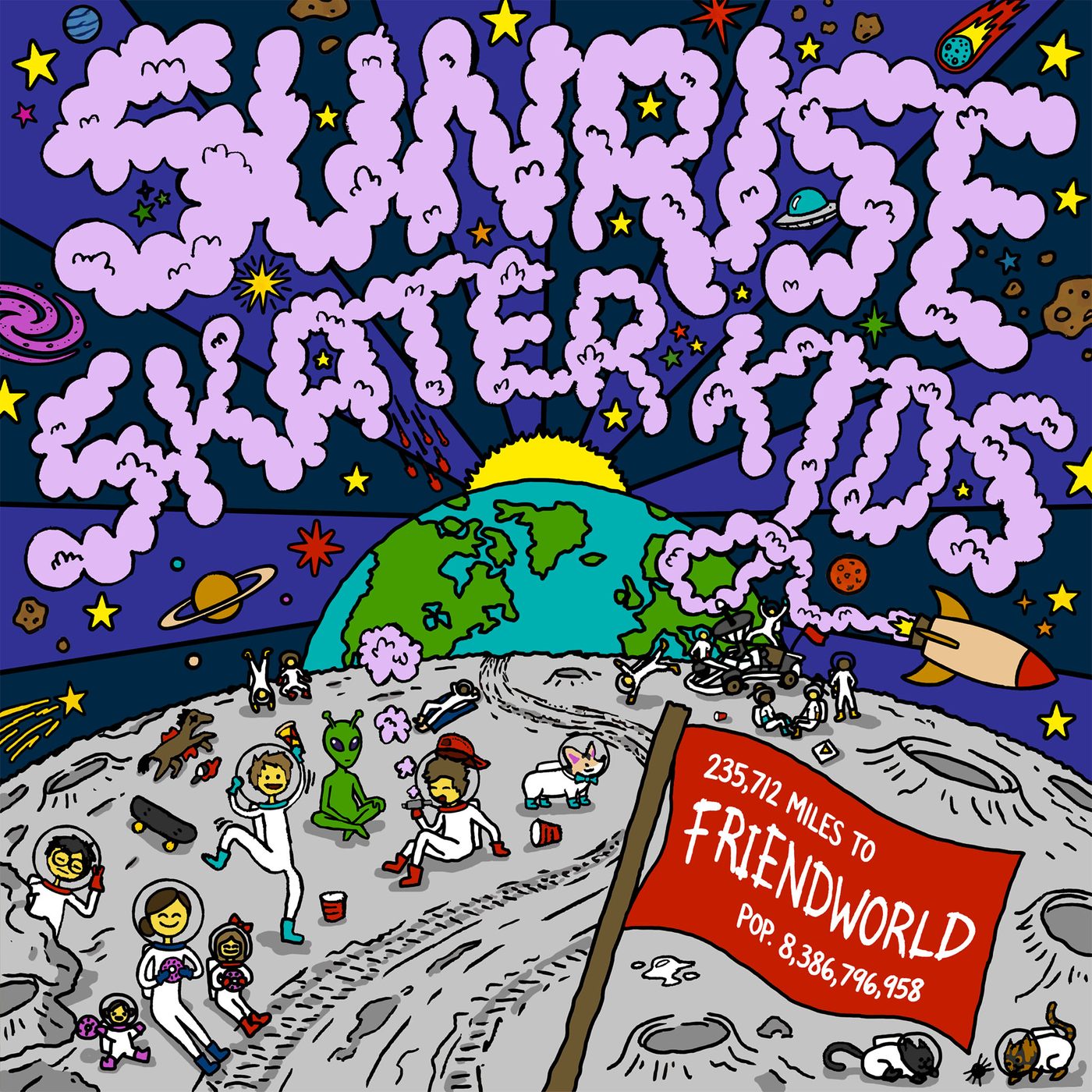
“Friendworld” is Sunrise Skater Kids’ second full-length album, released independently through Jarrod Alonge’s Boketo operation. The ten-track record first arrived as a direct-to-consumer download on 21 September 2026 before reaching streaming platforms on 2 October. You can buy the album directly from Boketo, listen on Apple Music or follow Sunrise Skater Kids through their official YouTube channel. The jokes may have got older, and Jarrod and Clay certainly have more to complain about, but the pop punk is still very much alive.
🔔 IDIOTEQ is ad-free, independent, and runs on one person’s time. If you want it to stay that way: DONATE via PayPal or SUPPORT via Patreon.
NEW: IDIOTEQ Explore 🗺️ Browse 15+ years of our archive by city, country, and style. Find artists on the world map or trace related sounds through the styles map.
Stay connected via Newsletter · Instagram · Facebook · X (Twitter) · Threads · Bluesky · Messenger · WhatsApp.