

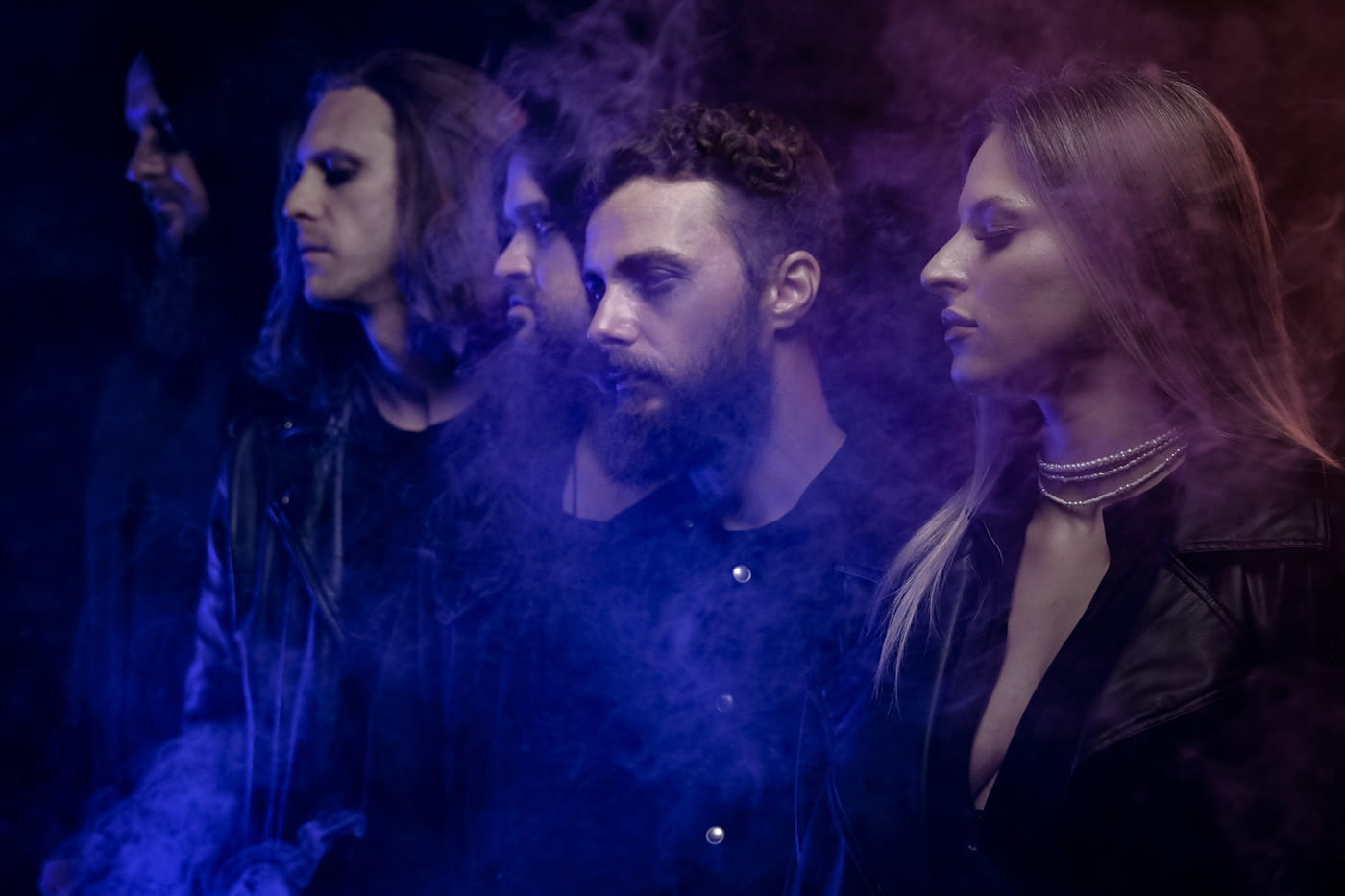
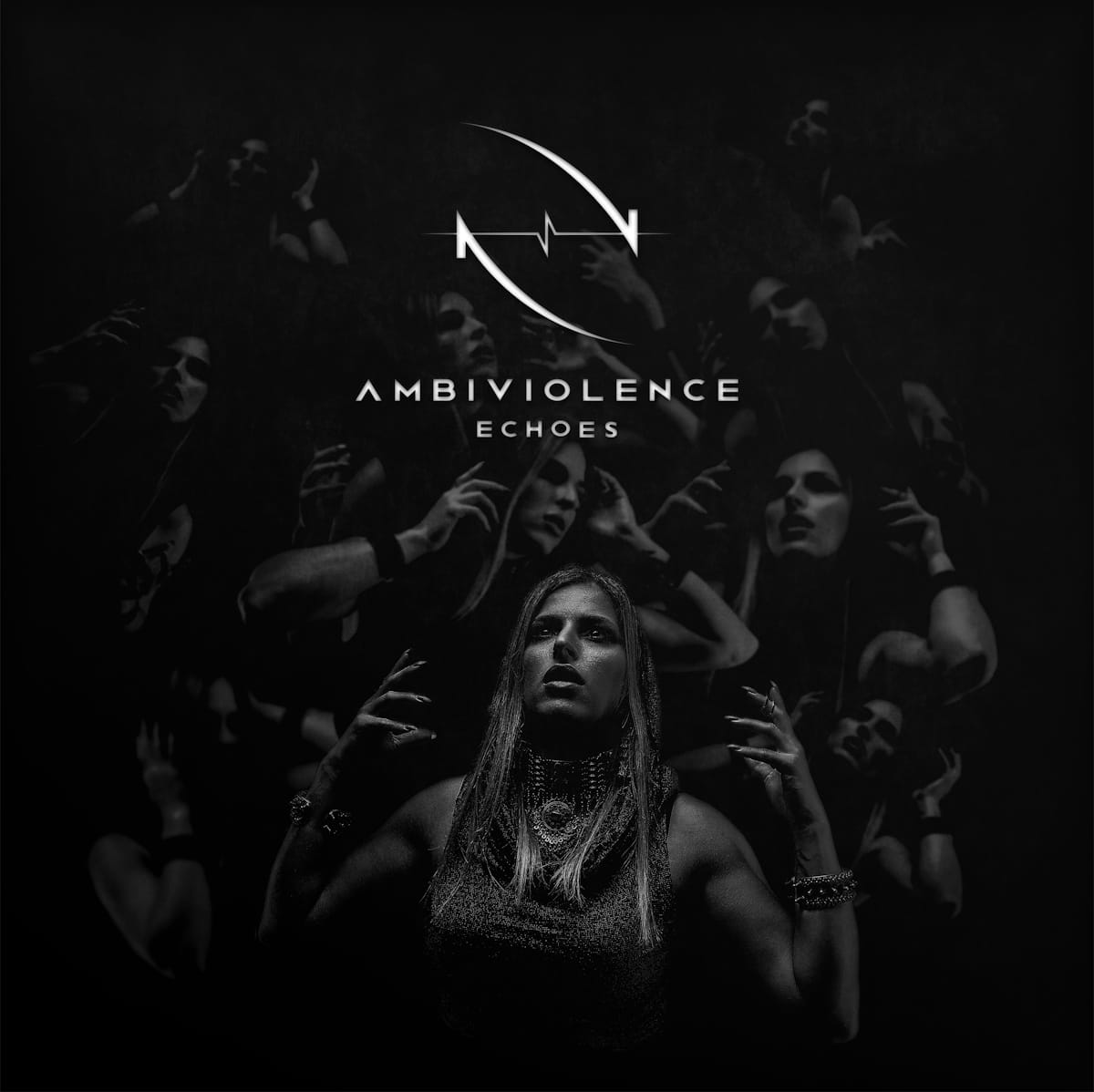
Franz had written most of the words to “Curse” before Salome joined AmbiViolence. When she first tried singing them, the Ukrainian vocalist recognised something painfully familiar. She still gets that feeling every time she performs the song. On the Warsaw band’s new EP, “Echoes”, her voice moves between operatic singing and extreme vocals, with metalcore breakdowns, black-metal influences and electronics all finding their way into the five-piece’s self-described gothcore.
“Curse” deals with the damage somebody can do to themselves by ignoring what is wrong for too long. Elsewhere on the three-song release, “Siren” directs its anger at Russia’s war against Ukraine, and “Crown of Whispers” gets caught up in the things people tell themselves when they’re trying to sleep. The people behind these songs come from Poland, Belarus and Ukraine. Some have known one another for years. Salome arrived in Warsaw after fleeing the full-scale invasion in 2022, having given up extreme singing a decade earlier.
All interview quotes from AmbiViolence have been translated from Polish into English.
“When I first sang ‘Curse’, I immediately felt it reach right inside me,” Salome said. “I think it affects me in exactly the same way every time I perform it. I also believe that for many listeners, it could give a voice to their own experiences and emotions, which Franz put into words so accurately and sensitively.”
The words that struck her include a line about becoming everything you once hated and despised. By this point in the song, the narrator has started recognising the damage left by old memories and the person he has become.
“There are moments when you realise where life has taken you and conclude that you can’t stand being there for another second,” Franz said. “I think we’ve all experienced something like that in our own way. Plenty of things can eat away at you: relationships, habits, passivity. Everyone will find something of their own in there. ‘Curse’ is about the devastation that ignoring these things for too long can cause.”
The song was already part of AmbiViolence’s material when Salome joined in October 2023. Franz had started the whole thing as a studio black-metal project, initially working on the music and vocals himself. Her arrival brought another voice into those existing arrangements. She changed some vocal parts and passages of the lyrics, then gradually began writing new material together with Franz and the rest of the band.
Salome has an affection for the gothic imagery in their words. She suggests imagining the lyrics being read in a cemetery on a foggy day. Put that together with operatic singing, fry screams, blast beats and breakdowns, and you get some idea of why the band settled on the term gothcore.
TPH, the bassist, admits that his own listening habits are quite far removed from what AmbiViolence play.
“What we listen to every day doesn’t entirely overlap with what AmbiViolence play,” he said. “For me, this kind of music is completely unfamiliar. Even if I named a few records or bands, it would still be difficult to find references to them in our music. Somebody who knows this style better might be able to say what our songs resemble, but I can’t. And I don’t think we need those comparisons to define ourselves.”
The name gothcore came about spontaneously because their influences were so varied. TPH sees the gothic element in the group’s music and lyrics, even though those influences aren’t necessarily direct. Franz reckons the term suits them well enough, although he cares little about genre categories. Salome is comfortable with the difficulty of pinning the band down. None of them is interested in establishing a new musical rulebook.
For Salome, getting back into this kind of music took a long and fairly complicated route.
Her first band, back in Ukraine in 2011, played ethno-rock. She sang Ukrainian poetry with clean vocals, but soon realised she wanted to do something else. Death metal followed, along with invitations to a black/death-metal group and a trip-hop-influenced alternative-rock project. She was studying and working at the time, and trying to keep several bands going eventually burned her out.
One of those projects gave her complete freedom to write songs and pursue her growing interest in black metal and demonology. She remembers a sound somewhat reminiscent of Opera IX, without the synthesisers. The band never managed to record anything or play live. Everyone was too busy, and eventually the project fell apart.
In 2012 she moved to Minsk, Belarus, and joined another death/black-metal band. They were making progress and had started recording an album when conflicts between members brought everything to a stop. Once again, no completed record and no gigs. She lost the desire to sing and stepped away from it altogether.
She returned to Ukraine in 2014. Four years later she moved to the Philippines, spending two years there and occasionally experimenting with meditative music and clean singing. Those sessions were enjoyable precisely because they came without commitments. The people involved agreed to keep them as loose jams. She returned to Ukraine in early 2021 without any active band.
Then came February 2022.
“I had to leave everything behind and flee to Poland,” Salome said. “Honestly, it wasn’t my choice. I stubbornly refused to accept the change, but life eventually went its own way.”
Settling in Warsaw was difficult. She was making new acquaintances, including somebody she met first at an ecstatic dance event and then, completely by chance, at an acting workshop. They became friends. At some point she told him her story, including her years playing metal.
That same person later happened to meet AmbiViolence guitarist Aleks at Scena Chmielna, a Belarusian club on Chmielna Street in Warsaw that has since closed. Aleks mentioned over a beer that his band needed a female vocalist. He was given Salome’s Instagram contact.
For somebody who had stopped singing extreme metal ten years earlier, the invitation came with a fair amount of anxiety.
“Before I met Aleks, he sent me a few messages and demos,” she recalled. “I recorded a couple of vocal parts over them, just improvising and going along with the music. Aleks and Alex invited me to an introductory rehearsal at the studio. There were three of us, and I was really excited, but also stressed because I hadn’t used extreme vocals for ten years. I had absolutely no idea what I would sound like after such a long break.”
She found a way to calm herself down.
“After stealing some of Aleks’s beer to settle my nerves and letting out my first roar, the guys recorded a few videos of the rehearsal and sent them to the other members. I suppose it went pretty well, because they haven’t given me a moment’s peace since.”
“If it weren’t for my band, I would definitely have gone back home, even if the war was still going on, or moved somewhere else. It was really difficult for me to find my feet here.”
“But every one of us puts so much work and commitment into AmbiViolence that there’s no turning back now. I believe in this project like never before. We’re all adults and nobody wants to waste time. Everyone takes responsibility for what we do, and the whole thing keeps developing and getting better. It gives me enormous joy, makes me believe in our future together and inspires me to create more and more.”
AmbiViolence had already been through several changes by the time Salome turned up. Aleks, originally from Belarus, first met Franz in 2019 when he joined Franz’s metalcore band Hangman’s Hill on bass. That band eventually split, but they kept working together. Aleks also recorded bass for “Phantom Hearth”, an early track from Franz’s studio incarnation of AmbiViolence.
Franz later met Ukrainian drummer Alex during an unsuccessful audition for another band. He suggested the three of them get together independently.
“That’s how AmbiViolence started, in July 2023, over a beer on a bench in Mirowski Park in Warsaw,” Aleks said. “For a month we played as a trio: guitar, bass and drums. We needed another guitar, but we had trouble finding a second eight-string guitarist.”
Aleks was a guitarist by background and had been playing bass for a change. Returning to guitar meant getting used to an eight-string instrument, something he’d never played before. After several years concentrating on five-string bass, it took some work.
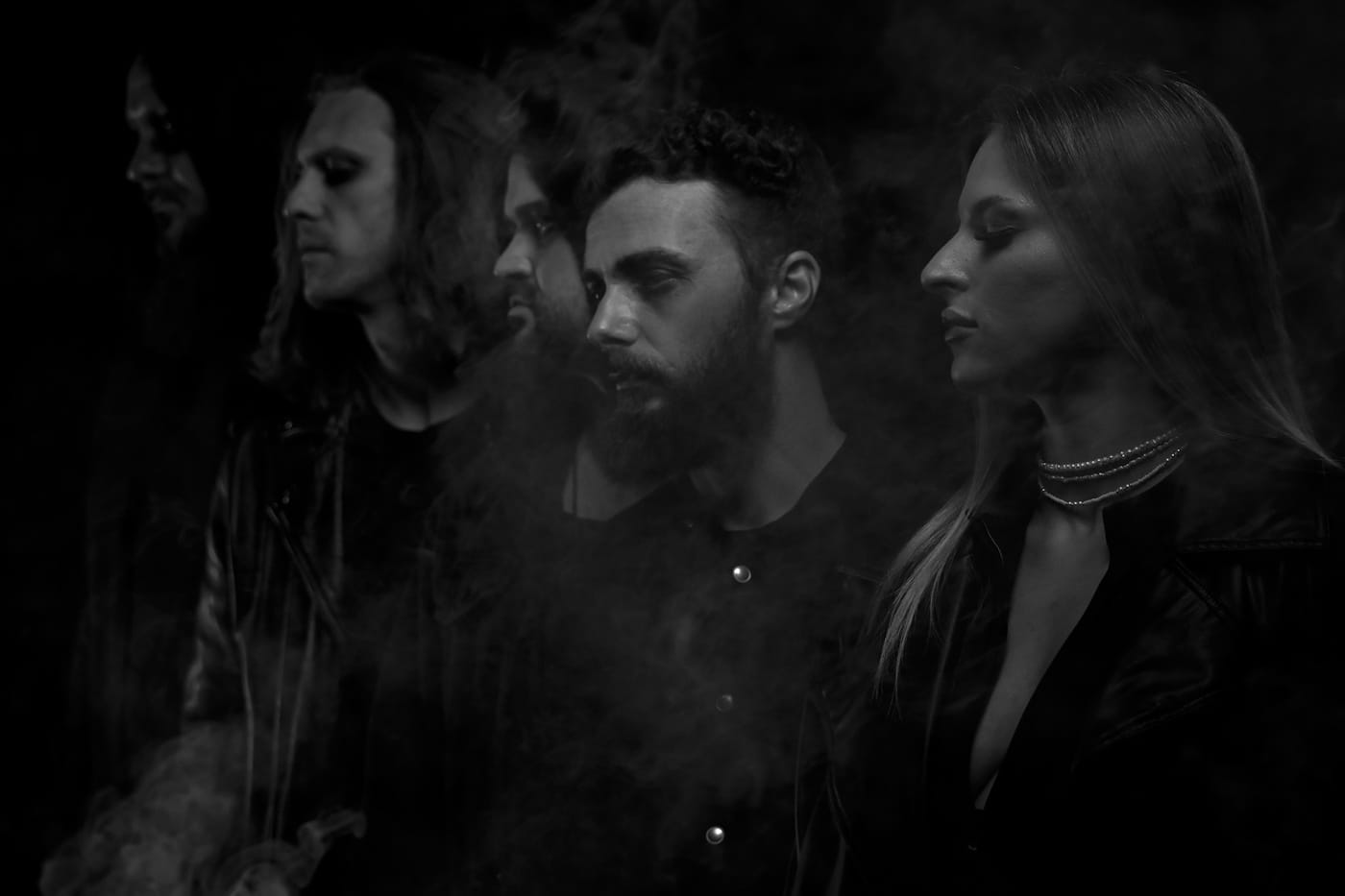
He put an advert on Facebook looking for a new bassist. TPH came to an audition in August 2023 and stayed. Salome followed in October, giving the band its five-person line-up.
“I think we all wanted to say something of our own, and the musical approach suits each of us,” Aleks said. “Our musical sensitivities are similar and at the same time very different. Without being unnecessarily modest, I think that lets us do something quite interesting and original with AmbiViolence.”
Those differences have affected what gets recorded. The band’s self-titled EP came out in September 2025, containing “Space”, “Walk Among Devils” and “Phantom Hearth”. “Echoes” arrived just over a year later, although its songs weren’t all new. “Crown of Whispers” was the first piece TPH ever played with AmbiViolence.
They’d also written material that hasn’t made it onto either release. Some songs failed to satisfy all five members. They experimented with different guitar tunings before setting those ideas aside, concentrating on arrangements that worked with their heavier approach. TPH leaves open the possibility of revisiting the unused material in another form.
Franz sees the three songs on “Echoes” as separate stories, joking about their titles as a curse, a siren and a whisper. Salome connects them through the voices that people carry around inside their heads.
“The main idea is voices in your head. A monologue that drives you insane,” she said. “The piercing sound of madness and pain that wants to get out becomes a scream, and the scream becomes an echo. In the end, nothing changes. But try keeping it all bottled up inside, and everything explodes with nuclear force.”
On “Siren”, that scream has a specific political target. Franz hears the song as a response to the fear, uncertainty and violence of the world around the band, calling it a cry of despair for a reality buried under rubble. Aleks puts it plainly: some of them come from Belarus and Ukraine, and they know something about state terror and war.
Salome wanted the song to draw attention to Russia’s war against Ukraine and to give her rage a place in the music. Her account is deeply personal, and she has no interest in making it sound detached.
“There are no words that could describe the level of rage and frustration I wanted to pour into this song,” she said. “It’s only the tip of the iceberg. This is where that aggressive, uncompromising element of our music comes out.”
She directs her anger at Russia’s leadership and those responsible for carrying out its violence, using language as brutal as the feelings behind it.
“It’s built around the desire for endless suffering for that sadistic Russian pig sitting at the top of the hierarchy and all his cruel orcs below him,” Salome said. “Every single word is like a spell that I hope will come true one day. Like every dictator before him, he too will eventually fall. I just hope that day comes as soon as possible.”
“It may sound extreme, but honestly, if you’ve got nothing to do with any of this yourself, of course it will. This subject and this song bring out all the darkest parts of me. And that part of me has absolutely no fucking mercy.”
Her anger extends beyond her own displacement. She talks about children who have lost their parents and homes in bombings, families waiting for people who won’t return from the front, and those forced to leave their countries.
“It’s the song of a warrior preparing for a battle that could be his last. It’s the song of a generation of children who lost their parents and homes to bombing. It’s the song of a mother who lost her husband, son or daughter at the front. It’s the song of all those who left or lost their homes and were forced into exile.”
“Ukraine, Belarus, Georgia and other neighbouring countries have all been affected by this evil. They’ve suffered and continue to suffer while that evil gnome remains in power.”
Among the events she had in mind was the explosion at a Russian-occupied detention facility near Olenivka in Ukraine’s Donetsk region on 29 July 2022. Ukrainian prisoners of war were being held there, including defenders of the Azovstal steelworks in Mariupol. Salome connects the lyrics’ reference to people burning alive with those deaths and holds Russian forces responsible.
At least 50 Ukrainian prisoners were killed and 151 injured in the explosions at Olenivka. The UN Human Rights Office documented those casualties and reported that Russian authorities obstructed efforts to establish what happened. Investigators rejected Russia’s claim that Ukrainian-fired HIMARS rockets caused the explosions. They could not determine the precise weapon used or where it was fired from. Some of the additional details recounted by Salome about the prisoners’ final moments have not been independently established by that investigation.
Franz considers the violent language in “Siren” part of what their music allows them to express. For him, the song also belongs to a world where people are living with the loss of places and lives they once knew. Salome’s involvement gives those words an immediate connection to events that forced her out of Ukraine.
“Crown of Whispers” stays with a different kind of torment. Its images of memories burning, thoughts spiralling downwards and somebody digging through what remains of themselves grow out of an everyday habit Franz knows well: lying awake, rehearsing arguments that ended long ago.
“In the evening, just before falling asleep, that’s when you think of that one answer, the brilliant, devastating comeback you never actually gave,” Franz said. “And then there’s no pretending, because who would you be pretending for? Everything’s out on the table. You know who’s to blame for what, and sometimes it stings, it burns. ‘Crown of Whispers’ is basically a flowery description of late-night overthinking.”
Salome puts it more mischievously.
“At night, all the demons in your head start a group chat where they join forces to come up with the worst possible insults and look for new ways to make your life even more miserable.”
The band made a video for “Crown of Whispers” themselves. Franz handled most of the filming, editing and lighting, and the original visual concept changed while they were working on it.
“There was a lot of improvisation and a lot of luck involved,” he said. “The original idea was slightly different, but I think it turned out well. That’s what I love about creative work with people, especially these particular people. Somebody always comes up with a thought or an idea that one person alone simply wouldn’t have had.”
Salome appreciates how much everyone can contribute beyond playing their instruments. Franz’s experience with cameras, lighting and editing meant they could make the video themselves, with the rest of the band helping develop the result.
Back in the rehearsal room, the songs are just as open to change. The guitarists generally bring in an initial sketch, and then everybody starts working on the arrangement. TPH says recorded songs often pick up new details when played live, because nobody feels especially obliged to reproduce every part exactly as it was tracked.
“We don’t want to limit ourselves to what we’ve already recorded once,” he said. “Our music keeps evolving. We change as people, and over time you can see the effect those changes have on what we’re creating.”
“Curse” is a good example. Its arrangement was still changing during the recording sessions, after earlier revisions had given the song greater dynamic range. The fretless bass passage that opens the finished track was the final thing they recorded during those sessions.
Working with recorded demos gives them time to try ideas before committing to them, and that freedom extends to the lyrics. Franz and Salome regularly exchange unfinished passages, rewrite lines for each other and make spontaneous changes while recording vocals.
“It’s a bit like playing ping-pong: one sentence from Franz, one from me,” Salome said. “Sometimes I’ll spontaneously send him the draft of a poem, and he’ll send it back edited or expanded. Sometimes Franz writes the whole lyric from beginning to end, and sometimes I do. Very often, when we’re recording my vocal parts, we’ll change a word, or even an entire sentence.”
“Space”, from their 2025 debut, went through one of those improvised revisions. Its original lyrics were in Polish under the title “Przestrzeń”, meaning “Space”. Salome translated and rewrote them in English while preserving the rhymes. When they recorded the main vocal, there were still gaps between verses, so they improvised an additional passage at Aleks’s flat.
She thinks Franz wrote those extra words while she devised the melody and vocal arrangement, although she’s no longer certain who contributed exactly what. The song is one of several examples of how the members pass ideas around until they’re happy with them.
There’s already a new lyric being written by Salome. She sent it to Franz, who wasn’t convinced by every part, and she’s defending the passages she wants to keep. Neither knows exactly what the finished song will become.
AmbiViolence record their work themselves, with Franz responsible for much of the technical work. During the “Echoes” sessions, they tried collaborating with several people but eventually decided that the results weren’t close enough to what they wanted. They kept the recording and mixing under their own control, bringing in an outside engineer for mastering.
“We record everything ourselves, almost in a garage-style way,” TPH said. “The tools available to people like us today make it possible to get pretty decent results. The way we record and the way we perform live are quite similar, so there’s no great difference for us between playing a gig and recording the material. That makes it fairly easy to take what we’ve recorded into a live performance.”
They had planned from the beginning to send the mastering elsewhere. Haldor Grunberg of Satanic Audio was recommended to them, and the job went quickly enough, with results they liked, that they saw no reason to look further.
Mixing takes far longer. Every member hears different things that need changing.
“We definitely spend the most time on mixes, because we’re trying to satisfy five people, each of whom pays attention to completely different details,” TPH said. “It isn’t simple, and reaching a compromise doesn’t always happen quickly. But ultimately we’re happy with how the material sounds today.”
The ability to do all this themselves gives them room to keep changing arrangements until the last stages of a session. TPH likes how accessible recording technology has become for small bands, even if having that freedom can make the process longer. The group can test an idea, hear it back and decide together whether to keep it.
Warsaw gives AmbiViolence plenty of people to play with, but its size can make getting noticed difficult. TPH has been part of the city’s heavy scene for roughly fifteen years. Before that, he was involved in Poznań’s much smaller underground.
“Warsaw’s scene is far more scattered,” he said. “In a way, that’s one of its biggest strengths, although at the same time it’s difficult to find all the bands worth listening to simply because there are so many of them. It’s good that so many people can do what they want creatively.”
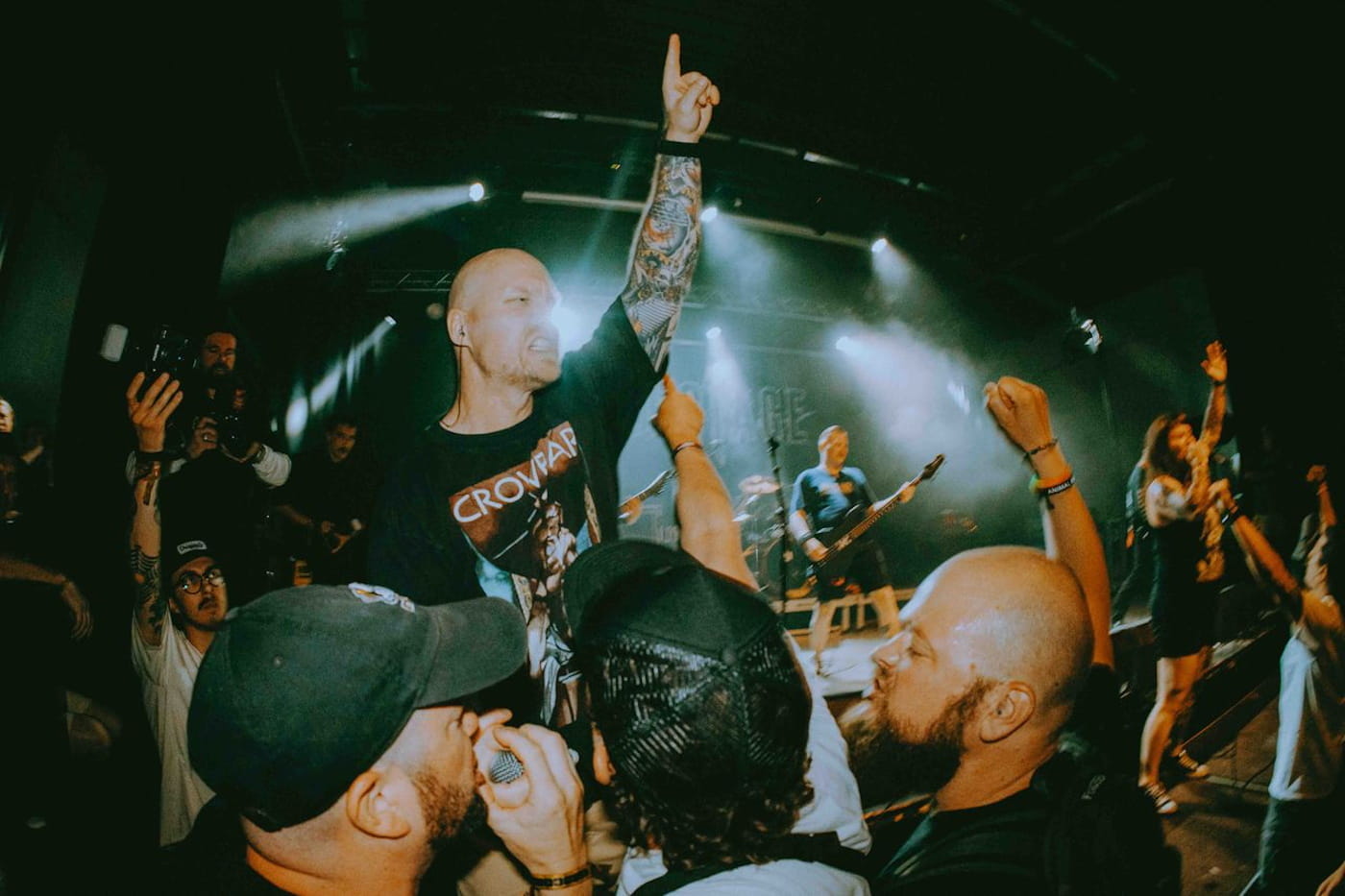
The group are still working out how they want to present their music live. Franz is interested in doing more with the visual and theatrical possibilities available to them, and TPH sees their performances as something that will continue developing alongside their playing.
Franz also knows the disadvantages of playing in a city where several bigger acts and dozens of small bands might have shows on the same evening. People often choose gigs based on where their friends are going. He remembers playing in Ciechanów and Tomaszów Mazowiecki, where the situation could be very different.
“Sometimes a small band from Warsaw is the only thing happening in town that day,” he said. “So even people who aren’t connected to that kind of music turn up just to have a good time.”
Aleks played relatively few shows in Belarus and considers Warsaw his first real heavy-music scene. AmbiViolence have shared stages with Dead Due, Deadly Nightshade and Super Fun Happy Hour, three groups he recommends checking out even though their styles differ from what AmbiViolence are doing.
More recordings are already being discussed, potentially on a larger release. TPH expects the band to keep the heaviness and electronics that have become familiar parts of their music, but some of the experiments they’ve abandoned may find their way back into new arrangements.
“We’re probably going to close a certain stage of the band’s activity and sum it up,” he said. “We’ll be working on something a bit bigger, but it’s far too early to say which way the music will go. We expect it to be heavy and to have those electronic elements that are characteristic of our sound. But it might turn out that we head somewhere completely different.”
“Echoes” was released by AmbiViolence on 2 October 2026, with mastering by Haldor Grunberg of Satanic Audio. The three-song EP is available through Bandcamp, Spotify, Apple Music and the band’s other official channels. Their self-produced “Crown of Whispers” video is also out, showing what this five-person operation can put together when everyone gets involved.
🔔 IDIOTEQ is ad-free, independent, and runs on one person’s time. If you want it to stay that way: DONATE via PayPal or SUPPORT via Patreon.
NEW: IDIOTEQ Explore 🗺️ Browse 15+ years of our archive by city, country, and style. Find artists on the world map or trace related sounds through the styles map.
Stay connected via Newsletter · Instagram · Facebook · X (Twitter) · Threads · Bluesky · Messenger · WhatsApp.