
On “Tempest Mirage”, Sidewave’s Phil Golyshko imagines walking through the door of his childhood home and finding himself back in 1991. He hadn’t visited the place in over a decade when the idea came to him. A few songs later, he’s wishing he could slow down the passing years, and on “The Red Tide” he’s thinking about the day his child will grow up and begin a life away from him.
These songs belong to “Dispel“, the third album from the Denver-based alternative rock and shoegaze project, and the first Sidewave record in eleven years to bring back drummer Brandon Dickert and bassist Matt Russell. Phil spent roughly six years writing it, filling the songs with thick, distorted guitars, synths and the melodic pull he’s always loved in bands such as Hum and Swervedriver. By the time he invited his old bandmates to record, the arrangements were practically finished.
And hell yeah, we needed some of this sound on our pages to balance things out in our catalog.
Some of those songs had been sitting on his computer for so long that he’d become attached to every programmed drum hit and temporary bass part. Hearing Brandon and Matt play them was an adjustment, even though bringing them back had been the plan for years.
“The funny thing is, after listening to my demos for so many years, I initially had trouble adjusting to the changes he brought to the songs. I had to listen repeatedly just to get past my own familiarity bias. Now I can’t imagine the songs any other way.”
Phil had learned what was missing when he made 2019’s “Ultraviolet” entirely on his own. He could write and record as much as he wanted, but he couldn’t reproduce his friends’ musical instincts. “Dispel” gave him another chance to hear what they would do with his songs, even with the three musicians now living hundreds of miles apart.
For somebody making music with so much guitar distortion, Phil is remarkably interested in the little things that happen underneath it. Matt’s bass on “Wash Away” is his favourite example. The part moves in and out of the main guitar figures, with small melodic runs that sit tightly against Brandon’s drums. Phil had been fairly indifferent to the song before Matt recorded his part.
“His little flourishes really make that track something special for me, whereas before I was honestly kind of “meh” about it.”
Brandon did something similar on “The Surface”, changing the feel of verses and interludes that Phil had originally written with steadier rhythms. His new syncopated drum parts made those sections move differently without requiring a rewrite of the song.
These were songs Phil had spent years getting exactly how he wanted them, and some of his favourite parts of the finished album were things he hadn’t thought to write.
The first Sidewave album was born from considerably more time spent in the same room, although getting the musicians together was a problem even then.
Phil’s history with Brandon and guitarist Bill Collins goes back to suburban Illinois. Around 2007, he met Bill through Bill’s girlfriend, whom Phil had known at high school. They quickly got talking about The Life and Times, Oceansize and other bands they both loved. Bill was working at a studio in Orland Park and had placed a Craigslist advert looking for a drummer. Brandon answered it, and the two began spending late evenings playing together.
Bill eventually invited Phil along. The project they called Big Bend combined Bill’s interest in unusual tunings and syncopated riffs with Phil’s love of long compositions and melodic chord changes. They worked up plenty of ideas, around sixteen by Phil’s latest recollection, although only four became complete songs. There were hopes of finding a bassist and getting onto stages, but the project fizzled out as the musicians moved away.
Wyświetl ten post na Instagramie
In 2011, Phil relocated to the San Francisco Bay Area. Living near the ocean gave him a fresh burst of enthusiasm for writing. He finished “Weightless” and began recording the “Big Time Demos”, which are still on Bandcamp despite the band never treating them as official full-length releases.
Bill and Brandon were living in Los Angeles, writing music for games, television, films and commercials. The friendship continued through visits, birthday celebrations and dinners whenever Phil was in town. In early 2013, the pair got in touch after listening to his recordings and suggested trying the songs as a band.
Phil began flying down regularly for rehearsals. Eventually, he left his equipment at their practice space.
“Kind of like leaving a toothbrush at a lover’s apartment. Things were getting serious.”
Wyświetl ten post na Instagramie
The three-piece needed a bassist. Bill had met a fellow musician and music fan named Kimo through an online forum, apparently through their shared interest in Houston. Kimo knew the Los Angeles rock scene and recommended Matt Russell. Phil remembers liking him almost immediately, both as a person and as a player.
By the middle of 2014, Sidewave had the four musicians who would record “Glass Giant”. They were writing and rehearsing with the intention of making a record they could take onstage, and Phil eventually moved from San Francisco to San Diego, then Orange County, hoping to spend more time with the others.
Even getting geographically closer couldn’t give them all the hours they wanted.
When the debut came out in October 2015, the band were operating on a limited budget. They borrowed recording equipment, tracked songs at their downtown Los Angeles rehearsal space and put what money they had towards mixing and promotion. After having some guitar parts re-amped at Back to Bassics in San Diego, Phil was introduced to Aaron Harris of ISIS and Palms, who mixed “Glass Giant”.
The band played Los Angeles shows alongside acts including The Life and Times, Black Map and Æges. A proper tour was something they wanted badly enough to discuss publicly. In an October 2015 interview with Rebel Noise, Phil was looking ahead to more writing with the group and the possibility of taking the album on the road.
He was also thinking about how much further Sidewave could go when everybody brought ideas to the table.
“Hearts” offered one example. Bill had written its music, with Matt and Brandon working out the arrangement before Phil added the vocal melody and lyrics. Bill’s guitar playing was rhythmically adventurous, full of unusual layers and sounds that could be abrasive or strange. Phil tended to chase attractive chord changes, big melodies and choruses. The two approaches gave Sidewave room to make songs neither guitarist would have written alone.
“Bill was much more rhythmically inclined than I was. He was a riff writer, but he also had this ability to create unconventional layers of guitar that didn’t really follow the usual rules of rock music. He was exceptionally good at making spectacular noise.”
Phil still regards “Hearts” as one of the band’s best songs. Bill’s music had a patient build and an enormous payoff, and Phil found a vocal part that worked with the arrangement. He wishes they had developed more songs that way.
“I think Hearts offers a glimpse of where Sidewave might have gone if we’d had more time to really collaborate. That combination of Bill’s unconventional instincts and my melodic sensibilities could have taken us somewhere pretty interesting.”
The problem was finding enough time together to do it. Most Sidewave songs still began as something Phil had largely written or as one of Bill’s ideas. They occasionally came up with something new while jamming, but the distance and their working schedules made that difficult to repeat.
Phil is quite open about his disappointment.
“I think we had the potential to become a much more collaborative band than we ever managed to be. That’s probably one of my bigger regrets about that era.”
The hoped-for tour never happened. They played a handful of local venues, but their crowds weren’t growing much, and going on the road without label support was too expensive. By around 2016, the band had effectively stopped operating as a live group.
Phil moved to Denver in the middle of 2017. Bill and Matt eventually moved back to the Midwest. Before continuing Sidewave on his own, Phil sent the others a message asking whether they were happy for him to keep using the name. They were completely supportive.
He still had songs from the final band period. “Killing Time” and “Vehement”, both played live before the split, eventually appeared on “Ultraviolet”. By the end of 2018, he had written five more tracks, including “Ultraviolet” and “Bricklayer”, two songs that allowed him to experiment with longer arrangements and different structures.
Working alone suited him in some ways. He could pile on guitars, use EBows and synths wherever he liked, spend weeks shaping the drums and mix the entire record himself. There was no rehearsal to prepare for and nobody waiting for the next batch of songs. The pressure had gone, along with much of the regular contact with other musicians.
“In my mind, it was a complete work of art that I’d created entirely on my own.”
Phil was pleased with what he’d made, but he could hear the absence of Matt and Brandon when he listened to the rhythm section.
“All that freedom came at a cost. The hyper-singular vision had stripped away some of the finesse and tightness that Matt and Brandon brought to the rhythm section. I could build these enormous walls of sound, but I couldn’t replicate the musical instincts of those guys.”
It was a lesson he carried into the next album.
After “Ultraviolet” came out in 2019, Phil had used up most of the songs he’d been keeping around. He had a new baby, fewer hours to work on music and no immediate reason to rush into another Sidewave release. A full year passed before he recorded “Headlong”, the earliest finished song for “Dispel”. By then the pandemic was underway, and the lyrics came directly out of that period, with the feeling of being stuck in a repeating dream and wanting somebody to pull him back into his life.
He told Brandon and Matt in 2020 that he’d been writing new stuff and wanted them involved. His rough expectation was to finish around 2022. The songs kept taking longer, and everyday responsibilities repeatedly pushed music into whatever free hours remained.
When Phil finally contacted the pair about recording in August 2025, the guitars and vocals were already done. Some of the demos had been sitting around for as long as six years. The arrangements were almost complete, with programmed drums and temporary bass parts giving the songs their rhythm while Phil worked on everything else.
Brandon and Matt were still happy to join in.
Matt had remained in contact with Phil and suspected something new was coming. He knew Phil’s way of working and wasn’t surprised to receive songs that already had a clear direction. Brandon remembered the rehearsals and recording sessions for “Glass Giant”, when Phil would regularly drive more than two hours from Oceanside to Los Angeles. Working across state lines was familiar territory for Sidewave, although now the three were spread between Colorado, California and Illinois.
There was one thing Brandon always appreciated about Phil. He knew exactly what he wanted from a song, but listened carefully when somebody else suggested a change.
“The main constant is Phil knows exactly what he wants. Sidewave is his baby, and he’s always brought his songs to the table as fully formed sonic landscapes. We try to honor that the best we can.”
For “Dispel”, Brandon played through the demos, worked out where he could bring something of his own and sent recordings back to Phil. Most songs needed only one round of comments. “Tempest Mirage” was the exception, requiring two.
Phil had to spend time listening to the new performances without constantly comparing them with his programmed versions. He sometimes played the recordings several times in a row to get used to the changes. Once he did, the songs began to sound like Sidewave playing together again.
Brandon’s favourite small intervention was the intro to “The Red Tide”. The guitar riff immediately brought Hum to mind, and he let some of Bryan St. Pere’s drumming influence the part.
“I think my favorite change was the intro to Red Tide. That riff just smells like HUM, and I was happy to channel some Bryan St Pere!”
Matt had his own method for working with Phil’s nearly finished recordings. He would listen to each song with the original bass muted, then record his own ideas. Once he felt comfortable with the track, he’d listen again with Phil’s temporary bass playing. Sometimes the two had arrived at similar ideas. Other times, Phil had written parts that hadn’t occurred to Matt, so he’d learn those and fold them into what he was doing.
He sent Phil several different bass takes to choose from, giving him the freedom to use the parts that worked best. Matt describes the process with an excellent word.
“So I’d Frankenstein his ideas and mine and deliver what I thought sounded the coolest to me and closest to what I thought he wanted, but he still had those other tracks to pull from to lay it all out as he saw fit. This is his baby.”
“Tempest Mirage” was a favourite for Matt, especially the chorus. He took the chance to add his own melodic flourishes and was pleasantly surprised to hear how much Phil retained.
The song itself had come together relatively quickly in February 2025, when Phil found that two ideas he’d been developing worked together. He had originally planned a much longer opening, but cut it back after deciding he didn’t want a seven-minute song with a three-minute intro. He recorded the guitars against a click track and built the programmed drums in Logic, then kept adding parts until he had something he could begin singing over.
Its words went somewhere very personal. Phil had been thinking about his childhood home, a place he hadn’t visited for more than a decade. He imagined walking through its door and suddenly finding himself back in 1991, when the future still seemed full of possibilities. He was clear that he wouldn’t trade his present life for the chance to start over. The idea of returning to that particular moment still appealed to him.
“Big Whisper” deals with another kind of passing time. There’s a line about wanting to slow things down, which Phil connects to loving the people closest to him while knowing that some moments together will never happen again. Being a parent has made that feeling stronger. He also sees the song as encouragement for somebody he loves to follow their own ambitions and keep doing the things that excite them.
The guitars are among the most densely arranged on “Dispel”. Phil used more than sixteen guitar layers on “Big Whisper”, a song recorded partly with B-standard tuning, alongside “The Surface”. He had spent years trying different fuzz pedals before settling on the Electro-Harmonix Deluxe Big Muff Pi as the main source of his guitar distortion, with a Nuñez Tetra-Fet Drive contributing other parts. There’s a lot of extra recording work underneath the main riffs, although he still wants the songs to move with the weight and rhythmic pull of a rock band.
On “Let the Stars Turn to Dust”, he used seven E-Bow guitar parts and three synths just for the intro. Some of its melodic ideas came from listening to Genesis and Tears for Fears, and Phil found himself drawn to the simplicity of their vocal melodies. Another passage has an unmistakable eighties influence, something he was happy to leave in the finished song.
It all fits his long-standing interest in building songs out of layered guitars, synths and effects. He once imagined Sidewave landing somewhere between M83 and Hum, although his instinct to write big guitar riffs has usually won out.
Mario Quintero of Spotlights mixed “Dispel”, with Dereck Blackburn handling mastering at Quiethouse Recording. Phil had admired Mario’s production work for years and wanted that combination of weight and clarity. He prepared his basic guitar tracks with plenty of room for Mario to shape the sound, while exporting some of the more complicated guitar and synth parts with their effects and automation already set. After working remotely on the mixes, he flew to Mario’s studio in June 2026 for a final session that took around two hours.
Bill Collins wasn’t involved in the new album. Phil would have liked to hear what Bill might bring to these songs, but by the time the recordings were ready for other musicians the guitar and synth arrangements were too developed. Bill’s best contributions came from getting involved early in the writing, and Phil didn’t think exchanging finished tracks remotely would give them enough room to work that way.
He still talks about Bill with plenty of affection.
“Bill is an incredible musician and a good friend. For this album, much like Ultraviolet, I’d already recorded a pretty intense number of guitar and synth layers while writing the songs. I would’ve loved to have him contribute, but the arrangements were already fully realized by that point.”
Bill has continued making music with Forbidden Seas, releasing two singles in 2024 with Matt and Brandon contributing to the recordings. Phil is a fan and points to “Wolves, Sheep” as a song where some of Bill’s old Sidewave instincts can still be heard. He had spoken with Bill recently, and more Forbidden Seas music may be coming.
The original friendships have lasted. Getting Sidewave back onstage would require rather more planning. Everyone now lives in a different city, with jobs and other responsibilities, and finding enough rehearsal time would be a serious undertaking. Phil still likes the idea of playing the songs live, although there are no plans in place.
And the music they’d be playing has found a different generation of fans in the meantime.
Heavy shoegaze and space rock occupied a much smaller corner of guitar music when Sidewave released “Glass Giant”. Phil remembers how bands such as Nothing and DIIV began drawing new listeners into shoegaze, leading some to discover older records and then make their own versions of that sound.
He has seen the change firsthand. At Slide Away, he watched Hum play to younger fans who were excited enough to start a mosh pit.
“Watching a crowd of younger fans erupt into a mosh pit for that band still gives me goosebumps. I honestly hadn’t seen that kind of energy at a show in decades. It was incredible.”
Sidewave haven’t received a comparable surge of interest in their older albums. Phil is pleased to see bands he loves connecting with younger listeners, but the sheer number of new shoegaze acts makes it harder for independent artists to get heard.
“If anything, the sheer number of bands making this kind of music has made it harder to stand out. There’s so much great music competing for the same listeners that it’s arguably more difficult to get noticed now than it was ten years ago.”
He still checks out new music. Shye’s latest album has been a favourite, along with a recent Purple Pilgrims single. He has also been listening to Trentemøller, whose more aggressive work combines electronic and industrial elements with shoegaze guitar sounds. Phil’s own tastes remain close to the heavier, melodic side of the genre, where the riffs stay prominent and the songs have room to change pace.
Promoting a record now means something quite different from releasing “Glass Giant” in 2015. Back then, the band borrowed equipment, made an album, hired a mixer, spoke to magazines and played shows. Social media was somewhere to share the activity. Phil now finds himself trying to make videos and posts throughout the entire recording process, then finding even more things to share once the record is finished.
He tries to treat that work as a series of small creative projects, but it’s difficult to produce a constant supply of interesting content when most of the actual music is being made alone. Instagram and Spotify occupy a lot of his attention, and he doesn’t always enjoy the feeling that he needs to document everything.
“It’s a strange position to be in. I spent years making this record because I love writing music, and now I have to spend an enormous amount of energy figuring out how to convince someone to stop scrolling long enough to hear it.”
There is another part of Sidewave that Phil continues making on his own. He’s designed the artwork for all three full-length albums, usually by experimenting until an image begins to suggest something interesting. He rarely starts with a fully planned concept, much as he rarely begins writing a song with the lyrics already in mind.
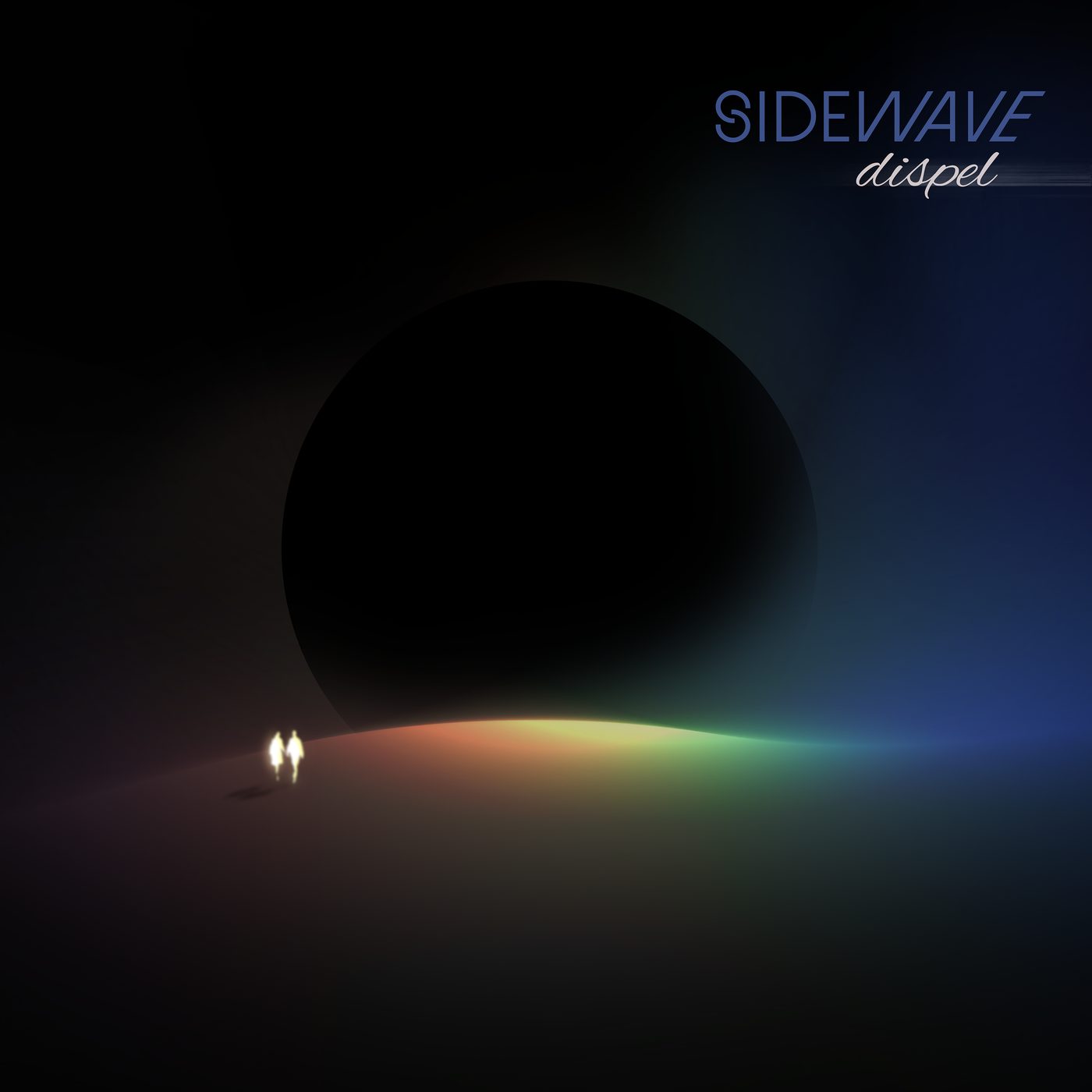
For “Dispel”, he returned to the visual world of “Glass Giant”. Both covers have two small figures travelling together across a vast, empty space. The artwork for “Ultraviolet” went somewhere else, full of colour and movement, but Phil wanted to bring those two travellers back for the new record.
Wyświetl ten post na Instagramie
On “Dispel”, they stand hand in hand near an enormous dark circle, with a strange band of colour spreading out across the ground. Phil imagined the darkness itself producing a rainbow-like glow, even though a real rainbow needs light. He was drawn to that impossibility, much as he dreams of seeing distant worlds and understanding more about the universe while knowing he’ll still need to get up for work and make dinner.
The two figures have a simpler meaning for him.
“For me, those two figures represent soulmates. There’s something profound about finding another person whose existence becomes inseparable from your own.”
He has returned to that image more than a decade after “Glass Giant”, and the songs around it have changed with his life. “The Red Tide” is about watching his child grow, knowing that one day they’ll have a world of their own. “Big Whisper” comes from the wish to keep certain moments around for a little longer, while also wanting the people he loves to live fully and follow their own paths.
Phil’s approach to writing is still much the same as it was when Sidewave began. He picks up a guitar and plays around until he finds something that catches his attention. Once he’s got a few sections that belong together, he starts programming drums and recording layers. The words come later, sometimes after weeks of trying ideas.
“I’ve tried starting with bass lines or drum patterns, but my brain just doesn’t seem to work that way. I need to discover the song through the guitar first.”
There are fewer free hours now. Sidewave began with a young musician recording demos in San Francisco, became a four-piece playing Los Angeles shows and continued in Denver after the band stopped rehearsing. The third album brought Brandon and Matt back into the recording process, even if it didn’t bring everybody back into the same room.
“Dispel” was released independently on 23 October 2026. Phil wrote and recorded the nine songs, handling vocals, guitars and synths, with Brandon Dickert on drums and Matt Russell on bass. Mario Quintero mixed the record and Dereck Blackburn mastered it. The complete album is available on Bandcamp, alongside the earlier Sidewave recordings that go all the way back to the first demos.
🔔 IDIOTEQ is ad-free, independent, and runs on one person’s time. If you want it to stay that way: DONATE via PayPal or SUPPORT via Patreon.
NEW: IDIOTEQ Explore 🗺️ Browse 15+ years of our archive by city, country, and style. Find artists on the world map or trace related sounds through the styles map.
Stay connected via Newsletter · Instagram · Facebook · X (Twitter) · Threads · Bluesky · Messenger · WhatsApp.