

The first notes of Gyoza’s new songs pulled me, almost against expectation, towards the more rock-facing, lighter side Viva Belgrado have been showing in recent years. That is one of our favourite Spanish bands, so the comparison arrived quickly, then started to loosen. Gyoza are not working the same nervous temperature. Their songs draw you in through the soul of the thing: rock writing with a sideways sense of melody, grief sitting inside it without turning the whole room grey.
The Barcelona band first wrote to us with a simple note: they had been playing together for around ten years, were releasing a new EP the following week, and wanted to send the songs over for review. The route was a small Spanish underground chain in itself. Guillem from Damasco gave them our contact, while Marina Berlanga and Adrià Marva also play with him in Coherence.
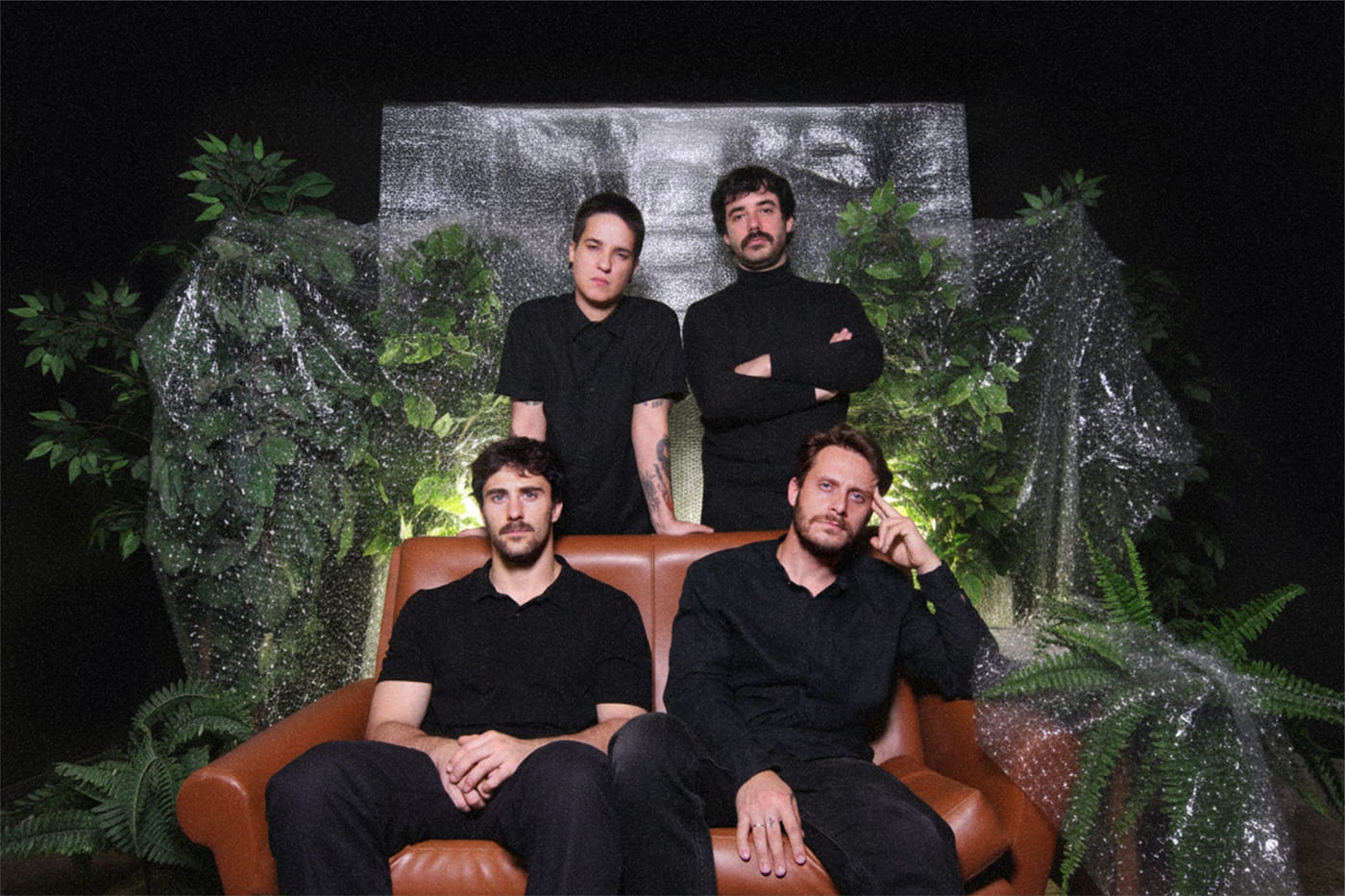
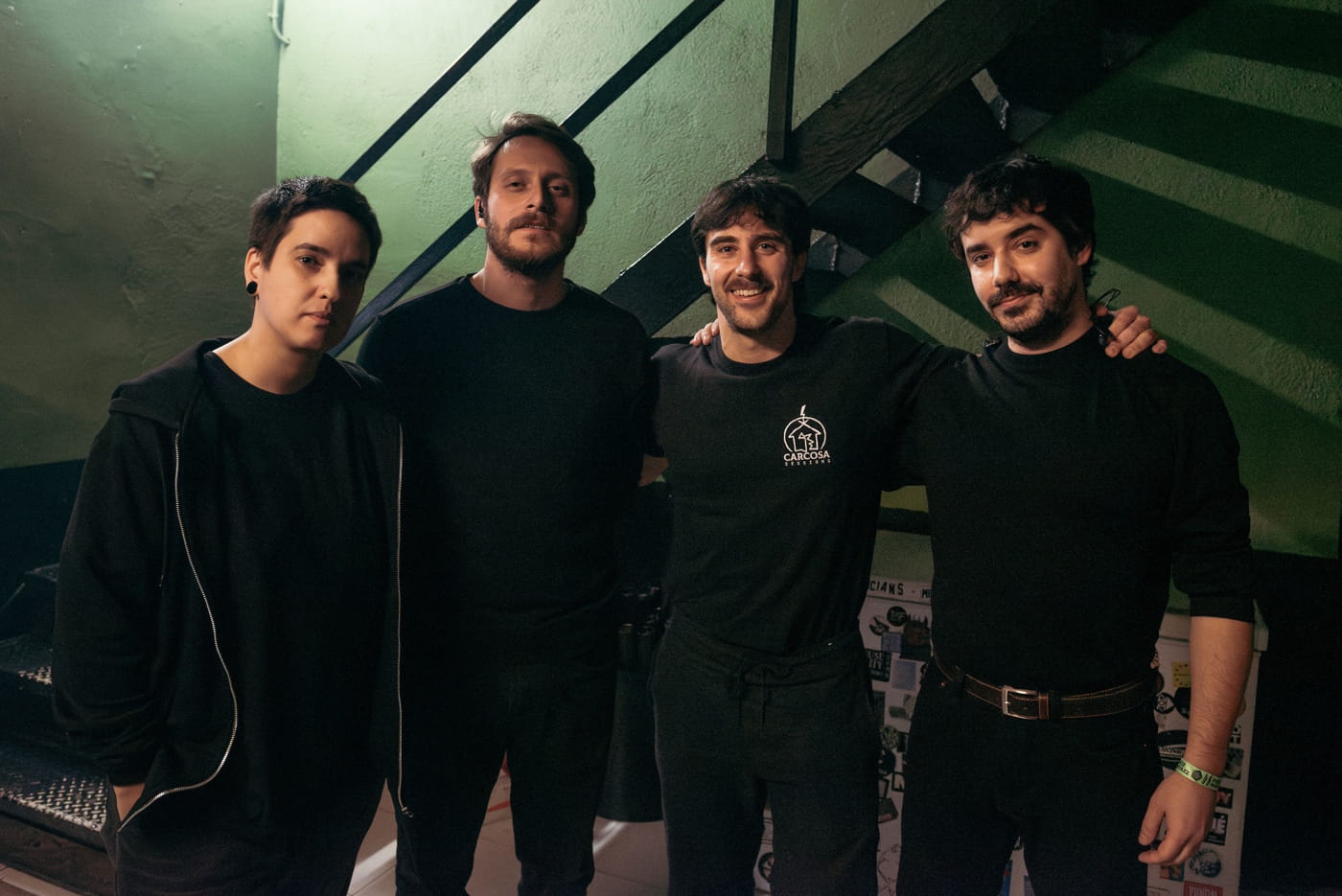
Gyoza formed in Barcelona in 2015 with Adrià Marva on vocals and guitar, Xavi Montferrer on guitar and backing vocals, Marina Berlanga on drums, and Alex Fernández-Cardellach on bass and backing vocals. They place themselves between alternative rock, indie, and experimentation, with progressive melody and firm rhythmic weight under Adrià’s voice, while keeping away from one fixed tag.
That history matters here because “Beber y soltar” does not sound like a band testing a new direction from zero. It sounds like a group already comfortable with its own shape, using rock songs to hold something heavier than the songs themselves can solve.
Their latest step is built around two linked releases: “Beber y doler” and “Beber y soltar“. The new EP continues the world opened by “Beber y doler“, where time does not clean the wound so much as change its weight. Gyoza have now put both works onto one vinyl, A-side and B-side, making them read as a single object rather than two separated chapters.
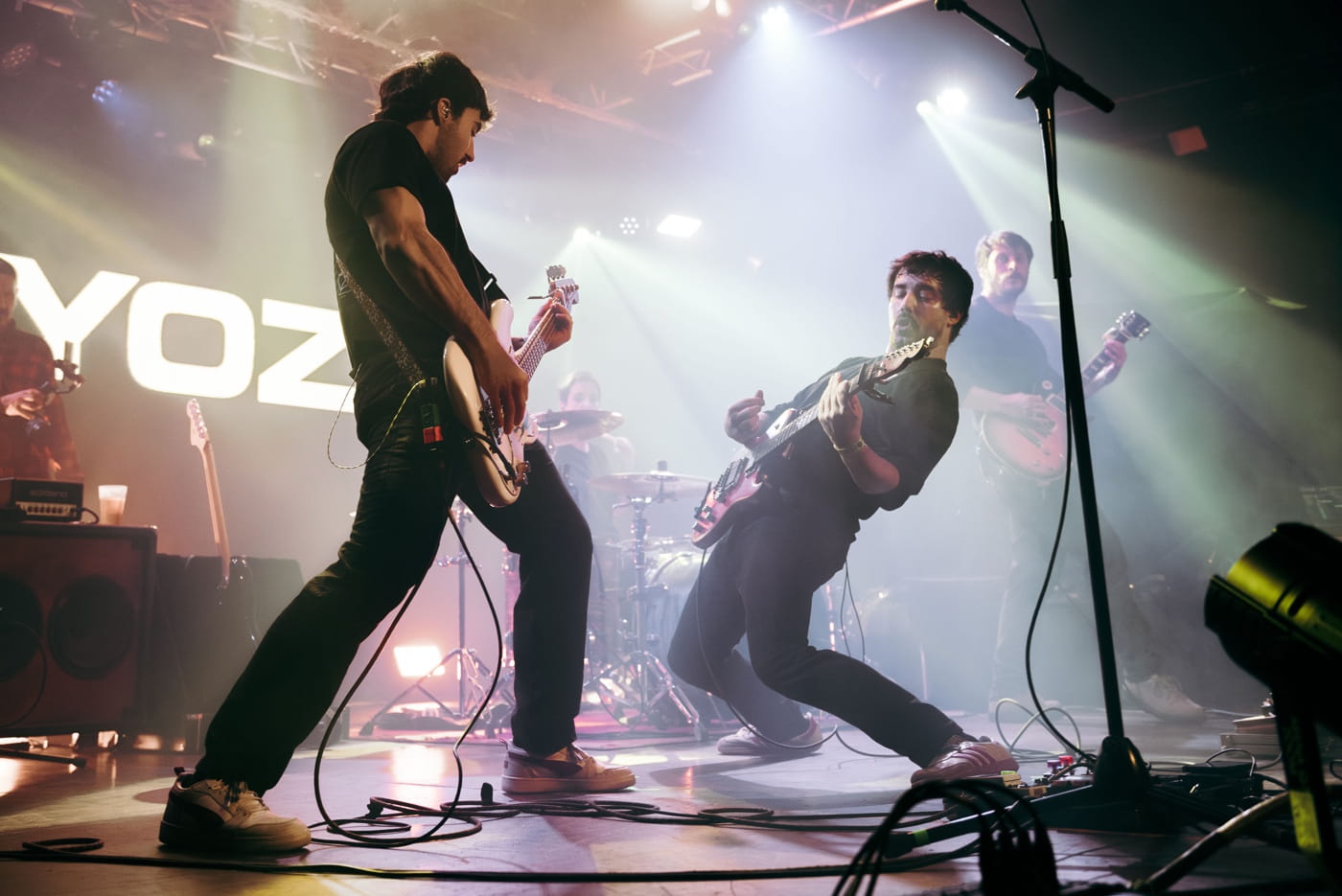
The same closed circle shows up in the credits. “Beber y doler” is performed by Gyoza and Isaac Valdés, with extra vocals by Violeta Mosquera from Bala. Adrià produced, recorded, and mixed both “Beber y doler” and “Beber y soltar” at Cal Pau Recordings and Bandicoot Records, while Jose González recorded the vocals for “Beber y doler” at La Atlántida Estudio. Victor Garcia mastered both works at Ultramarinos Mastering. The music is by Adrià, the lyrics are by Marina, and the visual side extends the same logic: David Rico shot the “Beber y doler” cover photo, Marina shot the “Beber y soltar” cover photo, Andrea Novalbos shot the band photo, Guillem Martín handled the artwork and concept, Jackie Aguilera took photos 01 to 08, and Andrea took photos 09 and 10.
The idea was not planned in any neat way. It came from the band sitting together after listening to new song ideas, drinking beers, and talking about grief. What shook them was not the thought of overcoming it, but the opposite: the slow realisation that grief may not be something you beat.
“It feels as if the idea of binding together both releases had been on our minds forever but it surely never was much planned at all,” they explain.
“On a conceptual level, we weren’t sure the road our next release after Beber y doler should take, but one afternoon we were having some beers after listening to some new song ideas to work on next while talking about overcoming grief and how that could be interesting as a central point in future work. And if something came across our minds during that conversation and startled us in an unpredictable way is realising that grief is here to stay and any effort made in order to overcome it will be in vain and also realise that we, human beings, are not willing to sustain or cope with emotional pain and are eager to get over things, quick, if possible, that may be too much to handle for us instead of gaining personal perspective over life-changing events. Grief may change in form and it will sure change you as well, but it will never go away. So it seemed clear to us that Beber y soltar should revolve around becoming aware that getting over grief was never an option in the first place and the process now was to allow it to be a part of the life and new reality that comes after loss.”
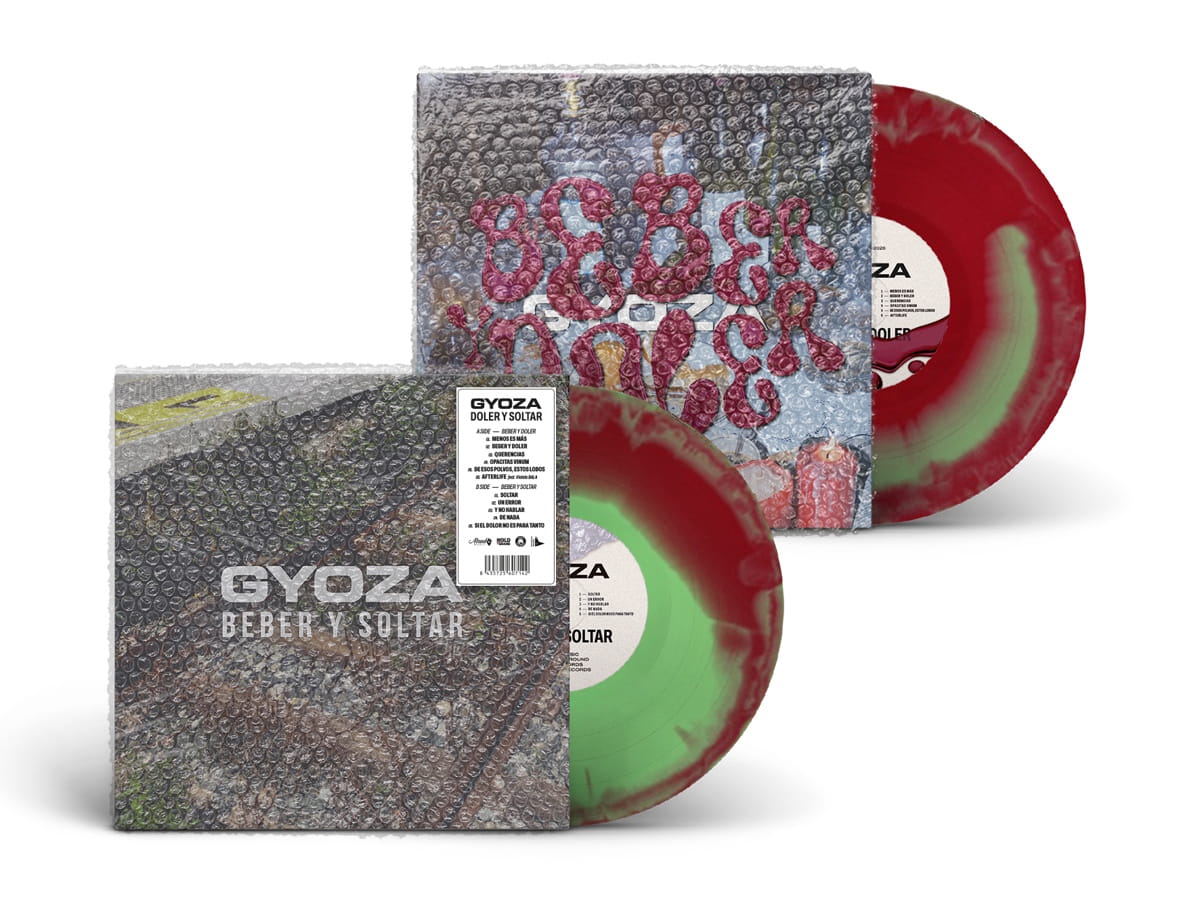
That is where “Beber y soltar” starts making sense as a companion piece. The title suggests release, but the band are not talking about closure in the clean, false way people often use that word. Letting go, here, is closer to learning what cannot be let go of.
The physical form followed once Gyoza returned to Guillem Martín, their long-time friend, designer, and art director, to discuss how this new work should look. “Beber y doler” already had its own visual identity, so “Beber y soltar” needed to stand alone while still carrying the same wound from another distance.
“Physically, it started to take form once we joined forces again with Guillem Martin, art director/designer and long-time friend, to discuss the graphic concepts for this new work and the idea that one should go with the other in a single vinyl was more than obvious. It also obviously didn’t mean we had any idea of how to combine them properly and in a way it could live up to the conceptual importance of the leitmotiv that comprises both, but we started to work on conceptual paths that could lead us to it. Keeping in mind Beber y doler’s graphic aspects where already set up, we knew we needed to work on Beber y soltar independently and we started exploring the concepts of passage of time and what it causes to the environment as a way of representing the distance between one work and another until we could have a grasp of how it would possibly look like.”
Their own description of the two EPs does more than explain the concept. It quietly rejects the usual story about grief ending somewhere. “Soltar reads as a follow up of the leitmotif Doler started and reinforces the fact that grief is a one way path, but not an only way one. And that time here maybe has its own undiscovered rules that we must honour.”
Those rules also sit inside the B-side tracklist. Read the titles together and they form a sentence: “Soltar un error y no hablar de nada si el dolor no es para tanto.” It was not there from the start. “Soltar” and “Un error” were already written and titled before the band noticed they had the beginning of a phrase in front of them.
That discovery connected back to “Beber y doler“. During that earlier writing process, the initials of the opening titles started to matter. “Menos es más” and “Beber y doler” carried initials connected to the person whose loss runs through the work, and the band extended that into a private ode.
“The idea of building a phrase from the song titles came once the lyrics were all mostly written. The first two songs, “Soltar” and “Un error”, were already finished and had their respective final titles. That is when we noticed that the titles of those two songs made a short phrase, one that could be continued if we felt like developing it. During the composition of the lyrics for Beber y doler, quite by accident, the need arose to create a pseudo-acronym using the initials of each title, starting with the ones that begin the EP. The “M” in Menos es más and the “B” in Beber y doler constantly reminded us of the initials of the name of the person whose loss is referenced throughout the work, so we decided to include the initial of the second surname followed by the word “oda” (ode), intending to give the work the status of an ode to the lost loved one. With this in mind, we ultimately felt it appropriate to continue with these kinds of easter eggs, so to speak, in the second installment as well. Once the final tracklist was decided, we were able to definitively name the remaining songs that make up Beber y soltar and the phrase hidden in their titles. You could say that in both cases, one thing led to another, and in retrospect, it works perfectly as a conceptual synthesis of the narrative thread woven through both releases.”
“Si el dolor no es para tanto” closes that hidden sentence, but Gyoza do not treat it as a settled answer. It is not a conclusion they reached, and not a mantra they repeat until it becomes believable. The line sits closer to contradiction. Pain is never enough for someone else to understand it without living through it, and at the same time it may not destroy you in the exact way you once feared.
“We wish it had occurred to us, a closing and a conclusion to what we’ve reached, but the truth is, it’s neither. If this is how it’s interpreted from an external perspective, it confirms that the narrative thread of the leitmotif has a coherent evolutionary structure, and since it wasn’t planned (we based it solely on real-life experiences) the grieving process is following its natural course. It’s not so much something we want to convince ourselves of, but rather two sides of the same coin, in the sense that pain will never be enough for people to understand it without experiencing it firsthand, nor will it destroy you as much as you think it can. The wound will always be the same size, but when it comes to loss, perhaps it’s about applying specific treatments and not assuming that the cures will be the same as in other cases. But above all, it’s about understanding that it will never fully heal. Hence the lyrics of Soltar, which here serve to close a curious reverse circle, which speaks about not letting go and invites pain to evolve in order to accompany, guard, escort or protect.”
That last thought is the centre of the record. The wound is not made smaller. The person carrying it changes around it. Between “Doler” and “Soltar“, Gyoza are not trying to cross from one emotional state to another with a line drawn under the first one. They are measuring what time does when it does not fix anything cleanly.
“As we mentioned at the beginning of the interview, it was a more or less safe bet that we made. In part to explore the possibilities and capabilities of the concept of letting go of something as universal and transversal as the loss of a person and from where that subsequent need to document in words the experience and/or journey finally arises. Organically, it is understood that it is a point that any griever wants to reach, to be able to let go, to be able to say goodbye to that pain. And in an equally organic way we come to the understanding and acceptance of that grief as something persistent, which is constantly evolving and mutating.”
The song “Un error” gives that passage of time a number. It speaks about two years between loss and the beginning of acceptance, but even that measure is not final. The title points to one error, then opens into a pattern: year after year, error after error, the mistake of believing this will be the year when the wound finally closes.
“In Un error, for example, we talk about the number of years that pass from the loss to the beginning of that acceptance, which is a purely personal amount and, as we have previously said, is constantly evolving, but it serves to confirm that the only thing that has passed between Doler and Soltar and being able to write from another place is basically time. The song specifically talks about two years but the title refers to a single error, which suggests that year after year and error by error (especially year after year of errors in assuming that this is the one in which we get the wound to close) we let time do its work and make us understand what shapes our new reality as grievers.”
The artwork carries that same argument without explaining it away. Bubble wrap appears across both covers and becomes more than a surface trick. It suggests preservation, a need to protect objects when people cannot be kept in the same way. The typography shifts too: less steady on “Beber y doler“, more settled on “Beber y soltar“. Gyoza read that change as part of the emotional movement between the two works.
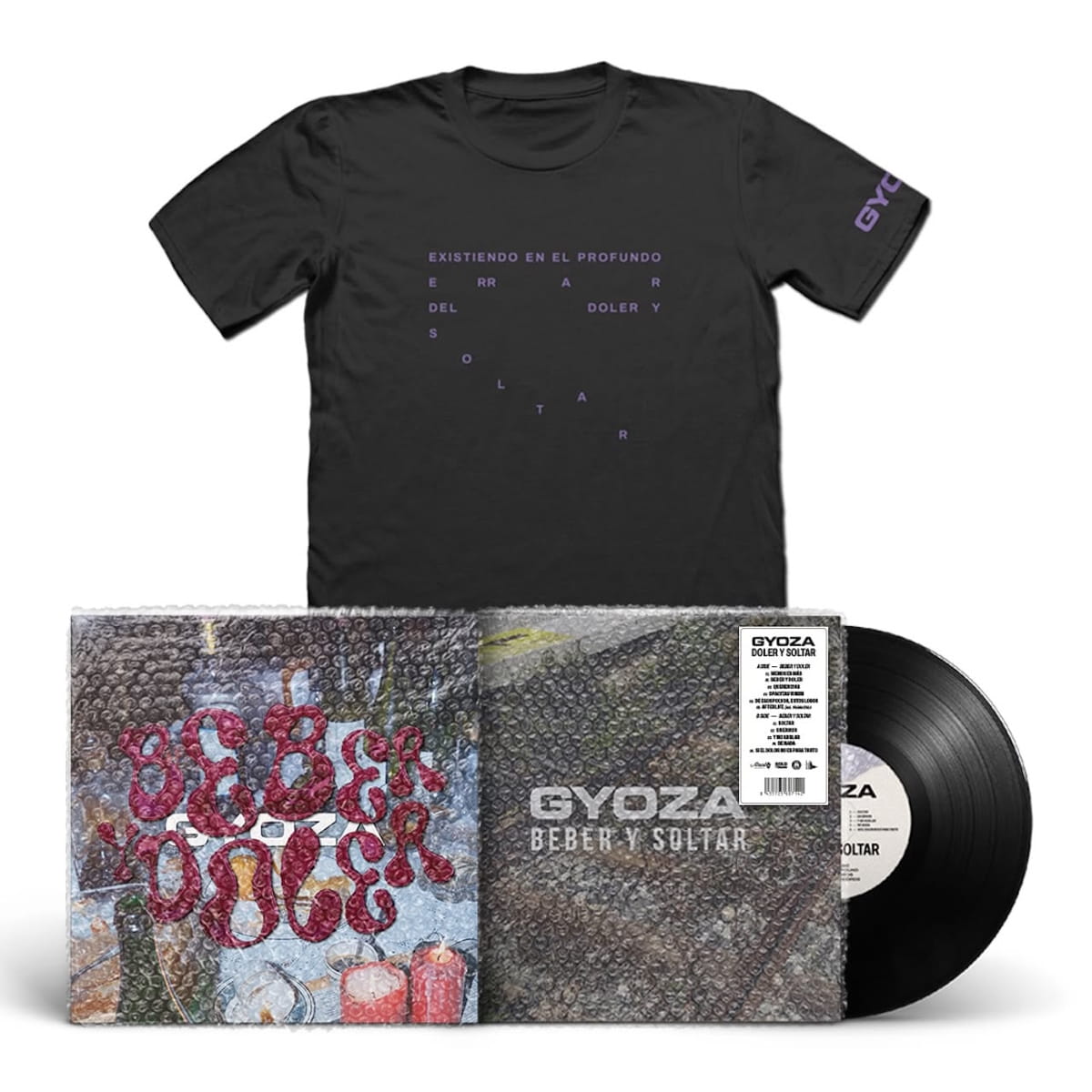
“The concept of bubble wrap as a protective wrapping for something you want to preserve came from among several conceptual proposals Guillem made for the cover art for Soltar. As a proposed texture, it was the one that worked best to translate the idea we had in mind into a more physical format. During the brainstorming sessions for the promotional photoshoot that was going to take place before the first single release, the idea of wrapping ourselves in bubble wrap, wrapping objects, and various other options came up, some of which were ultimately discarded. But one of these ideas eventually led us to the double EP we have today, protected with its own bubble wrap vinyl sleeve. We could say it was an idea that came from Guillem, and that through several exchanges of ideas between us and some friends who aren’t part of the band, we came to the conclusion that the vinyl couldn’t be presented in any other way.
As for the difference between the covers, the evolution of the typography, for example, speaks for itself. A stabilization follows a somewhat less solid stage, a more fluid phase, fueled by alcohol as a method of procrastination in the face of pain and overcoming it. The images follow the same path. Chaos, lack of control, and unfinished tasks in Beber y doler, and the passage of time, the protection of physical objects associated with memories, and acceptance in Beber y soltar.”
The Bala link is not only external context. “Afterlife“, with Violeta from Bala, closes the A-side and sits right before the flip into “Beber y soltar“. Gyoza recently opened for Bala at Razzmatazz 2 in Barcelona, playing to more than 500 people on a date they describe as especially meaningful because of the relationship between the two bands. The song makes that relationship audible.
“Definitely, something really deliberate. It’s basically a matter of friendship and support. We wanted someone dear to us, from a band we liked and whose style we thought could match the vibe of the song. In fact, and as we already pointed out, at the time we weren’t fully aware we were going to make something with this level of continuity. Also, Afterlife was the first lyric we wrote for Doler. That’s why it’s in English. We wrote it and in the meantime, in between writing songs, we decided to go for our own language.”

Gyoza’s live trail keeps moving around the same period. Their 2024 run included Cadavra Club in Madrid, Los Conciertos de Radio3, La Ley Seca in Zaragoza, Rockcity and CaRevolta in Valencia, Sala Wolf in Barcelona, and Vive Festival in Cangas de Onís. In 2025 they moved through Krazzy Kray in Cambados, Mardi Grass in A Coruña, Kominsky in Vigo, Festival Pingüí in Flix, Peña La Bota in Lizarra, Kuivi Almacenes in Oviedo, Deustu Gaztetxea in Bilbao, Fonrock Fest in Pamplona, Moby Dick in Madrid, CaRevolta in Valencia, and Razzmatazz 2 in Barcelona. This year brings Sound Isidro in Madrid on May 22 and Laut in Barcelona on May 29, with the band also planning a European tour around the new work.
You can find Gyoza at gyozaisnotfood.com, Spotify as @gyoza, Youtube as @gyozaisnotfood.com, Twitter and Instagram as @gyozaisnotfood, and Facebook as @whereismygyoza. Booking and contact go through Adrià Marva at [email protected].
For a band marking roughly ten years together, it would be easy to make this into a milestone story. Gyoza resist that. The record is about letting go, but not in a clean biographical sense, and not as a neat statement about the project itself. They see change as something built into every release.
“We let go of something in each album. The making of any kind of piece, whether it’s a full album or just a song, can be cathartic. It can make something in you bleed in a permanent way. After every long composition and studio time (like Early Bird or It never rains but it pours) a feeling of nimbleness usually appears, and now that we are in a process of writing lyrics with a huge emotional load makes that impression grow. Gyoza doesn’t let go per se, Gyoza changes in each release, as a constant transformation that has its continuum in time.”
🔔 IDIOTEQ is ad-free, independent, and runs on one person’s time. If you want it to stay that way: DONATE via PayPal 𝗈𝗋 SUPPORT via Patreon.
Stay connected via Newsletter · Instagram · Facebook · X (Twitter) · Threads · Bluesky · Messenger · WhatsApp.