
J.D. Morgan was on the fire escape outside his Milwaukee apartment, three stories up, working through a guitar piece he’d been fleshing out at home. Gunshots came from the parking lot of the nightclub below. A 43-year-old man had been shot twice. He lived. The lyrics to “Invisible” poured out over the next few days.
That sequence is most of what you need to know about how Primitive Broadcast Service make records. The Milwaukee three-piece, who release their third album “Monsters” on June 4 via Learning Curve Records, have a working term for it: urban skronk.
Heavy, angular, dissonant pieces of music, written from the environment around them and routed through whatever field recordings happen to come within reach of a microphone.
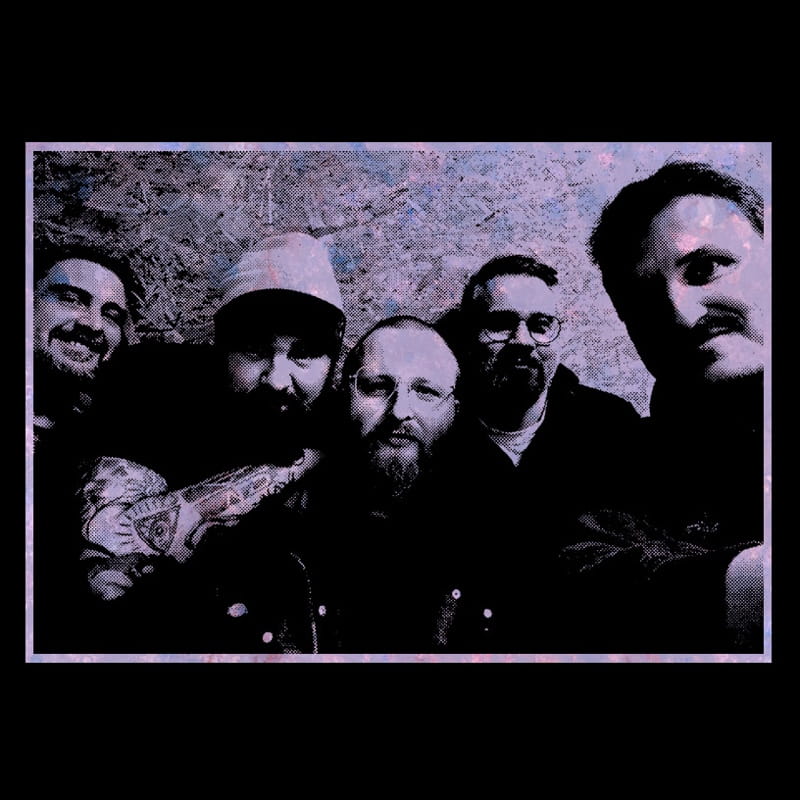
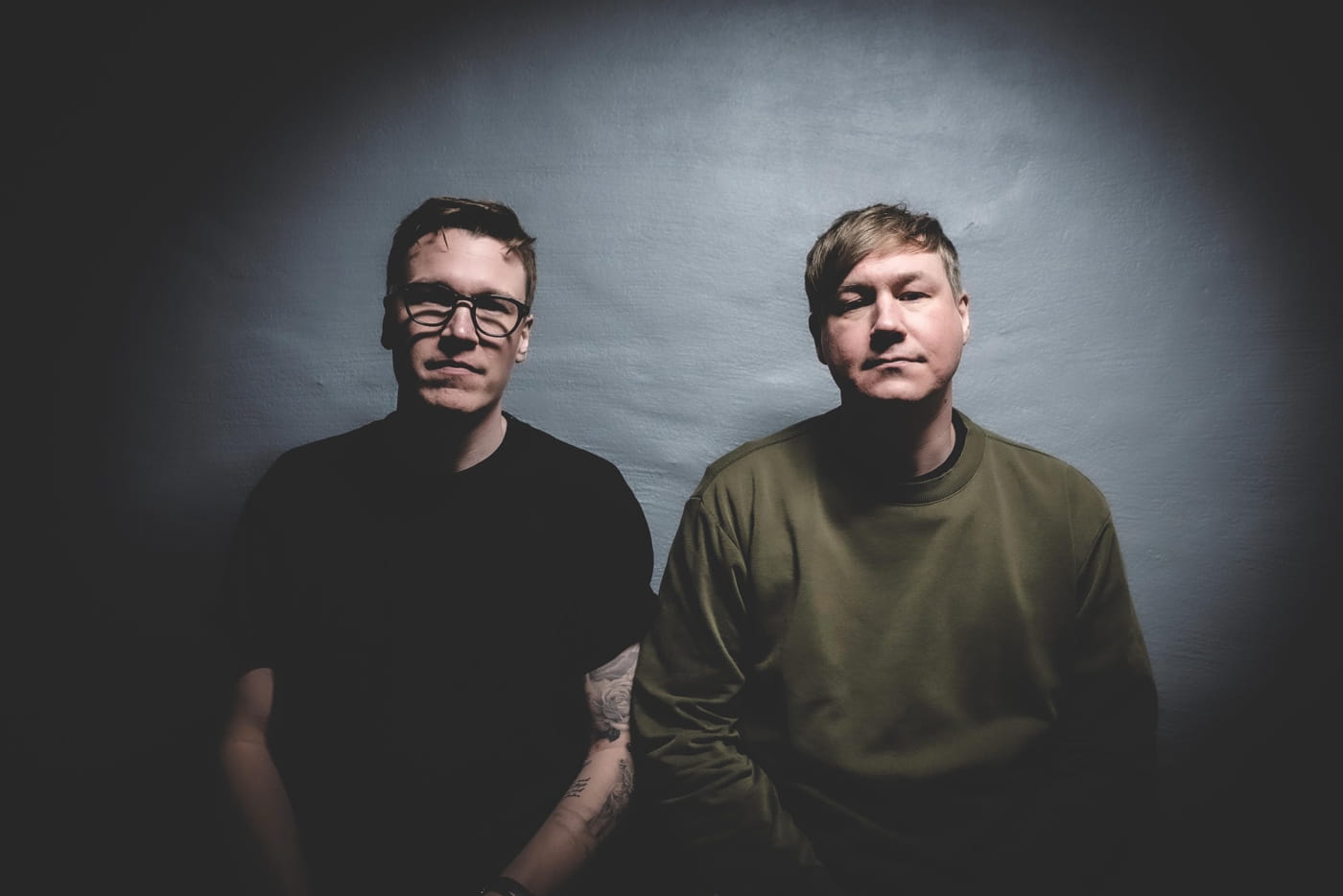
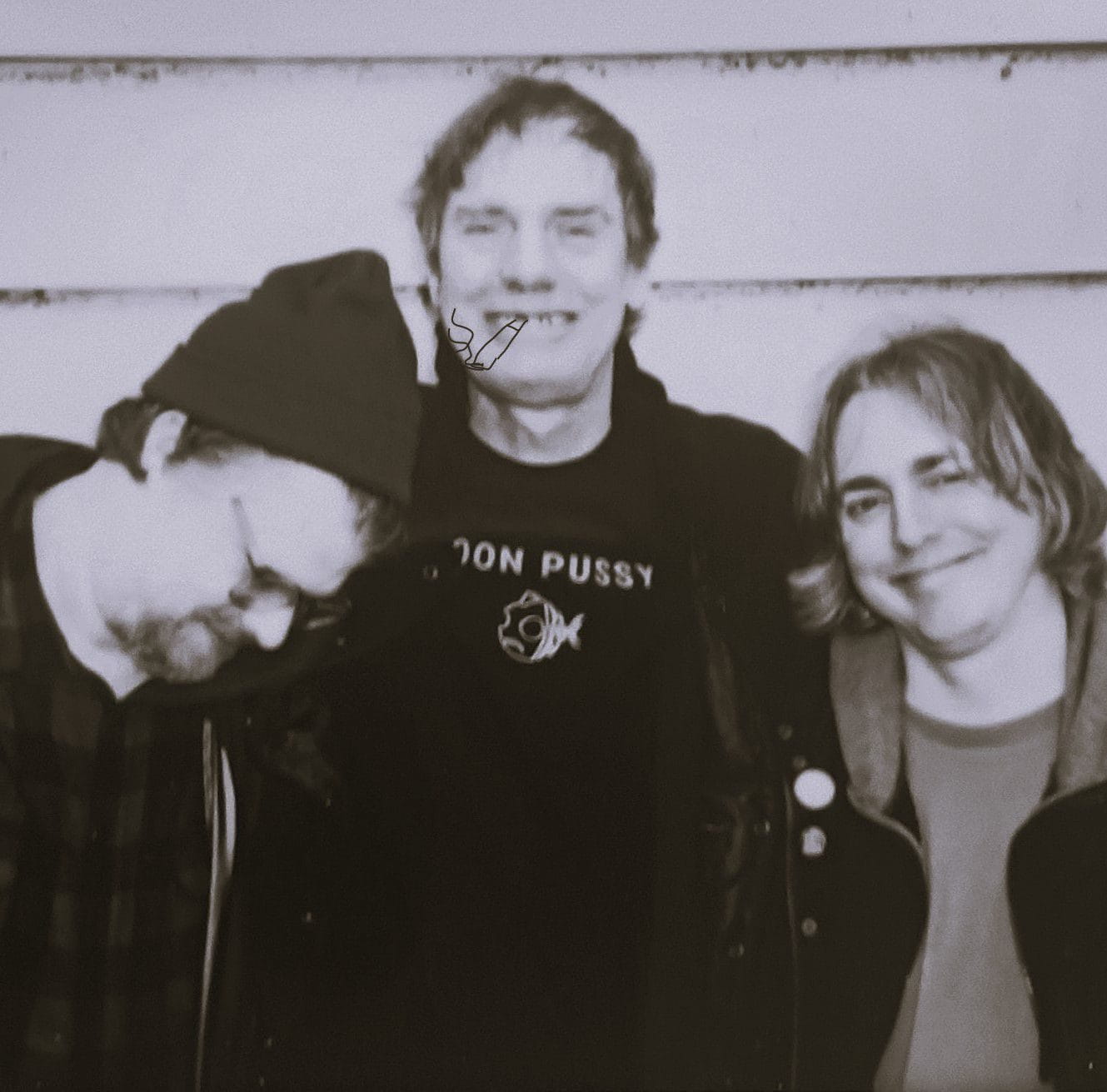
The current lineup is J.D. Morgan (guitar, vocals), Andy Steffenhagen (bass), and Bryan Dorn (drums).
“Our songs are heavy, angular stories about things that happen in our city, which happens to be Milwaukee,” Morgan says. “We don’t force lyrics or song ideas. We feel out our environment and let those feelings drain into our music. It’s a very physical approach to writing songs.”
The album was tracked at Electrical Audio in Chicago in 2022, in Studio B’s ambient drum room. “One of the best studios in the world for recording ambient drums,” Morgan says.
“The ceilings are two-and-a-half stories high. There’s a stairwell where the engineers hang microphones, and lots of other cool nooks to place microphones in that I probably never even realized were there. The drum sound is massive, echoing all over the hall and up the stairwell. Bryan Dorn, our drummer, was in drum heaven.”
Steve Albini wasn’t there the weekend it went down. The band found out later he was at a poker tournament. His Hi-Watt cabinet sits underneath every guitar track on the record. The band brought their own engineer, Shane Hochstetler of Howl Street Recordings in West Allis, WI. Mixing was handled by Vin Smith of Wreckage Industries, who also plays in the punk band Avenues. The final mixes went to Thomas Andrew Doyle (TAD) to preserve the bottom end.
“I don’t make ‘bright’ records,” Morgan says. “I like the overall sound to be more nebulous, and ‘Monsters’ was mixed by Vin Smith and I to emphasize bass and the full drum kit. I knew that TAD would not only respect this, but understand it. I love how bass-heavy ‘Monsters’ turned out to be, and that’s Vin and me, and TAD, making sure it stayed that way.”
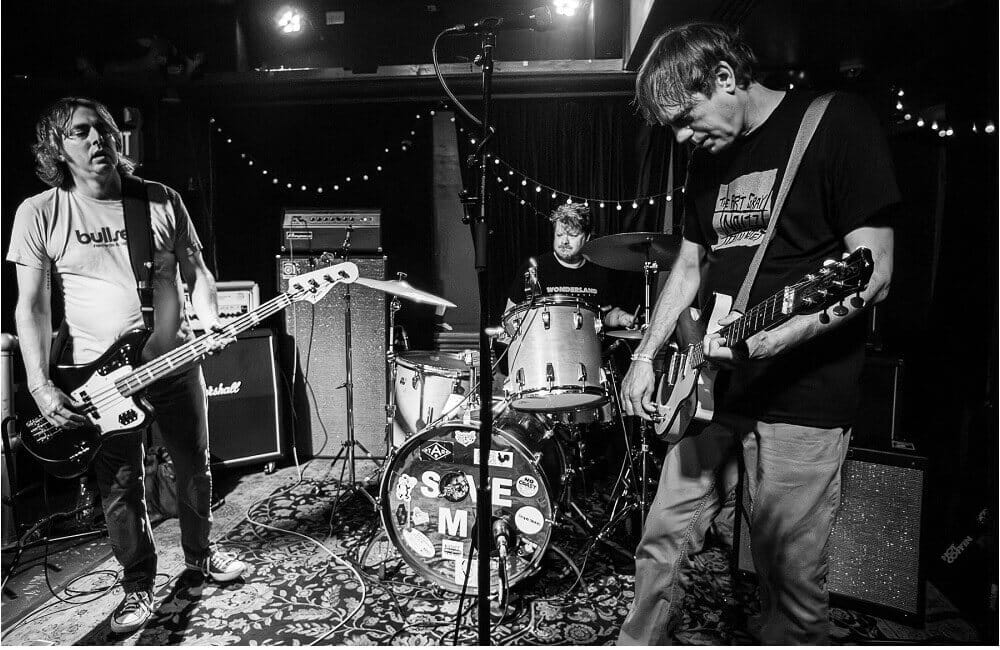
The result sits low and patient. Drums spread across the room rather than getting pushed up front; cymbals scatter back from the ceiling. Morgan’s guitar grinds underneath in the same register Shellac and Unwound work in, dry and unbright, with bass acting as a second melodic voice and Steffenhagen’s trumpet surfacing where the band wants it to. The press materials cite Shellac, Unwound and IDLES as reference points; the first two for the noise-rock chassis, the third for where the politics land on “Dead Horse.”
The album also carries a weight that wasn’t there on previous LP “Colors for Chameleons.” Themes of sleepless anxiety, alienation, bitterness, love and fear, emotional surrender. “The songs on ‘Monsters’ have endured through distressing years, as tiny monsters grew large and then became all too real,” Morgan says. “But this record seems to say that love still exists, in many forms.”
A note written during the making of the album sums up the angle: “Dissonance is essential to American life. It is the broken, angry heart of free speech.”
Morgan walked us through the six tracks.
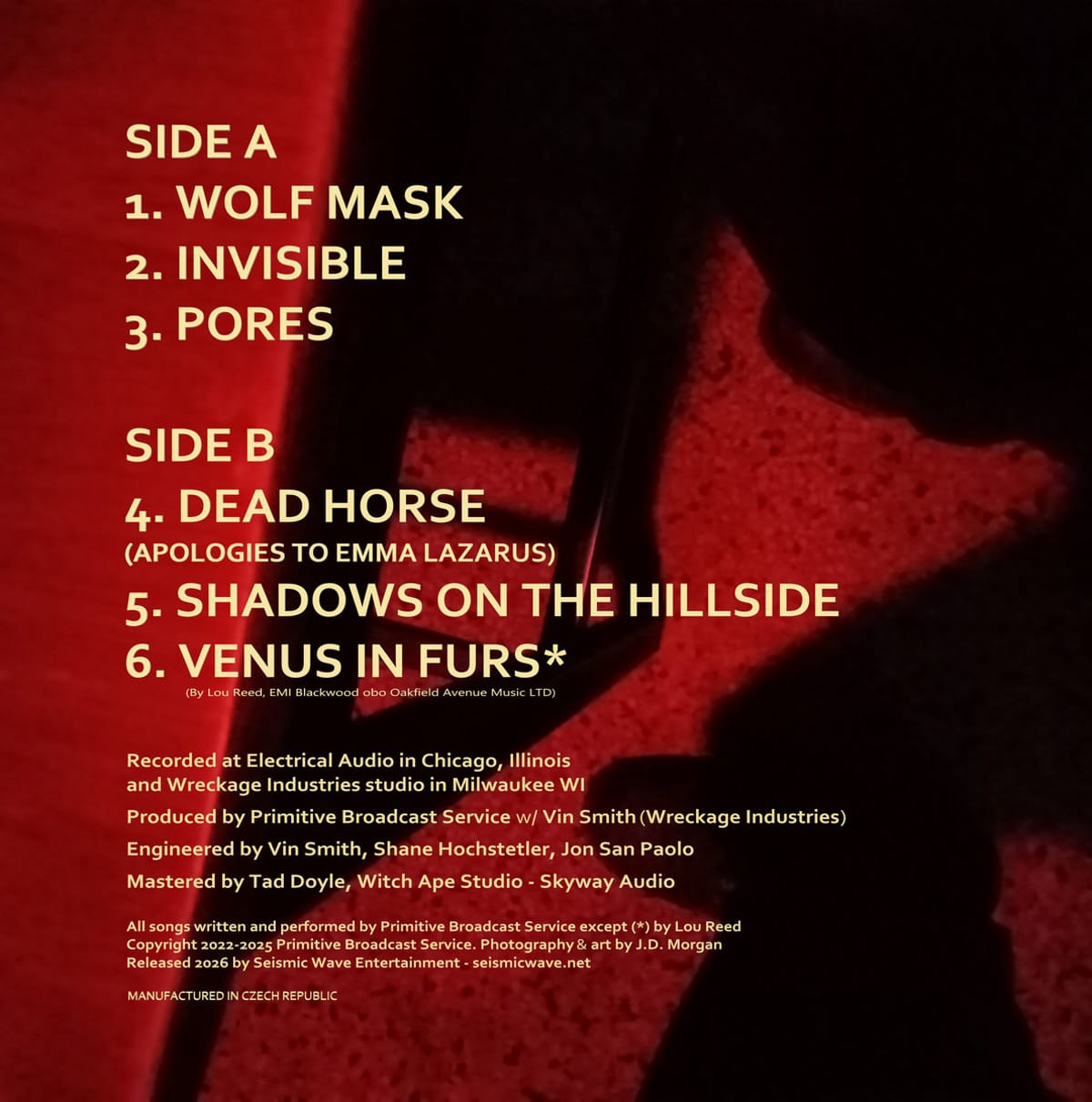
Wolf Mask
The band had been playing a cover of Roky Erickson’s “Night of the Vampire” (still do, every once in a while), and an unfinished song called “Little Monsters” had vampire references in it, “so we thought it was only fitting to have a werewolf song.”
Most of the music came together in a single session, which Morgan says is how things tend to go with this band. The opening sound on the track is a failed attempt to record one of the machines humming in the hallway of their practice space, followed by Steffenhagen laughing at the hubris of it. Days later, Steffenhagen brought in the song’s opening riff, which Morgan describes as a fanfare for both the song and the album.
The verse lyrics were the last piece. “They are, quite literally, the result of me sitting on the fire escape outside my apartment with a notebook, translating a sleepless dreamscape where my insomnia becomes a howling monster running from rooftop to rooftop at 3am.”
“The riff is taut, minimal ‘Chicago sound’ noise,” Morgan adds, “so that’s one reason it made sense to record at Electrical Audio in their ambient drum room to get the best sound for Bryan Dorn’s drums. That, and we want each album to have its own sonic identity.”
Invisible
The gunshot song. Unlike “Wolf Mask,” which Morgan calls “very much a group effort,” “Invisible” was a piece he developed at home before bringing it to Steffenhagen and Dorn. The shooting happened in the parking lot of the nightclub directly below his back windows. The news item confirmed it the next day.
“This is what we mean by the ‘urban’ aspect of ‘urban skronk,'” he says. “Our songs are derived from actual incidents and events that happen in our city. We don’t force lyrics or song structures. We feel out our environment and let those feelings and images become present in the music. I can still hear inside the imagery of the gunshots cracking outside my window, for example, and I hope that sense of immediacy comes across to anyone listening.”
Pores
A guitar experiment that turned into a song about a marriage destined to end in divorce. Morgan calls the chordal root “uncomfortable but beautiful at the same time,” with the lyrics climbing out in a lazy, hedonistic haze. The “rainbow on the wall” line lands as one of the image scraps he kept from that period.
The street sounds on the track are from the same nightclub as “Invisible.” Morgan had been trying to record, from a fire escape above, the HVAC motor at the top of the club. “The sounds of the street and the noise of people turned out to be more interesting than the machine,” he says. “Like people and streets tend to be. Another happy accident.”
He credits Vin Smith with how well the field recordings sit inside the music. “We don’t alter the found recordings electronically. It’s more about picking the right sections of sounds so that they work with the music. We have an extended version of ‘Pores’ built off the street scene noises at the end of the track that I hope will one day find its way into the world.”
Dead Horse (Apologies to Emma Lazarus)
“We cannot under-express outrage,” Morgan opens his note on this one. “In America, however much we protest, we have drastically underestimated the severity of what the current fascism from Washington DC intends for us.”
The song started as a repetitive noise metal riff and a poem titled “Good Morning America,” then took inspiration from Emma Lazarus’s “New Colossus,” the poem on the base of the Statue of Liberty. Steffenhagen, who played in a ska band in high school, handled the trumpet part.
The lyrics were written in the aftermath of the ICE shootings in Chicago in August and September of 2025. The track was finished before ICE invaded the Twin Cities and killed Renee Good and Alex Pretti. “The sickening, unaccountable cruelty of those murders isn’t accounted for here,” Morgan says, “which only adds to the sense of helplessness that I feel in trying to write about this.”
The lyric video was made with Christy Costello, whose band has been organizing and fundraising on the front lines in Minneapolis. Morgan wanted a presence directly involved in the fight, “whose focus and commitment would match the energy of the track.” Through that collaboration, the band learned that ICE was extremely active in Costello’s Northeast Minneapolis neighborhood. As a result, proceeds from “Monsters” are going to Northeast Neighbors Mutual Aid Fund of Minneapolis (IG: @nenmaf612) and Voces de la Frontera (vdlf.org) in Milwaukee.
Shadows on the Hillside
“A love song filled with ghosts and shadows and doubt.” This one was the first song written for the record. Morgan carried it around the Midwest and down to New Orleans while the pandemic was dragging on. Most of the music was written in Northfield, MN and New Orleans. The lyrics came together in Branson, MO. The hillsides are the foothills of the Ozarks, near Branson. There are no field recordings on this track, only what Morgan describes as “the dark of night skies free of light damage, and the ever-present vultures by the dam. It felt like something in the dark was moving, always moving. This was quite unnerving.”
Venus in Furs
The Velvet Underground song. The band love what the original does at the song level, but also recognized it as a framework that lets them play with dynamics and noise. They cut it at the end of their second day at Electrical Audio, tired, and thought it probably wouldn’t make the album. They changed their minds after listening back and playing different versions live.
There are three guitar tracks on the recording. One is labeled “Electrical Audio.” One is called “screwdriver.” The third is “spoons.”
Doubling the vocals came from Vin Smith. “I liked the idea of having two distinctly different versions of my voice interpreting the Lou Reed lyrics, which aren’t exactly part of the day to day environment we operate in,” Morgan says. He landed on the “different colors” line as the emotional center, “because it suggests that love exists in many forms, colors and shades, however strange.
The context in ‘Venus in Furs‘ is a sado-masochistic relationship, but it’s still presented as love, whatever the shade and color, or whether or not Lou Reed was being an asshole when he wrote it.” The lyric scraps at the end are pulled from other unpublished songs, an attempt to change the conversation to something more mundane, “like lovers do. Like the fact that California is on fire again, and the wind’s blowing east.”
Wyświetl ten post na Instagramie
“Monsters” is out June 4 via Learning Curve Records on vinyl and digital. Proceeds go to Northeast Neighbors Mutual Aid Fund of Minneapolis and Voces de la Frontera in Milwaukee.
🔔 IDIOTEQ is ad-free, independent, and runs on one person’s time. If you want it to stay that way: DONATE via PayPal 𝗈𝗋 SUPPORT via Patreon.
Stay connected via Newsletter · Instagram · Facebook · X (Twitter) · Threads · Bluesky · Messenger · WhatsApp.