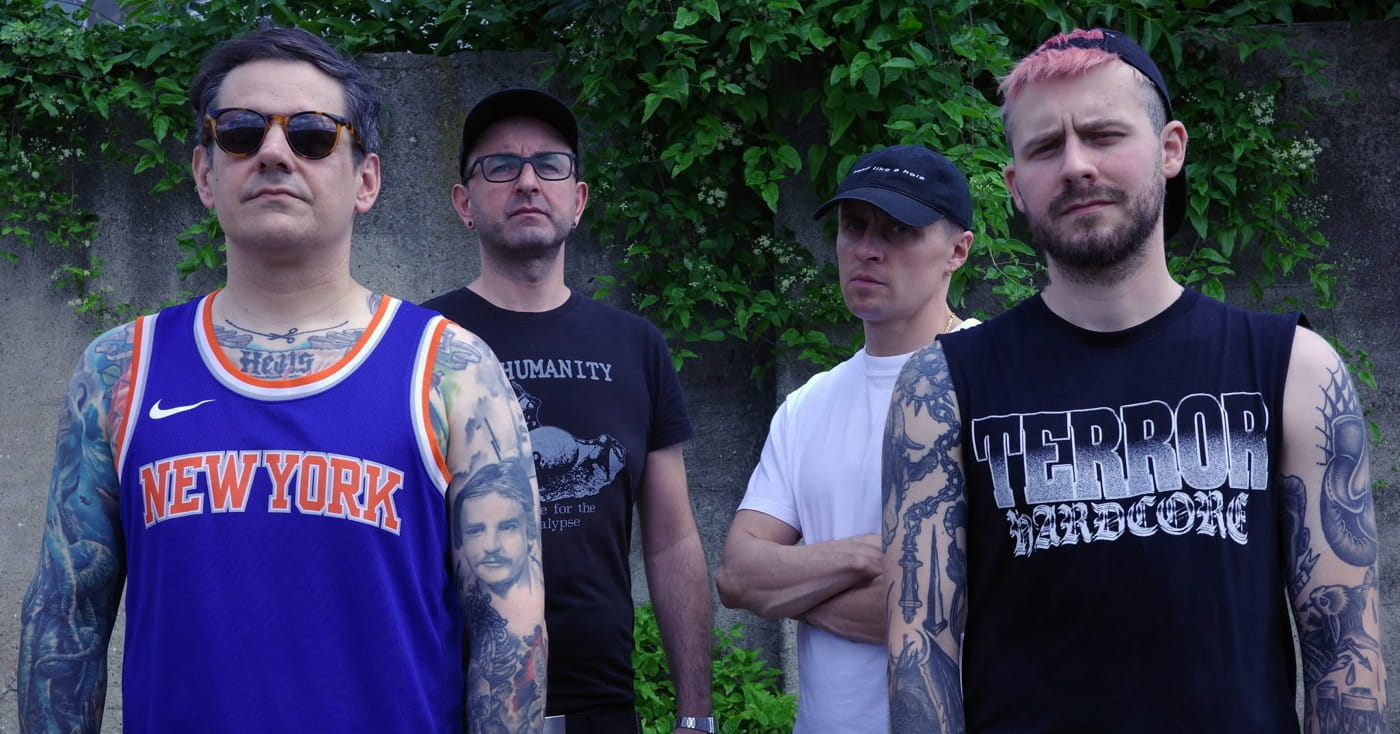

There are several ways to hear “Distance“, the old Moondog song that Norwegian melodic hardcore band Capital Scars have recorded. Somewhere between the original demo, grainy footage of Gorilla Biscuits playing it live and Walter Schreifels’ acoustic interpretations, the guys from Oslo and Molde had to work out an arrangement of their own.
It’s a song about growing apart and wanting to put things right, written by Walter Schreifels and Luke Abbey. For Capital Scars, it also goes back to friendships made through hardcore in the early ’90s, when Vegard Waske got hold of the Moondog demo through the late Peter Amdam of Onward and Sportswear.
“None of us ever owned the Moondog 7″ bootleg, so over the years we’ve revisited the song on YouTube, trying to track down the least grainy version we could find,” Vegard and Arild Dahlen tell us.
They’ve always felt that the song deserved a bit more attention. As far as they’re concerned, Gorilla Biscuits never quite settled on a definitive version of it. Walter touches on the subject himself around the 52-minute mark of episode 406 of Toby Morse’s One Life One Chance podcast.
“So the challenge was piecing together the different versions and figuring out how the song was actually supposed to fit together. There was definitely a bit of hardcore archaeology involved. We leaned mostly towards the original Moondog version, but wanted to capture some of the energy of Gorilla Biscuits.”
By the time they had finished working on it, they were comfortable taking a few liberties with the song.
“At some point, we also had to stop worrying about getting every little detail right and just make it sound like Capital Scars. We’re really happy with how it turned out, and hopefully we’ve done the song justice. We got a like from Walter on Instagram, so we’re choosing to take that as a nod of approval haha.”
Give their version of “Distance” a listen here.
Wyświetl ten post na Instagramie
Capital Scars’ own songs come with a bit of history too. In the early 2000s, Vegard, Arild, Bjørnar Næss and Anders Henningsen played together in The Goodtimes, who released an album through Beniihana Records. Some of the stuff they wrote towards the end of that band’s life stayed with them for years.
Around 2002, Bjørnar moved back to Molde and the others got busy with work and raising families. They remained friends, went to shows together and kept having the same conversation about those unrecorded Goodtimes songs.
“Eventually, an old rehearsal recording on MiniDisc resurfaced. Anders and Arild finally put together a demo based on those old songs and sent it to Bjørnar and Vegard as a surprise, just to see if there was any interest in taking things further. Initially, the idea was to use programmed drums and simply get the songs recorded, without any real ambitions beyond that.”
Wyświetl ten post na Instagramie
They got Jonas Thire involved, whose time behind the kit includes JR Ewing, Amulet and Wolves Like Us. With Jonas on drums, Arild singing, Anders and Bjørnar on guitars and Vegard playing bass, Capital Scars had a proper band going.
Four songs were recorded in early 2026. Their debut single, “Can’t Break The Broken”, came out in April, followed in June by the short, fast and melodic “Drunken Shadows”, featuring additional vocals from Torgny Amdam. “Distance” is their third single.
Making records together has become considerably easier over the years. Anders has taught himself recording, production and mixing, and Jonas can get through the drums for a song in half an hour. There’s less of the friction that used to come with being in a band when they were younger.
“We’re also at an age where we’ve pretty much moved past the egos and headbutting that sometimes come with being in a band. We’re good at listening to each other and finding musical solutions everyone is happy with.”
Well, except perhaps when it comes to picking a band name.
“Mind you, we did go through 181 band names before finally agreeing on Capital Scars. We figured that if we could survive that process, we could survive pretty much anything.”
Fitting the band around everyday life is another matter. “The main reason we do Capital Scars is simply that it’s a great way to stay connected and create something together. We’re taking things at a pace that works for everyone. After all, we have jobs, kids and broken tumble dryers taking up most of our time.”
Go back to the ’90s and you’ll find several of them involved in pretty much every aspect of Norwegian DIY hardcore. Arild sang in Billion Dollar Mission and The Suit Decides. Vegard and Bjørnar played in Lash Out, with Bjørnar also playing in Sportswear. Anders was involved in the rockier end of the punk scene with bands including Retardos. They made fanzines, ran labels and mailorders, and lived in Oslo at various points during that decade.
For Vegard and Bjørnar, a good deal of that experience came from a much smaller town on the northwestern coast of Norway.
Molde has a population of around 25,000 today, yet it had one of Norway’s most active punk scenes during the first wave of Norwegian punk and hardcore, according to the guys. Between roughly 1979 and 1984, local bands were putting out records that still make for a pretty fascinating introduction to Norwegian punk.
Anfall and Hjern & Mental released some early punk 7″s, with Psykisk Terror and Bannlyst coming along a little later and taking things in a faster, harder direction. The latter remain firm favourites among the Capital Scars guys.
“To our ears, pretty much every single Bannlyst song is outstanding, and we’d definitely recommend digging around online for their recordings, including the reissues and live album released by Norwegian Leather. Also worth checking out are Cease Fire Records’ Psykisk Terror discography and the Molde Punx Go Marching Out compilation, which gives a great introduction to that whole era.”
Some of the Bannlyst members eventually moved to Oslo, where they went on to play in So Much Hate and Stengte Dører. A similar migration would take place roughly a decade later, when the people involved in Molde’s second wave of hardcore also headed for the capital.
That second period, which included Lash Out, lasted from around 1989 to 1995. One of the best things that happened to the local scene was getting a house from the council. The kids had somewhere to rehearse and put on gigs, and even ran a café.
“We managed to bring bands like Refused, Abhinanda, Blindfold, Fireside, Four Walls Falling and Sense Field to Molde to play shows, which was pretty amazing considering the size and location of the town. It was a fantastic time, and having a place of our own made a huge difference. We could rehearse, put on shows, hang out and basically build the kind of scene we wanted to be part of.”
Look at the line-ups of Last Straw, Palfinger, Trigger and Lash Out and you’ll find many of the same people playing together in different combinations. Vegard and Arild reckon there were fewer people involved in this second wave than in the first. It certainly kept them busy.
Getting to Oslo by car could take a good ten hours back then, and Norway still had only one national television channel. The guys have spent some time wondering why such a geographically isolated town produced two generations of hardcore bands.
“Maybe part of the explanation is that Molde has always had a relatively large population of highly educated people, which might have influenced their kids and encouraged a certain curiosity about the world beyond the town. Or perhaps it’s the exact opposite. Molde has also traditionally been a fairly conservative place, and maybe that helped foster a counterculture among those who didn’t quite fit in.”
And then there’s jazz. Molde is home to one of the world’s oldest jazz festivals, where Miles Davis and Ornette Coleman have both played, the latter on several occasions. Vegard and Arild have a rather lovely comparison of what two very different groups of music fans managed to achieve in their hometown.
“Maybe there’s a parallel here. MoldeJazz brought Ornette Coleman, who helped shape the future of jazz, to Molde. And a few decades later, Molde Hardcore brought Refused, who went on to help shape the future of punk.”
“Not bad for a small town on the edge of the Atlantic Ocean!”
These days, Molde is fairly quiet on the hardcore front. Vegard and Bjørnar are already doing something about that, having got together again as Stormstrike. They plan to release music in 2027, promising “heavy Molde Black Circle hardcore”.
The name Stormstrike may also be familiar to anyone who’s been buying hardcore fanzines recently. Vegard put out the first issue of his new zine under that name in September, and copies have made their way to shops in Asia, Europe and the US.
For about ten years, he’d been writing down stories and memories from his time in hardcore. A few years ago he began working on a fictional account of a Norwegian hardcore band playing a disastrous gig in Germany. Set around a European tour in 1994, the story kept growing until he had the beginnings of a novel.
“He’s also always loved fanzines and missed the whole process of creating something physical. So the idea came about to start a fanzine combining chapters from the novel with interviews with bands he loves.”
Wyświetl ten post na Instagramie
The first issue has interviews with Integrity, Golpe, Tomar Control and Rifle alongside the opening chapter of the book. Vegard has already sold out of his own copies, although the zine has been stocked by Spin and Grind in Seoul, Nerds in Tokyo, Gutter Groove in Denmark, Refuse in Germany, BOOKS in London and Limited To One in New York.
“It’s been really rewarding to see something that started as a random story on his hard drive end up as a physical fanzine in independent record and bookshops around the world.”
The second issue is planned for around NewYear, featuring Vic DiCara, xDistantex, Xiao and Knifeman. Vegard has also found an international publisher who hopes to put out the complete novel in late 2028.
Getting Capital Scars off the ground and publishing the first issue of Stormstrike in the same year has given Vegard a chance to get back to two things he loved doing as a teenager.
“Both projects are really about rediscovering the joy of creating something simply because you want to, without worrying too much about expectations, commercial potential or whether anyone else will care.”
There’s something to be said for releasing music into the same little hardcore world you’ve spent most of your life in. Old friends have been getting in touch with Capital Scars since the singles came out, sometimes after decades of silence, and younger people are discovering the band without any knowledge of what the guys did before.
“Nobody is having our music shoved down their throats by Spotify algorithms. People have to find their way to it, or the music has to find its way to them. And a lot of that still happens through good old-fashioned word of mouth. In a strange way, despite everything that has changed in how music is made, distributed and discovered, that part of hardcore feels remarkably similar to how it was thirty years ago.”
So, where to start if you want to hear some Norwegian hardcore in 2026?
Vegard and Arild are enjoying the number of mixed bills these days. Punk and hardcore of different kinds are being played in the same rooms, with some of the guys from the original Oslo scene of the ’80s still active in bands like Pjolterguys and Knuste Ruter.
Jonas occasionally gets back on stage with Amulet, and there are familiar names from the ’90s generation in circulation again, including Recoil and Cargokult. Tiebreak recently released their first album in almost three decades.
“And much like ourselves, a whole bunch of people from the ’90s generation seem to have finally emerged from the chaos of raising small kids and found time to either resurrect old bands or start new ones.”
Among their recommendations for the rougher end of Norwegian punk and hardcore today are Daufødt, Problems, Draümar, Que Lindo, Stabber, Molbo, Invisible Hand, AG-3 and Assistert Sjølmord. There’s also Modern Love, coming from a different corner of punk.
Outside Oslo, check out Blood Command, Split//Bite and Jubb from Bergen. In Stavanger, there’s Psykostat, Purified in Blood, Autonomie, Matriark, Vulsion, Sagite and Wragh.
Trondheim has a pretty varied hardcore scene of its own. xSTALKERx play ’90s-style straight edge hardcore, Skyggesiden are doing D-beat, Gnasher draw on 2000s metalcore and First Charge play beatdown. Drop Knee have also recently put out an album.
“You see older and younger bands sharing stages, audiences and enthusiasm for the same music. You can have people who were playing hardcore in the ’80s sharing bills with bands whose members’ parents weren’t even born back then, haha.”
In Oslo, Blitz has been around since the early ’80s. Generations of punk kids have passed through the place and there’s still stuff going on there. Vaterland and Revolver are among the spots hosting punk and hardcore shows today, and people buying records have shops like Tiger, Råkk & Rolls, GSF and Neseblod.
Wyświetl ten post na Instagramie
Endless Tinnitus is another name worth knowing. As a rehearsal and recording space, it’s helped people from different Oslo bands get to know one another.
The guys are happy to see a band like Turnstile reach a huge crowd. For the most part, though, hardcore remains a small enough genre for people to run things themselves, just as Vegard and Bjørnar did when they got that house in Molde.
Who’s going to book the next gig, make the poster and find somewhere for the touring band to crash? There are still plenty of people willing to lose a bit of sleep and money getting it all done.
“And perhaps that’s what we appreciate most about being involved again. You realise that the scene doesn’t survive because of any particular band. It survives because there’s always someone keeping it alive.”
Wyświetl ten post na Instagramie
In Capital Scars and Stormstrike, some of those same people are back making records and putting together fanzines themselves, with a lot less to worry about than they had in their twenties.
“In a way, it’s coming full circle. We started out making music and fanzines as teenagers because we loved doing it, and more than thirty years later, we find ourselves doing pretty much the same things again. But this time, without all the insecurities and doubts we had in our twenties. We’re completely comfortable with who we are and what we’re doing, and we own 100% of everything we create. And we don’t think we’ve ever enjoyed being part of the punk and hardcore community more than we do right now.”
The next Capital Scars release, “Those Days Are Now”, will complete the four songs they recorded earlier this year. There’s a physical edition planned, too, with all four tracks on a 7″ limited to 50 handmade copies. As the guys joke, the person making them can only stand to hear the same song fifty times.
“To be fair, we’re mostly doing the 7” so we can have something in our collections, look back at it in twenty years and say, “2026? Yeah, I actually made something that year with my friends.””
The first three Capital Scars singles are available on Bandcamp, with news of the fourth song and the 7″ to follow via the band’s website.
🔔 IDIOTEQ is ad-free, independent, and runs on one person’s time. If you want it to stay that way: DONATE via PayPal or SUPPORT via Patreon.
NEW: IDIOTEQ Explore 🗺️ Browse 15+ years of our archive by city, country, and style. Find artists on the world map or trace related sounds through the styles map.
Stay connected via Newsletter · Instagram · Facebook · X (Twitter) · Threads · Bluesky · Messenger · WhatsApp.