
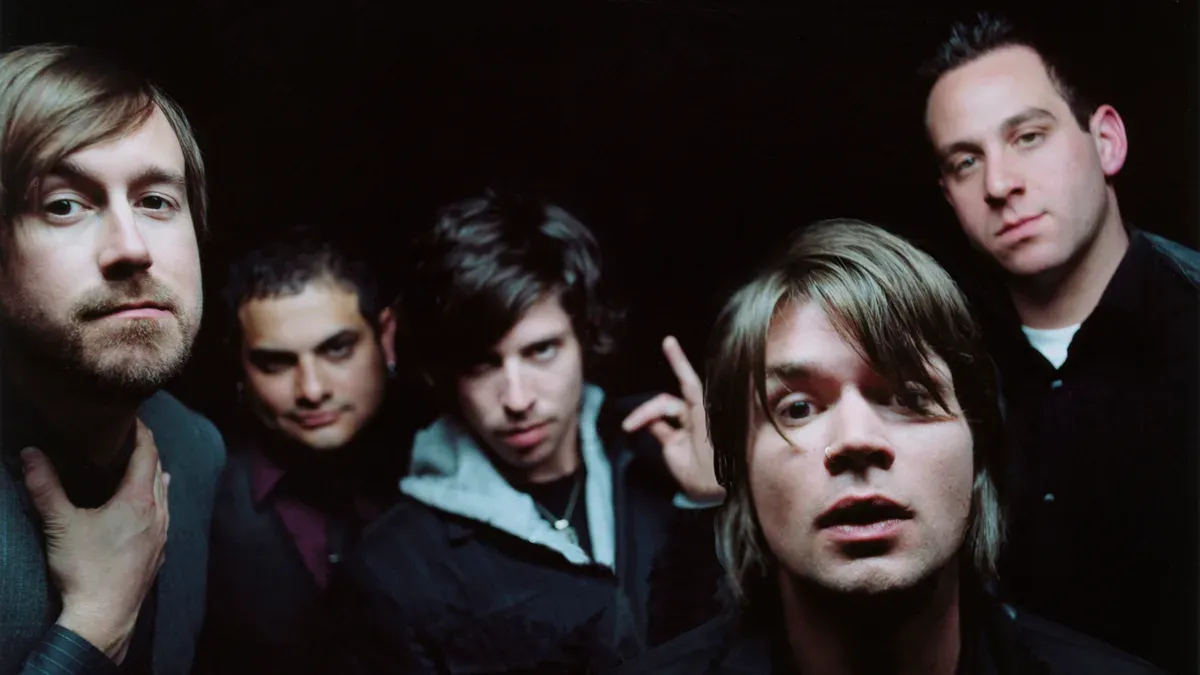
Long before Taking Back Sunday became one of the best-known bands associated with the early-2000s emo boom, guitarist Eddie Reyes was helping put on hardcore shows where the money left over after paying the bands went to an AIDS organisation. Long Island’s PWAC hosted everyone from Fugazi to Sick of It All, and the people running it worked for free. Eddie had been going to shows since he was twelve. By the time the rest of the world had discovered his local scene, he was already in his thirties and had been part of it for most of his life.
In April 2005, Matt Schichter caught up with Eddie in the Toronto area during Taking Back Sunday’s tour with Jimmy Eat World. The band had two albums out through Victory Records, “Tell All Your Friends” and “Where You Want to Be“, and their mix of post-hardcore, punk, huge melodic hooks and overlapping vocals had taken them well beyond the Long Island clubs where they started.
Matt met Eddie in person and got a look around the tour bus, which he described as looking like a moving Ikea store. There were enormous television screens, surround sound, a mirrored ceiling and little lights that changed colour. An unusually comfortable place for two people to sit down and talk about basement shows, old hardcore records and growing up around New York.
For Eddie, the musical label was simple. “Oh, yeah, it’s Long Island hardcore, is what we call it, the hardcore scene, but to the world it’s punk and emo, yeah, whatever that means.”
He had grown up surrounded by music from Long Island and New York, with punk and hardcore shows happening in garages and basements all over the area. He also pointed to older acts such as Twisted Sister, Pat Benatar and Joan Jett, whose connections to the region went back before his own years in the underground. Long Island had been producing musicians for decades, and Eddie was proud of the recognition that finally came its way.
By 2005, he reckoned the local scene was heading back underground. The major labels had spent their time looking for new bands there, and the industry’s attention had begun to move elsewhere. He compared it to Seattle, which still had plenty going on after the national spotlight moved away from grunge.
“I think the scene there is still very huge and it’s just kind of going back to underground,” he told Matt. He remembered New Jersey, Connecticut and Long Island as closely connected places for hardcore kids, with Washington, D.C. another important centre. The shows might have been getting less attention from the music business, but he expected them to carry on.
The PWAC was a big part of that history. Located on Long Island in the 1990s, the space was used for benefit gigs supporting the People With AIDS Coalition. Bands were paid, volunteers handled the shows, and the remaining proceeds went towards the organisation. Contemporary accounts from other Long Island musicians describe a warehouse that could accommodate sizeable crowds, with the local crew doing everything from taking money at the door to cleaning up afterwards.
Eddie also knew Geoff Rickly from long before Thursday became established. His earlier hardcore bands had played in the basement of Geoff’s house in New Brunswick, New Jersey, another town famous for DIY gigs. Matt noticed that Taking Back Sunday and Thursday both had days of the week in their names and wondered whether there was a connection. Eddie explained that Thursday had been around a little longer, but their history together went back much further than either band’s success.
Taking Back Sunday’s name came from a song by The Waiting Process, a melodic Long Island band whose demo Eddie had loved. James, the group’s bassist, was a close friend of his and was battling cancer at the time of Matt’s interview. The song’s lyrics meant something personal to Eddie, and he liked the idea of taking the name for his own band.
There was another association with Sundays. “Sunday was like the Sunday matinee shows, and it was just a day to spend with people you love, your friends and stuff.” Eddie thought of those afternoons as something special. He had named Taking Back Sunday around six or seven years before the interview, never imagining quite how far things would go.
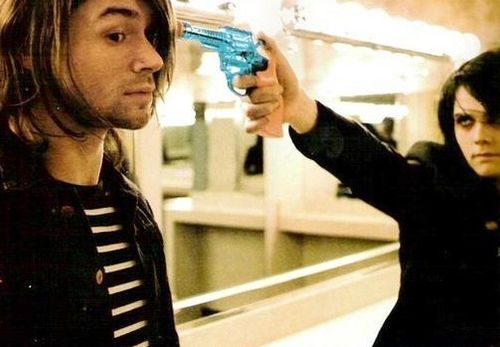
Gerard and Taking Back Sunday’s Adam Lazzara pose for Rock Sound, February 2005. Photo by Chris Mottalini.
By the time “Tell All Your Friends” came out on 26 March 2002, Taking Back Sunday had developed a way of writing songs that would become closely associated with the wave of melodic post-hardcore and emo bands that followed. The interplay between Adam Lazzara and John Nolan’s voices, the guitars and the direct, sometimes bitter lyrics made songs such as “Cute Without the ‘E’ (Cut from the Team)”, “You’re So Last Summer” and “Great Romances of the 20th Century” familiar to a generation of listeners.
Eddie remembered “Great Romances of the 20th Century” as one of the earliest songs they reworked when Adam became their singer. He joked that the earlier version hadn’t been very good. With Adam involved, the band found something they liked, and it became one of the songs Eddie still enjoyed playing in 2005.
The success of the debut was followed by a difficult period. John Nolan and bassist Shaun Cooper left in 2003 and formed Straylight Run, while Fred Mascherino and Matt Rubano joined Taking Back Sunday. Their second album, “Where You Want to Be”, arrived on 27 July 2004 and reached number three on the Billboard 200. The band had managed to keep growing through the changes, although the split continued to generate speculation among fans.
Matt brought up Straylight Run, whose self-titled debut had come out in October 2004. Eddie had bought the CD himself on release day. He liked the record and was pleased that John and Shaun were doing well. “Yeah, it’s good. It’s good for what it is, and those guys are working really hard, and I’m happy for them.”
There had been plenty of rumours online about what happened between the musicians. Eddie wasn’t keen on adding to them. He was concentrating on his own band and thought supporting the former members was the right thing to do. He also liked Straylight Run’s single and video for “Existentialism on Prom Night”, joking that they had stolen one of his video ideas.
When Matt asked whether musical differences were part of the split, Eddie acknowledged them. John wanted to write in a different direction, and Eddie was more interested in melodic guitar music. Straylight Run gave John and Shaun room to do what they wanted. Years later, in a 2019 oral history of Taking Back Sunday, John described a more complicated situation, involving constant touring, arguments within the band and friendships that had deteriorated as their success grew. Eddie’s 2005 comments offer his own view from a time when those events were still relatively recent.
Jimmy Eat World were another important part of the conversation. Taking Back Sunday were touring with them for the first time on a proper shared run, and Eddie was genuinely looking forward to spending time with the band. He owned an extensive collection of Jimmy Eat World’s early seven-inches, going back to the records they released in the mid-1990s.
Their influence had been important when he started looking beyond the kind of guitar playing he’d grown up with in hardcore. “Especially in the mid ’90s, you know, they kind of helped me go from being a hardcore kid to, wow, instead of playing these power chords, let me actually make up a sweet melody out of it.”
Jim Adkins had become one of Eddie’s favourite guitarists. The two musicians were around the same age, and Eddie found it a little embarrassing to admit how much he admired him. He planned to tell Jim during the tour, provided he could find the right moment without making a fool of himself.
That mixture of hardcore background and melody also came up when Matt asked about Eddie’s favourite records. His choices went through MC5, The Who, Bad Brains’ “I Against I” and The Cure’s “Disintegration”. Eddie credited MC5 with helping start punk rock, dismissing the idea that it all began with the Sex Pistols. He loved Paul McCartney’s voice and preferred him to John Lennon, even though he was a fan of both Beatles.
When pushed to choose one record above everything else, he settled on Quicksand’s “Slip”. Released through Polydor in 1993, the album came from musicians with deep New York hardcore connections, including Walter Schreifels of Gorilla Biscuits and Youth of Today. Quicksand took those roots into heavier, more melodic and rhythmically different territory, and Eddie regarded the record as a turning point for the music he loved.
“Quicksand was probably one of the biggest bands. They were doing what our bands are doing now, back then,” he told Matt. The members had come from hardcore bands, and Eddie believed the change in their approach had opened up new possibilities. “And that album changed my life too.”
Some of Eddie’s other listening choices in 2005 were fairly different from the old hardcore records. He was checking out Bloc Party, although he thought the hype around them was getting a little excessive, and listening to plenty of Keane. Matt wondered whether Taking Back Sunday might eventually head towards softer music. Eddie liked the idea of experimenting, but wanted their records to keep moving between heavier songs, slower parts, fast tracks and acoustic passages. He even floated the possibility of an entirely acoustic album somewhere further down the line.
At the time, they were already sneaking new songs into tour rehearsals and playing some of them live. The shows with Jimmy Eat World and The Format had just begun, and Eddie was enjoying being out with musicians he respected. When Matt asked about friendships between touring bands, he was clear that he had no interest in treating other groups as competition.
He had experienced tours with bands that were unfriendly towards them, although he refused to name anyone. “You know, it’s all about friends and family and shit, you know, not about competition.” He wanted the backstage environment to be comfortable, with musicians hanging out, talking and getting to know each other.
He was also pretty dismissive of the old rock-star fantasy. Most nights backstage involved taking showers, relaxing after a show and heading back to the bus. There were parties and drinking sessions, and Eddie admitted to a few memorable nights in Toronto, but he had little respect for the idea that getting wrecked or starting fights was an essential part of being in a rock band.
The hardcore scene he grew up in had a different set of habits. Straight edge, DIY organising and political involvement were all part of the world he knew, even if individual bands and people had very different priorities. Eddie thought those experiences had stayed with Taking Back Sunday as their shows got bigger.
The bus had become his second home, and sometimes he felt more comfortable there than in his own house. “When I’m home, I feel like I’m visiting. Really. When I’m on the bus, I feel like I’m at home.” He loved touring, but there were also times when he wanted to get away from it and spend a while at home with his family.
There was one recent moment when the band’s success had genuinely sunk in. Three days before the interview, Taking Back Sunday had played in Champaign, Illinois. Eddie had wandered through the car park before the show and found fans hanging around their cars, trunks open, coolers out and music playing. It reminded him of the crowds at old metal shows.
He sat down with some of them and spent a while talking. The kids were friendly, excited about the band and happy to have him there. Matt had asked when Eddie first felt he’d made it, expecting perhaps a story about quitting his job or reaching some career milestone. Eddie’s answer was that afternoon in Champaign. “I was like, this rules.”
The band were also getting used to the less enjoyable parts of making videos. Tom DeLonge of Blink-182 had directed “This Photograph Is Proof (I Know You Know)”, and Eddie remembered the whole shoot as exhausting. They had flown in, spent the day filming, flown out again and played another show shortly afterwards.
Tom made the process easier by running around and shouting while they performed, which helped them forget how strange it was to play without a crowd in front of them. Eddie had enjoyed making the “Cute Without the ‘E’” video with a friend, but some of their other shoots had involved being told where to stand and how to act. He didn’t think musicians necessarily made convincing actors.
The conversation also wandered into the music business as it existed in 2005. Illegal downloading was still a major argument, and Eddie had been on both sides of it. He admitted that he downloaded records himself, even quite recently, but hoped people who discovered music that way would eventually buy the CD, go to a gig or pick up some merch.
He knew musicians who had bills to pay and families to support, and he disliked people taking music without ever putting anything back into the bands making it. It was a pretty familiar discussion for the time, when CDs were still central to how independent labels and touring bands made money.
Hip-hop prompted a much stronger reaction. Eddie had grown up around New York rap, and his memories included mixtapes circulating in Brooklyn and Queens and members of De La Soul spending time at his family’s home because they had gone to high school with his brother. Amityville and nearby Wyandanch had played an important part in the development of Long Island hip-hop, and those connections were part of his childhood.
He loved A Tribe Called Quest, Leaders of the New School, Eric B. & Rakim and De La Soul. By 2005, though, he was frustrated with the commercial rap videos he kept seeing, especially their treatment of women and constant emphasis on money, cars and jewellery. He still had time for artists such as Kanye West and Mos Def, but thought much of the mainstream had become repetitive. His opinions were blunt, and Matt let him get into them at length.
That breadth of music was something Eddie returned to when talking about Taking Back Sunday’s own records. He wanted them to contain all the things the members liked, from the heavier hardcore parts to melody, quieter passages and the pop songwriting he admired in The Beatles and The Cure. He was happy when people heard those influences in the band’s songs.
Matt ended the interview with a handful of quick questions, although Eddie wasn’t especially good at giving one-word answers. He chose McCartney over Lennon, talked about smoking marijuana casually, and eventually picked rock and roll when asked to choose between sex, drugs and music. Asked for one word to describe Taking Back Sunday, he went with “Loving”.
For the final song, Eddie chose “You’re So Last Summer“, one of his favourites from “Tell All Your Friends“. It was a fitting choice for a conversation that had spent so much time returning to the band’s beginnings.
Taking Back Sunday went on to release “Louder Now” through Warner Bros. Records on 25 April 2006. It became their highest-charting album, debuting at number two on the Billboard 200, and brought them even wider attention through songs such as “MakeDamnSure”, “Liar (It Takes One to Know One)” and “What’s It Feel Like to Be a Ghost?”.
Fred Mascherino remained in the band through that period, while John Nolan and Shaun Cooper eventually returned in 2010.
Eddie continued playing with Taking Back Sunday until April 2018. The band announced his departure on 13 April, citing personal reasons and acknowledging his contributions as a founding member. In a later oral history, the other members spoke warmly about him and the part he’d played in getting the band started.
In 2026, Taking Back Sunday celebrated twenty years of “Louder Now” with a deluxe anniversary edition released through Craft Recordings on 16 October. The shows around the anniversary also brought Fred Mascherino back on stage with Adam Lazzara, John Nolan and Shaun Cooper, revisiting the songs from the years when Taking Back Sunday were moving from their Victory Records success into the mainstream.
Eddie’s memories in Matt’s interview go back further, to the people booking shows at the PWAC, the local bands trading ideas, and the basement gigs that helped give Long Island its reputation. Even in 2005, he was watching the area’s music scene go back underground after the industry’s attention had moved on. He was pleased that Long Island had received some recognition, and confident that there would always be people putting on shows there.
The original conversation was conducted by Matt Schichter during Taking Back Sunday’s April 2005 tour. Matt’s archive currently dates the recording to February 2004, but references within the interview and the documented tour itinerary place it in April 2005, most likely around the band’s 12 April show in Mississauga, Ontario. The original interview is preserved in Matt Schichter’s archive, with a 27-minute video, a longer audio programme and an automatic transcript. Matt has given IDIOTEQ permission to revisit and republish his archival work.
🔔 IDIOTEQ is ad-free, independent, and runs on one person’s time. If you want it to stay that way: DONATE via PayPal or SUPPORT via Patreon.
NEW: IDIOTEQ Explore 🗺️ Browse 15+ years of our archive by city, country, and style. Find artists on the world map or trace related sounds through the styles map.
Stay connected via Newsletter · Instagram · Facebook · X (Twitter) · Threads · Bluesky · Messenger · WhatsApp.