

Before this record, Shi ran for Congress as a leftist, then stayed inside that world for a few years after the campaign wrapped. By the time he came out of it, Scarboro had been on an extended hiatus, and he’d lost friends, personal connections, and what he calls his sense of self. One of the first songs he wrote when he returned to the band was “Turn It Up!” — a vow to never put the music down again, and a love letter to punk more broadly.
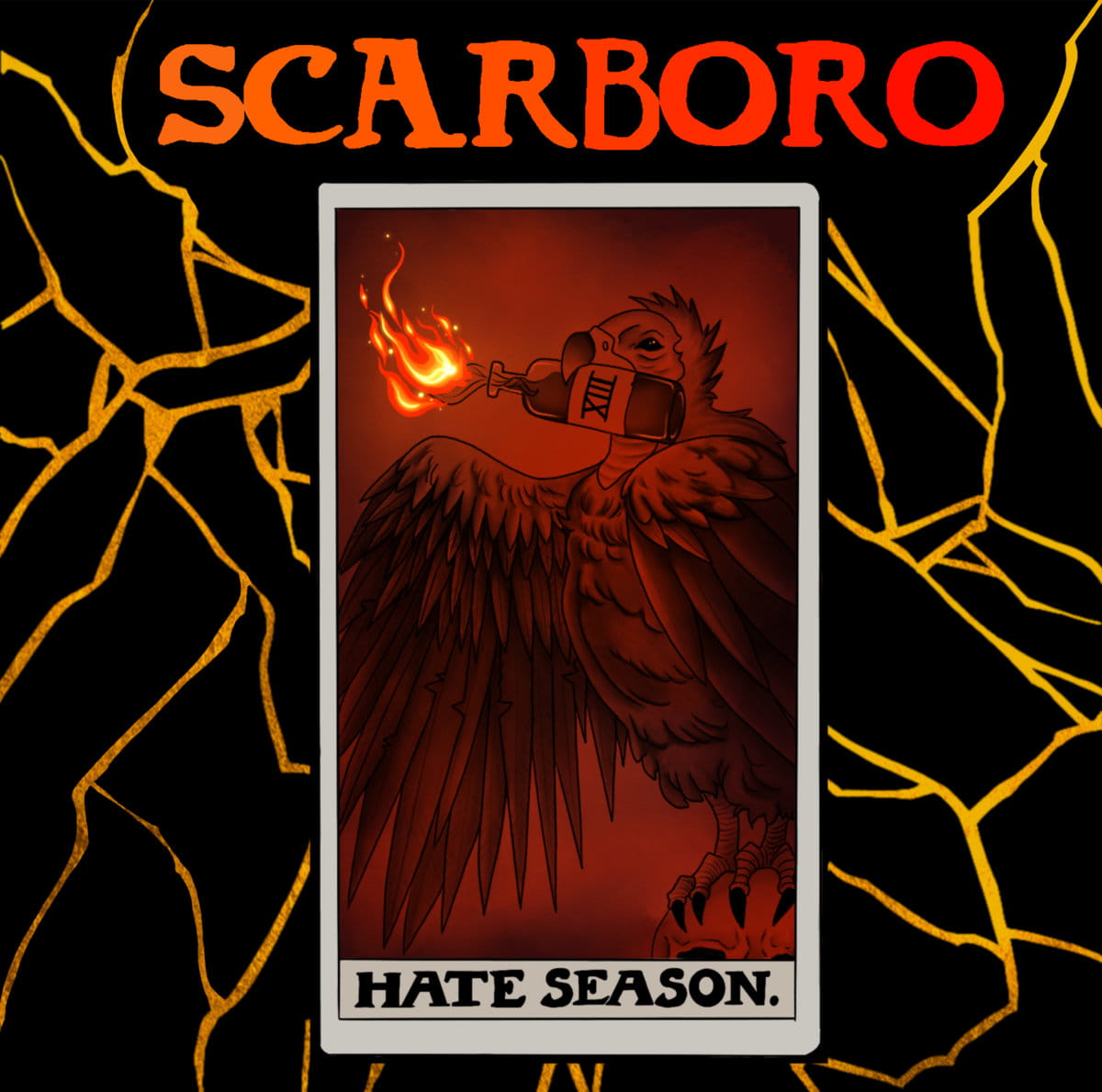
It sits near the end of “Hate Season,” the New York three-piece’s second album, out today on Sell The Heart Records in the US and WTF Records in Europe.
Thirteen tracks, no padding — Scarboro have worked at that length since 2012 — but the stretch of years inside them is dense. Depression, anhedonia, a valium addiction picked up from a bad psychiatrist, nearly two decades of marriage and the repair work that came with it, both of Jack’s parents buried, Shi flying to Puerto Rico to bury his great-aunt. Drummer Radhika holds it all together underneath. What follows is a full walk through the record — commentary from Shi on most tracks, with bassist and co-vocalist Jack taking over on closer “Got Soul?”

“Midnight Special”
The record opens on anxiety at night. “It’s about the insidiousness of anxiety creeping in during the nighttime hours,” Shi says — the ensuing insomnia, the rumination, and the deregulation left behind by the time the episode ends. No resolution in the song, just the loop.
“Sin Futuro”
In February 2025, Shi flew to Puerto Rico to bury his great-aunt. It was his first time on the island in nearly twenty years. Bad Bunny had just released his record dedicated to the Puerto Rican diaspora, and it was playing everywhere he went. “In a way it reconnected me to my roots,” Shi says, “and I sat there in recognition that I was half-Puerto Rican, half-Filipino: descended from two peoples colonized by the Spanish, living in a country with an ever growing fascist movement.” The song takes that recognition and sharpens it into a call — “a warning that history is repeating itself, a need to fight back in a meaningful way because there’s no future under the flag as it exists today.”
“Benzos & Coke”
Both Shi and Jack have had their own struggles with substances, prescription-based and otherwise. The song is an acknowledgment of those struggles but, more than that, of the support network — including each other, through the band — that kept them in one piece. Shi is clear about what the song isn’t: “It’s not a celebration of addiction but a celebration of overcoming it.” The central lyric traces the thought: Time is ephemeral, and then it’s lost. Future: idea. The past prologue. Time is ephemeral, and then it’s lost. We are defined in the epilogue.
“Save Yourself”
Shi wrote this one for his first daughter, who in his phrasing “won the genetic lottery of inheriting the mental health struggles of her parents.” It’s both an apology — for the moments his own mental illness kept him from being the father he wanted to be — and a note of solidarity, an insistence that she carries the strength to overcome it and that he’ll be there alongside her. Let’s take a walk together, down a path too familiar, a road I wish we didn’t have to share.
“Kill Your Ego, Not Yourself”
Shi’s experience running for Congress sits at the center of this one. The first half is about the dangers of ego and ambition getting in the way of altruistic work — “the need to eliminate your personal wants and desires in the pursuit of the greater good for those who don’t have access to power or justice.” The second half is what happens when you drop that guard. “Even among your own allies, when it comes to politics, everyone has their knives out and are willing to stick it in you if it means their own advancement.”
“Hate Season”
The title track lands a middle finger at gatekeepers and haters in politics and punk alike, and at the people who only stay close as long as you’re useful to them. “It’s a call to realize we’re running out of time metaphorically and literally, and that we need to come together instead of further entrenching ourselves in silos.”
“Chaser”
Shi came out of his time in government with a clearer picture of who was actually doing the work and who was mostly running their mouth online. The army that was promised wasn’t marshalled for the war, he writes. The song is an indictment of performative politics — people taking bold stances online and demanding others fall in, “unmoored from any coherent political strategy and meaningful action, which results in gaining clout while the underlying injustice remains largely unchanged.” He extends the critique to fellow comrades benefiting from systems they condemn, and he doesn’t let himself off either: “I know I’m guilty of the same hypocrisy at times — though I’ve never held a for-profit job in my adult life — so no one is spared.”
“Anhedonia”
Shi’s depression got bad enough that he stopped feeling things at all — no joy, no pleasure, even in the things that used to reliably deliver both. The track moves through the long arc of wrestling with mental illness, including the part where getting worse is a side effect of trying to get better. On the road to liberate, addicted to the cure, he sings, pointing directly at “a shitty psychiatrist who got me addicted to valium.” The song is also a plea to cut the extra chains your own mind adds on top of the illness.
“Kintsugi”
The second single off the record, which we covered in March, takes its name from the Japanese art of mending broken pottery with gold. “You don’t stay married for as long as I have (going on 20 years) without breaking some things, including myself, along the way,” Shi says. The mental health struggles meant there was real repair work to do, his own and the marriage’s both. What the song honors isn’t the repair itself but what the repair leaves visible — the flaws filled in, not covered up.
“Suicidal Babies”
This is the one about sounding like a broken record to the people who love you. Mental illness goes on long enough and you start to feel invisible even to the people closest to you — not because they’ve stopped caring but because their own lives require walking on eggshells around yours. I know it’s a struggle living this life, constantly balanced on a rusty knife. Shi names the tension honestly and doesn’t try to resolve it. Whether you overcome any of it, he’s clear, you don’t know going in.
“Turn It Up!”
One of the first songs written for the record, and the one that pulled him back in. “My politics came from punk rock to begin with, my identity for better or worse has always been tied to this music, it’s what gives me life,” Shi says. He calls it a love song to the music that kept him alive, and he tried to capture in the arrangement what his favorite punk songs do to him when he listens. “This thing we do, as much as it’s going the way of the buffalo, is hardwired into my DNA.”
“10,000 Miles”
The shortest track lyrically, and the one Shi says sums up everything that came before it. The question it answers is whether, after the loneliness and the political burnout and the illness and the years lost, he’d do it all again. “A resounding YES!” — because the lessons were worth the hardships, no matter how painful, no matter how uncertain they felt at the time.
“Got Soul?” (Jack)
Closing track, and Jack’s. He wrote it during a period that had hollowed him out — a toxic relationship, a loop of obsession. Running through regrets, swimming through subtexts in my mind. ‘
The chorus pulls back to a blunter statement: life’s a bitch and then you die. You don’t get answers, you can’t waste what time you have, so you take the steps you can and let go of what you need to. The breakdown is where the grief sits. “I didn’t go through so much pain and death just to be dried up and fucked with nothing left” — which is also where Jack locates his own rebuilding after losing both of his parents. “By the end, when I scream ‘I’ve got a soul,’ it’s me taking myself back.”
Wyświetl ten post na Instagramie
“Hate Season” is out now on 12″ LP, CD, and digital. Order from Sell The Heart Records in the US, and WTF Records in Europe (cherry colour eco-mix vinyl).
🔔 IDIOTEQ is ad-free, independent, and runs on one person’s time. If you want it to stay that way: DONATE via PayPal 𝗈𝗋 SUPPORT via Patreon.
Stay connected via Newsletter · Instagram · Facebook · X (Twitter) · Threads · Bluesky · Messenger · WhatsApp.