

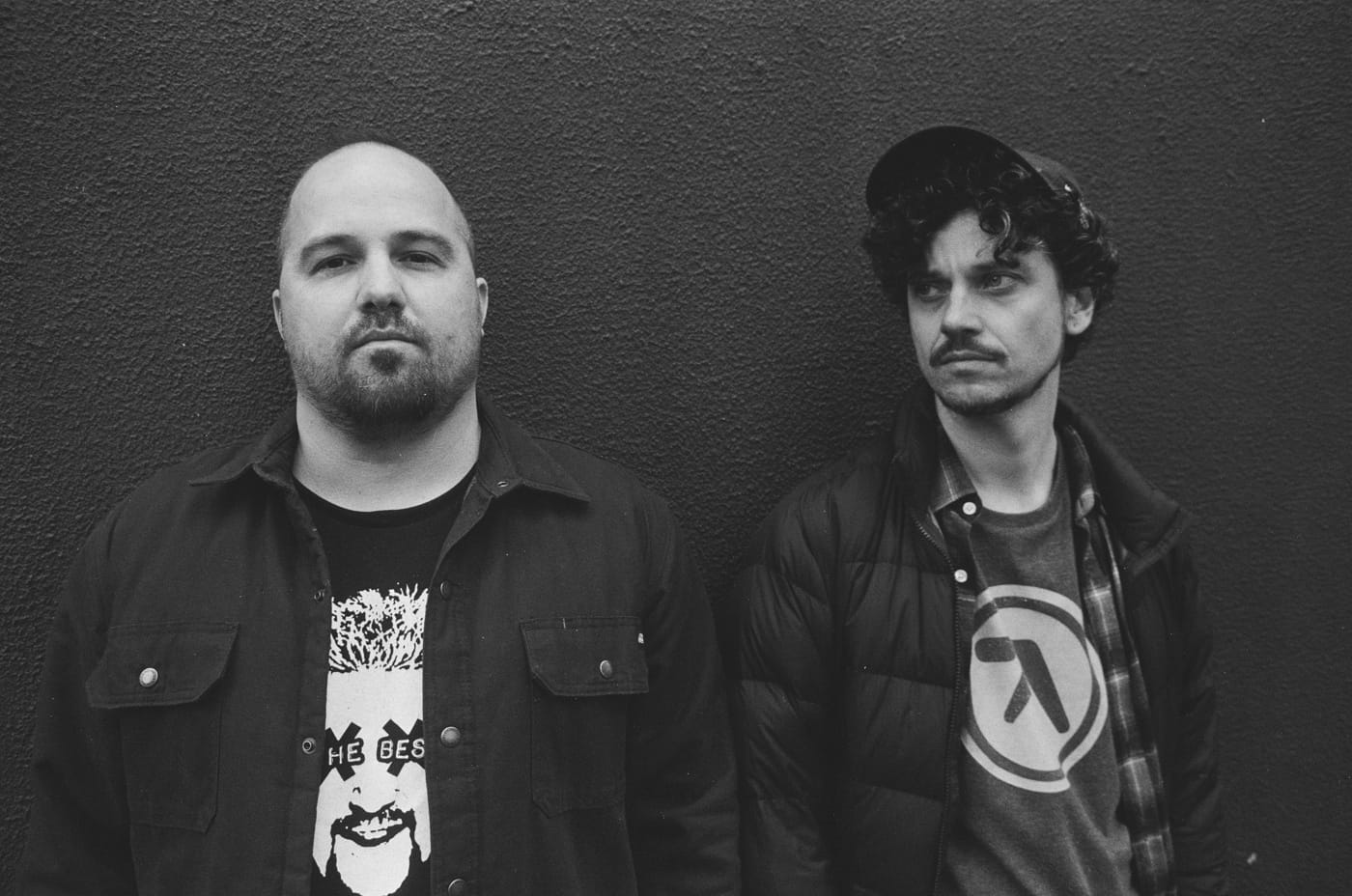
Among the things Buga missed after years on the road were his wife, his dog, his guitar, his office and, with no irony at all, his own bathroom. It is a small detail, but it says plenty about Scrambled Heads. The project began after the life that had made him a musician also started making it difficult for him to remain one.
Scrambled Heads are Buga, currently of Redlightz and formerly one of the main songwriters and front people in Abraskadabra, and André Pamplona, formerly of Monaco Beach.
Based in Curitiba, Brazil, they release their second EP, “Inward, Then Apart“, independently on 7 August 2026. Its first video and single, “I Build Shelter From Branches of Second-Guessing”, arrived on 24 July.
The six-song record’s guitars have the broad, slightly smeared grain of 1990s alternative rock and grunge, while the drums retain the direct movement of punk. The songs sit near Seaweed, Title Fight, Fiddlehead, Drug Church, and The Caulfield Cult though Scrambled Heads sound increasingly comfortable stepping away from the usual post-hardcore obligation to make every feeling arrive at full speed.
That change began before the duo had a name. Leaving Abraskadabra was one of the hardest decisions Buga had made, and there was no single fight or dramatic breaking point behind it. The feeling wore down gradually.
“I worked really hard and put a lot into it,” he says. “I was one of the people up front, one of the main songwriters in the band, and the band was my life. So getting to the point where I could actually admit it wasn’t working anymore took lots of conversations, thinking, and lots of therapy.”
The band’s direction had become part of the problem. Buga no longer had the same hunger for the music Abraskadabra were making or the direction they appeared to be heading in. Restlessness set in, along with a need to challenge himself and get outside the comfort zone built over many years.
The less romantic parts of keeping a touring band together had also grown harder to ignore. Seven people would spend weeks living across vans, venues, borrowed floors and shared bathrooms. Small disagreements gained weight. Egos became harder to manage as everyone got older. Touring became increasingly expensive, while much of the work was still done for love and excitement rather than money.
“In the end, touring is something you really need to want. You need to be fully into it,” Buga says. “At first it was amazing, honestly some of the best moments of my life. But anyone who’s been on tour knows what it’s like.”
Abraskadabra took music written in a Curitiba basement through Japan, the United States, the United Kingdom and Brazil. In Japan, people from the other side of the world wanted to know how those songs had been made and sang them back to the band. Hosts opened their homes. Others brought gifts or helped wherever they could. The friendships formed across different countries, backgrounds and languages remain the part Buga would never trade away.
“You end up creating really amazing connections with people who come from completely different backgrounds, who grew up in a totally different country,” he says. “But we were connected through music, through DIY, through belonging to that movement, whatever you want to call it.”
The cost was a nomadic existence with little routine. Food and sleep suffered first, followed by Buga’s mental health. Returning home did not necessarily mean resting either. Living entirely from touring was difficult, so he spent periods working as a sound technician and handling merchandise and production at shows. The band would come home exhausted, then everyone had to work out how to pay the bills.
Buga’s idea of a good day looks different now. He wakes slowly in his own bed, has coffee with his wife, spends time with the dog, walks around the neighbourhood, cooks something decent and eventually sits in his home studio to work on music.
Some mornings still begin with anxiety. Work, money, music, home and his own thoughts can all start competing at once. The difference is that there is ground beneath him now. His wife, his home and the animals around him remind him who he is when there is no stage nearby.
Five years earlier, the ideal day might have started on a Thursday or Friday with a short Brazilian tour. The band would reach a bar, set everything up, drink, play, meet people and wake the next morning ready to repeat it. Buga remembers the mission, youth and community inside that routine, but also the unstable money, constant improvisation and wear that nobody watching the show would necessarily see.
Learning to slow down without feeling guilty has proved harder than expected. Years spent moving between the next show, song and tour teach the brain to treat stillness as failure. Staying home and building something slowly can look like inactivity from inside that mindset, even when it is the work required to stay intact.
The surprise was how much Buga genuinely liked the quieter version of life. He misses particular people and nights rather than the entire touring structure. Writing at home, recording at his own pace and looking after his space became part of the reconstruction behind Scrambled Heads.
“It’s not less intense,” he says. “It’s just a less destructive kind of intensity.”
Music has been part of Buga’s identity since he started playing in bands at 12. Abraskadabra later strengthened that connection until friendships, travel and his way of understanding the world all ran through DIY music. Touring showed him different forms of community, generosity, effort and belonging. That remains central to his life with his wife. They still attend club shows around Curitiba, support touring bands and buy work from local musicians and artists.
What he had to unlearn was the assumption that music must become a full band operation. Tours, schedules, scene presence and constant proof of relevance had once appeared inseparable from writing songs. Scrambled Heads began from a quieter place, with no need to recreate another road band or perform a younger version of himself.
“I think at some point in my life I was hit really strong by this desire to make music just for the sake of music,” Buga says. He is not pretending that listeners no longer matter. Hearing that somebody connected with a song is still rewarding. The shift concerns the ego built around being seen, being active and making every move look bigger than it is.
From a distance, many achievements that once appeared enormous become smaller. The music remains. So does the possibility that it may reach another person for a few seconds, or preserve a period when two people tried to move their confusion outside themselves and into a song.
Scrambled Heads sound patient because their lives now require patience. The songs contain doubt and silence alongside the harder punk movement carried over from earlier bands. Buga no longer feels obliged to deliver speed, choruses, stage presence and visible strength simply because that was how the old machine worked.
“The music doesn’t need to prove that I’m still that guy,” he says. “It can simply show who I am now.”
He now understands his purpose in music as making honest records of real moments, enjoying those moments while they are happening and recording them when it makes sense. “Inward, Then Apart” documents doubt, memory, family, fatigue, change, numbness and rebuilding. It also looks at compulsive patterns that may have little to do with substances.
For André, addiction can take the form of work, a phone, social media, perpetual busyness or the need to chase whatever comes next. Each can offer a way to avoid sitting alone with difficult thoughts. The songs came partly from recognising those habits and the anxiety, distraction and self-doubt beneath them.
“They aren’t really about addiction itself, but about the patterns behind it,” he says. “I’m still figuring that out, so I don’t think these songs are answers. They’re more like snapshots of that process.”
“I Build Shelter From Branches of Second-Guessing” gets closest to the central process behind the EP. Buga has always liked long song titles, partly because of bands he listened to when he was younger, though he cannot remember whether this particular phrase existed before the song or appeared while he was writing it.
The title followed a major life change and the questions surrounding his reconstruction. Would years of studying finally lead somewhere? Could he be happy outside the life he knew? Had he started again too late? Would he still count as a musician if he no longer lived at the same intensity?
Wyświetl ten post na Instagramie
Today, Buga says he feels fuller and more at peace than he did several years ago. He is able to enjoy the life he and his wife are building, though leaving parts of the old one behind was never simple.
The shelter in the title is constructed from the same things that once damaged him. Fear and doubt become crooked branches which can still be used to make some form of protection. There is no suggestion that uncertainty disappears.
“It’s not about feeling completely safe,” Buga says. “It’s about learning how to build some kind of shelter even in the middle of whatever life is throwing at you at that moment.”
On a bad day, those branches spread into questions about career, money, music and other people. The voice asks whether the studies will lead anywhere, whether a new beginning came too late and whether a person can remain a musician without touring constantly. One doubt leads into another until an entire life is under examination.
Buga no longer tries to defeat that voice completely. He tries to hear it without allowing it to make every decision.
“It’s not a perfect house,” he says of the shelter. “But it works.”
The song began with its verse guitar riff. Buga heard space for a strong vocal over the top and began testing ideas. The minimalist “Slowly, Forward” section caught him off guard. He had usually written dense sets of lyrics, but here two words could be repeated and allowed to roll with the riff.
The chorus originally belonged to another unfinished song. Once Buga placed the two sections together, they needed a connecting part, which became the later “Rocks Rolling” passage. Endless demos followed at his home and André’s place. They experimented, exchanged files and kept reshaping it until its early version barely resembled the finished recording.
“Thank Vishnu we have Gil Costa, our sound man, in our lives to make these ideas actually sound much better in the studio in the end,” Buga says.
The duo spent time deciding which song should introduce the EP.
“Chaos Left Unsaid” was a serious possibility, but “I Build Shelter From Branches of Second-Guessing” finally won because it held together the record’s ideas of doubt, reconstruction and slowly finding stable ground. Gil helped expand the recording without removing its personal character.

“If someone only hears one song before the EP comes out, this is the one we’d want them to hear,” André says. “It gives a pretty honest picture of what ‘Inward, Then Apart’ is all about.”
He also has a simpler ambition for the single.
“Honestly? I hope they think, ‘This song is fucking good.’ Hahaha.”
Beyond that, André hopes somebody in their late thirties hears it and recognises a familiar problem. The record has no interest in reliving youth. It concerns the harder and often less visible job of working out a life from the point where a person actually stands.
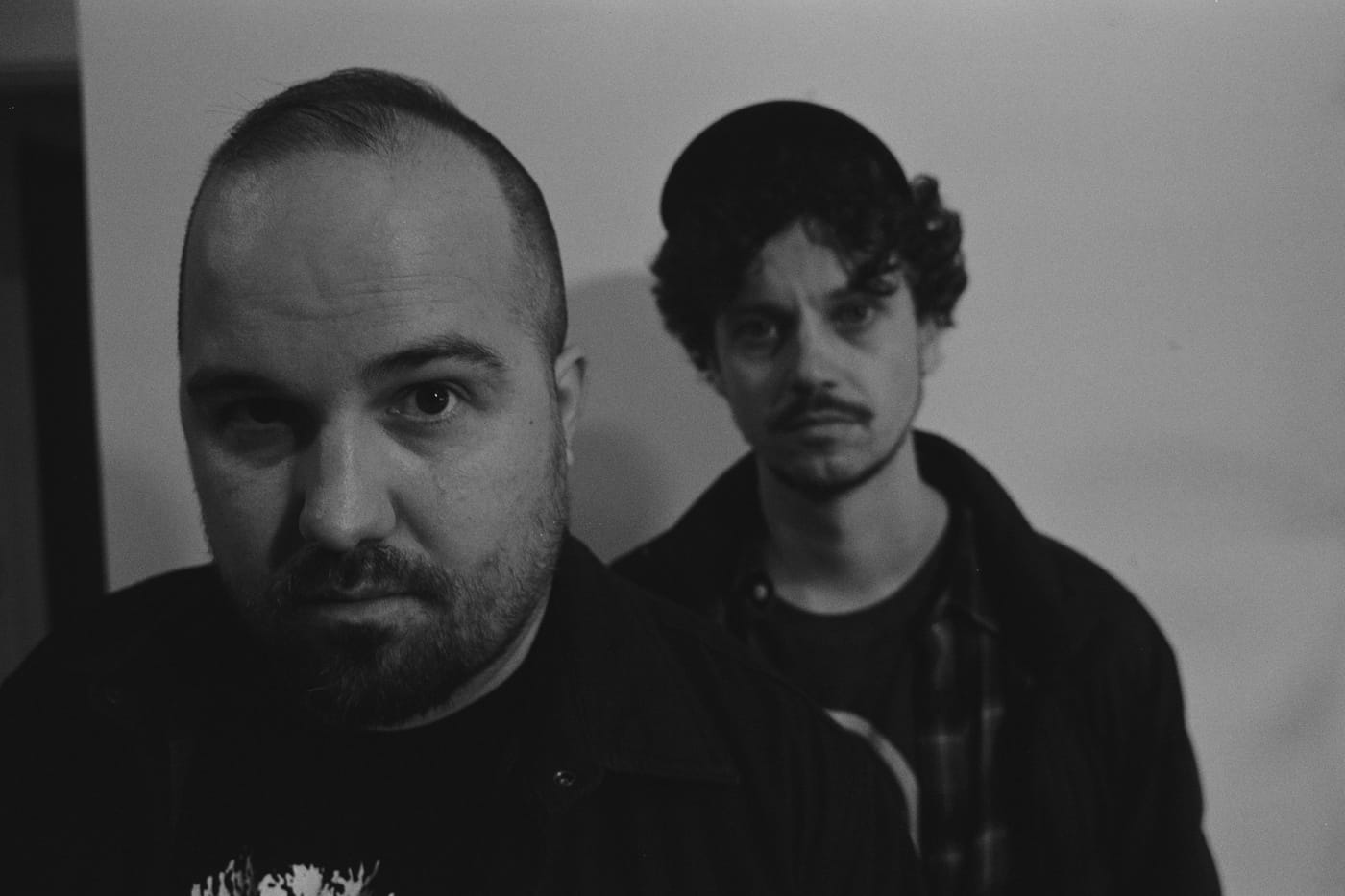
Scrambled Heads themselves appeared almost by accident.
Buga and André enjoyed playing together, songs began to emerge and only later did they decide it would be wasteful to let them disappear. There was never a meeting where they announced the beginning of an ambitious new band.
Neither currently feels much desire to play live. Both have spent years in bands and are enjoying calmer lives at home. Scrambled Heads can remain a recording project unless playing an occasional show begins to sound enjoyable again.
That informality extends into their writing. There are no fixed roles. Buga sometimes brings drum parts, André may arrive with chord progressions, and both alter every song. Limited free time has made them unexpectedly productive. When they meet, they work quickly.
They share similar songwriting instincts but bring different strengths. André considers Buga an exceptional punk and hardcore songwriter who can produce hooks within seconds. André pushes further into experimentation and introduces more melancholy to the melodies.
Their first EP, “Pricele$$”, was recorded and co-produced by Alexandre Capilé and released through Forever Vacation Records. Capilé and the label understood that kind of music, and André remembers the process as smooth, with many pieces falling into place naturally.
“Inward, Then Apart” required the duo to assemble the team themselves. Most of the people involved did not come from hardcore, which introduced uncertainty and a lot of experimentation. Independence made the process harder, though it also brought collaborators who heard the songs differently.
The largest part of the finished record belongs to Gil Costa, who recorded, engineered, mixed and mastered it. Gil has decades of experience and has worked with major artists, although his own background was far from hardcore. Buga and André reconnected with him shortly after he returned to Curitiba following almost a decade away.
They initially wondered whether the lack of shared hardcore reference points might cause problems. Instead, Gil’s outside perspective became one of the EP’s strengths. He remained patient and in a good mood while the duo tried ten versions of the same section, never making them feel that studio time was running out. For André, learning together became one of the best parts of making the record.
Gil kept the guitars thick without losing their edges, while the rhythm section can move between the slower pull of the opening and closing tracks and the quicker songs across the centre. “I Build Shelter From Branches of Second-Guessing” shows how the approach works: a compact verse figure, a vocal line reduced to a few words, then a chorus imported from another idea and a middle section added to make the pieces hold together. Seaweed’s heavy alternative punk is present, as are the blurred guitars associated with later Title Fight, Fiddlehead’s adult emotional concerns and the harder push of Drug Church. The record still sounds connected to Curitiba rather than assembled from reference points.
Curitiba is a calm city with what Buga calls a slightly grumpy disposition.
It is cold, full of bored people who enjoy heavier music and rarely short of a show. Lado B, Janaíno, Belvedere and Basement regularly host local and visiting bands, sometimes during the week.
São Paulo is around four hours away, close enough for Curitiba to receive a steady share of local, large and international shows. Zoom Discos/Records continue to keep releases and events moving. Buga points to Vida Ruim, Patada, Clan dos Mortos Cicatriz, Colligere and Water Rats, who are partly based in Curitiba, alongside Redlightz, whose new songs he is particularly excited about.
“It’s a cold city with bored people who like heavier music, so there’s always music somewhere,” he says.
Much of that activity remains outside English-language coverage. International music media tends to look towards the United States and Europe, while bands elsewhere remain harder to see unless they tour those places directly.
Buga names Argentina’s Boom Boom Kid, São Paulo’s Eu Serei a Hiena, Curitiba bands Better Leave Town and Colligere, and Garage Fuzz from Santos as examples of music that deserves a wider audience.
Brazil is a huge country with traditions extending through classical and popular music, though outsiders frequently reduce it to a few internationally recognised names such as Sepultura, Jorge Ben Jor and Tom Jobim.
The underground is broad and active too. Better Leave Town have played abroad, Abraskadabra toured extensively, and Buga recalls Dead Fish travelling outside Brazil last year and heading to Punk Rock Holiday this year. He hopes more bands will find ways to cross the physical distance that often keeps South American scenes outside US and European coverage.
André moves between indie, electronic music, punk and hardcore, and his own list from the period when “Inward, Then Apart” was written includes Colligere, Marrakesh and Tangerine and Elephants from Curitiba, Bullet Bane, Paira and Pense from São Paulo, Water Rats from Curitiba and São Paulo, and Fadiga from Belo Horizonte.
Scrambled Heads do not fit neatly into that local circuit.
Their relationship with Curitiba remains strong, but the project was not created to occupy a particular slot within it. They came from the scene, still support it and continue to live around it. They simply stopped treating constant participation as proof that their music was real.
The record’s cover makes that connection between home, family and art literal. The original paintings were made by Cila Maranhão, Buga’s mother and a visual artist based in Curitiba. Her work has surrounded him for years, with several pieces hanging in his home. She also taught him his earliest ideas about art and freedom.
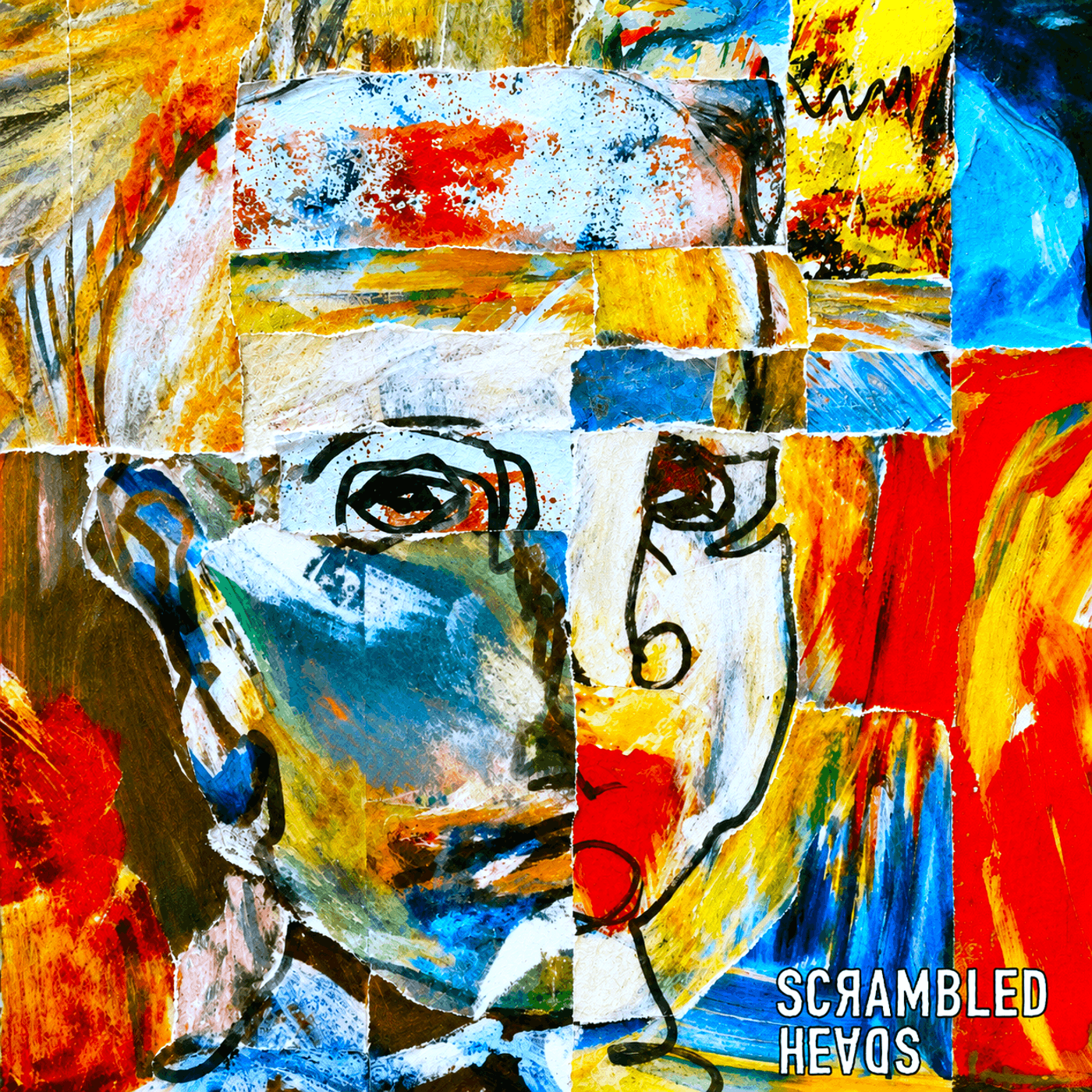
Buga approached her with an initial idea for the cover. Cila liked it and quickly produced around ten different versions. The duo first selected a single painting, but Ale, Buga’s wife, suggested combining several pieces into a collage. The finished cover came closer to what Buga had imagined and, in his view, improved on it.
Cila’s original paintings also appear throughout the video for “I Build Shelter From Branches of Second-Guessing“, where the duo play with the separate works before they became the final collage. Her artwork is credited across the release, while Gil Costa receives the full recording, engineering, mixing and mastering credit.
For Buga, “Inward, Then Apart” is the best-sounding work he has made and a project that has given him a real sense of fulfilment. For André, finishing it required leaving some lyrics exactly as they first appeared, even when releasing them felt uncomfortable.
“There were moments when I seriously questioned whether I wanted to release some of the lyrics exactly as they were,” André says. “They felt too honest, and part of me wanted to soften them or hide behind something less personal.
“I’m really glad I didn’t. I think those uncomfortable moments are exactly what give this record its heart.”
🔔 IDIOTEQ is ad-free, independent, and runs on one person’s time. If you want it to stay that way: DONATE via PayPal or SUPPORT via Patreon.
NEW: IDIOTEQ Explore 🗺️ Browse 15+ years of our archive by city, country, and style. Find artists on the world map or trace related sounds through the styles map.
Stay connected via Newsletter · Instagram · Facebook · X (Twitter) · Threads · Bluesky · Messenger · WhatsApp.