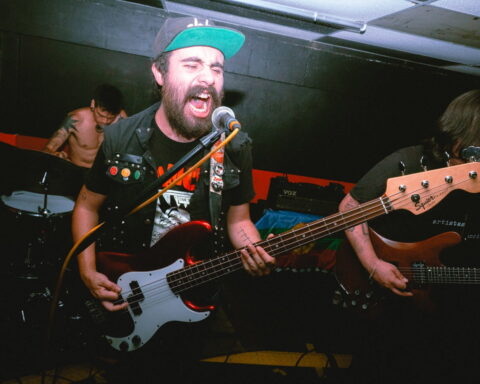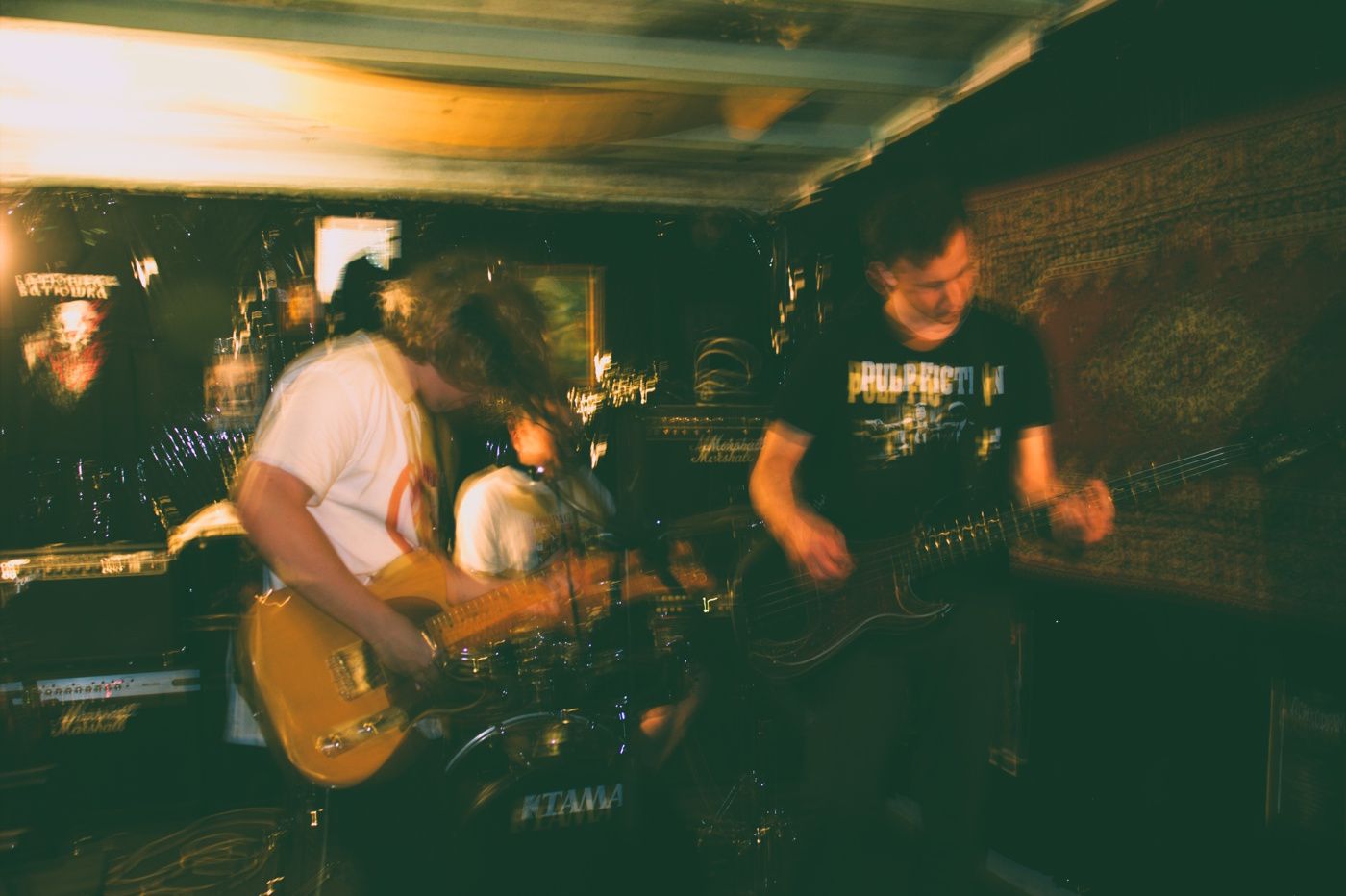


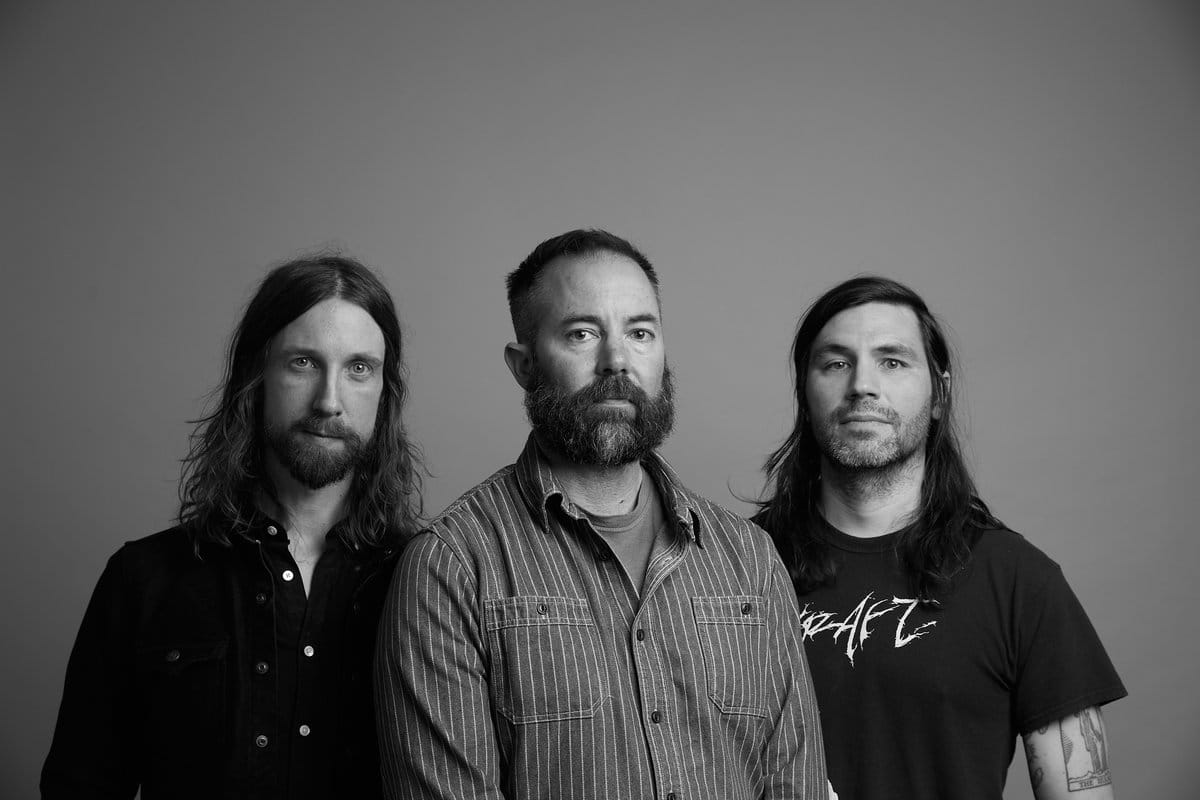
Russian Circles passed twenty years as a band in typically unspectacular fashion. They were halfway through the touring cycle for “Gnosis“, their eighth album, and spent 2024 playing Australia, South America, Europe and North America. There was no anniversary victory lap. They kept working.
Ask different listeners for the definitive Russian Circles record and the answers start spreading quickly through “Enter”, “Station”, “Geneva”, “Empros”, “Memorial”, “Guidance”, “Blood Year” and “Gnosis”. The band have built their audience through albums and touring, with no single crossover track carrying the whole story.
Their ninth full-length, appropriately called “Nine”, arrives today, August 28, through Sargent House. Guitarist Mike Sullivan now lives in Los Angeles, drummer Dave Turncrantz remains in Chicago, and bassist and keyboardist Brian Cook is on Vashon Island outside Seattle. The three still make records that sound like a band occupying the same room, even as much of the writing now travels around the country through Logic sessions and shared files.
Brian talks below about how that distance changed the way Russian Circles write. The old routine had Mike and Dave meeting a couple of times a week in Chicago and working through riffs together. The pandemic pushed Russian Circles towards remote demos during “Gnosis“, and the method stuck.
Mike usually starts a song, Dave works through arrangements and edits, then Brian brings in bass and synth. They can spend eight or nine hours alone on an idea in a way that would be impossible during a full-band rehearsal. The trade-off is that nobody knows for certain how every part will behave until they finally meet in the studio.
On “Nine“, they were still changing sections on the morning of the final mix.
Some older habits have proved harder to replace. Russian Circles recorded their 2006 debut “Enter” at Electrical Audio in Chicago and have repeatedly found their way back there. “Station” took them to Seattle to work with Matt Bayles. They returned to Electrical Audio for “Geneva“, then tried Phantom Manor for the stripped-down “Empros“, where they found themselves spending time trying to recreate sounds they already knew how to get in Chicago. “Memorial” brought them back again.
Kurt Ballou entered the recording history with “Guidance” in 2016. For “Blood Year“, “Gnosis” and now “Nine“, Russian Circles settled into a two-studio routine: basic tracking at Electrical Audio, then guitar overdubs and finishing work at Ballou’s GodCity Studio in Salem, Massachusetts.
Ballou, best known here through Converge and his work with bands including Mastodon and High on Fire, has become central to how Russian Circles separate detail inside all that distortion.
Returning to Electrical Audio for “Nine” carried different weight after Steve Albini’s death. Russian Circles never recorded with Albini himself and Brian says they were never personally close, but he was often around the building during their sessions. Brian remembers his presence there as a kind of “punk / audiophile blessing”. They held him in very high regard.
The record itself wastes little time getting difficult. “Borehole” is one of the more recognisably rock-shaped pieces Russian Circles have written, built from repeating sections that eventually lead back towards the same bleak place suggested by its title. The name began as a Logic placeholder while Brian was reading about extreme points on Earth. The Kola Superdeep Borehole, the deepest man-made hole in existence, stuck in his head: decades of labour poured into an enormous hole in a barren part of Russia, with no practical destination waiting at the bottom.
That accident fed into some of Brian’s wider thinking about making art now. During our conversation he connects the borehole with the strange question of why people keep making things while art is devalued, fed into an endless content cycle and increasingly pressured by the tech industry. He also points towards the hostility directed at professions he considers worthwhile: doctors, teachers, professors, librarians, journalists and artists. Russian Circles do not supply lyrics to spell any of this out. Their titles, sounds and images leave room for those ideas to collect around them.
“Empath” hits from another direction. A Godflesh-like bass crunch and a siren drone open the track before Mike’s guitar moves through thrash and death metal, dissonant black metal, a d-beat section that Dave redirects towards The Jesus Lizard, a hardcore breakdown and a final war-metal riff, all inside five minutes. Mike originally wrote most of it while trading riffs with his older brother, who had only recently started learning guitar. Brian and Dave heard the demo when the bulk of the structure was already there.
Inside the band, those sections acquired much less dignified working names. Brian remembers discussions along the lines of, “the Tragedy part will go into the Crush Your Soul part into the Pissgrave part.” In practice, that meant talking about sections as “the Tragedy part”, “the Crush Your Soul part” or “the Pissgrave part”.
“Eluvial” stretches out further. Mike uses ping-ponging stereo delay, with Brian Eno and The Edge’s work around “The Joshua Tree” somewhere in the technique’s ancestry. Dave plays around a Latin-influenced rhythmic pulse while Brian puts grinding bass against clipped electronics. The guitars keep extending a linear melody until the whole arrangement reaches its loudest section and then falls away.
The second half starts differently again. “E2” runs on low synth pulses, dubby bass, finger-tapped guitar and quick rhythmic changes. “Meridian” gives Dave more room to push underneath Mike’s repeating arpeggios, with Steve Reich sitting somewhere in the reference bank. The band know the slow build well by now, but the movement comes from the rhythm underneath it, not just an eventual increase in volume.
Then comes “Arletta“. Mike recorded the nylon-string solo piece separately with Dave Catching at Rancho De La Luna. The reason was wonderfully practical: he wanted one particular classical guitar and did not want to put it on a plane, so he drove out from Los Angeles to the desert with it.
“Arletta” originally sat at the end of the record, after “Seventh Seal”. Russian Circles swapped them and found a familiar metal sequence in the process. “Ride the Lightning” and “Master of Puppets” are recurring reference points for the band, and placing Mike’s solitary classical guitar immediately before the album’s hardest direct metal track let them use the same acoustic-to-crushing transition that Cliff Burton-era Metallica handled so well. “Seventh Seal”, the final preview released ahead of the album, goes straight into thick guitars and hard drums once that short introduction has cleared.
Wyświetl ten post na Instagramie
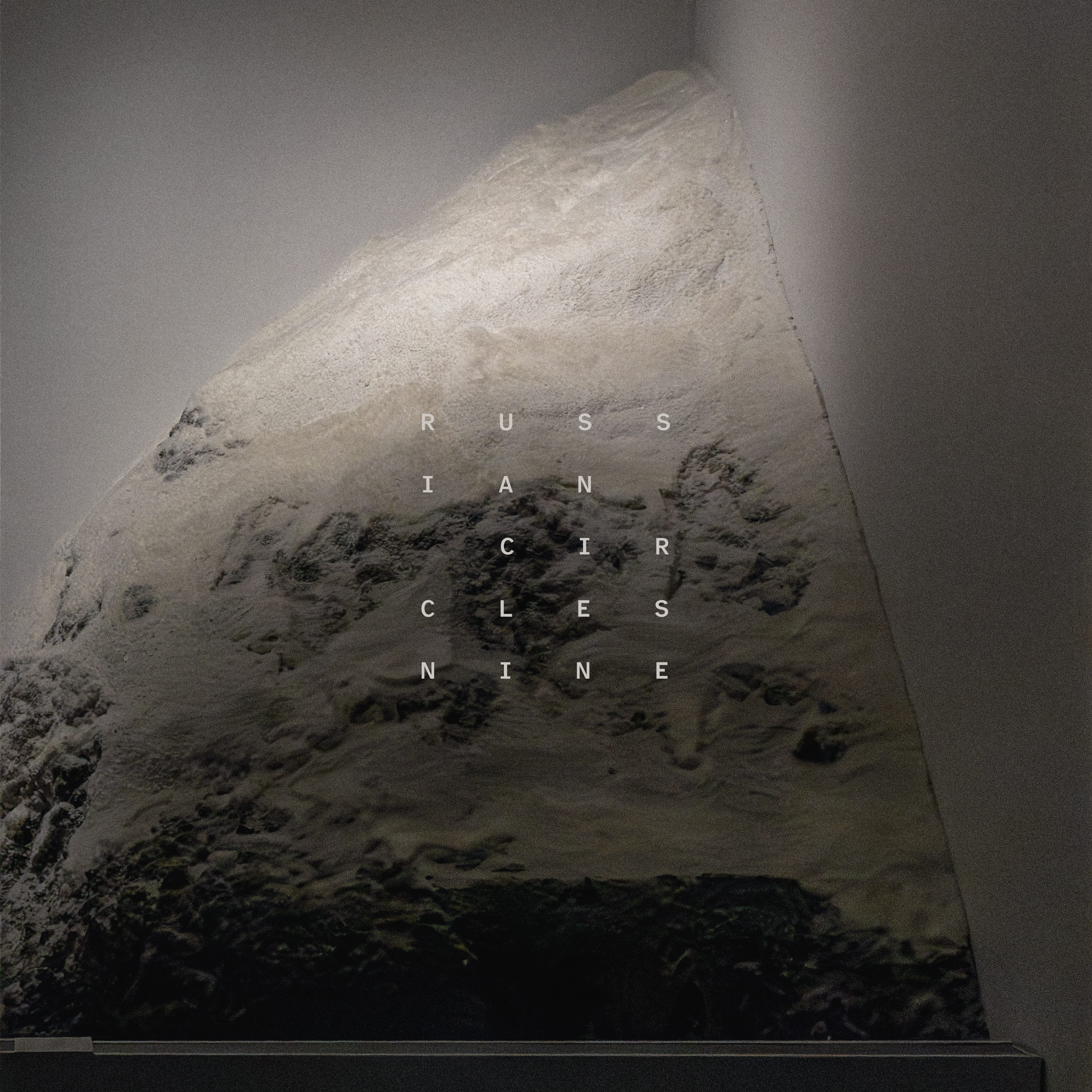
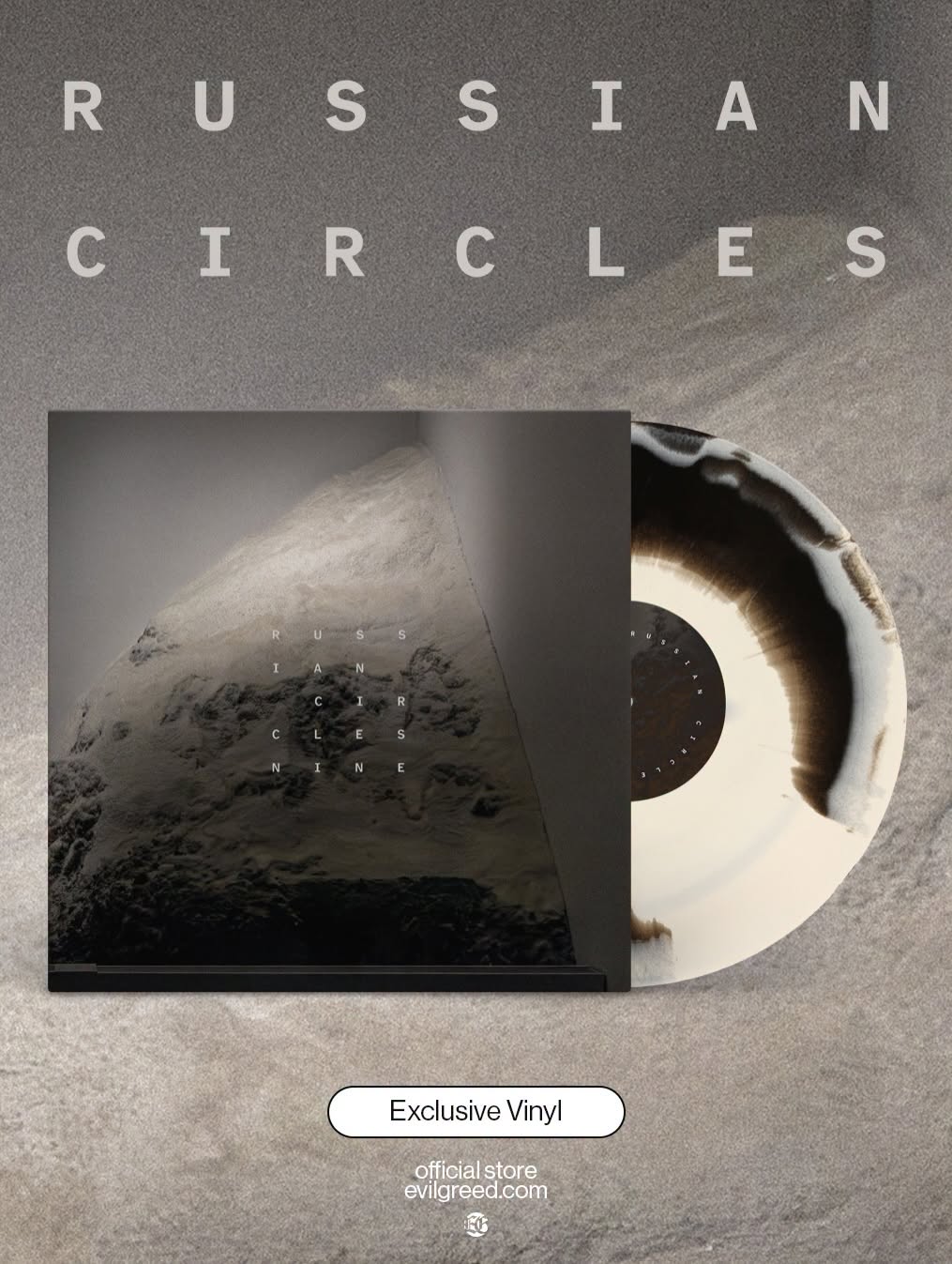
There is another Chicago connection on the cover. “Nine” uses photographs of Tony Tasset’s “Snowpile for Chicago”, a sculpture displayed in the windows of the Chicago Public Library’s West Town Branch since 2004. Cast bronze, brass, fibreglass, resin and oil paint are used to reproduce one of the dirty piles of snow that collect beside Midwest streets every winter. Mike and Dave had loved the sculpture for years.
A fake mound of filthy snow sitting indoors is a pretty good object to bring into a Russian Circles record. Brian talks about its strange mix of precision, ugliness and urban familiarity, and about the almost liminal-horror quality of seeing it isolated behind glass. From there the conversation gets into transgressive art, disposable content, AI, politics and the temptation musicians now face to explain every decision publicly.
Wyświetl ten post na Instagramie
Russian Circles have plenty of interests available for lighter conversation too. They are serious gear obsessives, and across the band the extracurricular rabbit holes include ice hockey, mechanical keyboards, skateboarding and graffiti culture. We ended up spending our time elsewhere.
Brian talks below about the song Russian Circles once thought could have been their crossover moment, then left off “Gnosis” because one member did not enjoy playing it. He goes back to joining the band around “Station”, when he was meant to be a temporary studio fill-in, through “Geneva”, the first record where he was present while the songs were actually being written. He talks about being camera shy on tour, why “Nine” accumulated meanings after the title was chosen, the usefulness and frustrations of remote writing, and why they keep returning to Electrical Audio.
Wyświetl ten post na Instagramie
We also get into the band’s long relationship with Sargent House. Brian first worked with Cathy Pellow in 2006, when Sargent House managed These Arms Are Snakes and helped them escape a bad record deal before moving to Suicide Squeeze Records. Cathy later helped Russian Circles through a similar situation. The move towards releasing through Sargent House eventually came from the simple practicality of keeping management and label work under the same roof. Brian’s experience with labels has included people he still values and, in his words, some “shady motherfuckers” whose business decisions could leave bands unable to operate. His account of Sargent House is much simpler: they respect the band’s decisions and provide enough infrastructure to keep Russian Circles working.
Why did the abandoned Kola Superdeep Borehole become the reference point for the opening track, and do the other titles on “Nine” point toward real places, objects or events in a similar way?
“Borehole” was initially just a placeholder name. I was working on it in Logic and you have to name the file something, and I just happened to be reading about various extreme points on the Earth. The Kola Superdeep Borehole is the deepest man-made hole in existence.
In most instances, placeholder names get swapped out for something more pertinent to the band or the process, but for whatever reason this one stuck. Aesthetic decisions like album and song titles tend to be pretty instinctual, meaning we deliberate on it quite a bit but there isn’t any real conscious criteria for what makes the cut. It just has to feel right. And it often works out that the thing that “feels right” winds up taking on a bit more of a weight and meaning as time goes by. In the case of “Borehole,” I think there’s something sort of strange and tragic about all the time and effort that went into digging this hole to nowhere in this desolate and barren landscape.
I’ve spent a lot of time thinking about art, particularly in the current climate where art seems to be under attack or constantly undermined by the tech world, and can’t help but wonder if there’s a similar futility. Are we just digging a hole for our own amusement over here? But once you embrace the absurdity of modern life and realize how trivial most professions can feel, it really reframes the creative process. Doctors, professors, librarians, teachers, journalists, artists… these are all noble callings. And strangely, they’re also the professions that encounter the most hostility in our current political climate.
What first drew you to Tony Tasset’s “Snowpile for Chicago,” and what does that sculpture say about the record, the band and your relationship with Chicago after twenty years?
Mike and Dave have loved that sculpture since it first went up in the window of a building in downtown Chicago. It’s visually striking, especially considering that it occupies an interior space.
There’s almost kind of a liminal horror aspect to it. It feels like a very “Chicago” piece of art—it references the environment; it speaks to urban blight; it’s meticulously rendered even if it’s kinda ugly. We see a lot of parallels between that sculpture and our music. I could really spiral into this whole discussion on transgressive or “ugly” art and tie that all back into the aforementioned notion of futility in art but we’re just getting started here and I’ll spare you the tangents for the time being. Haha!
As an instrumental band, how do you deal with the expectation that musicians should constantly explain their politics, intentions and reactions online? Does staying wordless protect the music, or does that silence get interpreted as a position anyway?
Well, here ya go… I’m probably cramming too much context into “Borehole” and “Snowpile for Chicago” when I should probably just keep my mouth shut and let people interpret things as they see fit. I’ll say this much though… I think younger and newer musicians have gotten really talented at articulating their vision and speaking of their work in a manner that imbues it with layers of meaning.
And in many ways, I feel a compulsion to try and live up to that… to make a grand artist statement to accompany the music. But it would be a little disingenuous of me to go much deeper than I’ve already gone here, because really… there’s not a complex vision or muse or subtext to what we do.
On the contrary, what we mostly do is just try to write music that resonates with us, that compensates for the lack of clear language by communicating with the listener on a purely timbral level. By no means are we apolitical, but I learned awhile back that once you open the Pandora’s box of attaching a clear political / activist platform to your music, you suddenly spend all of your time debating trolls online. It’s exhausting and pointless. I’d rather be the Trojan horse that infiltrates hostile spheres under the guise of mean riffs and then, you know, go on stage in a Tom of Finland shirt and do a band fundraiser for Black Lives Matter.
Could you walk through “Empath” section by section and explain what each turn draws from, from the opening bass and drone through the thrash, black metal, d-beat, hardcore and final war-metal passage?
That song is a bit of an anomaly. Mike sent us a demo of the song almost fully formed. It stemmed from a creative exercise he was doing with his older brother, who’s just now learning guitar, where they would take turns writing riffs to programmed drum beats.
I think Mike kinda realized he had something good going here and sent it to me and Dave and we both latched onto it immediately. The bass and drone opening was something I pitched more as an interlude, but it became the intro to the song. But yeah, the remainder of the song was mostly written before Dave and I heard it.
But the fact that it feels like an overview of the various corners of heavy music was a big part of the appeal. It has that initial thrash/death riff, that dissonant black metal part, the d-beat part where Dave refused to actually play a d-beat and went more of a Jesus Lizard route, and that big dumb breakdown at the end. I don’t know how in-depth you want me to go here, but we we definitely referred to sections of the song by referencing other bands. Like, “okay… so the Tragedy part will go into the Crush Your Soul part into the Pissgrave part.” I honestly don’t know how we make a living doing this. Hahaha!
What changed in each member’s signal chain or recording setup between “Gnosis” and “Nine,” and what did Kurt Ballou hear or push that you would not have arrived at by yourselves?
Oh man, there’s no way we can really keep track of that kind of thing. I mean, my rig is pretty consistent, but both Mike and I basically tear our pedalboards apart and spend hours tone-chasing in the studio to get the “right” sound… and then we have to figure out how to replicate that live.
For me, I wanted a bass tone that was a little less bright and a little more full, so Kurt and I worked towards that. And Mike wrote a lot of this material around ping-ponging stereo delay, so there was a lot of work to make sure each amp was dialed in currently to maximize the effect. But in terms of specific gear changes, I can’t really tell you what we did.
You recorded “Enter” at Electrical Audio in 2006 and returned there for “Nine” twenty years later. How has the way you use that room changed, and what did returning after Steve Albini’s death mean to you?
Well, it seems like every time we try to venture out and try something new, we just wind up coming back to Electrical Audio. We did Enter there, and then the guys decided they wanted to work with Matt Bayles in Seattle, which was great, but it’s also a lot easier to record in your hometown than drive 36 hours with all your gear at the onset of winter.
So after Station, we went back to Electrical for Geneva. And that record felt so lush and elaborate that we were like “we should try to make a stripped-down, grimy record,” so we went to Phantom Manor for Empros where we spent way too much time just trying to get things to sound like they did at Electrical. So back to Chicago for Memorial. Then we went out to God City to record with Kurt on Guidance, but we couldn’t track drums with the rest of the band in that room, so we went back to Electrical for basic tracking on Blood Year.
And we’ve kinda just stuck with recording basics at Electrical with Kurt and then doing guitar overdubs at his studio in Salem. That just seems to be the most efficient way to do things. At this point, we know what we want things to sound like and we don’t want to spend multiple days getting sounds dialed in, so it just makes sense to go to studios where we know we can crank things out in a matter of days, versus a matter of weeks.
But it was definitely a little somber to return to Electrical after Albini had passed. We all held him in very high regard. And even though we never worked with Steve and weren’t close with him, having him in the building during so many of our sessions was a kind of treat in and of itself. It felt like there was some sort of punk / audiophile blessing attached to our records just by having him in the general vicinity.
How does a Russian Circles song move between Los Angeles, Chicago and Vashon Island before the three of you meet in a studio, and where are disagreements about arrangements finally settled?
It’s not a streamlined process by any means. In the old days when Mike and Dave both lived in Chicago, they did things the old fashioned way where they would meet up a couple of times a week and try out various riff ideas until a song started coming together.
But starting with Gnosis and the whole pandemic obstacle, we finally grudgingly stepped into the 21st century and embraced recording programs and file-sharing. The song origins usually stem from Mike, though I’ll occasionally pitch a song. Dave will then flesh out some ideas and suggest some edits, and then I’ll do my best to glue it all together with synth and bass.
We’re not exactly luddites, but we’re also definitely not recording engineers, so there was a lot of troubleshooting, a lot of glitches and hiccups, and a lot of “I can’t tell if this is a bad bass line or if you just can’t track bass very well.” Hahaha! But yeah, it’s a difficult process because you’re never hearing things in a proper full-band context, so sometimes you don’t know if something really works until you’re actually in the studio together. We were changing parts, redoing sections, and making edits up until the last morning of mixing.
You have built a twenty-year career without one obvious crossover song defining the band. Has that given you more freedom, or have there been moments when you felt pressure to simplify what Russian Circles is for audiences, labels or festivals?
When I was younger I had a bit more of a cynical attitude about pop music and the notion of selling out. I really believed that people would deliberately dumb down their music for popularity. And maybe some folks do… I don’t know.
But as I get older I’m more convinced that deliberately writing music for other people versus writing music for yourself is actually WAY harder, because you don’t really know if the music is effective if you’re not emotionally invested in it. Maybe I’m too idealistic in my thinking now, but even if you were to take, say, Peter Gabriel-era Genesis versus ’80s MTV Genesis, I don’t think those guys were actively turning their backs on the music they loved to pander to the masses.
I think they were genuinely interested in trying new things, albeit in 4/4 time signatures. We had a song from the Gnosis sessions called “Five Points of Light” that was a four-minute song with a simple structure that I absolutely loved and am convinced would’ve been our crossover song, but not everyone in the band was feeling it, so we left it off the album. There’s no joy in playing a song that you know your bandmates don’t like. It was an easy decision to cut it.
Does anyone in the band keep notes, photos or voice memos on tour, and would you be open to turning the “Nine” run into a proper post-tour diary for IDIOTEQ?
We don’t. I take some photos, but even then, I think my bandmates are generally pretty camera shy.
Is “Nine” simply a record of this being your ninth full-length, or did the title start to carry another meaning once the album was finished?
We threw around a bunch of title options but nothing felt right. Nine felt neutral and straightforward, though in the classic aforementioned “go with what feels right and see what meanings attach to it later,” it winds up that nine is a pretty loaded number.
It symbolizes purity and completeness in Baha’i and Hindu faiths while also being associated with Satan in LaVeyan Satanism. In science, nines are a notation for expressing the purity of a chemical. I also like that it’s a homonym of German’s “nein” or “no.” So it seems like a very paradoxical number, or at least one that has strong connotations across a broad spectrum both within and across various cultures and schools of thought.
“Arletta” was recorded separately with Dave Catching at Rancho De La Luna and is built around Mike’s nylon-string guitar. Why did that piece need a different room and recording situation from the rest of the album?
Mike wanted to play it on a very specific classical guitar and he didn’t want to fly with it, so he drove out to the desert from LA to record it at Rancho De La Luna.
What made “Arletta” the right entrance into “Seventh Seal,” and how did you decide that the record should close by moving from a solitary guitar piece into its most direct metallic attack?
Originally, those two songs were swapped. So “Arletta” was going to be the somber comedown for the album. But we reference Ride the Lightning and Master of Puppets all the time, so it seemed fitting to pay homage to the classic Metallica records by doing the “classical guitar intro into the brutal metal song” thing that made those albums so compelling.
Brian first entered the band’s orbit around “Station” and became a permanent member by “Geneva.” Looking back, when did the current three-person identity of Russian Circles fully become its own band rather than a continuation of the original lineup?
I was literally just a fill-in when we made Station. The songs were pretty much all written. They were recording in Seattle with Matt Bayles.
My old band These Arms Are Snakes had done some shows with Russian Circles and I’d done some fill-in studio work with Mouth of the Architect, so when I heard that they’d parted ways with their original bass player and were recording in my city with my friend Matt, I offered my services. I tried to keep things simple, which back then meant still making the bass kinda complicated and busy.
They tried doing some touring with another bassist but they wound up enlisting me to do more with them. I don’t remember ever formally joining the band… apparently they got me drunk before asking. But Geneva was the first album where I was a part of the band as the songs were coming together.
The distance-based writing process for “Gnosis” began under pandemic conditions. Which parts of that method became permanent once living in separate parts of the country became the normal situation?
I don’t think we’ll ever go back to the whole “practice twice a week” method of writing. I mean, I’d LOVE to practice twice a week. I’d LOVE to hang out with Mike and Dave all the time and hear the songs come together as an actual living unit. But we honestly get things done so much faster when we work individually and in isolation.
Even when we finally met up in Chicago to record, the last few days before we started tracking we basically scrapped in-person rehearsals because everyone wanted to workshop specific ideas on their own. It’s hard to practice as a unit for more than 3 or 4 hours a day. But you can EASILY work 8 or 9 hours a day if you’re tracking ideas in Logic.
“Empros” began your long relationship with Sargent House, which now stretches across roughly fifteen years. What has that continuity allowed you to protect as the music business and the band’s circumstances have changed?
Well, the relationship with Sargent House goes even further back. I started working with Cathy Pellow at Sargent House back in 2006 when they took on managing These Arms Are Snakes.
We were stuck in a bad record deal and they helped us get out of our contract and move over to Suicide Squeeze Records. Similarly, Cathy got Russian Circles out of a bad record deal with their old label so that we could also work with Suicide Squeeze.
And honestly, we’d still work with Suicide Squeeze, but it just became easier to consolidate everything under one roof. Since Sargent House had a label arm, it just made sense to start releasing our records that way. I’ve dealt with a lot of record labels over the years and I’ve been very lucky to work with some amazing people in that regard. But I’ve also had some really shitty experiences with some shady motherfuckers.
Record labels always have to juggle artistic integrity with financial realities, and unfortunately I’ve been stuck with some folks that really just wanted to monetize off my bands even if it meant crippling the band into inactivity. For us, Sargent House has been a label that honors and respects our decisions while also providing enough infrastructure and resources to keep everything operational. It’s the best of both worlds.
Russian Circles Tour Dates
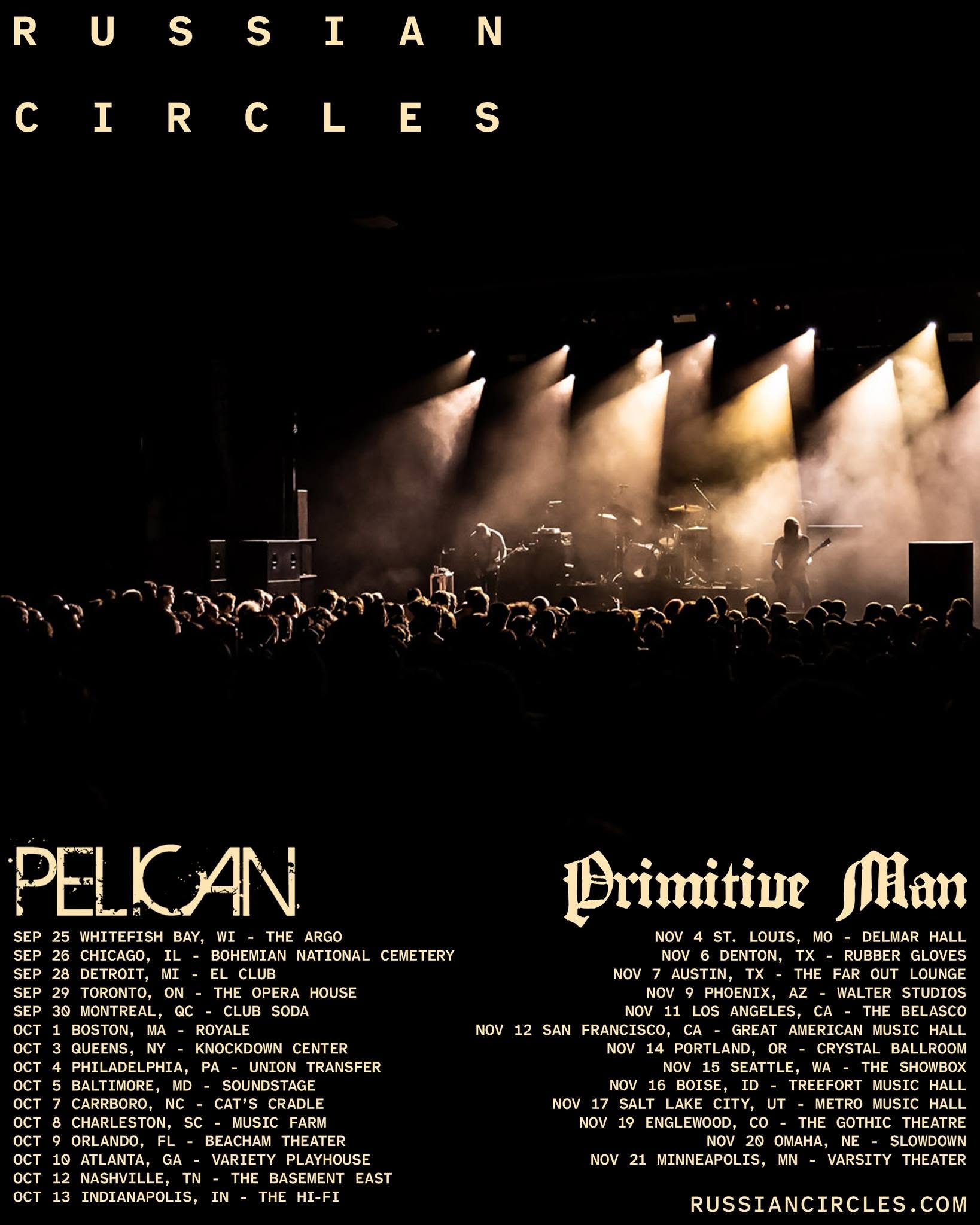
Fri. Sept. 25 – Whitefish Bay, WI @ The Argo *
Sat. Sept. 26 – Chicago, IL @ Bohemian National Cemetery *
Mon. Sept. 28 – Detroit, MI @ El Club *
Tue. Sept. 29 – Toronto, ON @ The Opera House *
Wed. Sept. 30 – Montreal, QC @ Club Soda *
Thu. Oct. 1 – Boston, MA @ Royale *
Sat. Oct. 3 – Queens, NY @ Knockdown Center *
Sun. Oct. 4 – Philadelphia, PA @ Union Transfer *
Mon. Oct. 5 – Baltimore, MD @ Soundstage *
Wed. Oct. 7 – Carrboro, NC @ Cat’s Cradle *
Thu. Oct. 8 – Charleston, SC @ The Music Farm *
Fri. Oct. 9 – Orlando, FL @ The Beacham Theater *
Sat. Oct. 10 – Atlanta, GA @ Variety Playhouse *
Mon. Oct. 12 – Nashville, TN @ The Basement East *
Tue. Oct. 13 – Indianapolis, IN @ The Hi-Fi *
Wed. Nov. 4 – St. Louis, MO @ Delmar Hall $
Fri. Nov. 6 – Denton, TX @ Rubber Gloves $
Sat. Nov. 7 – Austin, TX @ The Far Out Lounge $
Mon. Nov. 9 – Phoenix, AZ @ Walter Studios $
Wed. Nov. 11 – Los Angeles, CA @ The Belasco $
Thu. Nov. 12 – San Francisco, CA @ Great American Music Hall $
Sat. Nov. 14 – Portland, OR @ Crystal Ballroom $
Sun. Nov. 15 – Seattle, WA @ The Showbox $
Mon. Nov. 16 – Boise, ID @ Treefort Music Hall $
Tue. Nov. 17 – Salt Lake City, UT @ Metro Music Hall $
Thu. Nov. 19 – Englewood, CO @ The Gothic Theatre $
Fri. Nov. 20 – Omaha, NE @ Slowdown $
Sat. Nov. 21 – Minneapolis, MN @ Varsity Theater $
*w/ Pelican $ w/ Primitive Man