

Kraanerg are one of the more interesting bands to get into at the level of how the music is actually made. Almost every note on their second full-length, “Aria for Labellum Tongues“, existed on paper before anyone recorded it, and the record was already close to finished as an instrumental when Nat Bergrin spent another year pulling parts out and rebuilding sections around their own voice.
A deathcore breakdown can be planned bar by bar, Robbie Basho sits alongside Brazilian chôro and Scriabin, and a missed snare hit becomes one of the very few accidents that survives Nat’s scores. Their own shorthand for the whole thing is “reinventing metal/prog from first principles”.
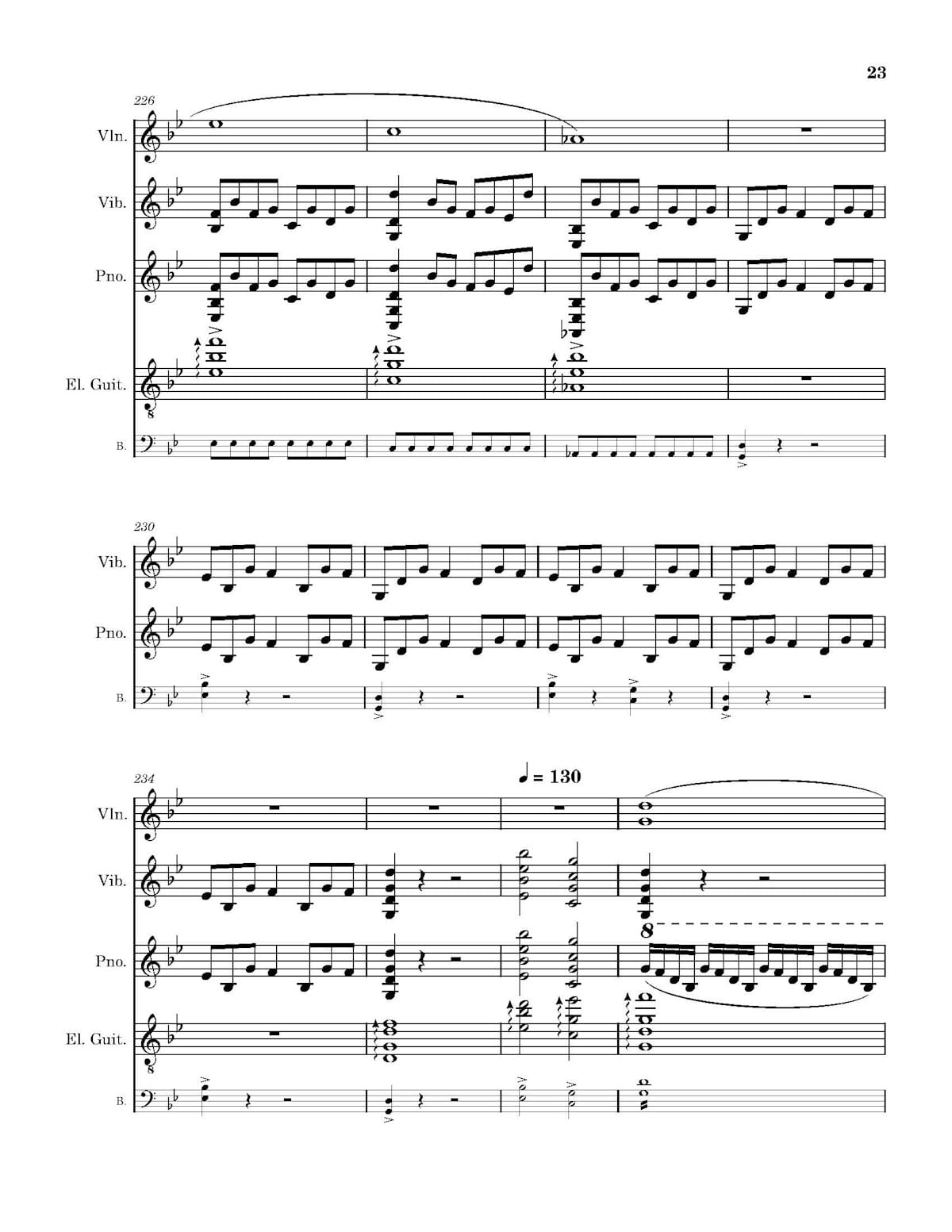
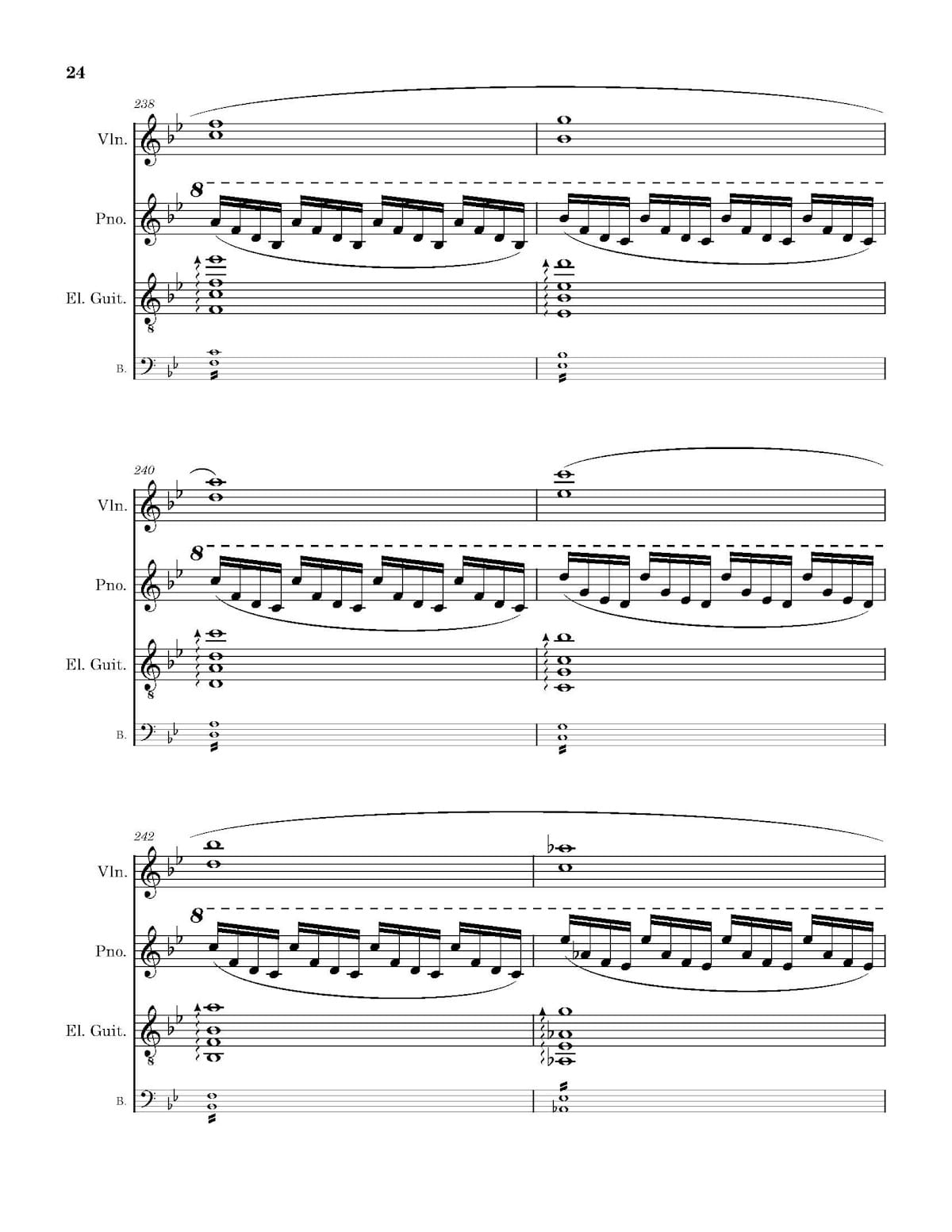
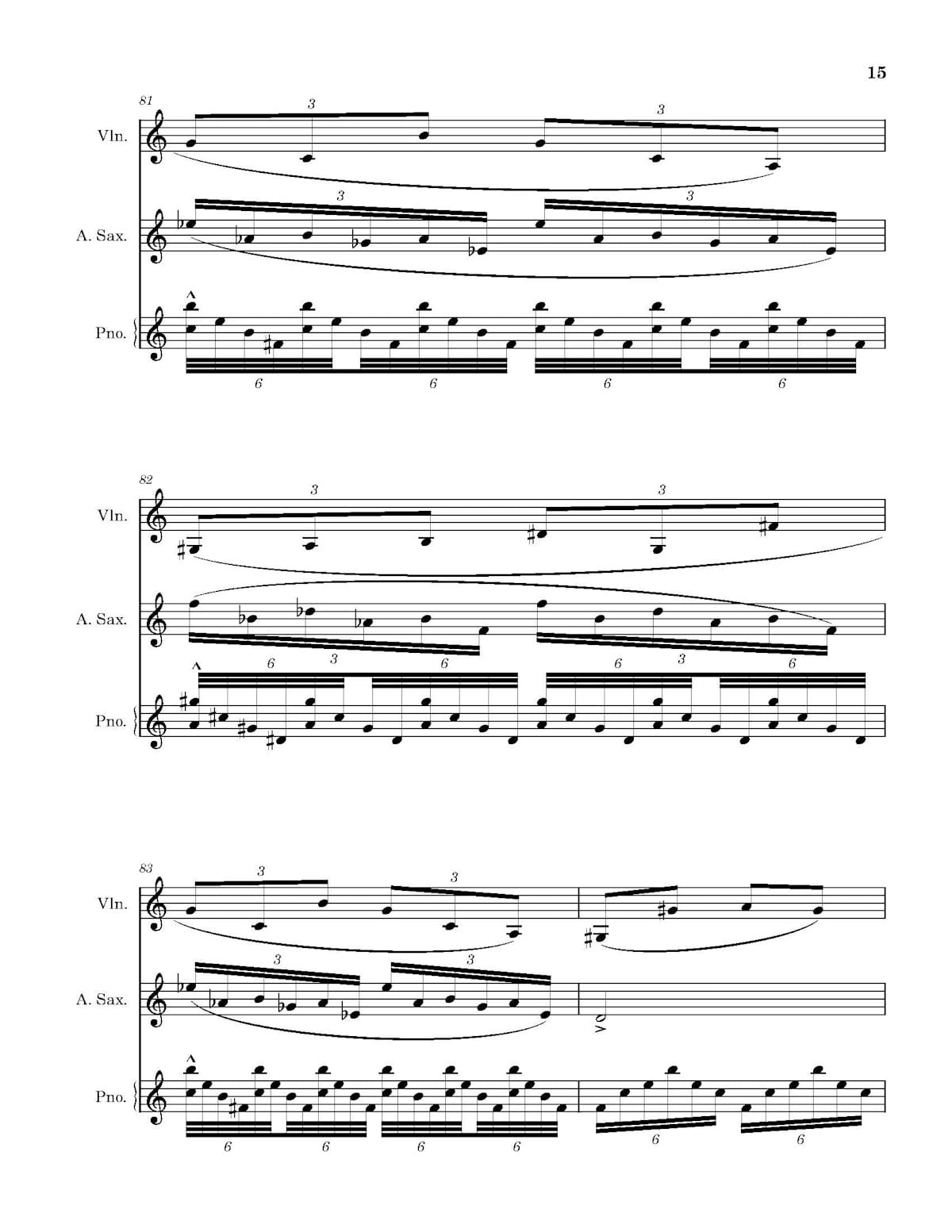
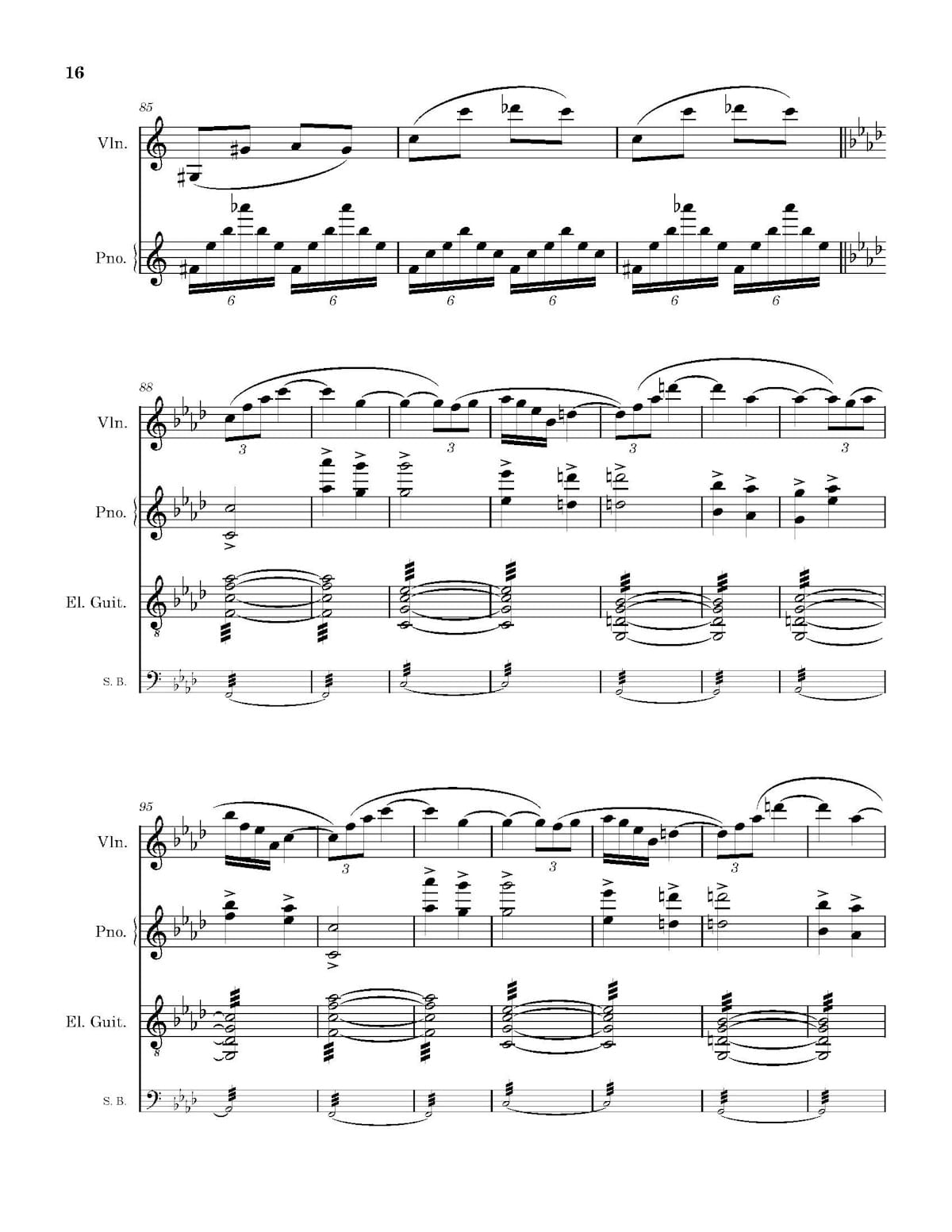
Five minutes into “Amargosa Raga“, Kraanerg speed up. Bars 237-245 repeat four times, moving down a scale with a flattened second and resolving a fourth higher each time, first from G minor to C minor, then through F minor and B flat minor. Nat thinks of the section as a breakdown. The reference goes back to being 14 and finding underground music through Suicide Silence and Whitechapel.
“Not-so-deep inside me still lives a deathcore kid,” Nat said. “I got into underground music through Suicide Silence and Whitechapel when I was 14, and part of me still sees the breakdowns in Kraanerg the same way.”
The section speeds up and pushes much of its weight into the upper register. Nat calls these passages “light/positive” versions of metal and hardcore tropes, carrying the same kind of release through brighter tones and a faster tempo.
Nat grew up in rural northern Nevada, what they describe as genuine cowboy country. As a kid, they spent winter holidays camping around Death Valley and the Amargosa Range. The empty space and huge sky meant something spiritual to them.
Nat did not return to Nevada from mid-2019 until lockdown had mostly eased in 2022. During those years they started questioning their identity, politics, social circles and the direction of their life. Returning to the same places felt very different.
“I often think of this period as a major personality overhaul, questioning many of my prior values: everything from social groups to political leanings to career paths,” Nat said. “Put bluntly, I wasn’t all that woke up until then, and now I am.”
Growing up, Nat had found something close to religion in the Thoreau and Muir idea of transcendence through nature. Coming back visibly genderqueer made that connection harder to access. Nat points to the settler machismo of the rural West, the money required to enter many tourist spaces, colonial erasure, ranching and the way land and resources are controlled. Their own understanding of what counts as “natural” had changed too.
“By fleshing out my understanding of myself and my relation to the land around me, I felt like I lost a bit of God as a result,” Nat said. “I’d already been fairly disillusioned with organized religion by then, but my preferred workaround of National Park solitude wasn’t going to cut it either: a painful but inevitable tradeoff.”
That period also sits between “Veins Preserved in Coiled Wire” and 2024’s “Heart of a Cherry Pit Sun”. Nat started taking Kraanerg more seriously, bringing more people into the recordings and moving towards the vibrance and extravagance that now define the band.
Nat chose “Amargosa Raga” as the first single because its poem has a self-contained story and the music has what they call the right mix of “punkiness and compositional meandering”. Robbie Basho became part of that story through Nat’s changing relationship with the American West.
“The thing I love about Robbie Basho is precisely his artificiality,” Nat said. “A lot of folk-adjacent music feels like it’s all about performing soul and authenticity, and he turns that on its head. It’s a clunky mess of world traditions, jammed together from scratch ingredients, in order to strive for something ostensibly spiritual.”
Wyświetl ten post na Instagramie
“As far as I’m concerned, virtually all Americana is ‘fake’ to some degree,” Nat continued. Basho’s American Primitivism appeals to them partly because its constructed nature is so visible. His “world musician” persona pulls together traditions with little concern for keeping their original contexts intact.
Nat knows the same problem exists in their own work. They lived in Brazil for about a year for work and “Aria for Labellum Tongues” includes a chôro cover. Questions about inspiration and misappropriation come with that. Basho also gives Nat a way into the rural West they remember: a place they still feel deeply attached to, while carrying much more discomfort around its history and culture.
“Basho’s death, however, also embodies the inherent unsustainability of this kind of creative process,” Nat said.
“I’m not sure where I draw the line between living my day-to-day life and disavowing the entire US empire, and even if I feel like I’ve been disillusioned out of one facet of my life, I still engage with potentially harmful American institutions all the time. Everyone does.”
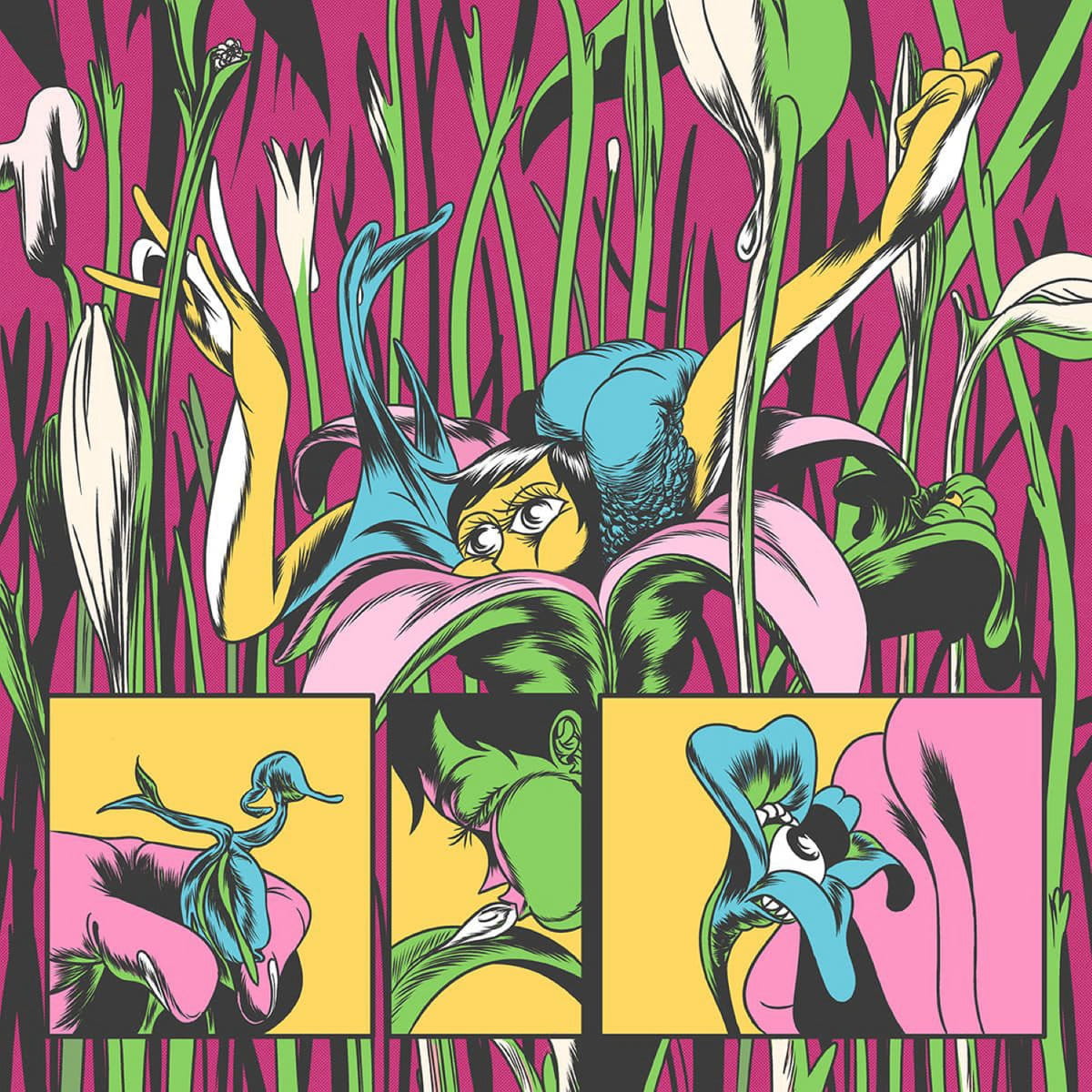
The name “Amargosa Raga” points to both the region and the Amargosa Opera House. Nat went camping around Death Valley and the Amargosa Range almost every winter holiday as a kid. They never saw Marta Becket perform at the Opera House, although they have been inside.
“It’s not tacky, it’s gorgeous,” Nat said. “You can really tell that it’s been a labor of love even after her passing.”
The building has no windows or natural light. Nat was reminded of nearby casinos designed to blur the passage of day and night, except here the sealed room exists around a performance. David Lynch using the place as a setting made immediate sense to them. Nat also describes the Opera House as a “cultural island hanging on by a thread”, separated from its surroundings and still surviving there.
Basho enters the score directly too. Around 6:30 in “Amargosa Raga“, Maximilian Jacobs’ violin line comes from the final vocal line of “Rhapsody in Druz“, beginning around 19 minutes into Basho’s recording. Nat also kept much of the song within that piece’s chordal range, limiting their usual tendency to move constantly between keys. Later comes a direct quotation from “Rocky Mountain Raga”: “And now you’ve caused my heart to tremble / like the leaves of Autumn and May.”
Nat describes the “Rhapsody in Druz” passage as a transformation. The quotation is used inside their own story about Nevada, Basho and the West they grew up around.
Its eight bars finish on a different chord from the one where they began, so every repetition moves into another key. Nat connects that habit directly to composing at a piano.
They own several guitars and refuse to write on them because the fretboard naturally favours particular shapes and keys. On a keyboard, Nat can move chromatically without the instrument pulling their hands towards those familiar patterns. They connect that freedom to post-Romantic piano writing.
Cardiacs’ “Dirty Boy” is another reference. Nat calls it one of their favourite songs. Its middle section resolves the main riff a half step higher on each repetition until it has travelled through the chromatic scale. Nat comes back to that trick regularly when writing Kraanerg’s climactic passages.
The companion poem for “Amargosa Raga” predates the vocals. Nat wrote it when the album was still instrumental, and it carries much more of the story than the words eventually sung on the record.
It opens on “a tulle-raft on a time-river”, with ashes running down from Big Wheeler and out the San Jacinto. The narrator gets tired of tiny river men, “pines and fires and million dollar lighters”, patches together an Amargosa raga and leaves. By the time the poem reaches the city, Charon is giving hair advice at Supercuts and Basho has appeared as a “great trickster spirit” with a recorder. His scales are fake beetle scales, machetes scrape like cricket legs, and he snarls like the last living jaguar in Nogales. The Basho quotation returns near the end before the poem sails into “endless June”. Nat signs it simply as a memorial to Robbie Basho.
Nat wrote companion poems for the album before deciding to sing. The vocal texts came later and pull phrases and images from those longer pieces, without matching them line for line. Nat wants the poems treated as the published writing around the record, and the sung transcriptions left as reference.
“Aria for Labellum Tongues” had already come close to being another instrumental Kraanerg album. Nat spent roughly a year reopening finished arrangements, removing existing melodic parts and finding places where their voice could live.
For years, Nat had also leaned heavily towards instrumental music as a listener. “Heart of a Cherry Pit Sun” stayed instrumental partly because of the baggage Nat heard in their previous harsh vocals. That voice immediately pulled Kraanerg towards metal and towards a darkness they were trying to move away from. Nat was not yet comfortable enough with their plain singing voice to go another way, so they left vocals out.
“I think that was fine on Cherry Pit, it works as an instrumental, but that just wasn’t enough here,” Nat said. “Once I feel like I got over the hump with months of practice, I feel like the vocals unlocked a whole new set of toys to play with.”
The first rewrite was the title track. “Aria for Labellum Tongues” already had something close to verse-chorus form, so Nat could clear space for vocals without taking the whole composition apart. It became the most hook-oriented song on the album. “Iron Sign of the Masdevallia” followed fairly easily because of its long ABA form. “Visible to the Wrong Faces” took much longer. Its through-composed structure offered fewer repeated sections that could become refrains.
Most of the work involved removing saxophone, violin and piano melodies. The voice itself was the least planned part of the record, built through repeated takes, practice and feel after the instrumental parts had been mapped in detail.
Nat also wanted to avoid a vocal style that would immediately tell the listener where to file the band. Harsh singing comes with metal associations. Operatic singing points towards neoclassical music. Wordless pseudo-Kobaian vocals make zeuhl an obvious reference. Nat wanted the voice to feel immediate and memorable without carrying one of those signals.
The first attempts went too far.
“Some of my original vocal drafts were a little too zany and Patton-esque,” Nat said. “I think I overcompensated the serious tone of the compositions by making the vocals exaggerated to the point of being grating, and I had a few people (including DL at one point) push back on that.”
D.L. describes the finished voice as loud, distorted, unrefined, imprecise and impassioned. The single word D.L. settled on was “yeasty”. It adds something bodily and unruly to music where nearly everything else has been subjected to notation, MIDI demos and repeated revisions.
Nat eventually worked out that some of the exaggeration had been a way of hiding from their own voice.
“The more unadorned the vocal style, the more you have to confront that yes it’s really you, and that took incremental adjustment for me to grow comfortable.”
There was no one session where that suddenly changed. Nat kept practising over a period of months. Russell Rode, who plays viola on “Visible to the Wrong Faces”, later told Nat they had ended up “singing in the same style as the violin”. Nat liked that description. The voice had become another part of the arrangement, with its character coming from the notes and delivery rather than a ready-made genre convention.
Early twentieth-century piano music has occupied a huge part of Nat’s musical life, yet they now describe that tradition as increasingly “foreign and irretrievable”. Putting their own voice inside Kraanerg gave them the most physically present thing available.
“It’s more of a… conduit,” Nat said. “It’s a translation device to make the personal appeal of Kraanerg more intuitive to others.”
Nat has repeatedly found that a melody which feels like an obvious hook inside their own “Kraanergiverse” can pass straight by another listener. Vocals give those melodies a familiar marker. They also help Nat carry piano writing with a century of history behind it into a contemporary heavy-rock setting.
“Having a voice in the music feels like having a ‘human face’ on a message so that it sticks better,” Nat said. “It’s an appeal to pathos.”
The companion poem for the title track has its own travel running through it. Houston opens the piece, followed by years spent driving every few months across what Nat calls “a vast grid of sorrow” in a discontinued Pontiac. Black lines cut across forests, plains and deserts. Stakes crack the shell of the world until its yolk spills out and hardens into “a milky way which will never / Take anyone home.” Some of those images later made their way into the vocal part.
Kraanerg have never shared a stage. The band are split across Minneapolis, Portland and Washington DC, and the record exists through files moving between people who rarely occupy the same room. Everyone involved has played live elsewhere, and Nat has performed piano recitals, but Kraanerg themselves remain a studio band. Nat wants to change that eventually. Geography has made it difficult so far.
Nat calls the score the “master copy”. Composition and arrangement are finished on paper and in MIDI before recordings arrive from the other players. That setup also grew out of basic logistics. Nat starts their first teaching position through their PhD in September, semesters leave little time for Kraanerg, and economic necessity and field research have kept them moving between living situations since 2020.
“Timewise, it’s absolutely competition haha,” Nat said of academia. “Part of why the songwriting process is so fragmented, based on assembling many recordings from different people in different cities with only a paper score as a ‘master copy,’ is because I tend to be very busy during semesters and have traveled a lot for my particular brand of work.”
Nat has not spent a full year in the same living situation since 2020. The asynchronous method eventually became part of how Kraanerg write. The final master of “Aria for Labellum Tongues” was only about two weeks old in early August, with Nat trying to finish the release before the new teaching term started.
Jason Roe entered Kraanerg through another oddly specific connection. Ian Chainey’s Stereogum piece about zeuhl’s influence on metal included both Nat and Jason’s band Baring Teeth. Kraanerg’s previous drummer had relocated, and Nat asked Jason if there was anyone worth approaching. Jason listened to the full MIDI compositions and volunteered.
The full scores were more information than Jason needed behind a drum kit. Jason made a one-page linear map for each track with Nat’s basic drum idea, the number of measures and short reminders such as where the hi-hat should stay closed.
For each song, Jason recorded three versions. The first stayed close to the MIDI drums. The second gave the part more freedom. The third went for ideas “completely out of left field”. Jason then pieced together a preferred take, sent it to Nat and kept working with different cymbals, drums and tunings.
Nat leaves very little to accident.
“I’m not gonna lie this has barely ever happened,” Nat said. “There’s maybe 1-2 ‘happy accidents’ across the entire album. I don’t really think there’s room for constructive imperfection or the ‘human touch’ in music this dense. It’ll just come out like a mess otherwise.”
Jason sees the written part as a way to remove guesswork. Once the structure is fixed, each player can concentrate on playing with conviction. A couple of actual mistakes did survive.
At roughly 3:45 in “Amargosa Raga”, Jason was trying to release some tension with a half-time beat and missed the snare completely. The gap sounded good in playback, so Jason built it into the finished drum part. The ride pattern around 1:50 in the “punk rock baion” section of “Iron Sign of the Masdevallia” came from another accident.
“I think the album is a success largely based on our ability as a band to marry rigidity and chance,” Jason said.
Across the album’s roughly 62 minutes, Jason has to think about the drums on a much longer scale. “Aria for Labellum Tongues” runs for roughly 62 minutes. In Baring Teeth and Freak Puke, Jason may drop a drum idea quickly to keep a song moving. Kraanerg ask for attention across long pieces: which cymbal sits correctly in a section, how hard to play, where to push the beat and how to keep dynamics moving around an arrangement that was already there.
Jason also brought vibraphone into the band. Hearing “Anguloa Virginalis (Um Rosto de Mulher)”, the ii-V-I passages reminded Jason of a 1930s big-band ballad. Jason owns a vibraphone, wanted more reasons to play it and suggested adding one. Nat liked the idea enough to spread vibraphone through other tracks, often doubling the highest piano voice.
That meant Jason had to sit down with Nat’s conventional notation. Wide intervals, dense chords and tempos reaching 160 BPM made the parts difficult to play with any ease.
“Only then did I realize how virtuosic Nat’s piano performances actually were,” Jason said.
D.L. has been part of Kraanerg much longer. D.L. and Nat have known each other since high school, and Nat counts D.L., Markov Soroka and Dom Grande among their personal friends. D.L. first recorded with Kraanerg in 2020, adding several lead guitar parts to “Veins Preserved in Coiled Wire”, then returned for “Heart of a Cherry Pit Sun”.
Standard notation is less useful for D.L., who has barely used it since middle school. Nat generates guitar tabs from the score. D.L. initially remembered some of those tabs producing impossible fingerings, then went back to old notes and corrected the timeline. That had been a much bigger problem on “Heart of a Cherry Pit Sun”. “Aria for Labellum Tongues” only had the occasional small tab error.
Across the earlier recordings, D.L. often preserved Nat’s written pitches through punch-in and punch-out recording when a passage could not realistically be played in one live take. Nat’s directions have always carried a sense of “this is exactly the way this should be”, according to D.L., leaving very little interpretive room around the notes themselves.
The guitar parts also use the instrument differently from D.L.’s own writing in Kostnatění. Kraanerg often need rhythmic power chords moving vertically around the neck, with distorted guitar filling a specific part of the arrangement. D.L.’s own guitar writing tends to treat the instrument as one highly inflected voice.
For D.L., Kraanerg have also been useful technical practice. D.L. is self-taught and tends to think about scales horizontally across the neck, joking that heavy-metal players can get away with that and still become decent guitarists. Nat’s parts force much more movement across strings and positions.
At one point D.L. also told Nat that some low-register chords would turn to mush on guitar and needed to move higher or become single notes. D.L. no longer remembers whether that exchange happened during this album or “Heart of a Cherry Pit Sun”, so the exact record is unclear. Nat kept the higher-register approach and it is all over the current guitar writing.
Bass took even longer to enter Kraanerg. D.L. remembers Nat avoiding a conventional bass instrument for years while looking for other ways to occupy those frequencies. “Aria for Labellum Tongues” is the first Kraanerg album with synth bass, played by Markov Soroka. Markov also mixed and mastered the record.
D.L. hears Magma, MPB and Robbie Basho clearly in Nat’s writing. There has also been a huge expansion in the number of parts. Kraanerg started much closer to a piano-centred spectralist exercise. On this album, more than half a dozen melodic voices can appear inside the same song.
“Hearing the band at an Aria scale of composition is like watching an inanimate torso finally breathe to life,” D.L. said.
“Iron Sign of the Masdevallia” packs several of those melodic voices into the same sections. Jack Dell plays alto saxophone across the album, Sydney Smith soprano saxophone, and Dom Grande of Stabscotch adds another saxophone on this track.
At 6:22, four vocal lines arrive back to back in E minor, F sharp minor, F minor and G minor. Nat chose the sequence to cover as much chromatic ground as possible while keeping the vocal jumps manageable. The same idea returns around 8:24 in G minor, A minor, G sharp minor and B flat minor.
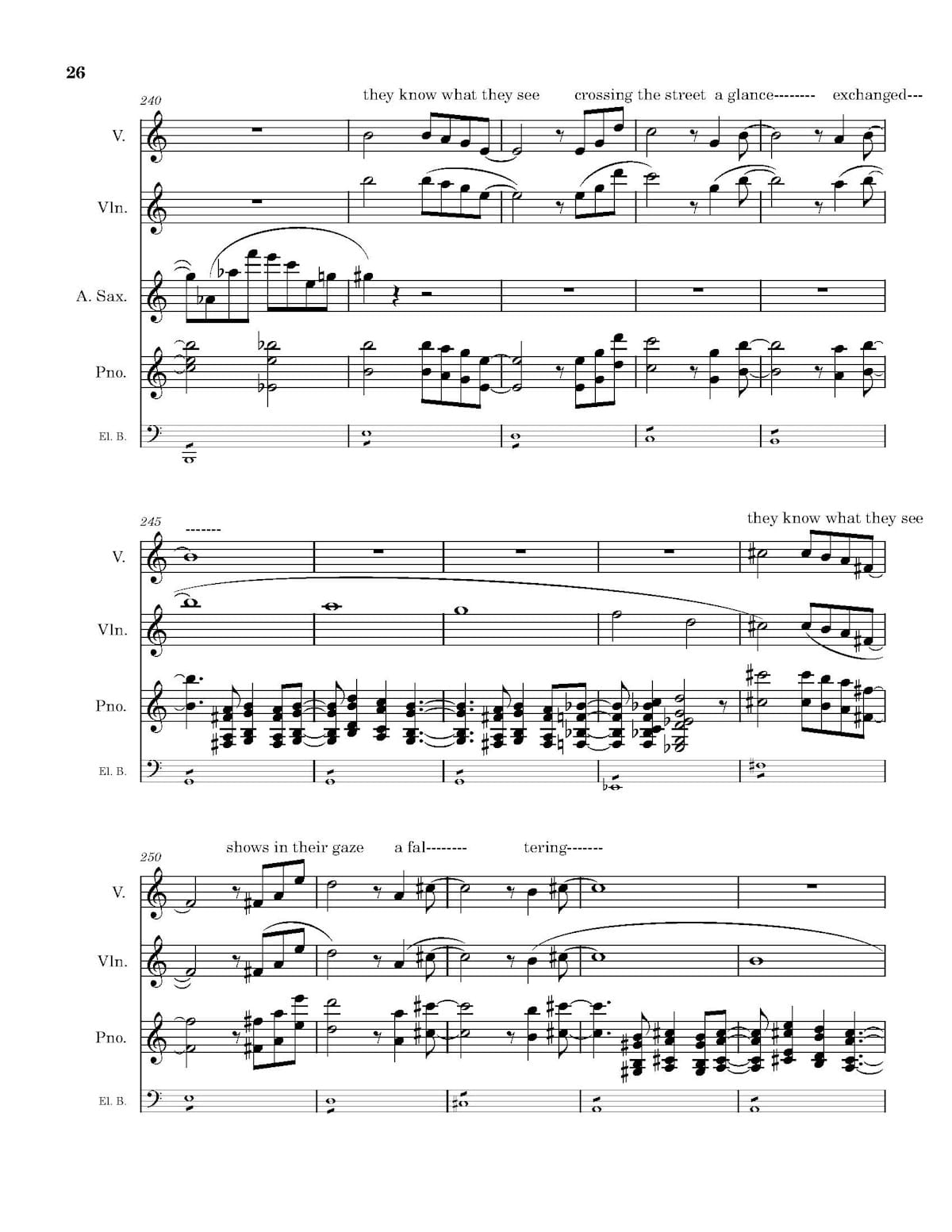
Bars 245-248 start with parallel thirds, the sort of exercise Nat remembers playing as a child, before running through G, G minor 7, F4 and E flat major 7. Nat usually starts with melody, harmonises underneath it, then returns for several passes at the harmony. Synaesthesia plays into those later choices. Nat talks about trying to get as much “spice and color variety” as possible without making the melodic line difficult to follow.
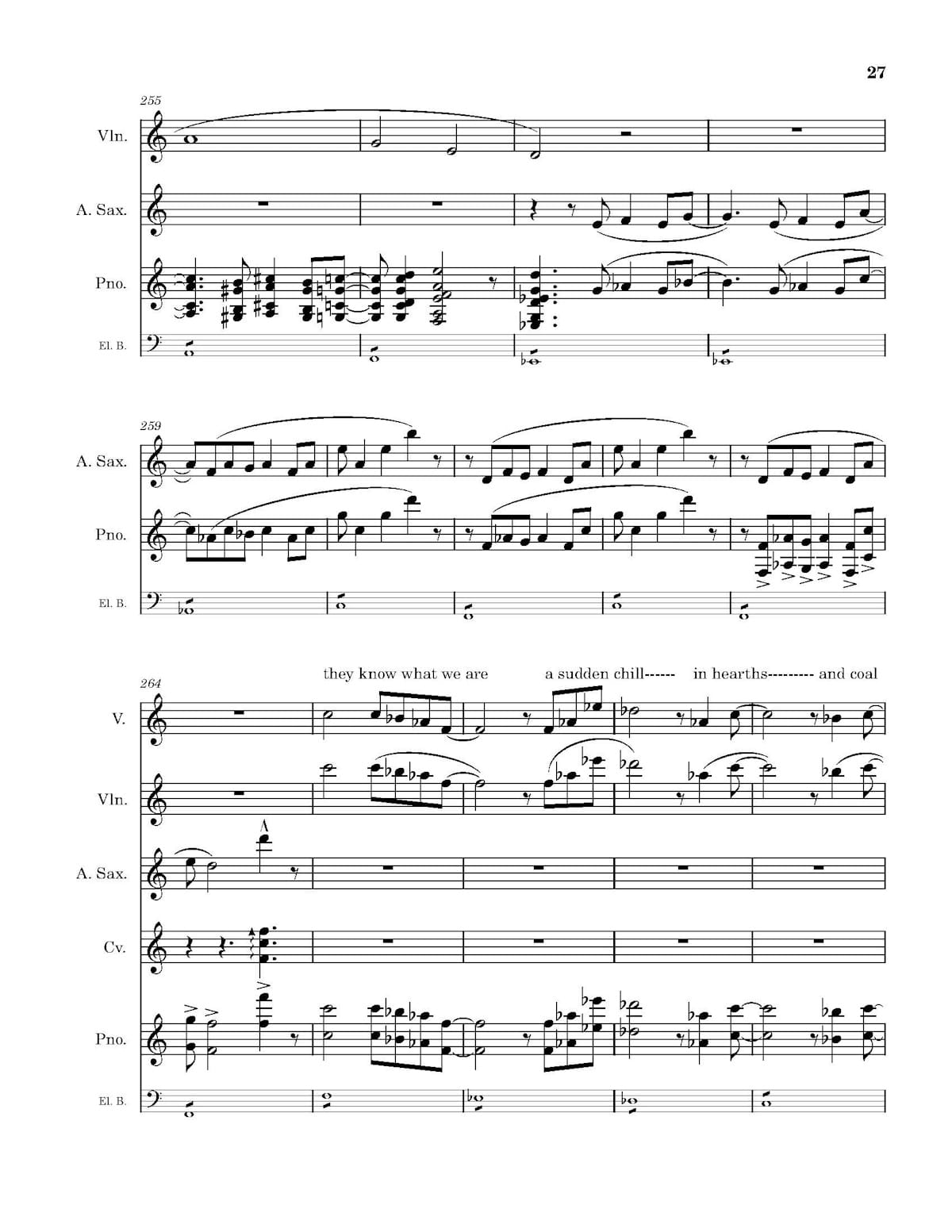
At bar 264, the high plucked sound is a heavily processed cavaquinho. It also carries a line under the vocals near the beginning of the track, around 0:45.
Nat loves the clear upper register of cavaquinho and related treble guitars, especially the way that sound cuts across samba percussion. Kraanerg use a similar principle by moving some accompaniment into bright, ringing upper-register guitar parts. Nat had already used a cavaquinho for the arpeggios around 2:09 in “Here the Ground is a Spandrel”, renting one for a weekend from a guitar shop while living in Rio. On “Iron Sign of the Masdevallia”, it gets a much larger role.
Its companion poem starts with paranoia passed down through blood, an imprint first pressed into the narrator’s grandfather and hands scrubbed with Original Orange until eczema and black mould take over. The mould turns into creepers. Passionflowers appear from clenched fists, jeweled beetles offer counsel, and banyan roots become a royal guard.
Further in, the “iron sign of the masdevallia” hangs around the narrator’s neck. Pollen scorches the soil, bouquets become events of mass destruction for nematodes, and the pendant becomes tied to being seen. The poem explicitly rejects “blind, immutable identity” and still admits to feeling incomplete without that cold piece of metal.
“I wear that speck not to be known by allies, / But because I want it to be recognized by the wrong man,” Nat writes. The poem ends on a fixation with being recognised by the wrong audience and accidentally inviting war.
The first three minutes of “Visible to the Wrong Faces” are the oldest music on “Aria for Labellum Tongues”. It’s taken from a longer chamber piece Nat abandoned while recording “Heart of a Cherry Pit Sun”. The piece had given them somewhere to put slower, undistorted writing during those sessions.
The opening alternates A major 7 flat 5 and C major 7 flat 5, the same chord shape moved by a minor third. Nat often reaches for that movement when writing something menacing. They hear two possible origins: old black-metal riffing habits and the octatonic writing of Scriabin, whose pieces they have listened to obsessively.
The drums arrive around 3:45. Tremolo-picked guitar sits high in the mix with little distortion and a small amount of chorus warble. Nat describes the tone as “searing”. The section carries the weight of a sludge or metal entrance through sharp high mids.
Maximilian Jacobs plays violin on the album. Russell Rode adds viola here and Jules Liebenthal another guitar.
The companion poem moves through Texas. Hyacinths and caddisflies grow alongside cinder blocks, crushed cars, bridges, cloverleafs and slip lanes. Concrete ferns open next to steel stamens. Parking lots ring with ice picks and drill bits grind against enamel. I-45 becomes a flower, “unfurled and alive”, shedding a scarlet hide and sending spores into the sky.
The danger keeps moving closer. It goes from a wrong turn to the wrong Uber, then the wrong neighbour, the wrong boys upstairs and walls that are too thin. A demon makes rounds through Texas and leaves vines turned into wires. The final lines state the threat directly: “I want you invisible to the right faces. / I want you visible to the wrong faces. / I want you dead.”
“Blessings in Silk, Saffron, and Naran-Ji” takes another part of Nat’s writing into questions of texture, bodies and ornament. Ants carry ambrosia through cracks in the pavement towards hospital rooms. Children are born feeling everything as warm velour. Silk, saffron, citrus, gesso, jeans and lace trim appear alongside a flight from Korea and a crown worn around the neck, its spires digging into the shoulders.
The poem later fixates on perfectly smooth laminate flooring, filled cracks, monochrome surfaces and a bronze sphere at the bottom of a handrail. Oil accumulates under a car. Bodies chip down to dust, palaces rise from the rubble and softness hardens. The movement between softness and hard surfaces fits Nat’s wider interest in ornament taken so far that beauty starts becoming strange.
“Anguloa Virginalis (Um Rosto de Mulher)” gets only four lines in its companion poem. Nat welcomes an intermission in the Great Sky’s ramblings, followed by a voice with an “insufferable, saccharine lilt” going on about the Triassic.
The music is Kraanerg’s first complete cover. Nat took Paulo Bellinati’s transcription of Garoto’s “Um Rosto de Mulher”, moved the guitar part to piano almost note for note and slowed it to around one third of the original speed. Garoto’s piece lasts only about a minute.
Nat had wanted one full cover somewhere on the album from the beginning. Several rock songs crossed their mind, then fell away because of all the cultural associations already attached to them. Garoto fit where Nat’s listening had been heading anyway.
By the middle of recording “Heart of a Cherry Pit Sun”, Nat had grown tired of many of their usual classical favourites. Early twentieth-century Latin American composition brought some excitement back. Chôro and tango have become major sources for their recent writing, following the year Nat spent living in Brazil.
Kraanerg have been hiding quotations in their music for much longer. Nat says nobody has found them.
The “Harbinger” demo grew partly from putting distortion over specific combinations of notes and listening for the overtones. “Harbinger II” has an ostinato built from a low C and high B flat near the seventh harmonic, an idea Nat took from Tristan Murail’s “Territoires de L’Oubli”, around 25 minutes into the piece. Murail’s “La Mandragore” also fed into “Harbinger”, although Nat’s transcription disappeared on an old hard drive and they no longer remember exactly where.
The main motifs in “Veins Preserved in Coiled Wire” came from the melodic character of Leo Ornstein’s “Poems of 1917”, especially “Wrath of the Despoiled” and “Dirge of the Trenches”. The opening of “Here the Ground is a Spandrel” uses Rachmaninoff’s Op. 32 No. 5 Prelude. The start of “Heart of a Cherry Pit Sun” comes from Bartók’s “Pe Loc” from “Romanian Folk Dances”. This time around there is Basho’s “Rhapsody in Druz” and the Garoto cover.
Nat treats zeuhl as a philosophy and a creative process, with the idea extending well beyond Magma and the music associated with the term in the 1970s.
“Kraanerg isn’t a retro band, and I have no interest in prog trappings like vintage gear or pastiche sci-fi aesthetics,” Nat said. “To me, zeuhl is all about musical futurism. It’s about trying to do justice to music’s spiritual potential by rebuilding it from the ground up.”
Christian Vander’s response to John Coltrane’s death is the model Nat returns to. Vander set out to make work with the same ecstatic scale through a new musical construction. Nat places him alongside Tim Smith, Alexander Scriabin, Alan Bishop and Richard Bishop in a line of musicians who aimed very high and built their own rules to get there.
“The point is the cosmic aspiration,” Nat said. “I wouldn’t say I’ve made a Great Work yet, but I am trying.”
Nat has called Kraanerg’s target “ecstatic, hyper-vibrant romanticism”. Magma’s commitment appeals all the way through the pomp, cheese and huge transhuman space opera. Nat likes what happens when that ambition goes too far and gets messy. Their own phrase for the goal is “constant maximalism, effluence, and futurist joy”.
“The fact that ‘trying too hard’ is seen as a problem in so many music circles feels like it’s completely missing the point of what rock should be,” Nat said.
Nat is drawn to zeuhl’s “Wagnerian space opera” and its total commitment, failures included. Kraanerg bring the same seriousness to deathcore, Garoto, Basho, Scriabin, chôro and experimental metal written down to the bar.
Nat grew up with recordings, scores and archives available online, without needing direct access to the institutions that traditionally housed that knowledge.
“We don’t have to go to a physical record store in France to get inspiration from Magma,” Nat said. “We don’t have to have a conservatory education to work with post-impressionist piano harmonies. All of that and so much more is right here, at home.”
The people Nat most imagines hearing Kraanerg are part of the DIY crowd and its online extensions, particularly the trans and genderqueer Gen Z art world they are part of themselves. Nat calls “Aria for Labellum Tongues” “a rallying cry that rock can do more than ape the rebellious tropes of the 90s.”
For Nat, the huge amount of music available to a random person in their twenties is one of the internet’s real creative gains. They call it an antidote to rock’s “maladaptive nostalgia”. Trans art already has an intensely online culture, and Nat sees the same connectivity giving musicians permission to take references from much further outside their immediate scene.
Classical concerts are expensive. Conservatory training is inaccessible to most people. Even people who can enter those institutions often find programmes built around maintaining the established canon. Humanities funding in the US has become harder to secure as well.
Nat is trying to build a career in humanities research, so those limits are familiar from outside music too.
“So much of Kraanerg feels owed to the ability of accessible online archiving to circumvent institutional barriers to access,” Nat said.
“I hope that Kraanerg can be something of a strategic escape route,” they continued. “It might take a lot of time, and a lot of compositional perfectionism, but you can do it on a budget.”
Nat’s ideas about excess run through the music and their own gender expression. Dense orchestration, complex soloing and intricate decorative detail can all be beautiful on their own. Kraanerg pile them together until that beauty becomes strange and sometimes uncomfortable. Nat connects this directly to being nonbinary and often femme-presenting with a beard. The same appearance one person reads as beautiful can look unnatural or grotesque to another.
Nat calls Kraanerg “parallel-universe-punk”, loud rock reassembled from classical and jazz basics. They also describe themselves as an avowed transhumanist and think about personhood as something built from the available pieces of social performance.
“In both art and self, I hope to be a case study for what another evolution of our world could look like, and for the alternate possibilities that are only fathomable in a post-internet, hyperpluralistic condition,” Nat said. “Nothing is more inspiring to me than the idea that there could be another way to live, and I think that’s inherently threatening to the powers that be.”
Nat knows that questioning basic assumptions about bodies and art can make other people uncomfortable. Gender nonconformity has made that part of everyday life for them.
“For me it’s all just one project,” Nat said.
They also see the whole thing as futurist, even with so much old music sitting underneath Kraanerg. Nat thinks people in 2026 have unusually easy access to the idea that many foundations of society and culture are arbitrary. They see anxiety about that lack of fixed foundations across the political spectrum. For Nat, it creates room to look at Western classical music from above, take it apart and put the pieces somewhere else.
“I owe that same perspective to realizing I can wear any dress I want, and that there’s other Gods besides the one Teddy Roosevelt saw on his stolen land,” Nat said. “So, Kraanerg is a band that I hope typifies the unsettling effluence of plurality that I’ve come to love.”
Nat keeps that part of Kraanerg tied to their own experience. Markov is the only other trans person who plays on the record, and Nat leaves everyone else involved to decide what the music means to them.
Nat has been fixated on rare plants for years, especially orchids. Orchids are a long-running fixation. Their forms can be colourful and delicate, then turn almost face-like through specialised pollination and evolution. Some resemble exaggerated insects closely enough for Nat to find them slightly threatening. That has never made the flowers any less beautiful to them.
The labellum is the specialised petal Nat imagines as the orchid’s mouth.
The same plant imagery runs across the record: Masdevallia, passionflowers, banyan roots, epiphytes, hyacinths around I-45, pollen, flowers growing through concrete, bodies that soften and harden. The “aria” in the album title is the voice coming out of that mouth.
“The album is written from the perspective of the proverbial orchid-creature, i.e. me, by and for other orchid-creatures. I like to imagine that the tracks are ‘sung’ by the flower’s pareidolic mouth, formed by its labellum petal. It’s a message from one queer zoomer prog nerd to the rest of us out in the ether.”
🔔 IDIOTEQ is ad-free, independent, and runs on one person’s time. If you want it to stay that way: DONATE via PayPal or SUPPORT via Patreon.
NEW: IDIOTEQ Explore 🗺️ Browse 15+ years of our archive by city, country, and style. Find artists on the world map or trace related sounds through the styles map.
Stay connected via Newsletter · Instagram · Facebook · X (Twitter) · Threads · Bluesky · Messenger · WhatsApp.