


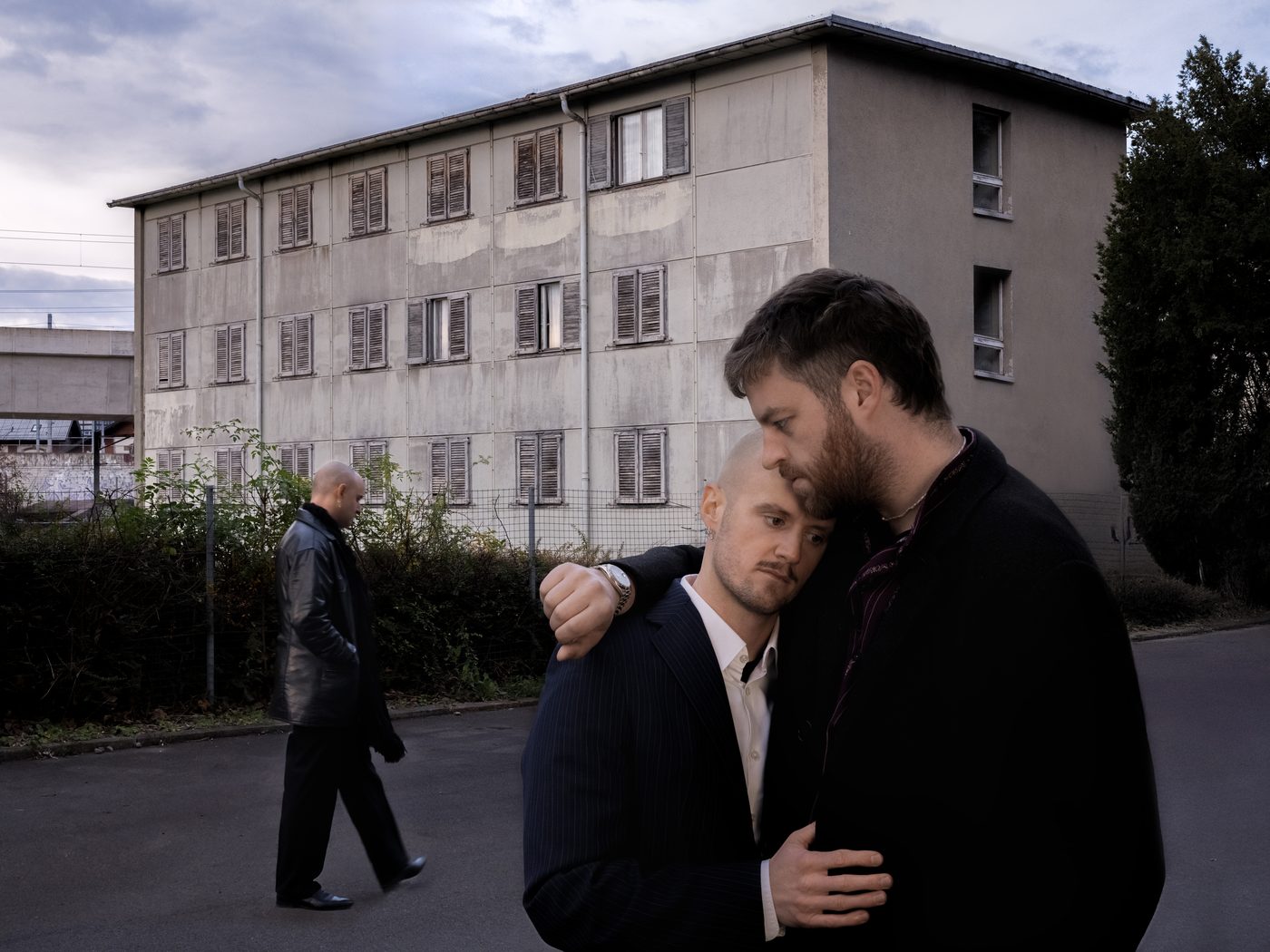
On “Faust” and “Innen”, the drums barely give Film 2’s guitars a moment to settle. The Swiss trio’s new EP, “ok sibs let’s scramble this up“, runs through five short tracks of restless mind-bending noise-kraut, abrasive post-punk and repeated vocal phrases that gradually lose their original shape. Released in September, it’s another fairly unpredictable record from Elischa Heller, Elias Bieri and Jonas Albrecht, who have spent years playing around with repetition, improvisation and the possibilities of three people making a tremendous amount of noise.
They also spend an unusual amount of time thinking about what happens once the recording is finished. Film 2 run their own online music library, where an older album starts automatically at sunrise and sunset, another appears during full and new moons, and certain downloads are only available during specific listening windows. They have intentionally left Spotify and Amazon out of the distribution of their new EP, giving people other ways to find the music and keep in touch.
The question of how to release music has become one of the things they enjoy working on together.
“the sparkly thing is to see the topic of ‚how to release music nowadays?‘ as a big playground. to experiment and to be curious is joyful,” Elischa said.
The internet makes sharing files relatively easy. Being noticed is more complicated, particularly for a band interested in maintaining some control over how its work reaches people. Film 2 have been trying different solutions for years, and their latest EP gives us a good reason to talk about them again.
There is plenty happening in those songs, too. “Faust” and “Innen” have the fastest, most tangled passages, with insistent drums pushing the guitars through sudden changes and repeated figures that keep twisting around one another. “Industrial Stars” takes 92 seconds to move through a more uneven rhythm, with guitar strings bending and scraping against the drums. “lndnsdl” works with similarly unstable movement, allowing the instruments to pull apart briefly, before “Singen” takes the EP back towards a noisy, grinding finish.
The band have compressed some of their familiar playing habits into much shorter pieces. Repetition still does much of the work, and they remain interested in the moment when sounds begin to change through the simple act of repeating them.
Words get similar treatment. Elia Brülhart, who contributed a text about the EP, describes how language changes during the songs.
“On ok sibs let’s scramble this up text becomes material. Words abstract themselves in the process of repetition until they dissolve into pure sound, only to then concretise back into thoughts.”
Melodies and harmonies continue around those vocal patterns, and the rhythms often become the clearest thing to follow when the individual parts grow difficult to separate. For a band whose longer recordings have depended so heavily on repeated structures, working with songs that finish after a couple of minutes creates a different kind of movement.
We first covered Film 2 in 2023, when their album “Sorge*” arrived through BlauBlau Records. That record had grown out of a rather different period in the band’s life. During Covid, the three musicians met in a rustic space normally used as a nightclub, lit candles and spent time working through unfinished ideas together. They repeatedly played and developed a long piece called “Welt”, eventually making it the centre of the album.
It was a period when they could slow things down and concentrate on playing together. Care for one another and for the world was part of how they understood those sessions, and they wanted the finished record to retain something of that experience.
They recorded three different versions of “Welt”, each in a separate setting. The vinyl release came in three editions of 33 copies, with buyers receiving one of the versions at random. Even the three different sleeve designs offered no reliable way of knowing which recording was inside.
A few years later, the band are working with five short songs, and the circumstances around the release are different. Their basic approach has stayed much the same, though. Jonas was particularly keen to correct the suggestion that the musicians had fundamentally changed direction since “Sorge*”. They still try to find an appropriate setting for each new recording, taking into account the music, their own circumstances and what they want to share with an audience.
Between the two records, Film 2 released “Telefone” and joined forces with Radon as 222Rn, bringing the musicians together in a larger, noisier six-piece setup. Their 2024 performance at Bad Bonn Kilbi was recorded and later released as “Angelica Archangelica”.
The trio’s friendship has remained constant through these different projects and recording methods.
“What hasn’t changed is our friendship, our curiosity, and the intention to let the same care that shapes how we work together inform how we bring our music into the world.”
Film 2 have a similar attitude towards gigs. Their history in the Swiss underground has included small club shows, festival appearances and sets ranging from brief 20-minute performances to several hours of playing. They choose their material according to the room, the audience and the progression they want to create during a particular show.
The complete extended version of “Welt” has only been performed live twice. On both occasions, the band felt that the venue and the attention of the audience suited its slow, meditative development.
Sometimes they purposely choose something that seems unsuitable for the occasion. An unexpected change in the music can affect how people respond to a show, and the band enjoy interfering with those expectations.
“To play with the framework intentionally, to confirm it and later break it again, creates tension. and we’re all in for tension :)”
Their website, unbewusst.love, gives them another place to experiment with how music is presented.
It began in 2020 as the digital home of their debut album “Unbewusste Liebe”. Film 2 wanted people to be able to hear the record online, although they were reluctant to place it on the established streaming services. They came up with a listening system connected to the natural cycle of the day.
The album starts automatically twice a day, once when the sun rises and again when it sets. The website uses the visitor’s IP address to estimate their location and determine the appropriate times. Another recording, the chaotic sister album “Die Schlafe Der Seelenden”, appears at random.
When “Sorge*” arrived, Film 2 decided that it belonged on the same website, with its own listening schedule.
Every full moon and new moon, the album begins playing automatically. Its three versions run one after another, and the whole sequence repeats three times. Visitors get approximately six hours of “Sorge*” before the cycle ends.
There are restrictions built into the website as well. Whenever one of the albums is playing, the other functions become unavailable. Full-length album downloads are only possible during their respective listening cycles. The EPs and singles can otherwise be streamed and downloaded whenever someone wants, provided an album session is not taking place.
Everything is available free or on a pay-what-you-want basis, with donation options attached to the individual releases and the website itself.
After technical problems forced unbewusst.love offline for a period, Film 2 rebuilt it as a library for their complete catalogue. They kept the listening rituals and extended the service to accommodate their shorter releases.
Elias is interested in how constant availability affects the value people attach to music, and whether musicians can do something creative with the act of temporarily withholding it.
“Absence is a tool, not a limitation. If everything is always available, nothing has weight and endless availability often mirrors an extractive logic that mistakes growth for value. Can withholding, timing, or disappearance become creative material again, a small ecological gesture of restraint in a culture of excess?”
For Film 2, these questions are connected to a wider concern about the amount of music, information and other content people are encouraged to consume continuously. They want to remain accessible to listeners, while choosing their own methods of making that possible.
“Our music is meant to be visible, meant to exist, but without the violence of algorithm’s rules. If we refuse quantity as the goal, visibility has to be reinvented through community, through small trusted networks, through play, rather than through metrics we didn’t choose.”
That approach reaches well beyond the website.
“We aim for relationship instead of reach. The bond between artist and listener has thinned out. Instead of chasing algorithmic reach, how do we rebuild something closer to trust, closeness, even solidarity? What if listening became a form of caring for each other, not just consuming?”
Their SMS newsletter is one way of putting this into practice. People can sign up through the band’s website and receive updates directly, without relying on a social media feed to show them the next announcement. Physical records and personal recommendations offer other points of contact. Someone might discover the band through a friend, buy a tape at a gig or hear about a new release from somebody already following their music.
Film 2 have also been paying attention to smaller digital services. They mention Subvert, Chorus and Unknown Band as examples of people experimenting with different ways of listening, discovering artists and interacting with music online.
Shows remain the main focus. The band have always regarded playing live as their most direct opportunity to spend time with listeners and find out how the music works between them.
Their choice of platforms also has an explicitly political side. Film 2 are critical of the commercial systems behind large streaming companies, particularly the way music, attention and personal information can be used to generate financial returns.
“We see streaming platforms as an extreme expression of capitalism, turning music, attention and personal data into financial assets.”
Elischa is particularly direct about the difficulty of enjoying the process of releasing music through companies whose investments the band oppose.
“to find pleasure in releasing music is impossible when dealing with ultra capitalist, war technogology funding platforms, so we don’t do it.”
The connection to military technology they raise concerns Spotify founder Daniel Ek and Helsing, a German company developing AI-based defence systems. In June 2025, Helsing announced a €600 million funding round led by Prima Materia, the investment firm co-founded by Ek and Shakil Khan. Other investors, including Saab, Accel and Lightspeed, also participated in the round. Ek is Helsing’s chairman, and Prima Materia had previously invested in the company. The full financing details can be found in Helsing’s June 2025 announcement.
Film 2 connect those financial relationships to their broader concerns about where their music appears and which businesses benefit from the attention it receives. Their decision to avoid Spotify and Amazon is one response. They also want to support alternatives that give musicians a greater say in how their records are presented and distributed.
For “ok sibs let’s scramble this up“, they made a small additional choice before the EP’s official release on 18 September. “Industrial Stars” arrived one week earlier, on 11 September, exclusively through Bandcamp and Subvert, accompanied by a video. The band wanted to give those two platforms some priority during the single’s first week.
That exclusivity has since ended. The single and the complete EP are now available through the other streaming services Film 2 use, excluding Spotify and Amazon. Their own site remains another place to listen and download the record.
There’s a physical release coming too. On 17 October, Swiss DIY label Chrüsimüsi Records will issue “ok sibs let’s scramble this up” on cassette, adding an unreleased 18-minute piece called “Blauwal” to the B-side.
It gives the short EP a considerably longer companion and another place within the band’s catalogue of recordings that work with very different lengths and ways of playing.
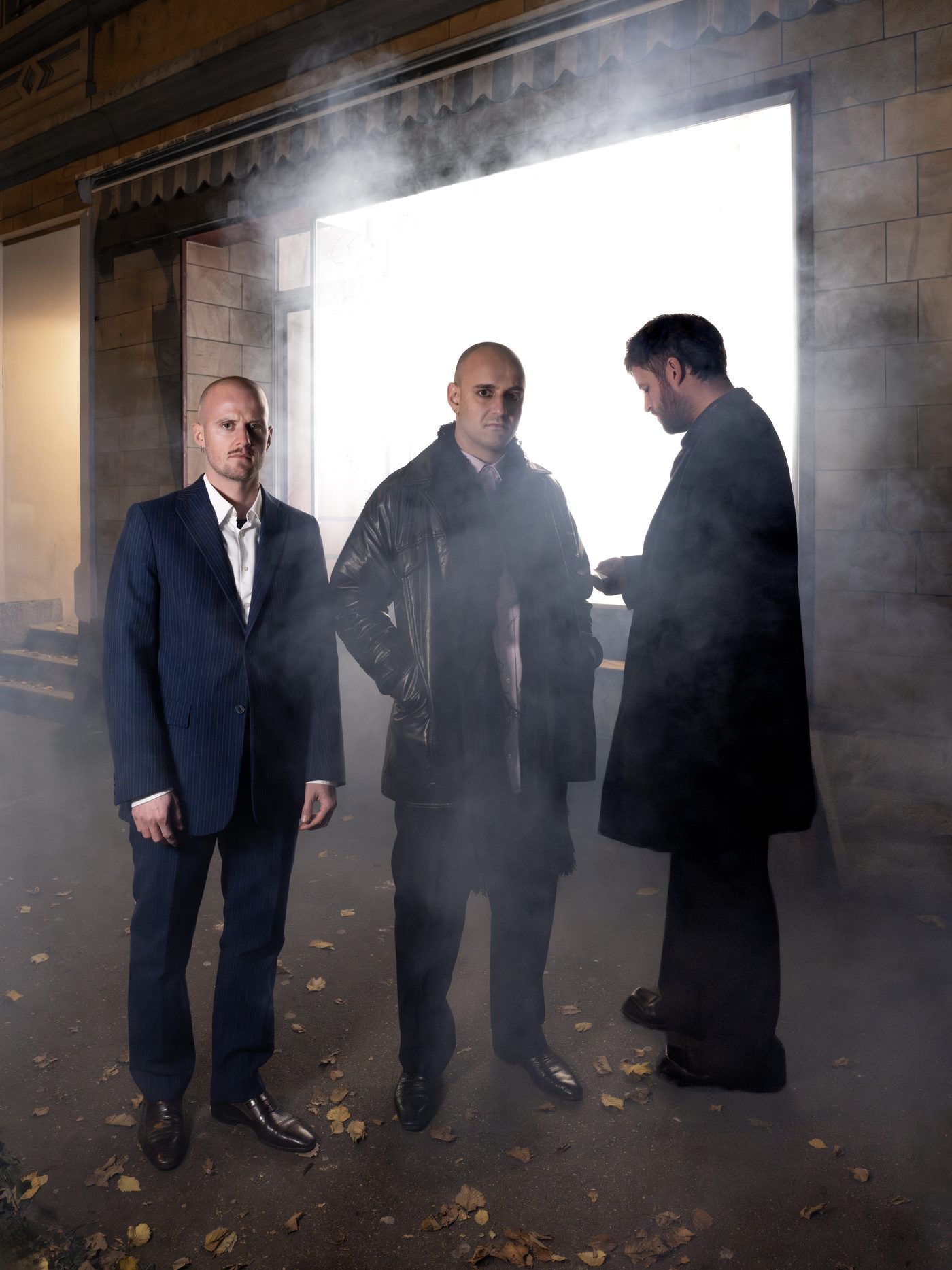
Film 2 wrote and recorded the new EP themselves. Rainy Miller mixed it, Olan! handled mastering, and Linus Stiefel created the cover artwork and took the band’s photographs.
For Jonas, the importance of putting a record out comes back to what happens between the people making the music and those who eventually hear it. A release can give people something to share, talk about or identify with. He is interested in the relationships that develop around those experiences, including the personal histories and emotions that people bring to them.
“releasing music offers the potential to open up space for connection and exchange, to present something allows social interaction, or even identification; between producer and receiver.”
He connects those relationships to something that he believes remains beyond the reach of artificial intelligence.
“something very human – something AI and bots are not capable of, because there is no emotional biography behind it that’s being translated.”
“ok sibs let’s scramble this up” has been available since 18 September as a self-release, with the Chrüsimüsi Records cassette arriving on 17 October. You can hear the five tracks through unbewusst.love, Bandcamp, Subvert and the other platforms Film 2 have chosen. Their older albums still keep their own schedules. If you want to hear some of those recordings through the band’s website, you’ll have to turn up at the right time.
This feature was made possible through artist-funded editorial support. The artist covered the time needed to produce and schedule this feature. This support allows us to dedicate more time to the story, while the writing and editing remain fully in our hands.


