

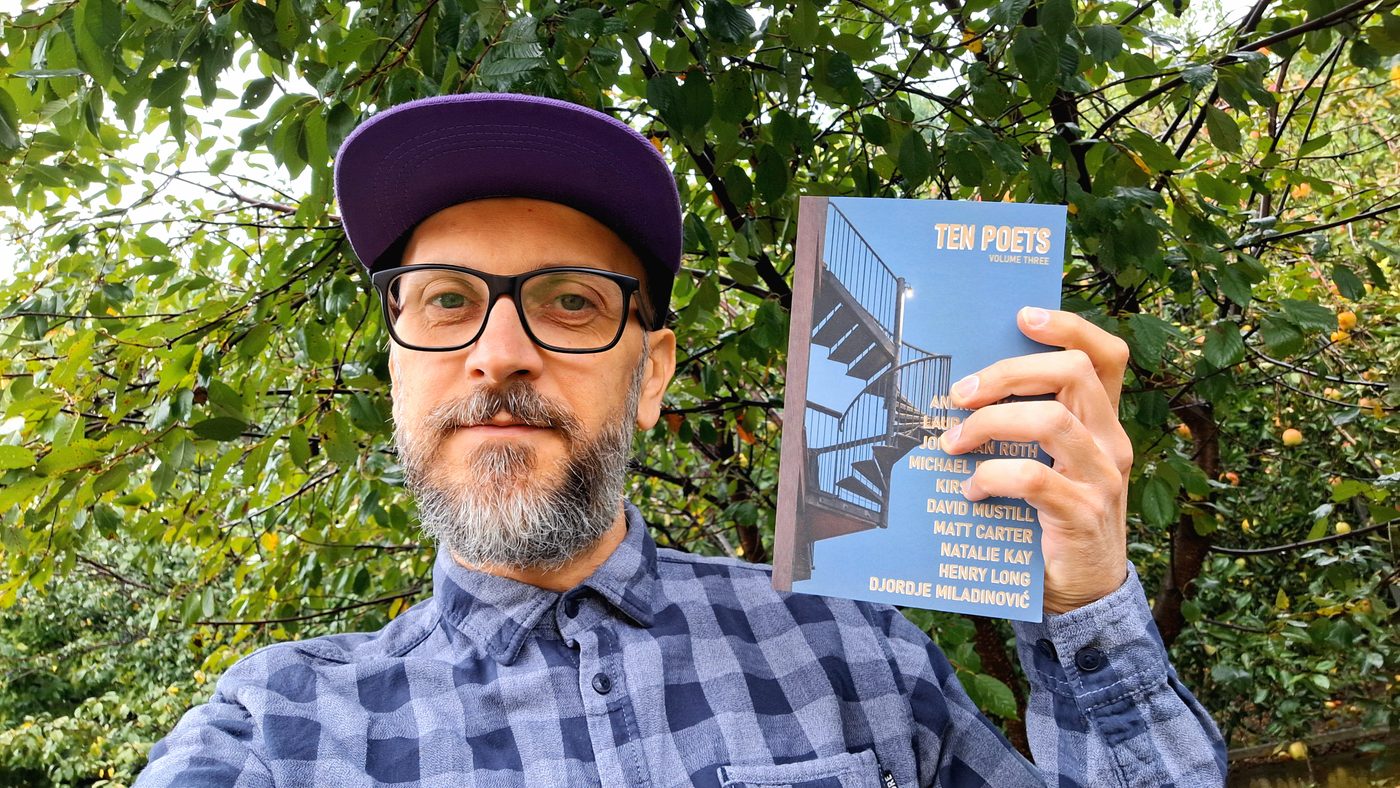
For more than 25 years, Đorđe Miladinović has been involved in underground music through bands, fanzines, record releases, artwork and his own music publication, Thoughts Words Action. The Serbian writer and musician, based in Čačak, has spent much of that time covering other people’s work. Now his own poetry is finding readers through “Ten Poets #3“, an anthology published by the British independent publisher Earth Island Books.
The book brings together ten writers connected to punk and independent culture, including experienced poets and newer voices. Đorđe’s contribution has received a response he genuinely hadn’t expected, with interest coming from the hardcore and punk communities he knows well and from poetry readers discovering him through the book. He’s already working on a standalone collection, too.
There’s plenty of history behind that. Đorđe founded Thoughts Words Action and remains its editor-in-chief, writing reviews, columns and interviews while continuing to work with other international underground publications.
He’s also a graphic designer, art director at Geenger Records, and a vocalist and musician whose activities have included punk, metal and harsh noise. After roughly three decades in the DIY scene, writing has become one of the constants across everything he does.
Poetry gives him room to do something different with it. His hardcore background naturally comes up when discussing rhythm and language, although he makes a fairly sharp distinction between the demands of songwriting and working on a poem.
“Writing lyrics for hardcore punk songs and writing poetry are two completely different beasts. The physical act of writing is the only real connective tissue—the actual approaches are miles apart.”
With hardcore, there’s a song already imposing certain requirements. Words have to work around its structure, dynamics, rhythm and vocal phrasing. On paper, he can follow an idea as far as he wants without having to make the next line fit a guitar part or a particular vocal delivery.
“Poetry, on the other hand, can be as chaotic, relentless, and unrestricted as you want it to be. It gives you the total freedom to write sincerely, unfiltered, straight from the heart.”
Music is still present when he sits down to write, often before he’s worked out where a poem is going. An imagined rhythm can help him get started, and sometimes the words develop quickly from there.
“While writing, I almost always have an internal hum, a melody, or a specific beat in mind that helps me get those initial words and lines down on paper. Sometimes the entire narrative unfolds right before my eyes, while other times I need to go through several revisions before the poem feels complete.”
Wyświetl ten post na Instagramie
Those revisions can take a while. First drafts frequently leave him dissatisfied, and he’ll keep working on the wording, cadence and structure until he’s happy. He also knows the familiar frustration of becoming attached to a line that no longer works with the rest of the poem.
“I think every poet has those moments where they’d rather scrap an entire piece than cut out a few favorite words, phrases, or lines.”
There are occasional pieces that seem to work almost immediately, when the rhythm and flow arrive together on the first attempt. He considers those exceptions.
The influence of Beat literature is especially apparent in the way Đorđe talks about rhythm. Jack Kerouac, Allen Ginsberg, William S. Burroughs and Charles Bukowski are among the writers who helped get him interested in writing his own poetry. Edgar Allan Poe is another long-standing favourite.
His reading interests extend into crime noir, horror, thrillers and dark romanticism, alongside spoken word and free verse. He admires authors who found ways to document their own times through distinctive language and techniques, and he’s trying to develop writing that people can recognise as his.
The relationship between literature and music gets particularly interesting when he starts naming records that could accompany the poems in “Ten Poets #3”. Jazz comes first.
“Since I drew heavy inspiration from the Beat movement while writing, anything by John Coltrane, Miles Davis, Chet Baker, Bill Evans, or George Benson would fit flawlessly.”
Then there are the hardcore and post-hardcore records. His choices include Strife’s “In This Defiance”, Veil’s “The Burden of Life”, Quicksand’s “Slip”, Hot Water Music’s “Caution” and Knapsack’s “This Conversation Is Ending Starting Right Now”.
It’s quite a collection of listening references for a poetry book, and a decent indication of the records that have stayed with somebody who’s spent much of his life around this music.
The subjects he’s writing about are often considerably less pleasant. Daily news, politics, the influence of social media and the behaviour of people around him all provide ideas. He pays attention to personal difficulties and the situations people find themselves in, often approaching them from a psychological or philosophical perspective.
“If you pay close attention to what’s happening around us, whether you turn on the TV, doomscroll on your phone, read the newspaper, or simply take a walk through your city, you’ll find plenty of inspiration and themes to write about.”
Wyświetl ten post na Instagramie
Đorđe is especially critical of what he sees as an increasing obsession with material wealth and the declining importance of ethics in public life. He connects that change to modern politics, media and the way social networks influence people’s behaviour.
“We’re living in strange times, driven far more by materialism than by ethics and morals.”
He sees plenty to write about in those conditions, from ordinary situations to larger questions about the way society works. Some poems are intentionally abstract, with details that leave room for different readings. Others take a more conversational approach.
When choosing his contributions to “Ten Poets #3”, he was comfortable leaving those interpretations open. The poems deal with hardships, personal circumstances, different moods and the psychological side of everyday experience. Readers can find connections between them, although each piece can also be read independently.
“Ultimately, though, it comes down to the reader’s perception and how they interpret my work. Some will find the pieces unified under a cohesive thematic arc, while others will discover distinct meaning in all those tiny details and nuances.”
One of the people helping get those poems into print is David Gamage, whose work with Earth Island Books and Engineer Records has long connected him with punk bands, writers and independent publishers.
Đorđe and David have known each other for years. Through Thoughts Words Action, Đorđe has regularly helped promote books, records, authors and artists associated with David’s projects. The invitation to contribute to a literary anthology grew out of that existing relationship.
“David Gamage (Earth Island Books and Engineer Records) and I have been friends for years, working together closely to promote everything published through his outlets. From books and records to authors, artists, and bands, everything shines with pure quality.”
David had invited him to take part in several projects over the years, including the “Ten Poets” series and the “Hardcore Horror” anthologies. Đorđe was pleased to finally contribute his own creative writing alongside both established authors and people relatively new to publishing.
The third volume of “Ten Poets” includes poets at different stages of their careers, some already published and active on spoken-word bills, others with less experience outside smaller literary events. The series introduces readers to writers whose other work they might want to seek out, and it also gives performers another way to reach audiences interested in booking poetry events.
Earth Island Books has a wider catalogue covering punk rock biographies, music journalism, countercultural fiction and poetry. Its work with independent authors, artists and musicians is familiar territory for Đorđe, who has spent years dealing with similar people through underground music publishing.
“David brings years of knowledge, experience, and practical skill to the table—he knows exactly what works and what doesn’t.”
There is also the question of where he wants to publish. He is happy working with somebody who understands DIY culture and the readership around it.
“As someone who has been part of the DIY punk scene for thirty years, I don’t know any other way than aligning with an underground publisher who lives by those same ideals. Traditional, academic, or mainstream poetry might offer something larger that I’m not familiar with, but I have no interest in pushing my work into circles where no one understands what I’m trying to convey.”
Đorđe has plenty of contemporary writers on his reading list as well. Andrea Janov, E. D. Evans, Sam Marsh and James Domestic are four whose poetry he particularly enjoys. He appreciates their different approaches to structure, rhyme and free verse, as well as the ways they develop their own subjects.
The connections with Earth Island Books run through that reading, too. Janov is among the contributors to the third “Ten Poets” volume, while Evans and Marsh appeared in the second. James Domestic has also been involved in the series and has published his own poetry through the independent press.
For somebody already involved in zines and music journalism, the overlap is familiar. People write about records, publish books, perform, contribute to compilations and recommend each other’s work. Đorđe continues to read widely, and his interest in those authors comes from the writing itself.
As he puts it, their individual styles and subjects differ, but their techniques, structures and approaches to rhyme and free verse are all worth paying attention to.
The reception to his own poetry has been particularly encouraging. Colleagues, friends, fellow journalists and acquaintances have been in touch, alongside readers from regional and international underground music communities.
“To my surprise, the poetry received an exceptional reception from colleagues, media, friends, acquaintances, and across both the regional and international underground scenes. It generated a serious buzz on social media, something I truly never expected for my debut.”
Ksenija Mitrović, the independent music journalist who conducted this interview, had noticed that reaction across hardcore and punk circles as well as among people involved in poetry. Writing for Serbian and Croatian fanzines herself, she wanted to give Đorđe’s work some additional attention and help introduce it to readers who might know Thoughts Words Action but hadn’t encountered his poems.
For Đorđe, the discussions that followed publication were particularly welcome.
“More than anything, the book has acted as an introductory platform for deeper dialogue, which was my primary intention all along.”
He is realistic about poetry’s audience today. People spend an enormous amount of time scrolling through social media, and he believes that fewer are making time for books. Still, independent publishers have readers who actively seek out new work, including people who continue to prefer physical copies over digital editions.
He’s also noticed how strongly people react to poetry itself. In his experience, readers tend either to love it or have very little interest in it. There isn’t much middle ground.
Despite that, the response from the press and readers has been overwhelmingly positive, and it has given him more opportunities to introduce his writing to people outside his usual music circles.
He hopes those readers approach his poems with a willingness to question both what they read and the things happening around them. His outlook is closely connected to his criticism of contemporary society, including the belief that people need to examine their own behaviour before expecting wider changes.
“I hope readers engage with these poems with an open heart and a critical eye, recognizing that systemic societal transformation begins with personal introspective effort. Only when we confront the foundational flaws and conflicts within ourselves do we acquire the capacity to meaningfully reshape the world.”
There is already plenty of work ahead. Đorđe is preparing new poems for upcoming editions of “Ten Poets”, along with short stories for the next “Hardcore Horror” anthology. His music writing hasn’t stopped either. Reviews, interviews and columns for print and online zines remain part of his regular workload, alongside Thoughts Words Action and other underground projects.
The main priority now is his first standalone poetry collection. At the time of the latest correspondence, the book still had no title. Đorđe needed to write several more poems to complete it, and there was no confirmed publication date.
“My standalone debut collection takes priority right now, with the other projects following close behind.”
For now, “Ten Poets #3” is available through Earth Island Books, with a paperback edition listed in the publisher’s shop. Readers can also follow Đorđe’s ongoing journalism and other writing at Thoughts Words Action and find updates about his forthcoming collection through his social media accounts.
Interview by Ksenija Mitrović. Photos courtesy of Đorđe Miladinović.