

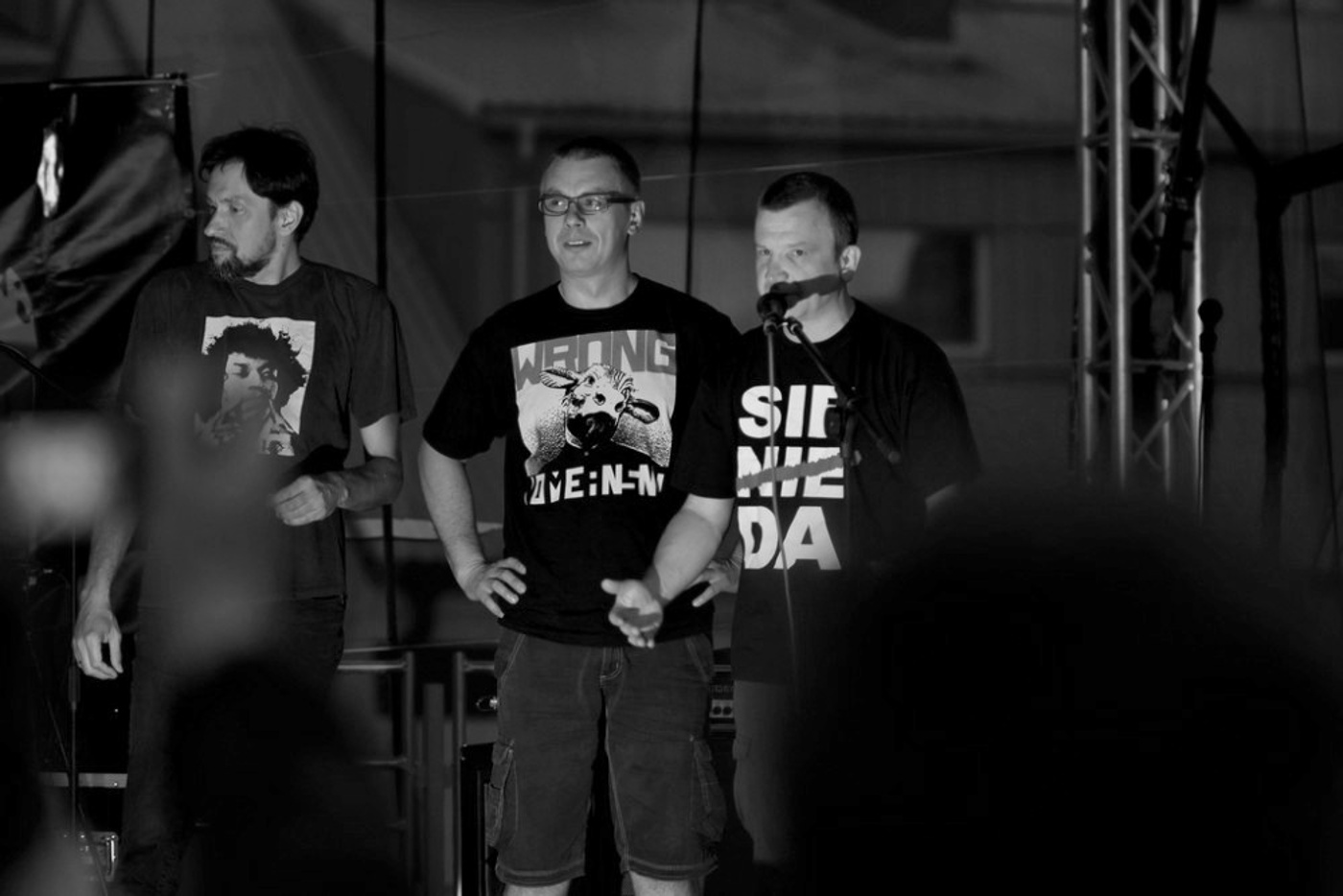
In “Sami damy radę”, Polish post-punk trio DRAH sing about people fighting to defend their country as others debate whether to help them. Towards the end, there’s a bitter little suggestion that those watching from a safe distance might as well have a cup of tea. Bassist and vocalist Marcin Hościłowicz began writing the lyrics around the start of Russia’s full-scale invasion of Ukraine. It was only after singing them at gigs that he realised how well the title, which translates as “We’ll Manage on Our Own“, also suited the band he’d been playing in since 1991.
DRAH’s mix of punk, post-punk, jazzcore and the psychedelic guitar music they grew up with has always been a curious fit for the Polish punk scene. Their five new songs have the same appetite for difficult subjects that ran through 2020’s “BRUD”, with lyrics about the political use of national suffering, hunting, sexual violence and depression. Four of them had already been played live before the band went into their own Mordor Studio in Płociczno to record them.
“Polish society was very open to welcoming refugees at the time. Perhaps because we ourselves remember 1939,” Marcin tells us, looking back at the early months of the war. “Later, the political wrangling began and you could increasingly get the impression that Ukraine was being left on its own.”
He’s troubled by the hostility towards Ukrainians and the willingness of politicians to capitalise on it. Poland’s experience of abandonment during the Second World War is on his mind, although he’s well aware of the differences between the two historical situations.
“Later, when we started playing this song and I was singing it at gigs, I realised that it also suited our history as a band perfectly. From the beginning of our existence, in the early nineties, we’ve always managed on our own. We released our albums ourselves, paid for their production on various formats and organised gigs.”
All quotations from our new conversation with DRAH have been translated from Polish.
We first interviewed the band on 23 November 2016. Back then, Marcin was already questioning how much of an influence independent music still had on younger people. We were curious to revisit that conversation ten years later, especially with a new record containing some of his most openly political lyrics.
“I think the political situation has definitely changed since 2016. Young people, but also society as a whole, are becoming more interested in the political and social situation in our country. You can see that in the growing electoral turnout,” he says today. “I also see more and more young people at independent and punk shows. That’s a very good sign.”
Guitarist Maciek Makarewicz has noticed changes in the way people engage with politics, too.
“Politics started brutally entering our homes, our living rooms, kitchens and sometimes even our beds. The younger generation differs from ours in that they take the freedom they have for granted. They were born in a free country and see that freedom as something they’re entitled to. We’re a slightly different generation. We grew up at a time when many things were restricted, although we often weren’t even aware of it. Perhaps that’s why we have a better idea of what we could lose.”
Maciek has watched people of different generations take to the streets in response to political decisions in Poland. He’s less convinced that the popularity of those social movements has carried over into punk rock.
“Punk and music that wants to communicate something more are still in the minority. I get the impression that most people come to gigs primarily to enjoy themselves. They’re not necessarily looking for a message that makes them reflect or think. Not everyone needs that and not everyone wants it.”
Marcin’s lyrics for the opening track, “Cierpienie narodowe” (“National Suffering”), take aim at the way Poland’s history of occupation, war and resistance is used in contemporary politics. Faith, honour and patriotism appear alongside intolerance towards relationships between women, the celebration of national defeats and the threat of another enemy waiting at the country’s borders.
“I get the impression that different political groups make excellent use of our heroism, martyrdom and the illusion that we’re some kind of chosen nation. These are great tools for manipulating society. Because suffering probably sells best. Heroism and victories somehow sell less.”
Marcin brings up the example of politicians praying for rain in the Polish parliament. He’s careful to express his respect for those who died defending the country, and for the culture and language they helped preserve. What frustrates him is the political capital that can be made from keeping people frightened and continually returning to past tragedies.
“Maybe if we didn’t nurture this suffering so obsessively, all these graves and crosses, we’d be a slightly happier nation, one that smiles a bit more. And besides, fear is a brilliant way of controlling society.”
There’s some useful context for Marcin’s writing in what he does outside DRAH. A teacher and teaching methodology adviser by profession, he works with the Polish fact-checking organisation Demagog, helping prepare educational resources on verifying information and developing critical thinking among teachers and pupils.
Shortly after the new record came out, he got into a conversation with someone who had been reading his lyrics closely. They were still discussing them when we caught up with the band.
“For me, as the person who writes the lyrics, that’s a really big success. People listen, read, think and try to respond to those words. Perhaps some people find these lyrics depressing. Or perhaps they’re just brazenly honest?”
Maciek has a wonderfully straightforward explanation for putting “Cierpienie narodowe” first on the record.
“Because it’s got a great riff and a good kick to it!”
He likes Marcin’s lyrics and agrees with much of what he writes, although he sometimes encourages him to leave enough room for the words to make sense outside the immediate political circumstances in which they were written.
“It would be nice if, in ten years’ time, or even when we’re no longer around, somebody was still listening to this music and understood what we were singing about. Hopefully that’ll happen. For me, though, the music always comes first.”
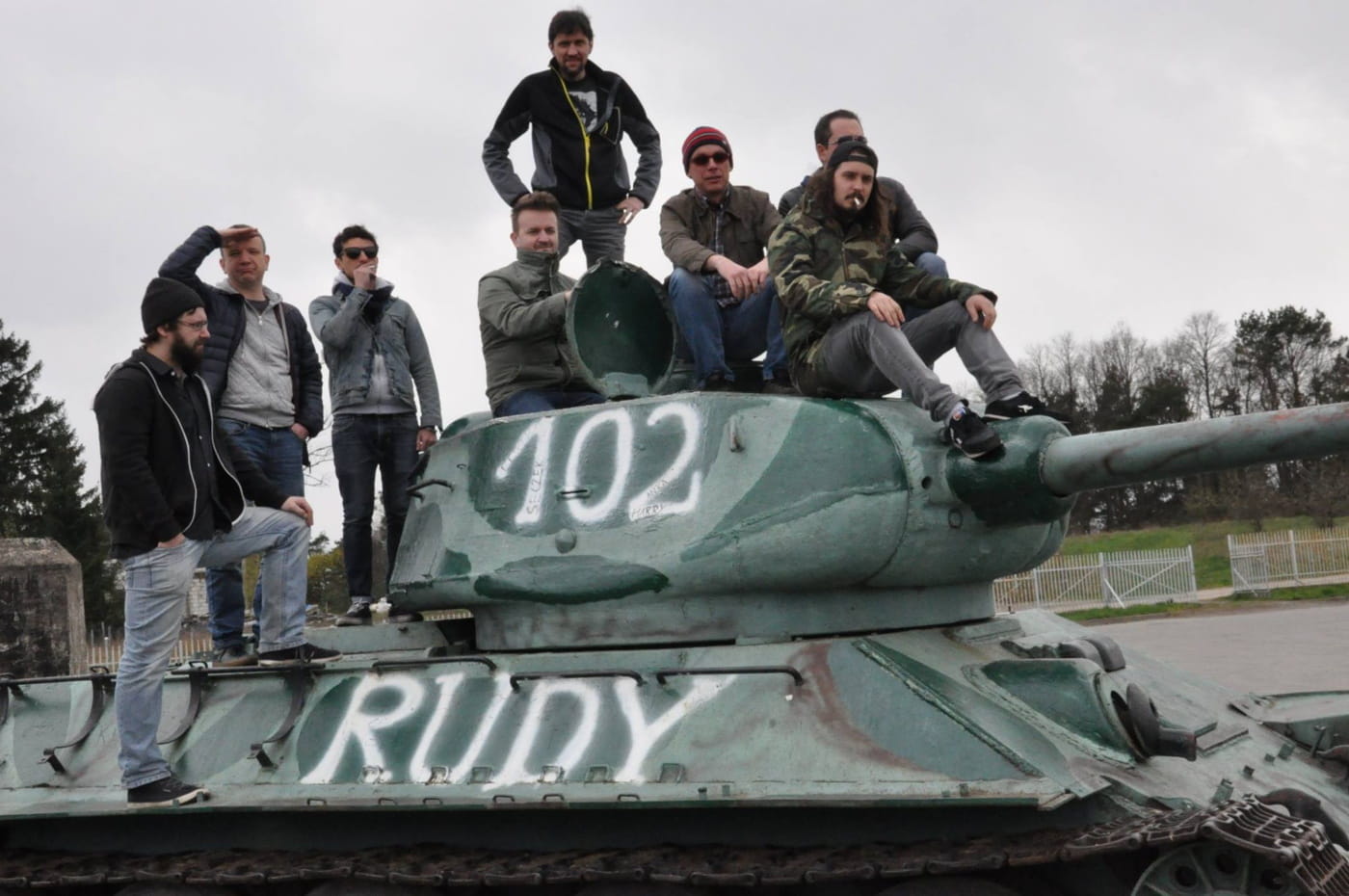
DRAH started rehearsing in January 1991. Marcin and drummer Artur Sofiński had previously played together in Tampon OB and Bigos, and the band’s first gig came in 1992 with Armia. They were still without a singer and played an instrumental set.
There was already a good deal happening in the Suwałki underground. People involved in Grupa Poczynań Frywolnych were bringing Polish punk bands to town, among them Apatia, Ahimsa, Inkwizycja and Dezerter. The guys in DRAH were also discovering bands such as Nomeansno, Fugazi, Bad Brains and Victims Family, whose music gave them plenty of ideas about what could be done with punk rhythms and a guitar.
The band’s early years were disrupted by the tragic death of their vocalist Sasza. They carried on with Czerwik singing and recorded “Muchy” in 1999, preserving songs they’d worked on with Sasza. By 2000, work, family life and problems finding a way forward with a different guitarist had brought their activities to a halt.
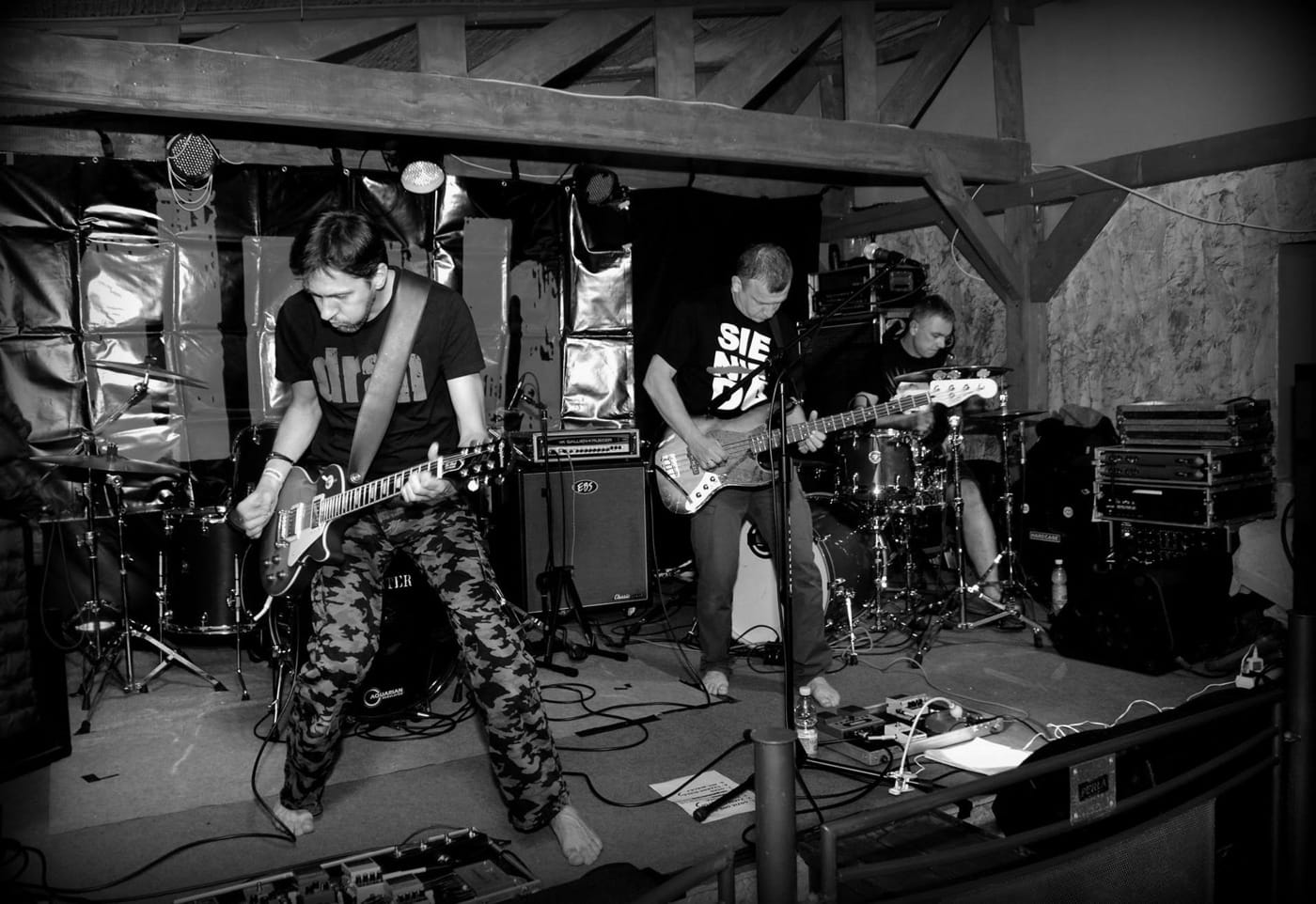
When they got together again twelve years later, they were living close to one another and Artur had built himself a place to play drums. An invitation to share a bill with Armia helped get DRAH back on stage. They enjoyed playing together enough to keep doing it.
These days, the three split their ZAiKS songwriting royalties equally. Marcin writes all the lyrics, and the songs are collectively credited to DRAH.
“It comes from the fact that we simply trust one another,” he says. “We don’t lay claim to individual riffs, drum hits or rhythms. We’re a band and we create music together.”
Artur is keen to make sure the people who have helped DRAH along the way are remembered when talking about the title of the new record.
“With our previous record, ‘BRUD’, Pasażer Records helped us out as a co-publisher. On the record before that, ‘Zjadłem siebie’, we also had support from Atman and Extinction Records. It’s not that we’re completely alone or that people from the scene don’t help us. We simply don’t have extensive management, a whole group of people responsible for running the band or some kind of promotional machine. We do most of it ourselves.”
Maciek reckons their position slightly outside even the alternative and punk scene has given them a good deal of freedom. They have people who follow their records and come to their gigs, and when a problem comes up, the three of them generally have to work out how to deal with it.
“I think our generation, the generation of people in their fifties, very often says to itself: we’ll manage on our own. We’ve been through a lot of different experiences and had to learn how to deal with all sorts of situations. Every generation has its own problems, of course, but I think we’ve really had to go through quite a lot.”
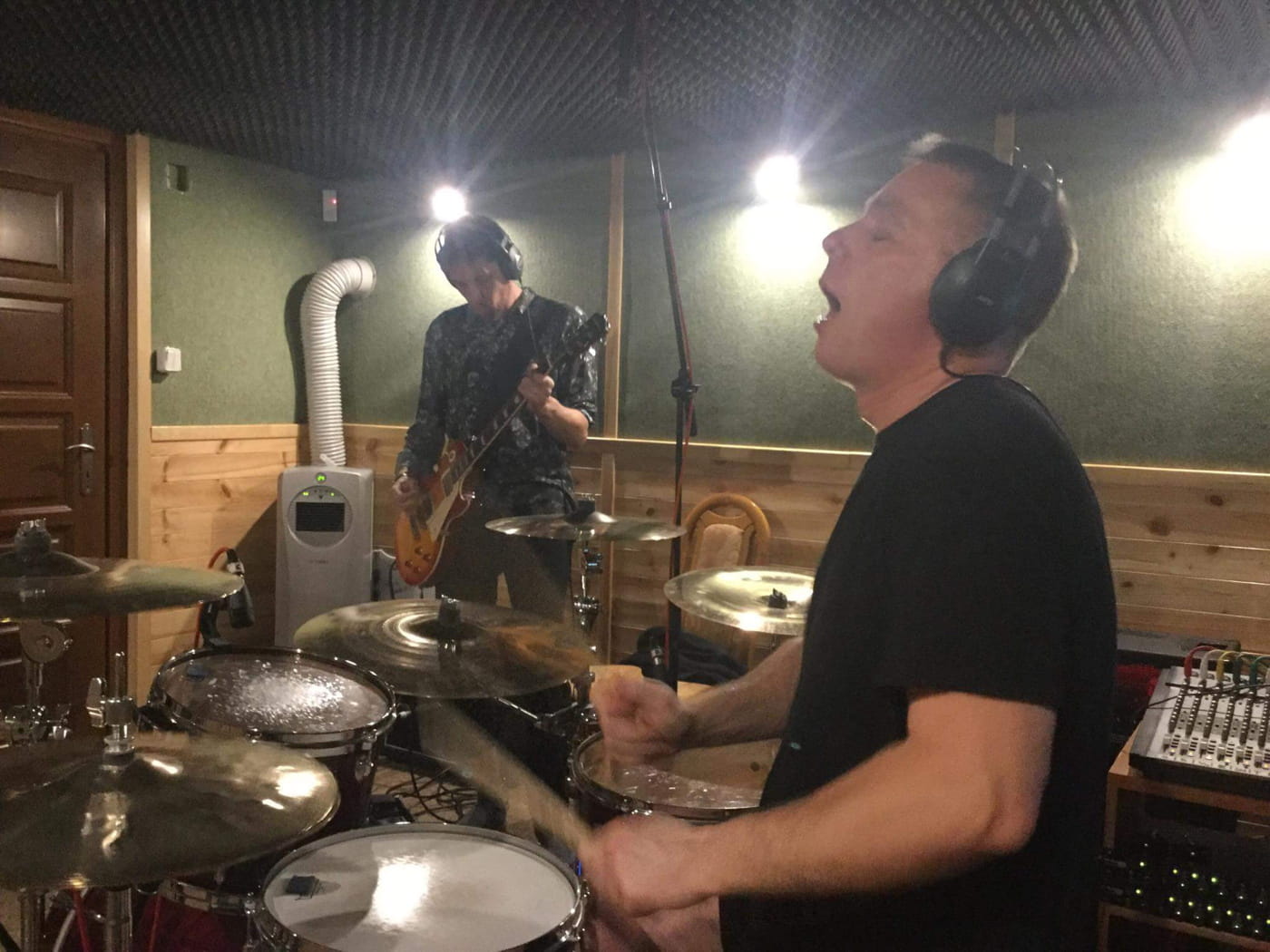
Having all their instruments permanently set up at Mordor Studio in Płociczno-Osiedle means DRAH can keep playing at a pace that suits their lives. There were stretches during the past six years when Maciek had other things to deal with and music took a back seat. The pandemic put an abrupt stop to a load of plans the band had made, including gigs.
“But the important thing was that we could always come back,” he says.
The guys have different ways of using the space. Artur has spent much of the past few years getting better at recording and learning how to make proper use of his equipment. He now prefers to work out his initial musical ideas on his own before bringing them into rehearsals. Maciek might come in with a riff, but he gets most of his writing done when the three start playing together.
“It reminds me a little of a sculptor working with stone. It doesn’t happen in a day. Everything gradually takes shape. Having our own place means we can afford to work like that. Nobody tells us how much time we can spend here. Well, except maybe Artur.”
“Nobody tells us what to record or how to do it. For nothing in the world would I want any record contract to lead to a situation where someone from outside tells us: this part is too long, this one’s too short, this isn’t melodic enough and that one’s too melodic.”
Marcin jokes that having their own studio also makes them a little lazy. With no hourly rate to worry about, it’s easy to let things drag on. By the same token, paying for every hour in somebody else’s studio could make rehearsing and recording a far more stressful experience.
Playing new songs live helps Maciek work out his guitar solos, sometimes over quite a few shows. He estimates that about ninety per cent of the structure of a DRAH song is already there when they finish working on it at rehearsals. Gigs give them room to make adjustments, and there are songs from the older records that now sound quite different when played live.
“Ambona” took another route. An early version had been hanging around for years, but Artur wasn’t happy with some of the parts and Marcin couldn’t get his original lyrics to fit. With the other four songs nearly recorded, they decided to give it another go.
“To be honest, it’s a song that wasn’t supposed to be there,” Maciek recalls. “I think we’d already recorded all the other tracks when the idea came up to try to do something with it once more.”
He tried two or three different guitar ideas with Artur, who reworked the drum parts. Marcin wrote a new set of lyrics, and Maciek helped him cut some unnecessary words without changing what he wanted to say. All three were still writing the song as they recorded it.

In Polish, an ambona is both a church pulpit and the raised stand used by hunters. Marcin had been listening to a media discussion about hunting involving former Polish volleyball player Marcin Możdżonek, who was president of the Supreme Hunting Council and involved in Confederation politics. The discussion followed a fatal shooting involving a hunter. DRAH directed us to this exchange with journalist Agnieszka Gozdyra.
Marcin wrote about animals being fed at the very places where they would later be killed. The traditional Polish hunting greeting, “Darz Bór” (roughly, “may the forest be generous”), recurs throughout the song.
“I’m firmly opposed to hunting. Not because I’ve got something against specific people, but because I consider it a bloody and completely unnecessary sport.”
He questions the arguments used to justify killing wild animals, given how much of their natural habitat has already been taken over by people. He also has a problem with the involvement of the Church in hunting ceremonies.
“A church pulpit is associated with spreading the good news, wisdom about life and certain moral principles. A place from which words are spoken that are supposed to lead people towards goodness. A hunting stand, meanwhile, makes me think of death rather than life.”
There’s a disagreement within DRAH on the subject of hunting, and it was interesting to hear Maciek talk about it so openly in the context of a song they’d just finished writing together.
“I don’t share all of Marcin’s views on this, but I respect them very much. And we’ll probably discuss it again many times. I’m not a hunter myself, but I do fish. In a sense, I hunt fish too. Sometimes I release them and sometimes I eat them.”
Maciek opposes the circumstances that allow fatal hunting accidents to happen and wonders whether tighter controls on firearms might help. He’s cautious about offering solutions outside his knowledge. He also understands why some people buy and eat game, and doesn’t advocate a complete ban on hunting. The wordplay in “Ambona” is something both of them appreciate.
The sessions took place during winter afternoons and evenings between December 2025 and February 2026. Artur tried out some different microphone placements this time, and from the beginning of the project the band had their friend Marcel Gawinecki in mind for the mix.
Artur also plays with Marcel in Próchno and has spent time at his Studio Cierpienie in Smarzykowo, in the Pałuki region. Marcel was surprised by the instrument sounds Artur had already achieved and found that they needed relatively little reshaping.
“The mixing process wasn’t long. Marcel mixes most things in analogue, and that encourages you to make decisions more quickly. In fact, the third version of the mix we received from him was the final one,” Artur says.
Marcel tends to work with music a little outside DRAH’s punk and post-punk territory, something Artur was happy to take advantage of. He then mastered the record himself at Mordor Studio.
One of the biggest changes to the songs during recording came when the band decided to bring in their friend Aga Karłowicz of KMKZ for “Zapach potu”. They already had all the instruments and Marcin’s vocal part recorded.
The lyrics describe a summer encounter that ends in sexual violence. The title translates as “The Smell of Sweat“, a reference to the smell of the perpetrator and the traumatic memory associated with it.
“It’s a story about rape. The lyrics weren’t based on my personal experiences or any specific story I knew. Thankfully,” Marcin says. “However, I’m a father of two daughters, Maciek has three daughters, and perhaps that’s what influenced the decision to write a song telling the story of a rape. I have no idea what somebody who has experienced something like that really goes through. I can only try to imagine it.”
The subject is also present in the lives of people Marcin knows, including friends whose children have experienced sexual violence.
In Poland, the 2025 Statistical Yearbook records 4,671 offences in 2024 under Articles 197 to 205 of the Criminal Code, the category covering offences against sexual freedom and decency. Of those, 1,109 fell under Article 197, covering rape and coercion into sexual acts. These figures concern officially recorded offences and cannot account for the full extent of sexual violence.
Marcin also refers to the work of Feminoteka, whose founder Joanna Piotrowska has spoken about research indicating that the great majority of women who experience rape know the perpetrator.
“We often think of a stranger hiding in the bushes, suddenly jumping out and attacking a random person. In reality, sexual violence very often involves people the victim knows and trusts.”
Wyświetl ten post na Instagramie
When DRAH approached Aga about singing the song, she agreed before she’d even read the lyrics. Having known the guys for years, she trusted their intentions. They gave her the instrumental recording and room to work out her own vocal arrangement.
“Thanks to her suggestions, the song was shortened a little, and Aga arranged the vocals differently from the way Marcin had done it,” Artur says. “The song gained more dynamics. There was also the idea of having them both sing together at the end, so we used Marcin’s previously recorded vocal parts.”
Marcin and Aga’s voices come together in the final section of “Zapach potu”. The friendship between their two bands also brought DRAH and KMKZ out for a short run of gigs together in November.
Wyświetl ten post na Instagramie
On the album’s closing track, “Chaos”, the words return repeatedly to the impossibility of knowing what’s happening inside somebody else’s head. Marcin wrote it partly out of personal experience, thinking about what is sometimes referred to as smiling depression.
“On the outside we can be smiling, cheerful, giving the impression that we’re happy people. And at the same time, very often we aren’t able to recognise what’s really going on with another person.”
There’s something particularly direct in the way Marcin describes what he would like somebody to take away from the song.
“The conclusion of this song could be expressed in very simple words: ‘Talk to me’. Ask how I’m feeling. How I’m doing. Whether everything’s all right. I think it’s worth talking. For someone struggling with depression, a conversation can be a helping hand.”
He also wonders how useful such a song might be to people studying psychotherapy. Professional training is necessary, but he reckons there will always be things about somebody else’s experience that no textbook can fully prepare us for.
All three members of DRAH live in Płociczno, and Marcin often tells people at gigs that’s where the band are from. When a new cultural centre opened in the village, they found themselves with a proper concert hall just two or three hundred metres from the place where they’d been rehearsing for years.
Wyświetl ten post na Instagramie
On 23 October, they played their release show at the Ośrodek Czytelnictwa i Kultury, with help from the centre’s director and Marek Szabłowski. The staff gave them time to prepare in the hall, get the sound right and have a full rehearsal.
They also had an enormous screen behind them.
For years, Marcin had been encouraging his friend Robert Wojczulis to show his photographs to more people. He admires Robert’s eye for things happening in ordinary life that he might never think to photograph himself. The release gig finally gave them somewhere to present the work, with some of Robert’s portraits projected onto a screen roughly eight metres wide and four metres high.
“From my point of view, it was one of the best, perhaps even the best gig we’ve played,” says Maciek.
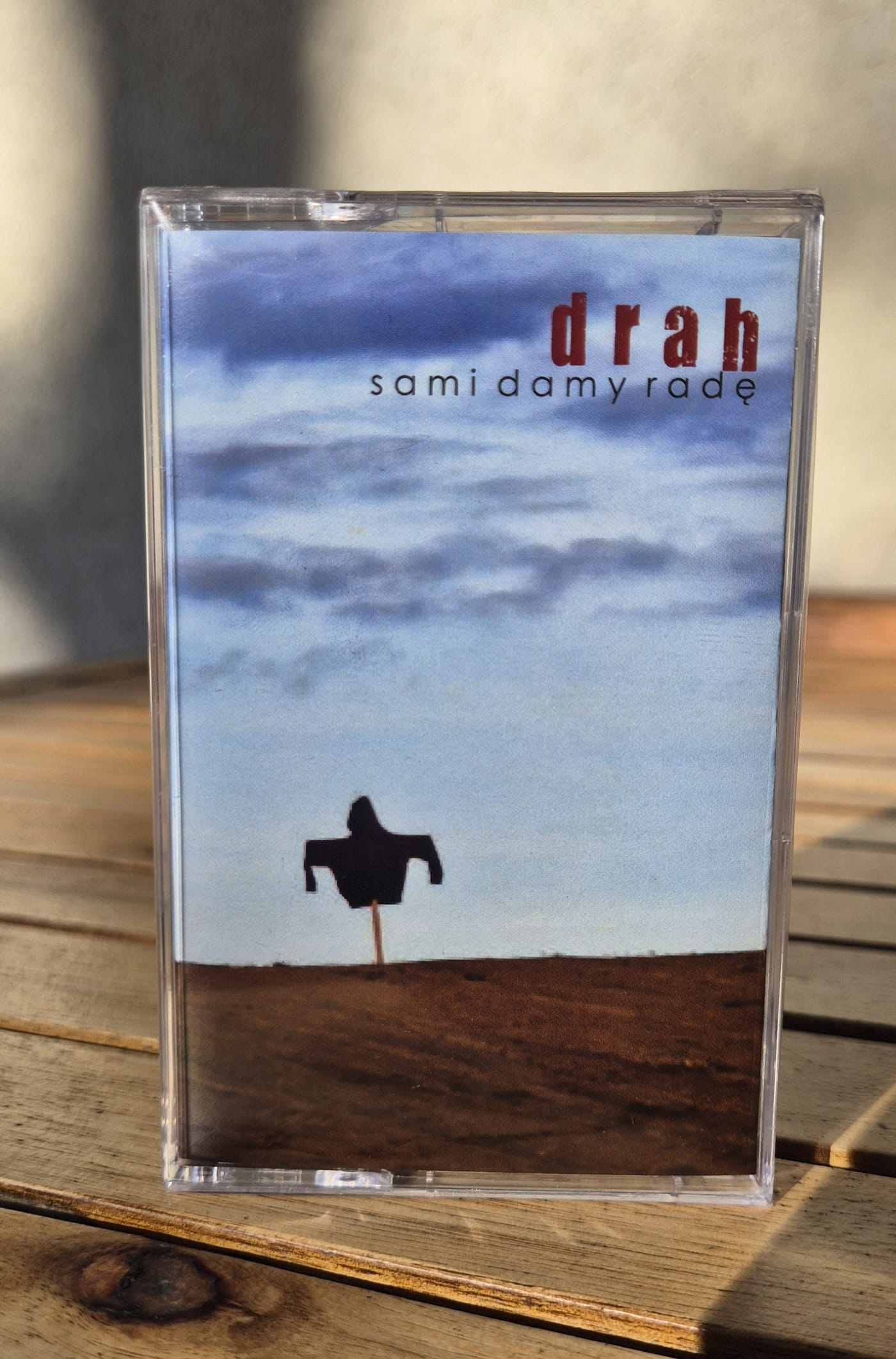
The three also chose one of Robert’s photographs for the sleeve of “Sami damy radę”. Artur had tried several versions of the artwork before settling on the image of a lone scarecrow.
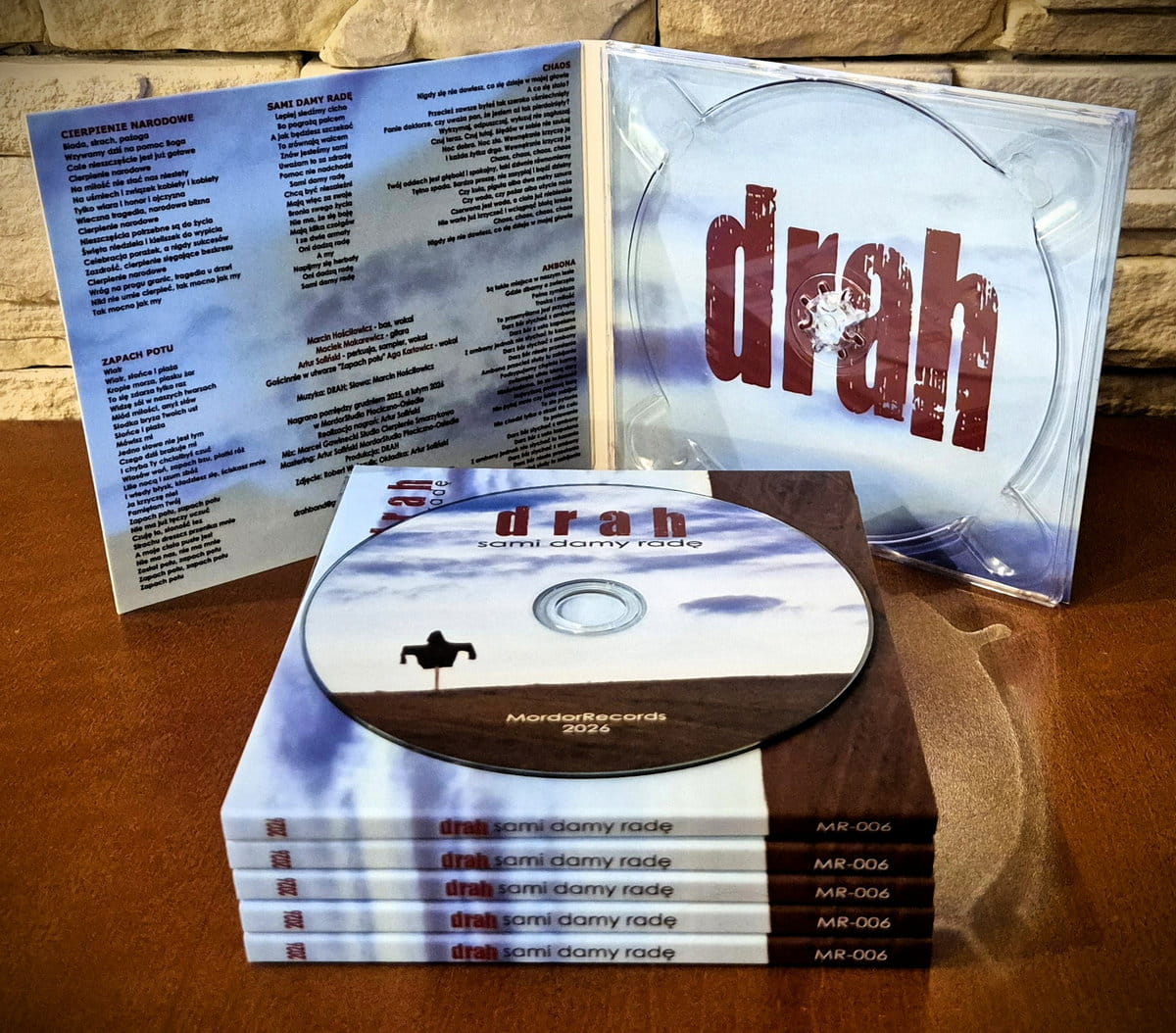
“The scarecrow stands alone and does its job, in this case scaring away birds or other animals,” Artur says. “What’s interesting is that in the photograph on the cover you can see it’s standing in a field where practically nothing grows. So on the one hand, it’s standing alone and managing on its own, but on the other, you don’t really know why it’s standing there.”
It was good to hear that HarDrahAtak, the band’s own gig series in Suwałki, had reached its tenth edition. On 20 November, DRAH brought KMKZ and Finnish hardcore punks No EI! to town.
“There are no package deals. Either we invite a band we appreciate and respect, or we simply don’t invite them,” Marcin says of how they put the bills together.
Wyświetl ten post na Instagramie
In nearby Olecko, he recommends checking out KUNDLE, who play politically engaged punk rock in Polish with a brass section, and SLAP!, whose stuff draws on hardcore punk and post-punk. The people in KOOPERACJA work with reggae, dub and ska, and some of them are also involved in local sound systems.
Marcin is encouraged by the return of some activity among older independent bands in the region. As for younger groups, he admits there may well be people starting bands locally whom DRAH simply haven’t come across yet.
Anyone planning to spend some time in north-eastern Poland in summer has at least two good punk-related reasons to look beyond the larger cities. Rock nad Legą takes place by the lake in Olecko at the beginning of August. The two-day festival grew out of the association founded by Zdzisław Maksimowicz, known as Maxiu, and has brought bands from different parts of the world to the town.
In the first half of July, there’s also Punk w Dolinie, organised by Edward Szacher in Wersele. The gigs take place in a barn on the farm of a friend of DRAH known as Walik, within the Suwałki Landscape Park. Bands from Lithuania, Mexico, France, Germany and South Korea have all played there.
“It’s not just great concerts, but also a fantastic place to meet people,” Marcin says. “A very friendly, safe atmosphere and amazing surroundings. The Suwałki Landscape Park offers beautiful views, peace and quiet, and extraordinary nature. It’s idyllic, a kind of harmony between man and nature. Except there’s punk rock playing in the barn.”
With so much music readily available these days, both Marcin and Artur wonder how much of it people actually have time to listen to. Artur appreciates every response they’ve been getting to the new record, and the three have already begun thinking about writing again. Anyone familiar with how DRAH work will know better than to expect a release date just yet.
“Personally, I’d like us to continue understanding one another, perhaps even better than we do now, musically and otherwise,” says Artur.
Marcin is keen to get back out to more festivals, meet people and support other independent projects.
“We’d love to play at more festivals and in new places. We’re open to playing gigs. We’ll get there ourselves and we’ll manage on our own.”
“Sami damy radę” came out on 23 October 2026 through the band’s Mordor Records. DRAH have made CD and cassette editions, both available alongside the digital record directly from their Bandcamp.
🔔 IDIOTEQ is ad-free, independent, and runs on one person’s time. If you want it to stay that way: DONATE via PayPal or SUPPORT via Patreon.
NEW: IDIOTEQ Explore 🗺️ Browse 15+ years of our archive by city, country, and style. Find artists on the world map or trace related sounds through the styles map.
Stay connected via Newsletter · Instagram · Facebook · X (Twitter) · Threads · Bluesky · Messenger · WhatsApp.